Google Gemini 3.1 Flash Live Launch and Search Live Global Expansion
TECH

Google Gemini 3.1 Flash Live Launch and Search Live Global Expansion

34+
Signals

Strategic Overview

  • 01.
    Google launched Gemini 3.1 Flash Live on March 26, 2026, its highest-quality real-time audio and voice AI model designed for natural conversations with lower latency, better acoustic nuance recognition, and improved background noise filtering compared to the previous 2.5 Flash Native Audio model.
  • 02.
    Search Live is expanding globally to over 200 countries and territories where AI Mode is available, up from its initial US and India launch in July 2025, enabling users to have voice and camera-based AI search conversations.
  • 03.
    The model is built on Gemini 3 Pro architecture with a 128,000-token context window, supports over 90 languages, and is available to developers via the Gemini Live API in Google AI Studio. All audio output is watermarked with SynthID to help detect AI-generated content.
  • 04.
    The launch coincides with competing voice AI releases from Cohere (Transcribe) and Mistral (Voxtral TTS), signaling that 2026 is becoming the year voice AI moves from demos to production-scale deployment.

Why This Matters

Gemini 3.1 Flash Live represents a significant inflection point in real-time voice AI. The model is not merely an incremental update -- it is a speech-to-speech system that bypasses the traditional text-in-the-middle pipeline, enabling more natural, emotionally nuanced, and low-latency voice conversations. It can recognize acoustic nuances like pitch, pace, and emotions, filter background noise more effectively, and follow conversation threads for twice as long as previous models. These improvements address the core friction points that have kept voice AI from feeling truly conversational.

The simultaneous global expansion of Search Live to over 200 countries transforms how billions of users can interact with Google Search. Rather than typing queries, users can now point their phone camera at objects and have back-and-forth voice conversations that draw on visual context from the camera feed. This is not a research demo -- it is a production deployment across Google's entire global search infrastructure, powered by the new model. The combination of a substantially improved voice model with worldwide distribution gives Google a formidable lead in the voice-first AI race.

How It Works

Gemini 3.1 Flash Live is built on the Gemini 3 Pro architecture and operates as a native multimodal model with a 128,000-token context window and up to 64,000 tokens of audio and text output. Unlike traditional voice assistants that convert speech to text, process it, and then convert text back to speech, this model processes audio natively in a speech-to-speech manner. This architectural choice enables the model to preserve and respond to tonal and emotional cues that would be lost in a text intermediary step.

The model is accessible to developers through the Gemini Live API in Google AI Studio, which uses WebSocket-based streaming for real-time bidirectional communication. Developers can configure different thinking levels -- from 'Minimal' with 0.96-second response times to higher thinking levels that take up to 2.98 seconds but deliver more sophisticated reasoning. All audio output is watermarked with SynthID, Google's AI content identification technology, which is interwoven directly into the audio signal to enable detection of AI-generated content without degrading audio quality. The model supports over 90 languages for real-time multi-modal conversations.

By The Numbers

By The Numbers
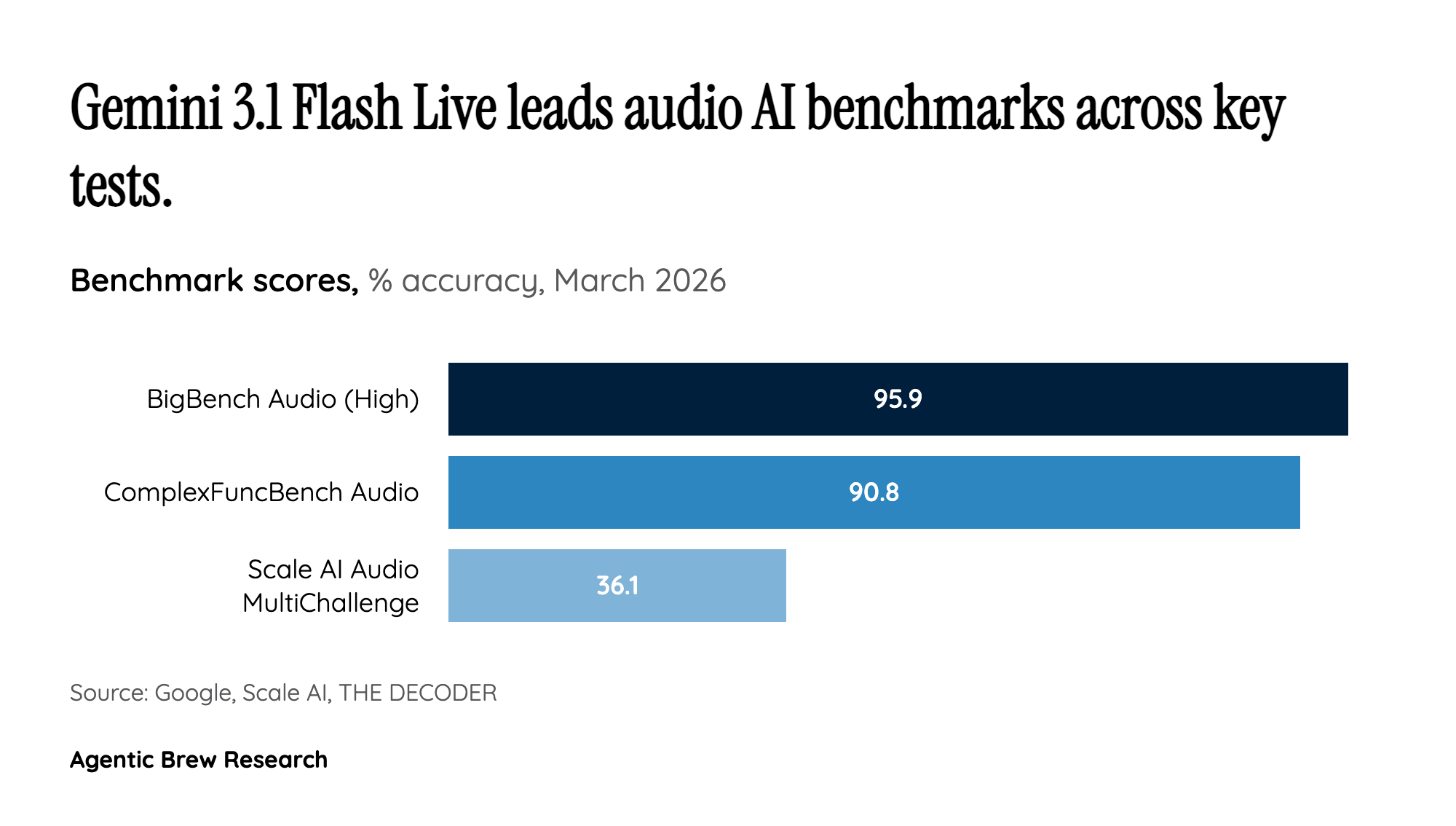
Gemini 3.1 Flash Live benchmark scores across BigBench Audio, ComplexFuncBench Audio, and Scale AI Audio MultiChallenge

The benchmarks and operational statistics paint a picture of a model ready for production deployment. On ComplexFuncBench Audio, the model scores 90.8%, indicating strong performance on complex function-calling tasks via voice. On BigBench Audio Benchmark, it reaches 95.9% at the 'High' thinking level. The Scale AI Audio MultiChallenge score of 36.1% is notable as this benchmark tests particularly difficult audio reasoning tasks.

Response latency ranges from 0.96 seconds at the 'Minimal' thinking level to 2.98 seconds at the highest thinking level, giving developers a configurable quality-speed tradeoff. Pricing is set at $0.35 per hour for audio input and $1.40 per hour for audio output. For context, one observer noted this makes it roughly 10x cheaper than OpenAI's real-time API. On the enterprise side, Verizon reports 96% accuracy in agent assistance across 28,000 customer care representatives using Google's voice models, and the CEO predicted the system would help retain 100,000 subscribers. Search Live is expanding from 2 countries to over 200 countries and territories.

Impacts & What's Next

The enterprise impact is already materializing. Major companies including Verizon, The Home Depot, and Kroger are deploying Gemini voice models in production customer service workflows. Verizon's deployment across 28,000 customer care representatives with 96% accuracy demonstrates that voice AI has crossed the reliability threshold for large-scale enterprise adoption. The improved quality of 3.1 Flash Live -- with better noise filtering, longer conversation tracking, and fewer awkward pauses -- should accelerate this adoption curve.

The competitive landscape is heating up rapidly. On the same day as Google's launch, Cohere released Transcribe (a 2B-parameter open-source speech recognition model with a 5.42 word error rate across 14 languages) and Mistral released Voxtral TTS (an open-source text-to-speech model with 90ms time-to-first-audio and voice cloning from less than 5 seconds of audio). LiveKit, which built the backend for ChatGPT's voice mode, lists the Gemini Live API as a supported integration and recently raised $100 million at a $1 billion valuation. The convergence of these launches suggests that 2026 is the year voice AI transitions from proof-of-concept to production-scale deployment across the industry.

The Bigger Picture

Google's move to expand Search Live globally while simultaneously releasing its most capable voice model signals a strategic bet that voice and multimodal interaction will become a primary interface for information retrieval. By embedding voice and camera-based AI conversations directly into Search across 200+ countries, Google is positioning itself to define how the next generation of users interacts with the internet. This is not just a model release -- it is an infrastructure play that leverages Google's unmatched global search distribution.

The SynthID watermarking of all audio output addresses one of the most pressing concerns around advanced voice AI: the potential for deepfakes and misinformation. By embedding watermarks directly into the audio signal, Google is building provenance tracking into the foundation of its voice AI stack. This proactive approach to AI safety could become an industry standard as voice AI proliferates. Meanwhile, the open-source competition from Cohere and Mistral ensures that the voice AI ecosystem will not be a closed garden -- developers will have multiple options ranging from Google's managed API to self-hosted open-source alternatives, driving rapid innovation across the entire stack.

Historical Context

2025-01-01
Gemini 2.5 Flash Native Audio was released as the predecessor real-time audio model, which Gemini 3.1 Flash Live improves upon with lower latency and better acoustic understanding.
2025-04-01
Verizon CEO Hans Vestberg predicted AI-assisted routing would help retain 100,000 subscribers, while already running Google voice models across 28,000 customer care reps with 96% accuracy.
2025-07-01
Search Live was first launched, initially available only in the US and India, allowing users to have voice and camera-based conversations with Google Search.
2026-01-01
LiveKit raised a $100 million Series C at a $1 billion valuation, underscoring investor confidence in voice AI infrastructure as a critical layer for real-time AI applications.
2026-03-26
Google launched Gemini 3.1 Flash Live and expanded Search Live to over 200 countries and territories, marking the global rollout of voice and camera-based AI search.

Power Map

Key Players
Subject

Google Gemini 3.1 Flash Live Launch and Search Live Global Expansion

GO

Google / Google DeepMind

Developer and launcher of Gemini 3.1 Flash Live; expanding Search Live globally across 200+ countries as part of its broader AI strategy to dominate real-time voice and multimodal search.

VE

Verizon

Enterprise customer running Google voice models across 28,000 customer care representatives with 96% accuracy in agent assistance.

LI

LiveKit

Voice AI infrastructure company that lists Gemini Live API as a supported integration; raised $100M Series C at $1B valuation in January 2026.

TH

The Home Depot / Kroger

Enterprise customers deploying Gemini 3.1 Flash Live for improved natural conversations in customer experience workflows.

CO

Cohere / Mistral

Competitors releasing open-source voice AI models (Cohere Transcribe and Mistral Voxtral TTS) on the same day, intensifying the voice AI market race.

THE SIGNAL.

Analysts

"Emphasized the strategic value of combining Google Cloud's AI infrastructure with enterprise institutional intelligence for business applications, positioning Gemini 3.1 Flash Live as a bridge between Google's AI capabilities and enterprise-specific knowledge."

Darshan Kantak
VP of Applied AI, Google Cloud

"Predicted that AI-assisted routing powered by Google's voice models would help retain 100,000 subscribers by identifying caller intent and connecting them with the right representative, demonstrating concrete enterprise ROI from voice AI deployment."

Hans Vestberg
CEO, Verizon

"Characterized Gemini 3.1 Flash Live as Google's most natural-sounding AI voice model yet, noting configurable thinking levels for developers and competitive benchmark performance across audio tasks."

Matthias Bastian
Author, THE DECODER

"Described the launch as representing more than a year of work improving the model, infrastructure, and experience, calling the result a step function improvement in quality, reliability, and latency for building voice and vision agents."

Logan Kilpatrick
Google (formerly OpenAI)
The Crowd

"Introducing Gemini 3.1 Flash Live, our new realtime model to build voice and vision agents!! We have spent more than a year improving the model + infra + experience, the results? A step function improvement in quality, reliability, and latency."

@@OfficialLoganK3200

"Search Live is now global. Interactive, multimodal conversations in AI Mode are now available in over 200 countries & territories. This update is powered by Gemini 3.1 Flash Live, our highest quality audio and voice model yet. This model is also inherently multilingual."

@@Google1200

"Will OpenAI decide the GPT-realtime is also a side-quest and kill it? Gemini Flash Live launched today is 10x cheaper, has way more context, native google search grounding, and is in my tests, much faster. While GPT-realtime which powers AVM is based on GPT 4o?"

@@altryne2200
Broadcast
Building Voice Agents with Gemini 3

Building Voice Agents with Gemini 3

Build a Voice Agent with the Gemini Live API

Build a Voice Agent with the Gemini Live API

NEW Google Gemini 3.1 Flash Live is INSANE!

NEW Google Gemini 3.1 Flash Live is INSANE!