The coordination layer is the new bottleneck — not the base model
The most consequential research arriving in 2026 isn't another model card; it's the growing case that multi-agent failure is an architectural problem masquerading as a model problem. A May 2026 arXiv paper reports production multi-agent LLM systems failing at rates of 41-87%, with the authors arguing the failures are dominated by coordination defects rather than base-model capability. Their proposed remedy is structural: treat coordination as a configurable architectural layer, 'separable from agent logic and from information access, enabling architectural reasoning rather than only engineering productivity.'
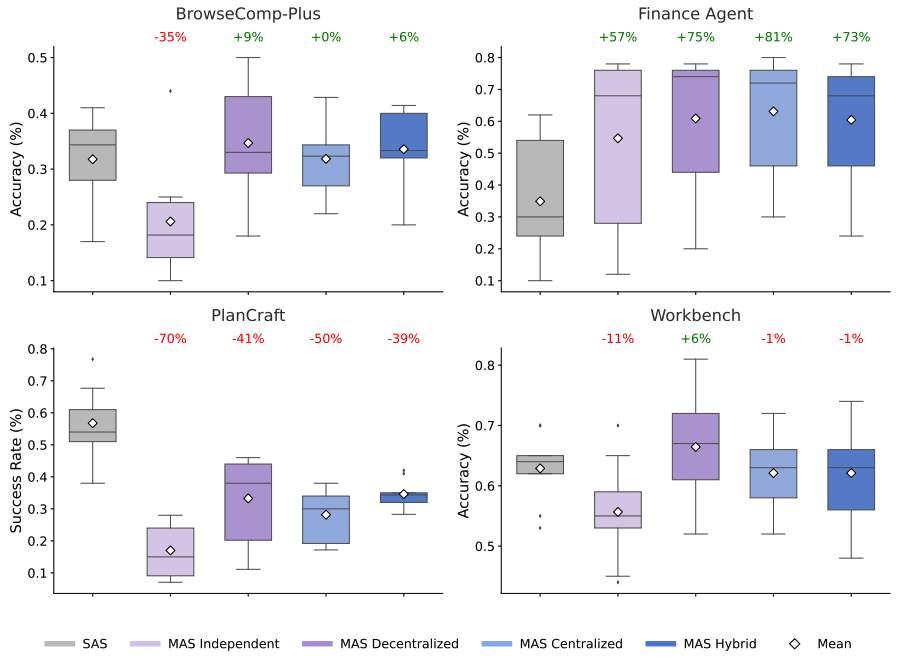
Google Research's January 2026 study sharpens that picture with numbers. Across 180 agent configurations spanning five canonical architectures, centralized multi-agent coordination improved performance on parallelizable tasks by 80.9% over a single agent — but the same multi-agent variants degraded sequential-task performance by 39-70%, and independent multi-agent setups amplified errors 17.2x compared with 4.4x for centralized ones. The conclusion is uncomfortable for any team that assumed 'just add more agents': architecture-task fit matters more than agent count, and the wrong topology can turn a working single agent into a system that loudly fails in production.