Anthropic launches Claude Design
TECH

Anthropic launches Claude Design

34+
Signals

Strategic Overview

  • 01.
    Anthropic launched Claude Design on April 17, 2026 as a research preview under Anthropic Labs. It converts prompts, screenshots, and codebases into interactive prototypes, slide decks, and marketing one-pagers, and is powered by Claude Opus 4.7 — the vision model introduced the day before with image resolution up to 2576px, roughly triple the prior ceiling.
  • 02.
    Available to Pro, Max, Team, and Enterprise subscribers, the tool exports to Canva, PPTX, PDF, and HTML, and hands designs into Claude Code as a single-instruction build bundle — closing the loop from idea to shipped code inside Anthropic's own stack.
  • 03.
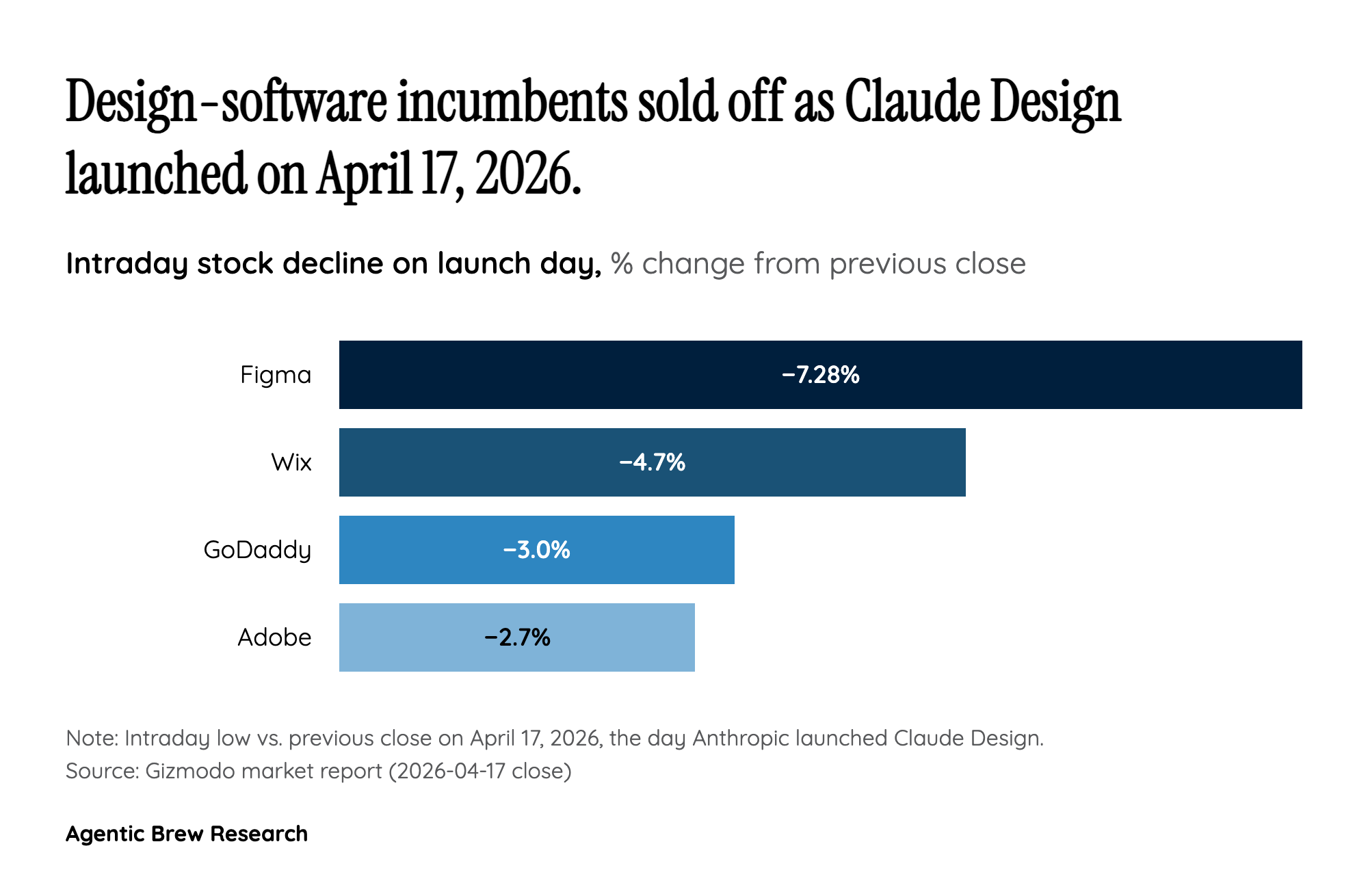
    Markets read the launch as a structural threat to design incumbents: Figma fell as much as 7.28% to $18.84, with Adobe down 2.7%, Wix 4.7%, and GoDaddy 3% on the same day. The move came three days after Anthropic CPO Mike Krieger resigned from Figma's board.

The closed idea-to-code loop is the real threat, not Figma parity

Most coverage frames Claude Design as a Figma clone, but the strategically novel piece is the handoff into Claude Code. When a design is ready to build, Claude packages everything into a single-instruction bundle that Claude Code can implement — collapsing the designer-to-engineer relay that has defined product teams for a decade. Anthropic isn't trying to win design software on features; it's trying to make the artifact a designer produces (a Figma file) irrelevant, because the next step no longer reads from Figma. Peter Yang's framing — Anthropic is 'coming for the full knowledge-work stack' — captures this: the goal is not a better canvas but an end-to-end pipeline where the canvas is a waypoint, not a destination. That turns every Figma seat held by a non-designer (PMs, engineers, marketers) into a candidate for cancellation, which is precisely the expansion vector Figma has built its business on.
The board-resignation timing has the smell of legal exposure

The sequence matters. On April 14, The Information reported Anthropic was building a design tool. The same day, Krieger's resignation from Figma's board was disclosed to the SEC. Three days later, the product shipped. Reddit's designer community immediately raised the obvious question: Krieger sat on Figma's board through the development of Figma Make, Figma's own AI design effort. A board seat grants access to competitive roadmap, pricing, and go-to-market detail that Delaware fiduciary duty explicitly forbids using against the company. Neither side has alleged wrongdoing, but the compressed timeline — resignation filed concurrent with a scoop about the competing product — is the kind of fact pattern that usually precedes a derivative suit or at least a strongly worded letter. Krieger's camp will argue he recused from Figma Make discussions; Figma shareholders will argue the structure itself was untenable.

The economic asymmetry that compounds Figma's predicament

The economic asymmetry that compounds Figma's predicament
Design-software incumbents sold off on Claude Design launch day (Figma -7.28%, Wix -4.7%, GoDaddy -3.0%, Adobe -2.7%).

Martin Alderson's point is the one that should worry Figma most, and it isn't about features. Anthropic runs its own inference; marginal cost of each Claude Design generation trends toward electricity. Figma, if it wants to match Claude Design's generative capability via Figma Make, pays Anthropic (or OpenAI) retail API prices — its competitor's cost of goods sold is literally its own supplier invoice. Layer on Alderson's claim that Claude Design shipped with fewer people than Figma has on a single product pod, and the unit economics stop being close. Figma's defense is distribution, collaboration primitives, and enterprise entrenchment — all real moats, but none of them priced into a stock that fell 7% on a launch-day rumor-plus-ship. The market is re-rating whether Figma's cost structure can survive a competitor whose costs are mostly subsidized by a separate, better-funded business.

The usage-limit paradox: the product is gated by its own economics

Every strategic advantage above comes with an operational caveat Anthropic has not yet solved: Claude Design burns tokens at a rate that collides with the subscription tiers it ships on. PCWorld's reviewer exhausted 80% of their weekly Pro allowance in roughly thirty minutes. Reddit's heavy-user thread reports a single design eating 50% of Pro quota, with practitioners recommending starting in Opus 4.7 then switching to Sonnet 4.6 for edits to stretch the budget. The frustration is loud enough — and the official launch thread's top comments pointed enough — that usage limits are currently the primary product critique, outranking output quality. This is the tension at the center of Anthropic's application-layer move: the economics that make it lethal to Figma (free inference, at Anthropic's own cost) still have to be rationed to paying customers, and the rationing currently feels punitive. If Anthropic doesn't loosen the valves, it hands Figma a credible counter-positioning pitch: unlimited, predictable, enterprise-friendly.

The designer community's fracture cuts deeper than the hype cycle suggests

Reddit's veteran-designer thread framed the moment with uncomfortable honesty: 'only 5% of us are actually developing brands from scratch or shifting the product design paradigm. The rest are just reading tickets and assembling components together.' That is not a defense of design as a profession; it's an argument that most of design work was always assembly, and that assembly was always automatable. The sharper concern in community discussion is the junior-to-senior pipeline — AI automating entry-level design and dev work breaks the apprenticeship path that produces senior practitioners in a decade's time. Meanwhile the 'slop' critique — that Claude Design outputs are cookie-cutter — is real and probably self-limiting: a generative system trained on common patterns will produce common patterns, and anyone asking for originality will still need a human. The fracture is between people whose work sits above that line and people whose work sits below it, and the honest answer coming out of the community is that most seats sit below.

Historical Context

2024
Instagram and Artifact cofounder Mike Krieger joined Anthropic as Chief Product Officer, laying the groundwork for Anthropic's application-layer push.
2025
Krieger joined Figma's board during an Anthropic-Figma model integration partnership that wove Claude into Figma's surfaces.
2026-04-14
Krieger resigned from Figma's board the same day The Information reported Anthropic was building a competing design tool; the SEC disclosure landed alongside the scoop.
2026-04-16
Claude Opus 4.7 launched with image understanding up to 2576px and 3.75MP — roughly triple prior resolution — supplying the vision backbone Claude Design would need.
2026-04-17
Claude Design launched in research preview for paid tiers, with Figma sliding as much as 7.28% and Adobe, Wix, and GoDaddy following it down.

Power Map

Key Players
Subject

Anthropic launches Claude Design

AN

Anthropic

Creator of Claude Design, ascending from foundation-model provider to application-layer competitor aiming to own the full knowledge-work stack.

FI

Figma

Incumbent UI/UX leader with 80-90% market share; stock fell ~7% on launch day and its CPO-level board connection to Anthropic collapsed days prior.

MI

Mike Krieger

Anthropic CPO and ex-Instagram/Artifact cofounder who resigned from Figma's board on April 14, 2026, three days before the launch of a directly competing product.

CA

Canva

Partner and export target with 265M MAUs; Claude Design outputs push directly into Canva where they remain editable, aligning the two against Figma.

AD

Adobe, Wix, GoDaddy

Adjacent design and site-builder incumbents whose shares dropped 2.7%, 4.7%, and 3% respectively on launch day, signaling a broader creative-software re-rating.

EA

Early customers — Brilliant, Datadog, Jane Street

Launch-partner users; Brilliant reports complex prototyping compressed from 20+ prompts to 2, and Jane Street is reportedly using Claude in place of Figma for day-to-day design work.

THE SIGNAL.

Analysts

"Argues Figma's strategic position is now structurally compromised: 'Figma now needs to out-execute a competitor whose inference is ~free to them, whose marginal cost to ship is roughly zero, and who employs fewer people on the competing product than Figma has on a single pod.'"

Martin Alderson
Independent tech analyst and blogger

"Frames the launch as a floor-lowering moment for visual production: 'The bar for creating visual assets has been lowered to the ability to converse with a model.'"

Thomas Claburn
Journalist, The Register

"Reports compressed iteration cycles inside product meetings: 'We've gone from a rough idea to a working prototype before anyone leaves the room.'"

Aneesh Kethini
Product Manager, Datadog

"Offers a sober practitioner view against existential-threat framing: 'I'm not yet ready to be scared of the end of design. I think it's gonna make a lot of stuff cheaper.'"

Molly McCoy
Graphic designer with 25 years of experience, quoted in The Register
The Crowd

"Introducing Claude Design by Anthropic Labs: make prototypes, slides, and one-pagers by talking to Claude. Powered by Claude Opus 4.7, our most capable vision model. Available in research preview on the Pro, Max, Team, and Enterprise plans, rolling out throughout the day."

@@claudeai147000

"Claude Design is insane. Just recorded a 18-min tutorial on how to build animated, award-winning websites with Claude Design + Opus 4.7!"

@@viktoroddy23000

"Used Claude Design and Opus 4.7 to design a personal dashboard. With Personal AI becoming more accessible in 2026, I always envisaged that one day we could have our own personal OS as well. Here's what I came up with!"

@@jerrod_lew6100

"Introducing Claude Design by Anthropic Labs"

@u/ClaudeOfficial2374
Broadcast
Introducing Claude Design by Anthropic Labs

Introducing Claude Design by Anthropic Labs

Claude Design: Everything You Can Build in 16 Minutes (5 Real Use Cases)

Claude Design: Everything You Can Build in 16 Minutes (5 Real Use Cases)

Claude Design is INSANE

Claude Design is INSANE