Apple-Intel Chip Manufacturing Deal
TECH

Apple-Intel Chip Manufacturing Deal

39+
Signals

Strategic Overview

  • 01.
    Apple and Intel have reached a preliminary agreement for Intel to manufacture some of the chips powering future Apple devices, according to a Wall Street Journal report published May 8, 2026, following more than a year of intensive talks.
  • 02.
    Intel (INTC) shares surged roughly 14-16% on the news, hitting an all-time intraday high of $130.57, while Apple stock rose about 1.7-2% and the rally helped propel the S&P 500 and Nasdaq to record highs.
  • 03.
    Analysts have linked the deal to entry-level M-series MacBook/iPad processors on Intel's 18A node targeting 2027 production, with potential discussions about low-end A-series iPhone chips on the 14A process expected to ramp by mid-2028 — specific products, volumes, and financial terms remain undisclosed.
  • 04.
    The Trump administration directly lobbied Apple, with President Trump personally advocating for Intel to Tim Cook at a White House meeting and Commerce Secretary Howard Lutnick steering business to the foundry — the U.S. government became Intel's largest shareholder in August 2025 with a 9.9% stake.

Deep Analysis

The Comeback Narrative vs. The Fine Print

The market priced this as a homecoming. Intel jumped ~14-16% to an all-time intraday high of $130.57, the rally pulled the S&P 500 and Nasdaq to record closes, and r/wallstreetbets revived the legendary Intel YOLO mythos with $150-200 price targets. The story writes itself: Apple left in 2020, Intel rebuilt under Lip-Bu Tan, 18A finally hit high-volume manufacturing at Fab 52 in January 2026, and Apple is back.

The fine print tells a more measured story. KeyBanc's John Vinh says Intel landed Apple "on 18A for low-end M-series processors for MacBooks and iPads" targeting 2027, with 14A discussions for low-end iPhone A-series chips around 2029. WSJ sourcing did not specify which Apple products are covered, and Bloomberg notes Apple has not yet placed orders. The estimated $1 billion in annual revenue is meaningful for an Intel Foundry that posted a $2.4B operating loss in Q1 2026 — but it is not a flagship-product win. Apple Silicon's Pro and Max tiers, the iPhone Pro A-series, and anything that defines Apple's premium products remain anchored at TSMC.

This is a legitimately important validation for Intel Foundry. It is not the 2005 Intel-inside era returning. The honest read is closer to: Apple is opening a second source on its lowest-margin silicon, on a node Intel just brought online, in a deal whose volumes and timing remain undisclosed — and the market priced it like a strategic reunification.

By the Numbers: What's Actually on the Table

By the Numbers: What's Actually on the Table
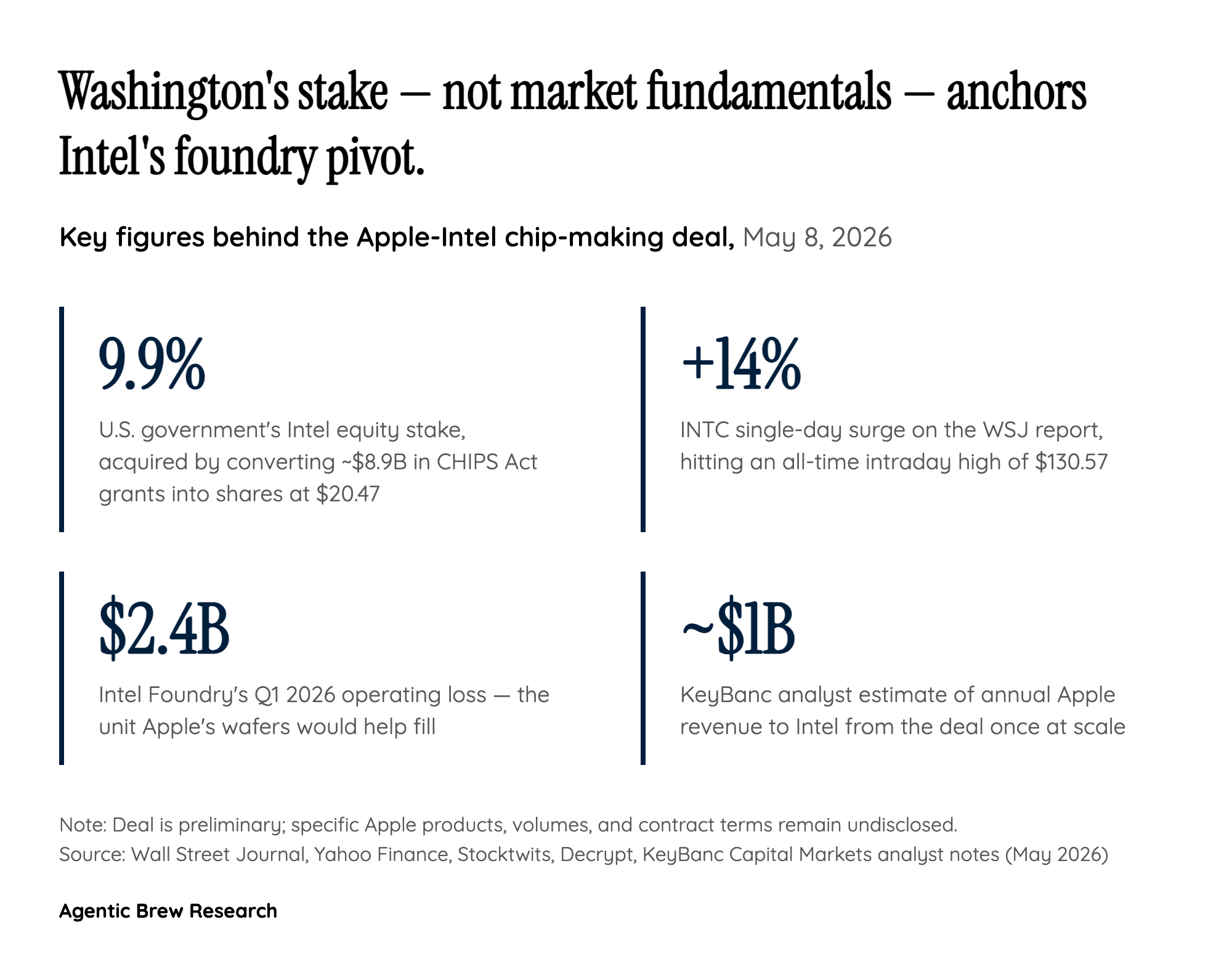
Key figures behind the Apple-Intel chip-making deal (May 8, 2026)

Four numbers frame what this deal actually is. The U.S. government's 9.9% stake (433.3 million shares, ~$8.9B at $20.47/share) makes Washington Intel's largest shareholder — every Intel revenue dollar now has a sovereign tailwind. The +14% INTC single-day surge on May 8, 2026 captures how starved the market was for a foundry validation story; the move alone added more market cap than KeyBanc's $1 billion annual Apple revenue estimate represents in steady-state value.

That $1B/year analyst estimate is the deal's most underappreciated number. Set against Intel Foundry's $2.4B Q1 2026 operating loss, ~$1B/year would not, on its own, close the gap. It buys credibility, not profitability. And it says something about scale: Apple ships ~200 million iPhones annually, with iPhones contributing ~59% of quarterly revenue — if Intel were making the flagship A-series Pro chip, the revenue figure would carry another digit. A ~$1B estimate is consistent with low-end M-series and possibly entry A-series wafers, sourced from Fab 52's ~40,000-wafer-per-month 18A line.

The chart's real lesson is the asymmetry: a 9.9% sovereign owner and a +14% rally are pricing the option value of Intel Foundry becoming a credible second-source, not the cash flows of the announced contract.

The Political Mechanics: Industrial Policy with a 9.9% Stake

The most underdiscussed element of this story is that the U.S. government is now Intel's largest shareholder and is actively transacting on that position. Commerce Secretary Howard Lutnick met repeatedly with Tim Cook. President Trump personally advocated for Intel to Cook at a White House meeting. An unnamed administration official confirmed: "In general, we want to and have been helping Intel. We have been trying to drum up business for Intel." The same playbook produced Nvidia's $5B Intel investment and Elon Musk's Texas Terafab partnership.

This is not subtle. The federal government took its 9.9% Intel stake in August 2025 via CHIPS Act funding, and within nine months three of the largest U.S. tech CEOs had committed to Intel's foundry. The administration's interests as a shareholder and as an industrial-policy actor are aligned in a way that has no recent precedent in American technology — Intel's commercial pipeline is functionally co-managed by Washington.

The risks cut two ways. For Intel, an anchor customer secured under sustained White House pressure is structurally weaker than one won on technical merit; Apple has not yet placed orders and could still default to TSMC. For Apple, accepting the lobbying provides political goodwill but introduces a customer who is also a counterparty to U.S. industrial strategy. And for the broader semiconductor market, the precedent — that sovereign equity stakes can be operationalized to direct private contracting — is the part of this story that will outlast the May 8 rally.

The Real Driver: TSMC Is Sold Out and Taiwan Is a Risk Premium

Strip away the politics and the market narrative, and the cleanest explanation for why this deal exists is supply. Tim Cook said it on the earnings call: "iPhone 17 models had been constrained during the quarter because Apple could not get enough A19 and A19 Pro chips from TSMC." That is a direct, public admission from the CEO of the world's most valuable company that his sole-source foundry is not delivering. TSMC is prioritizing AI server-chip production for Nvidia and others, and Creative Strategies analyst Ben Bajarin captured the situation bluntly: "they're already printing wafers as fast as they can."

This reframes the deal entirely. Intel is not winning Apple from TSMC — Intel is absorbing demand TSMC cannot serve. Bajarin's view that TSMC will not be materially hurt is consistent with the structural reality. There is also a second-order driver harder to discuss in earnings calls: TSMC's most advanced capacity is concentrated in Taiwan, and a pure single-source dependency carries geopolitical tail risk that no Apple board can ignore.

This is why the deal makes strategic sense even if Intel never matches TSMC on yield, performance-per-watt, or cost. Apple is not buying Intel's best node — it is buying optionality. A second source on 18A for low-end M-series, with a path to 14A for entry A-series, gives Apple a hedge against both capacity constraints and Taiwan concentration. The deal is best understood as a supply-chain insurance policy purchased at a moment when the U.S. government happens to be the seller's largest shareholder. The political alignment makes the timing convenient — but the supply pressure is what made the conversation real.

Same News, Opposite Communities: Reading the Social Split

The cleanest tell that this story is not one story is the sentiment split across investing and engineering communities. On X.com, the dominant frame was overwhelmingly bullish: a coordinated comeback narrative tying Apple, Nvidia's $5B investment, and Musk's Texas Terafab into a single Trump-administration-led semiconductor revival thesis. Bloomberg Television and Bloomberg News broke the story, and CNBC analysis cast it as deliberate volume-funneling toward Intel.

Reddit told a sharper story. r/wallstreetbets and r/intelstock went euphoric, reviving the legendary Intel YOLO lore and calling $150-200 price targets. r/stocks split. r/hardware — the community closest to the actual technical fundamentals — was the most skeptical. Top voices flagged that WSJ has "zero hard details" (no dollar amounts, quotas, or dates), that Intel Foundry is still burning $2.4B per quarter, and that the deal looks politically motivated. One pointed observation from the hardware community: "They aren't even manufacturing the main processor or they'd say so. Apple just confirmed TSMC is obviously better and Intel is just a second source fab."

Another thread elevated the supply-chain explanation: TSMC is reportedly sold out on 2nm/3nm through 2028, Samsung's 3nm yields are around 50% versus TSMC's 90%, and the Apple-Intel deal makes most sense as a Taiwan-invasion hedge. The pattern is unusually instructive — financial communities priced the headline (validation, momentum, sovereign tailwind) while engineering communities priced the substrate (which node, which product tier, which yields, which volumes). Both are correct about different timeframes. The headline is what moved the stock today; the substrate is what determines whether the deal still matters in 2028.

Historical Context

2020-06-22
Apple announced its transition away from Intel processors to in-house Apple Silicon for Macs, ending a 15-year partnership and signaling Intel's loss of a flagship customer over performance and roadmap concerns.
2025-03-01
Lip-Bu Tan was appointed Intel CEO and prioritized securing external foundry customers as the centerpiece of the company's turnaround strategy.
2025-08-01
The U.S. government took a 9.9% stake in Intel (~$8.9B at $20.47/share, 433.3M shares) via CHIPS Act funding, becoming Intel's largest shareholder and aligning Washington's industrial policy with Intel's commercial fortunes.
2026-01-30
Intel's 18A node reached high-volume manufacturing at Fab 52 in Ocotillo, Arizona, producing roughly 40,000 wafers per month with PowerVia and RibbonFET — finally giving Intel a credible advanced node to pitch external customers.
2026-05-08
WSJ reports the preliminary chip-making deal; Intel stock jumps ~14-16% to record high of $130.57, Apple stock rises ~1.7-2%, and the news helps drive the S&P 500 and Nasdaq to record closes.

Power Map

Key Players
Subject

Apple-Intel Chip Manufacturing Deal

AP

Apple

Buyer seeking manufacturing diversification away from sole-source TSMC reliance after Tim Cook flagged supply constraints on iPhone 17 A19/A19 Pro chips. Apple ships ~200 million iPhones annually, with iPhones representing ~59% of quarterly revenue.

IN

Intel (INTC)

Foundry seeking marquee anchor customer for 18A and 14A nodes; CEO Lip-Bu Tan (appointed March 2025) is leading the foundry revival as Intel Foundry posted a $2.4B operating loss in Q1 2026.

TS

TSMC

Incumbent sole-source manufacturer of Apple's advanced silicon, currently capacity-constrained as it prioritizes AI server-chip production for Nvidia and others.

U.

U.S. Government / Trump Administration

Intel's largest shareholder via a 9.9% stake (433.3M shares purchased at $20.47 for ~$8.9B through CHIPS Act funding); Commerce Secretary Howard Lutnick and President Trump have actively pushed Cook, Musk, and Huang toward Intel commitments.

TI

Tim Cook (Apple CEO)

Acknowledged on the most recent earnings call that supply constraints at Apple's contract manufacturer were holding back iPhone sales; met repeatedly with Commerce Secretary Lutnick.

LI

Lip-Bu Tan (Intel CEO)

Driving Intel Foundry's external customer pipeline, which now includes Apple, Nvidia ($5B investment), Musk's Texas Terafab, and Google.

Source Articles

Top 1

THE SIGNAL.

Analysts

"On the most recent earnings call, Cook attributed iPhone constraints to insufficient supply from TSMC, stating that "iPhone 17 models had been constrained during the quarter because Apple could not get enough A19 and A19 Pro chips from TSMC.""

Tim Cook
CEO, Apple

"Argues CPUs are becoming central to AI infrastructure as inference moves closer to the user: "The next wave of AI will bring intelligence closer to the end user…significantly increasing the need for Intel's CPUs and wafer and advanced packaging offerings," framing the CPU as "the indispensable foundation of the AI era.""

Lip-Bu Tan
CEO, Intel

"Says "Intel's Foundry Services (IFS) has landed Apple as a customer on 18A for low-end M-series processors for MacBooks and iPads" targeting 2027 production, with discussions about 14A for low-end iPhone A-series chips around 2029. Estimates the deal could be worth roughly $1 billion in annual revenue to Intel."

John Vinh
Analyst, KeyBanc Capital Markets

"Believes the Apple-Intel deal will not materially hurt TSMC because the Taiwanese foundry is already at maximum throughput — "they're already printing wafers as fast as they can" — meaning Apple's Intel volumes effectively absorb capacity TSMC cannot supply rather than displacing existing TSMC business."

Ben Bajarin
Analyst, Creative Strategies

"Confirmed the administration has actively been steering business to the chipmaker: "In general, we want to and have been helping Intel. We have been trying to drum up business for Intel.""

Unnamed Trump administration official
U.S. Commerce / White House
The Crowd

"$AAPL and $INTC have reportedly reached a preliminary chipmaking agreement with Intel set to manufacture chips for Apple devices. Six years after Apple left Intel, it may now return as a foundry partner to reduce reliance on $TSM."

@@StockSavvyShay433

"Comeback of the decade has taken place $INTC & @Apple have reached preliminary chip making deal"

@@soicfinance111

"APPLE AND INTEL JUST SIGNED A PRELIMINARY CHIP-MAKING DEAL. The two companies hammered out a formal agreement in recent months after over a year of intensive talks, per WSJ. It is the third major customer Intel has landed in 8 months: Apple $AAPL (will manufacture some chips), NVIDIA $NVDA ($5B investment, custom data center CPUs), and Elon Musk (Texas Terafab project for Tesla, SpaceX, xAI). The catalyst: the Trump administration converted ~$9B in federal grants into Intel stock last summer, taking a 10% government stake. Commerce Secretary Howard Lutnick met repeatedly with Cook, Musk, and Huang to push Intel partnerships."

@@WOLF_Financial38

"Apple, Intel Have Reached Preliminary Chip-Making Agreement"

@u/Several_Print4633639
Broadcast
US-Iran Ceasefire Holds; Apple Weighs Using Intel, Samsung for Processors | Bloomberg Brief 5/5/2026

US-Iran Ceasefire Holds; Apple Weighs Using Intel, Samsung for Processors | Bloomberg Brief 5/5/2026

Apple Exploring Using Intel and Samsung to Make Chips in US

Apple Exploring Using Intel and Samsung to Make Chips in US

The Trump admin. and tech sector are pushing to give Intel foundry contracts for volume: Ray Wang

The Trump admin. and tech sector are pushing to give Intel foundry contracts for volume: Ray Wang