The Upload-Consumption Chasm: A Fraud Economy, Not a Listening Revolution
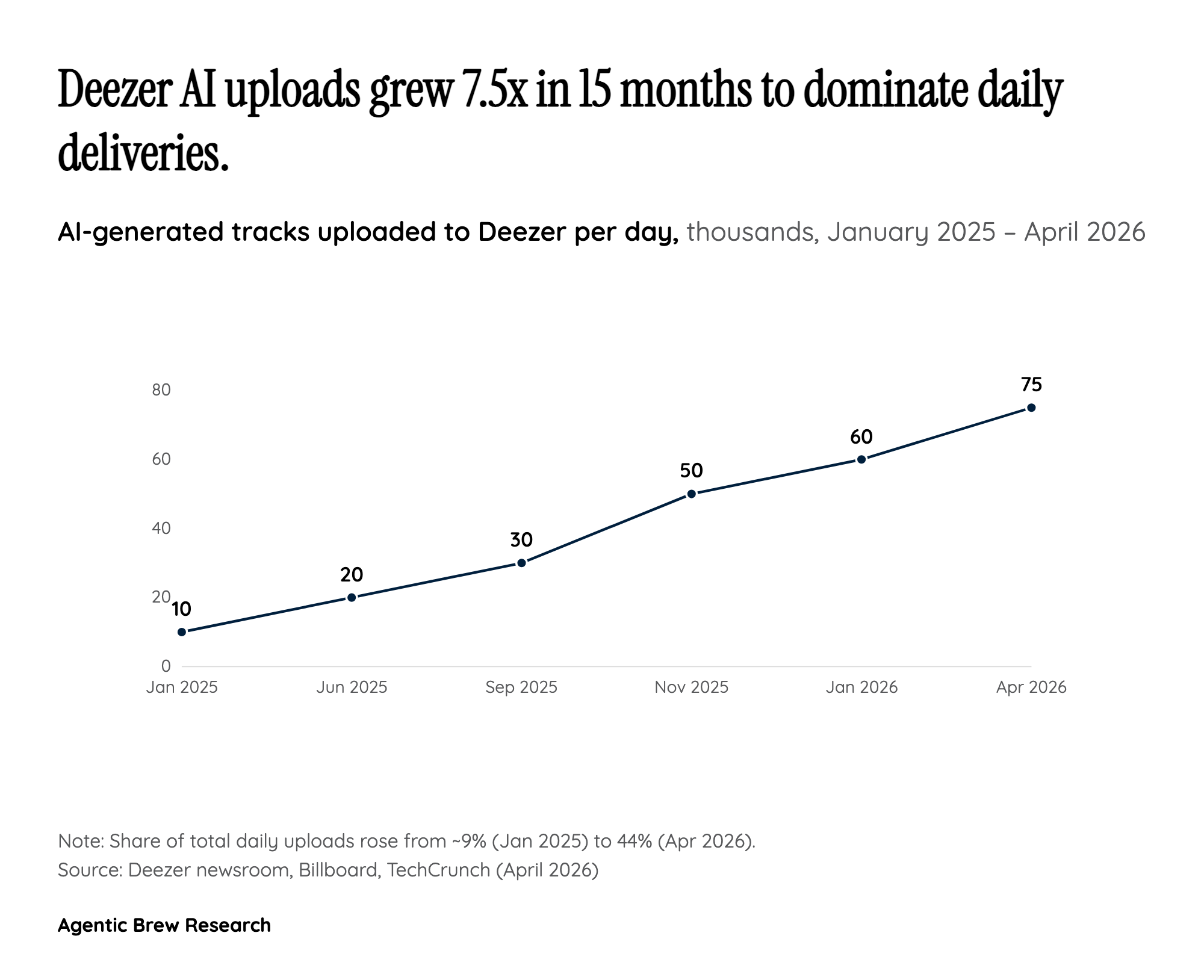
The headline 44% figure obscures a stranger story sitting beneath it. AI-generated tracks now represent nearly half of Deezer's daily deliveries and 75,000 uploads a day, yet account for only 1 to 3 percent of actual streams. The gap between supply and demand is so extreme that it cannot be explained by taste alone, and Deezer's own fraud accounting makes the reason explicit: up to 85% of the streams those AI tracks do generate are flagged as fraudulent and stripped from royalty pools, compared with an overall catalog fraud rate of roughly 8%. In other words, AI uploads are an order of magnitude more likely to be paired with bot-driven streaming than human ones. The economics only make sense if the uploader never expected a listener; the track is a vehicle for siphoning pro-rata royalty pennies via automated play-farms.
That reframes the entire phenomenon. This is not primarily a cultural shift in what audiences want to hear, it is a laundering pipeline bolted onto the streaming royalty model, using generative AI as the low-cost content supply. Community reaction on Reddit echoes this read, with commenters pointing to the 70-85% fraud stat as evidence that AI uploads are fundamentally a royalty-theft vector rather than art competing for ears.