Sierra Raises $950M Series E
TECH

Sierra Raises $950M Series E

34+
Signals

Strategic Overview

  • 01.
    Sierra closed a $950M Series E co-led by Tiger Global and Google's GV, with Benchmark, Sequoia, and Greenoaks doubling down, lifting its post-money valuation to $15.8B from $10B just eight months earlier.
  • 02.
    The company says it cleared $150M in ARR within eight quarters of selling, with Fortune 50 penetration above 40% and named customers including Prudential, Cigna, Blue Cross Blue Shield, and Rocket Mortgage.
  • 03.
    CEO Bret Taylor framed the raise as defensive capital to outspend a crowded field that now includes Salesforce's Agentforce Contact Center, which went GA in February 2026.
  • 04.
    Sierra has now raised approximately $1.585B in just 27 months across four rounds since emerging from stealth in February 2024.

Deep Analysis

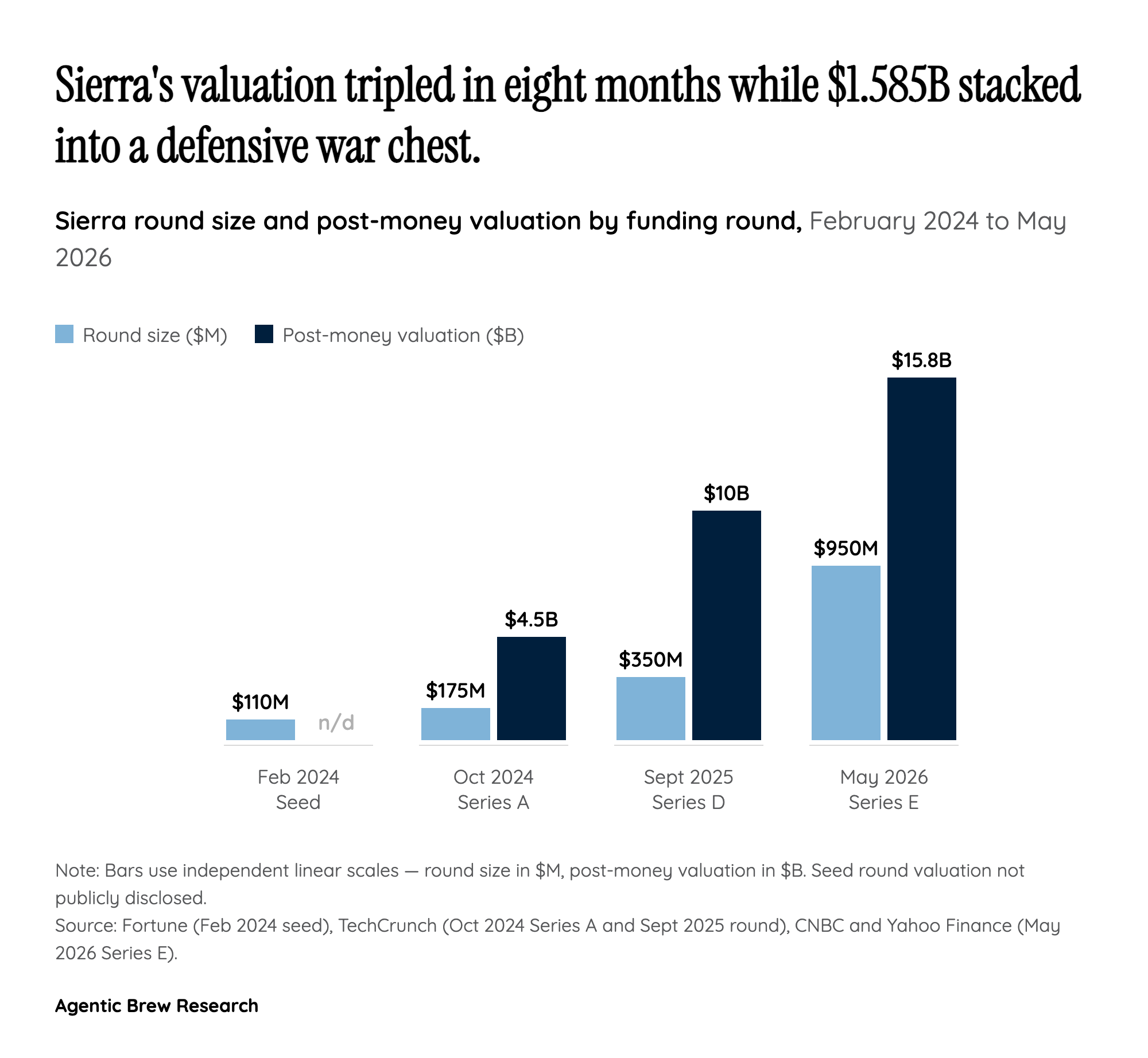
By the numbers: a 27-month capital stack and a 3.5x markup in eight months
By the numbers: a 27-month capital stack and a 3.5x markup in eight months
Sierra round size and post-money valuation by funding round, February 2024 to May 2026

Sierra's funding history reads less like a normal venture trajectory and more like a controlled escalation. February 2024: $110M from Sequoia and Benchmark out of stealth. October 2024: $175M led by Greenoaks at $4.5B. September 2025: $350M from Greenoaks again at $10B. May 2026: $950M co-led by Tiger Global and GV at $15.8B. That is roughly $1.585B raised across four rounds in 27 months, with the valuation marking up 3.5x in just eight months between September 2025 and May 2026.

What makes the curve unusual is not the size of any single round but the cadence — each round arrives before the previous one needs to be topped up, which is a deliberate signal. Sierra is not running out of money; it is choosing to take more, repeatedly. Bret Taylor was explicit that the capital is intended to widen Sierra's lead while it already exists, not to close a gap. Insider participation from Benchmark, Sequoia, and Greenoaks at every up-round also matters: those are the funds that price-discover Sierra's reality, and they have chosen each time to defend their positions at marks they themselves helped set, rather than letting new outside leads dilute them at lower entry points.
Why Taylor calls it a war chest: the culling-effect economics of customer-service agents

Taylor's framing of the round is unusually candid for a fundraise announcement. He told reporters Sierra is 'multiples larger than the next biggest' competitor and is raising 'so that we can continue to expand our lead'. That is not the language of a company chasing a market — it is the language of a company trying to make the market uncontestable. The competitive set he is implicitly pricing against includes Salesforce's Agentforce Contact Center (GA February 2026), as well as venture-backed pure plays like Decagon and Cresta.

The economics behind that posture are specific to customer service. Taylor estimates the global TAM at roughly $400B annually, and the addressable AI slice is growing fast — one industry forecast cited around the round puts the AI customer-service market at $15.12B in 2026, scaling to $117.87B by 2034 at 25.8% CAGR. In a market that big and that early, the dominant strategic risk is not that Sierra fails to find buyers; it is that a competitor with deeper distribution (Salesforce) or more customer-success bodies (a well-funded challenger) compresses Sierra's pricing power before its outcome-based model can compound. Peter Fenton's line that 'a watchful, waiting approach in AI is a path to extinction' is the LP-friendly version of the same thesis: in a winner-takes-most category, capital efficiency loses to capital deployment, and the time to deploy is now.

Outcome-based pricing and the constellation-of-models hedge

Two product choices distinguish Sierra from a typical SaaS company and explain a meaningful chunk of the valuation. The first is pricing: Sierra charges per resolution, with no charge when its agent escalates to a human. That structure aligns the vendor's revenue with the buyer's only metric that matters in customer service — issues actually closed — and it makes Sierra's economics scale with deflection rather than with seats. Outcome-based pricing is being widely held up by analysts as a template for AI-native SaaS, because it solves the credibility gap enterprises have when a vendor pitches a probabilistic system as if it were deterministic software.

The second is architecture. Sierra describes its system as a 'constellation of models' with proprietary fine-tuned layers on top — multiple specialized models orchestrated together rather than a single monolithic LLM call. For regulated buyers, that matters because hallucinations are a release-blocking risk in healthcare and financial services, and the multi-model approach gives Sierra room to route specific tasks (intent detection, policy lookup, response generation, safety classification) through models tuned for each step. Thomas Kluz of Venture Lab argued specifically that this architecture is what makes Sierra deployable in the kinds of regulated industries where most of its named customers — Cigna, BCBS, Prudential, Rocket Mortgage — actually live.

The Salesforce showdown: incumbent distribution vs. pure-play pricing

Sierra's biggest external risk is not running out of capital; it is Salesforce. Agentforce Contact Center went generally available in February 2026 with native integration into Salesforce's CRM and contact-center stack — exactly the systems Sierra has to integrate with from outside. Salesforce can bundle Agentforce into existing seven- and eight-figure enterprise contracts, attach it to existing renewals, and route it through procurement relationships that already exist. Sierra has to win those deals on merit, against an incumbent that controls the data pipes.

The counter-argument, and the one investors are pricing in at $15.8B, is that incumbent integration is a slower-moving advantage than it looks. Outcome-based pricing forces a buyer to compare resolution rates directly; bundling does not help if the bundled product loses on the resolution metric. Sierra's reported penetration of more than 40% of the Fortune 50 — alongside Bret Taylor's claim that Sierra serves one in three of the world's largest banks — suggests that for the largest, most regulated buyers, the procurement story is not 'cheaper because bundled' but 'better at the job, separately bought.' The next 18 months will test whether that pattern holds as Agentforce gets reps and references of its own.

The skeptical view from practitioners: feature, dependency, exit

Underneath the $15.8B headline, practitioner discussion in technical communities is more cautious than the funding announcement suggests. Three skeptical frames recur. The first is the 'feature, not a product' argument: that AI customer-service agents are an inevitable layer of every CRM and CCaaS suite, and that a standalone vendor is competing against a function that will eventually be free with the platform. The second is foundation-model dependency — the observation that any company built on top of OpenAI, Anthropic, or Google models is, in the dismissive phrase used in those threads, 'running a business on someone else's land', exposed to model-pricing changes and capability shifts it does not control. The third is the acquisition thesis: a recurring guess in tech-sales communities is that Sierra ends up bought by a platform incumbent inside 18 months, with Salesforce as the most-named acquirer.

None of those frames are dispositive. Sierra's multi-model architecture is partly a response to the dependency critique. Outcome-based pricing is partly a response to the feature critique. And a $950M Series E at $15.8B is a difficult valuation for any acquirer to digest, which makes a near-term exit mechanically harder, not easier — the round itself is a bet that Sierra is a standalone public company in waiting, not an acqui-hire. There is also a notable internal tension in Sierra's own messaging: Bret Taylor has separately predicted a 'culling effect' across enterprise AI startups even as Sierra raises the largest defensive war chest in the category. The honest read is that he is right about the culling and is buying insurance against being on the wrong side of it.

Historical Context

2024-02-13
Sierra emerges from stealth, co-founded by Bret Taylor and Clay Bavor with $110M led by Sequoia and Benchmark.
2024-10-01
Sierra raises $175M led by Greenoaks Capital at a $4.5B valuation, just eight months after emerging from stealth.
2025-09-04
Sierra raises $350M led by Greenoaks at a $10B valuation, doubling its mark in under a year and crossing into decacorn territory 18 months after founding.
2025-11-21
Sierra reaches $100M ARR in under two years; Bret Taylor publicly notes the milestone arrived faster than the team expected.
2026-02-01
Salesforce makes Agentforce Contact Center generally available, intensifying head-to-head competition with Sierra in the enterprise customer-service agent market.
2026-05-04
Sierra closes $950M Series E led by Tiger Global and GV at a $15.8B post-money valuation, bringing total funding to roughly $1.585B in 27 months.

Power Map

Key Players
Subject

Sierra Raises $950M Series E

BR

Bret Taylor

Co-founder and CEO of Sierra; former co-CEO of Salesforce; chair of OpenAI's board, putting him simultaneously at the head of a leading enterprise AI agent company and the governance body of its most important model supplier.

CL

Clay Bavor

Sierra co-founder and 18-year Google veteran who previously led Google Labs, AR/VR (Project Starline), Google Lens, and Google Workspace, bringing the consumer-product instinct to a B2B agent platform.

TI

Tiger Global and Google Ventures

Co-leads of the Series E. GV's involvement deepens Alphabet's strategic exposure to enterprise AI agent infrastructure, while Tiger's return signals late-stage growth investors are again willing to write nine-figure checks for revenue-proven AI.

BE

Benchmark, Sequoia, and Greenoaks

Returning insiders defending ownership at the higher mark. Greenoaks led both the October 2024 round at $4.5B and the September 2025 round at $10B; Sequoia and Benchmark have backed Sierra since the seed.

SA

Salesforce (Agentforce)

Sierra's most strategically threatening competitor. Salesforce made Agentforce Contact Center generally available in February 2026 with native CRM/CCaaS integration, leveraging incumbent distribution Sierra cannot match.

EN

Enterprise customers (Prudential, Cigna, BCBS, Rocket Mortgage)

The regulated-industry anchor accounts that validate the pitch. Sierra reports more than 20% of customers exceed $10B in annual revenue and over half exceed $1B.

Source Articles

Top 4

THE SIGNAL.

Analysts

"Frames Sierra as the category winner and casts AI investing in binary, existential terms: hesitate and you lose. The view doubles as a justification for marking Sierra up so aggressively in such a short window."

Peter Fenton
General Partner, Benchmark

"Justifies the size of the raise as a deliberate moat-building move. With Sierra already 'multiples larger than the next biggest', the goal of the capital is not survival but compounding the lead before incumbents and challengers catch up."

Bret Taylor
Co-founder and CEO, Sierra

"Argues Sierra's multi-model architecture directly addresses the hallucination and accuracy concerns enterprises raise across healthcare, finance, and logistics, which is what makes regulated buyers willing to deploy agents in customer-facing channels at all."

Thomas Kluz
Managing Director, Venture Lab

"Sees the funding climate rotating from speculative AI bets toward applied, outcome-driven AI — a thesis that explains why a customer-service agent company can command a $15.8B valuation while horizontal AI platforms struggle to defend their marks."

Suriel Arellano
Digital transformation consultant
The Crowd

"BREAKING: AI start-up Sierra co-founded by OpenAI chair Bret Taylor has raised a $950M Series E at a $15B valuation. The round was led by Tiger Global and Google's GV, with participation from Benchmark, Sequoia, Greenoaks and others."

@@etnshow0

"Sierra's co-founder thinks UI is dead. Is that actually where agents are heading"

@u/Dailan_Grace7

"Sierra ai, island, glean, cursor. Any ent/ strat AEs at these companies? Where do you see someone being most successful?"

@u/Best-Record-10381

"Sierra.ai"

@u/amazingthingshappen4
Broadcast
Sierra closes latest funding round at nearly $16 billion valuation

Sierra closes latest funding round at nearly $16 billion valuation

Bret Taylor of Sierra: How to sell to Enterprise Companies as an AI Startup | Frameworks for Growth

Bret Taylor of Sierra: How to sell to Enterprise Companies as an AI Startup | Frameworks for Growth

Sierra Head of Sales: $100M ARR in 7 Quarters | Builders Series

Sierra Head of Sales: $100M ARR in 7 Quarters | Builders Series