Cognition AI B Funding Round
TECH

Cognition AI B Funding Round

33+
Signals

Strategic Overview

  • 01.
    Cognition AI raised more than $1 billion at a $26 billion post-money valuation ($25B pre-money) in a Series D announced May 27, 2026, co-led by Lux Capital, General Catalyst, and 8VC, with Ribbit Capital, Atreides Management, Layer Global, Founders Fund, Elad Gil, Soma Capital, and Omri Casspi joining.
  • 02.
    Annualized revenue run-rate jumped from $37 million in May 2025 to roughly $492 million in May 2026, a 13x increase in 12 months, with enterprise usage growing 50% month-over-month for six straight months and 10x year-to-date.
  • 03.
    Devin now writes 89% of Cognition's own engineering code commits — up from 13% in December 2025 — and serves Fortune 500 customers including Goldman Sachs, Mercedes-Benz, NASA, Santander, Citi, Dell, Elevance, Itau, the U.S. Army, and the U.S. Navy.
  • 04.
    The round caps a transformative year that included the July 2025 acquisition of the remaining Windsurf team and IDE — turning Devin from a standalone agent into a full-stack developer platform — and the launch of Cognition's own SWE-1.6 model, the most-used model inside Windsurf.

Deep Analysis

From 13% to 89% in Five Months: Inside Devin's Acceleration

The single most consequential number in the Series D announcement is not the $1 billion check or the $26 billion sticker — it is 89%. According to Cognition's own Series D post, Devin now writes 89% of the code committed by Cognition's engineers, up from roughly 13% at the end of 2025 [1]. That is a 6.8x jump in five months, and it is the metric the round is actually priced on. The narrative investors are buying is not 'Devin is a better autocomplete.' It is 'Devin is improving the company that builds Devin,' a recursive loop that, if it holds, compresses the engineering cost curve below anything a copilot-style tool can match.

The mechanism behind the jump is the Windsurf integration and the SWE-1.6 model release. Cognition acquired the remaining Windsurf team and IDE in July 2025 after Google reverse-acquihired Windsurf's leadership [2], which gave Devin a first-party enterprise developer environment and a routing layer that can swap between Anthropic, OpenAI, and Cognition's own SWE-1.6 — now the most-used model inside Windsurf according to Cognition's own disclosure [1]. That multi-model stack is what lets Devin run long-horizon tasks at scale without paying foundation-model rents on every token. AI2Work captured the framing bluntly: 'The company is, quite literally, building itself — and investors are betting $1 billion that this self-reinforcing loop is the future of software development' [3].

The caveat that does not show up in the blog post but does show up in the analyst read is that humans still review every Devin pull request [3]. So '89% of commits' is closer to '89% of commits drafted by an agent and approved by a human' than to fully autonomous shipping. That distinction matters because it sets the upper bound on how much of the loop is real productivity vs. how much is rebranding what used to be junior engineering work. For now, the investor consensus is that the trajectory itself — 13% to 89% in two quarters — is the signal, and that the review burden will be automated next.

Why $26B Pencils Out — And What Would Break It

At $492 million ARR and a $26 billion post-money valuation, Cognition is being priced at roughly 52x annualized revenue. AInvest pegs the broader AI coding cohort at 20-40x ARR [4], so Cognition is trading at the top of the range — and meaningfully above public-market software comps, which rarely clear 25x even at hypergrowth. The math that makes this defensible runs through three numbers: 13x ARR growth in 12 months (from $37M to $492M) [5], 50% month-over-month enterprise usage growth sustained for six consecutive months [1], and a publicly stated target of crossing $1 billion in annualized revenue later in 2026 [6]. If Cognition hits $1B ARR by year-end, the entry multiple collapses to roughly 26x — which is a normal AI infrastructure premium, not an outlier.

The enterprise unit economics behind those numbers are starting to leak out. PYMNTS reports that Mercedes-Benz compressed an 8-month legacy modernization project to 8 days using Devin, and that Itau auto-remediates 70% of its security vulnerabilities through Devin's workflow [7]. Those are the case studies that justify Fortune 500 procurement at premium ACVs, and they are why Goldman Sachs, NASA, Santander, Citi, Dell, Elevance, the U.S. Army, and the U.S. Navy appear on the customer list [1]. If even a fraction of those accounts expand at the rate Mercedes implies, the seat-and-usage math gets to $1B ARR without needing new logos.

What breaks the model is sustained model commoditization combined with enterprise churn from reliability incidents. If Anthropic, OpenAI, or Google ship a directly comparable autonomous agent that hooks into the same enterprise IDEs at half the price, Cognition's multi-model insulation only delays the pressure — it does not remove it. And a single high-profile production outage at a named bank or defense customer would reset the 50% MoM growth curve overnight. The Series D buys Cognition the runway to outrun both risks, but it does not retire either.

How a $2.4B Windsurf Pickup Unlocked the Enterprise

The clearest causal chain in the Series D story runs through Windsurf. In mid-2025, Google paid roughly $2.4 billion to reverse-acquihire Windsurf's CEO and key research leadership, taking the talent without taking the company. Soon after, Cognition acquired the remaining Windsurf team and IDE assets [2]. At the time, the deal read as a salvage operation. In retrospect, it was the move that turned Devin from an interesting demo into a sellable enterprise platform.

The reason is distribution. Standalone autonomous agents have a procurement problem: they do not slot into existing developer workflows, they require new IT review cycles, and they compete with whatever IDE the customer already uses. Windsurf gave Cognition an enterprise-grade IDE with existing Fortune 500 trust, plus the model-routing infrastructure that became SWE-1.6 [1]. Suddenly Devin was not asking Mercedes-Benz to rip out its developer environment — it was an upgrade inside one. AInvest framed the deal as 'vertical integration in AI coding' that signaled a new era of tech consolidation [8], and the Series D is the validation: enterprise usage grew 10x in the months following integration, and the customer list reads like a procurement officer's safe-bet roster.

The Windsurf bet also reshaped the competitive frame. Rival AI coding tools are now competing against a stack rather than an agent: Devin orchestrates, Windsurf hosts, SWE-1.6 (and Anthropic and OpenAI models on demand) executes. That is harder to displace than a single product, and it is why the Series D coverage emphasizes Cognition's positioning against foundation-model labs rather than against other coding startups [9]. The strategic lesson is straightforward: own the surface the buyer already uses, and the agent becomes a feature instead of a procurement battle.

The Skeptic Read: Pets.com Echoes and the Tech-Debt Problem

The bull case for Cognition is loud, but the bear case is not absent — it is just concentrated in different rooms. On X.com, the conversation around the round was overwhelmingly celebratory, with Cognition's own multi-part thread and mainstream outlets like Bloomberg and TechCrunch amplifying the milestone. On Reddit's r/technology, where the funding announcement landed, the dominant tone flipped: the top comments echoed dot-com-bubble framing and raised tech-debt anxiety — the worry that AI-shipped code at enterprise scale will leave a maintenance burden that human engineers will have to clean up after the funding cycle turns. The split is its own data point: investor and operator audiences are pricing the same news in different directions.

The technical version of the skeptic case comes from George Hotz, founder of tiny corp and comma.ai, who has publicly called autonomous AI coding agents 'the most costly mistakes' in software development history [10]. The argument is not that Devin does not work today — clearly it does, given $492M ARR — but that the production code quality and long-term maintainability of agent-written software has not been stress-tested through a full system lifecycle. The 89% Cognition-internal commit number is the bull case headline, but it is also the case study that worries the skeptics most: if Cognition's own engineers are reviewing every Devin PR [3], then 'autonomous' is doing a lot of work in the marketing, and the review labor is the actual bottleneck.

Where the two sides converge is on the next 12 months. Cognition has publicly committed to crossing $1B in ARR later in 2026 [6], which means a second consecutive year of 2-3x growth at enterprise scale. If reliability incidents at a named bank or government customer slow that growth, the 52x ARR multiple compresses fast and the Reddit framing starts to look less ridiculous. If the growth holds, the skeptic case becomes a footnote and the self-improving loop becomes the dominant template for the next wave of vertical AI companies. Both outcomes are still on the table — which is exactly why a $1 billion check at $26 billion is the only price that clears.

Historical Context

2024-03
Introduced Devin as 'the first AI software engineer' — a fully autonomous coding agent capable of planning, writing, and debugging multi-file projects.
2025-07-14
Acquired the remaining Windsurf team and IDE after Google reverse-acquihired Windsurf's CEO and research leaders in a $2.4B deal, picking up an enterprise developer environment to pair with Devin.
2025-09-08
Closed a $400M round at a $10.2B post-money valuation just two months after the Windsurf acquisition, marking the first major upmark of the integrated platform.
2025-12
At year-end, Devin was authoring roughly 13% of Cognition's internal code commits — the baseline against which the 2026 acceleration would be measured.
2026-05-27
Announced Series D of more than $1 billion at a $26B post-money valuation, with $492M ARR and Devin authoring 89% of internal code commits.

Power Map

Key Players
Subject

Cognition AI B Funding Round

LU

Lux Capital

Co-lead investor in the $1B+ Series D, signaling deep-tech VC conviction that independent AI coding agent startups can compete with foundation-model labs on enterprise distribution.

GE

General Catalyst

Co-lead investor; continues to back enterprise-grade AI infrastructure plays with significant capital commitment alongside its existing Cognition position.

8V

8VC

Co-lead investor in the Series D, joining the round at the highest valuation tier of any AI coding company to date.

SC

Scott Wu

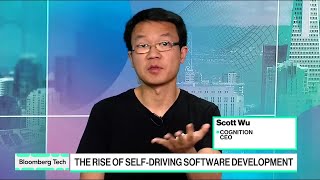
CEO and co-founder of Cognition who frames the raise as preserving independence and positions multi-model support as strategic insulation against foundation-model lock-in.

EN

Enterprise customers (Goldman Sachs, Mercedes-Benz, NASA, Santander, Citi, Dell, Elevance, Itau, U.S. Army, U.S. Navy)

Anchor enterprise users whose production deployments drive the 10x year-to-date usage growth and validate Devin's autonomous workflow at Fortune 500 scale.

AN

Anthropic, OpenAI, Google

Foundation-model competitors whose own coding tools directly compete with Devin; the Series D signals investor belief that Cognition can hold enterprise share against them.

Fact Check

10 cited
  1. [1] Series D — Cognition
  2. [2] Cognition, maker of the AI coding agent Devin, acquires Windsurf — TechCrunch
  3. [3] Cognition Raises $1B as Devin Writes 89% of Its Own Code — AI2Work
  4. [4] Cognition AI Windsurf Acquisition: A Bold Move for the Future of AI Coding — AInvest
  5. [5] AI Coding: Cognition Raises Over $1 Billion at $25B Valuation, ARR Nears $492M — Digital Today
  6. [6] Cognition just raised $1 billion at a $26 billion valuation — TNW
  7. [7] Cognition Raises $1 Billion to Expand AI-Powered Software Engineer — PYMNTS
  8. [8] Vertical Integration in AI Coding: Cognition AI Windsurf Acquisition Signals Era of Tech Consolidation — AInvest
  9. [9] Cognition Announces $1B Funding Round at $25B Valuation as Devin AI Coder Wins Enterprise Market — The AI Insider
  10. [10] AI coding agent Devin maker Cognition more than doubles its valuation to $26 billion in under nine months — The Decoder

Source Articles

Top 5

THE SIGNAL.

Analysts

"Frames the raise as enabling Cognition to remain independent and positions multi-model support as a strategic advantage rather than a dependency on any single model provider; publicly framed the raise as one that allows Cognition to remain independent."

Scott Wu
CEO and co-founder, Cognition

"Skeptical of autonomous AI coding agents, publicly calling them 'the most costly mistakes' in software development history — a sharp counter-narrative to the round's bullish framing."

George Hotz
Founder, tiny corp and comma.ai

"Reads the 89% self-written code metric as evidence of a self-reinforcing loop where Cognition uses Devin to build Devin, arguing investors are betting $1 billion that this loop is the future of software development."

AI2Work
Industry analyst publication

"Interprets the round as evidence that independent AI coding agent startups can defend enterprise distribution against Anthropic, OpenAI, and Google despite the foundation-model labs' direct coding products."

The AI Insider
Trade publication
The Crowd

"1/ We've raised over $1B at a $26B valuation, led by @Lux_Capital, @generalcatalyst, and @8vc. Our enterprise usage has grown >10x since the start of this year, and our run-rate revenue grew to $492 M. We launched Devin two years ago as the first AI software engineer."

@@cognition2323

"Cognition AI has raised more than $1 billion in a new funding round at a $26 billion valuation."

@@business207

"AI coding startup Cognition raises $1B at $25B pre-money valuation"

@@TechCrunch99

"AI coding startup Cognition raises $1B at $25B pre-money valuation"

@u/Logical_Welder34670
Broadcast
AI Startup Cognition Raises $1 Billion at $26 Billion Value

AI Startup Cognition Raises $1 Billion at $26 Billion Value

SHOCK: 90% of Cognition's Own Code Is Now Written by AI - Devin Just Hit a $26 Billion Valuation

SHOCK: 90% of Cognition's Own Code Is Now Written by AI - Devin Just Hit a $26 Billion Valuation

Inside Devin: The AI engineer that's set to write 50% of its company's code this year | Scott Wu

Inside Devin: The AI engineer that's set to write 50% of its company's code this year | Scott Wu