Cursor Composer 2 Launch
TECH

Cursor Composer 2 Launch

35+
Signals

Strategic Overview

  • 01.
    Cursor launched Composer 2 on March 19, 2026, a next-generation agentic coding model built on Moonshot AI's Kimi K2.5 with continued pretraining on code data and reinforcement learning for long-horizon agentic coding tasks.
  • 02.
    The model is 86% cheaper than Composer 1.5, priced at $0.50/$2.50 per million tokens (standard) versus $3.50/$17.50 previously, while outperforming Claude Opus 4.6 on CursorBench (61.3 vs 58.2) and Terminal-Bench 2.0 (61.7 vs 58.0).
  • 03.
    A key technical innovation is 'compaction-in-the-loop reinforcement learning' which allows the model to self-summarize context from 5,000+ tokens to approximately 1,000 tokens, reducing compaction error by 50% and achieving 5x token efficiency.
  • 04.
    Controversy erupted when researchers discovered Composer 2 is based on Moonshot AI's Kimi K2.5, raising questions about transparency and licensing compliance under the model's modified MIT license.

Why This Matters

Composer 2 represents a watershed moment in the AI coding tools market because it demonstrates that a vertical application company can build a proprietary model that competes with — and in some cases surpasses — the general-purpose frontier models from Anthropic and OpenAI. This challenges the prevailing assumption that only large foundation model labs can produce best-in-class AI for specialized domains. Cursor's approach of taking an open-weight base model (Kimi K2.5) and applying domain-specific continued pretraining and reinforcement learning shows a viable third path between building from scratch and simply wrapping APIs.

The 86% cost reduction is equally significant. At $0.50/$2.50 per million tokens compared to Claude Opus 4.6 at $5/$25, Composer 2 fundamentally changes the economics of agentic coding. This matters because agentic workflows — where models take hundreds of sequential actions to complete complex coding tasks — consume enormous amounts of tokens. Lower per-token costs make it economically viable to let agents run longer, attempt more approaches, and tackle more ambitious tasks. For enterprise customers processing millions of coding requests daily, this translates to tens of millions of dollars in savings annually.

How It Works

Composer 2's architecture starts with Moonshot AI's Kimi K2.5 as a base model, which was then subjected to continued pretraining exclusively on coding datasets. The critical differentiator is the reinforcement learning stage, where the model was optimized on multi-step programming challenges requiring hundreds of sequential actions — mimicking the real-world workflow of an agentic coding assistant that must navigate file systems, run tests, debug errors, and iterate on solutions autonomously.

The most notable technical innovation is 'compaction-in-the-loop reinforcement learning.' In agentic coding scenarios, context windows fill rapidly as the model accumulates terminal outputs, file contents, and previous actions. Composer 2 learns to self-summarize its context from 5,000+ tokens down to approximately 1,000 tokens during RL training, reducing compaction error by 50% compared to naive truncation. This 5x token efficiency means the model can sustain coherent multi-step reasoning across much longer coding sessions without losing track of critical information. The model supports a 200,000-token context window with semantic search, file editors, terminal access, and browser control — a full developer toolkit accessible through natural language.

By The Numbers

By The Numbers
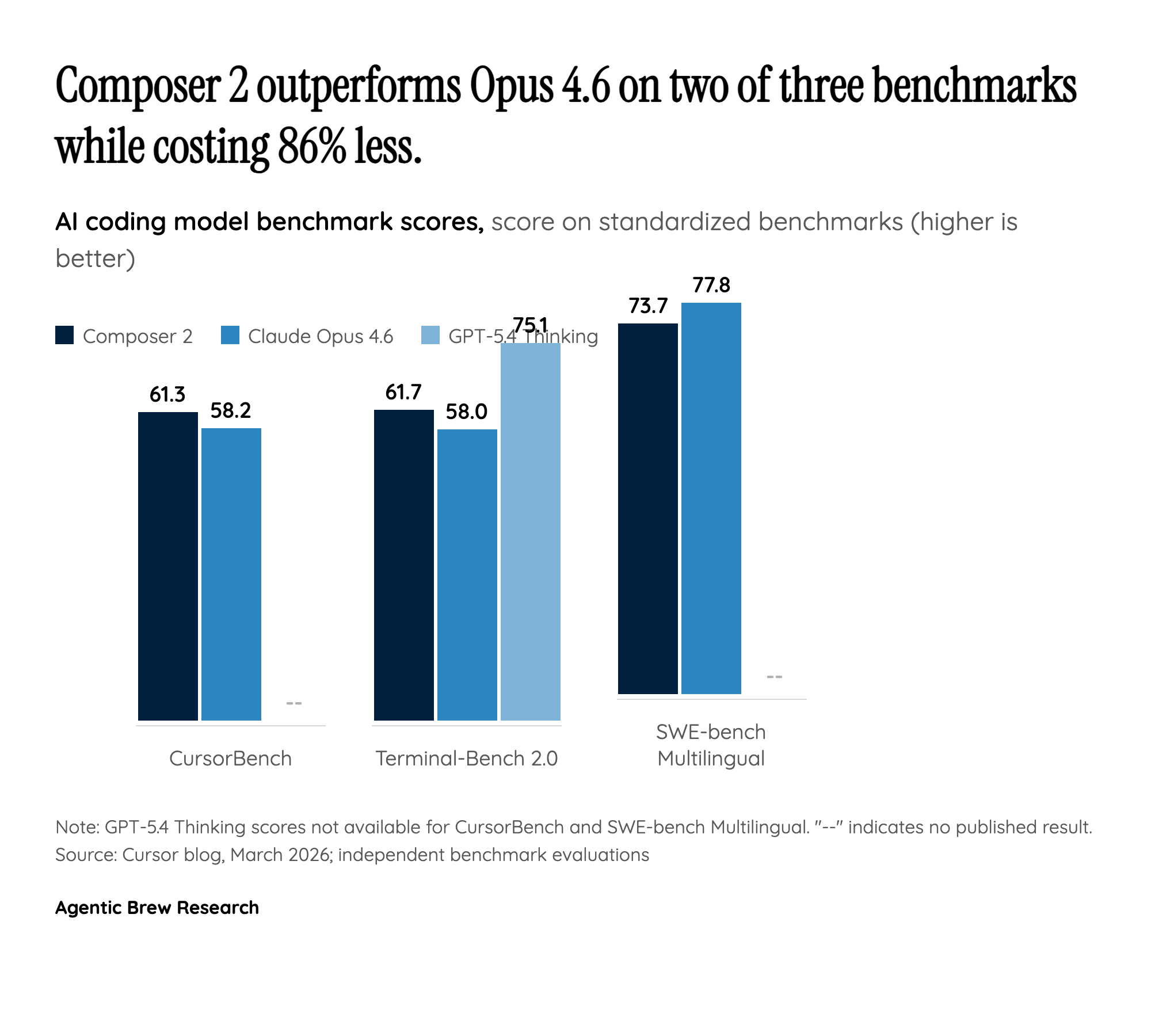
Composer 2 outperforms Opus 4.6 on two of three benchmarks while costing 86% less.

The benchmark results tell a nuanced competitive story. Composer 2 scores 61.3 on CursorBench and 61.7 on Terminal-Bench 2.0, outperforming Claude Opus 4.6 (58.2 and 58.0 respectively) on both internal and third-party agentic benchmarks. However, Opus 4.6 retains its lead on SWE-bench Multilingual at 77.8 versus Composer 2's 73.7, suggesting stronger performance on discrete bug-fixing tasks. GPT-5.4 Thinking still dominates Terminal-Bench 2.0 at 75.1, indicating significant headroom remains for agentic performance improvement.

Cursor's business metrics are equally striking. The company has reached $2B ARR as of February 2026, up from approximately $100M in 2024 — representing roughly 1,100% year-over-year growth. With 1M+ daily active users, 7M+ monthly active users, and 40,000+ paying teams, Cursor has achieved a scale that few developer tools have reached this quickly. The company is reportedly raising at approximately $50B valuation, up from $29.3B in November 2025. A University of Chicago study found that companies merge 39% more pull requests after Cursor's agent became the default, providing independent validation of productivity impact.

Impacts & What's Next

The immediate impact of Composer 2 is threefold. First, it intensifies price pressure across the AI coding market. Anthropic and OpenAI will face questions about whether their premium pricing for general-purpose models remains justified for coding-specific use cases. Second, it validates the 'vertical model' thesis — the idea that domain-specific fine-tuning of open-weight base models can rival or exceed frontier general-purpose models. Expect more application companies to follow Cursor's playbook, particularly in adjacent domains like data science, DevOps, and security analysis.

Looking ahead, several dynamics bear watching. The Kimi K2.5 licensing controversy could escalate if Moonshot AI's modified MIT license terms (requiring attribution when revenue exceeds $20M or monthly actives exceed 100M) are not properly addressed — Cursor clearly exceeds both thresholds. The community feedback about excessive token consumption (2.3M-6.4M tokens per run) suggests that while per-token costs are low, total cost per task may not have decreased as dramatically as the pricing implies. Cursor's trajectory toward a $50B valuation will depend on whether Composer 2's agentic capabilities translate into measurable enterprise productivity gains beyond the headline benchmarks.

The Bigger Picture

Composer 2's launch crystallizes a broader shift in AI industry structure. The era in which foundation model labs held an uncontested monopoly on model quality is ending. Cursor has demonstrated that an application-layer company with 400 employees can produce a competitive coding model by leveraging open-weight foundations (Kimi K2.5), proprietary data (coding-specific training sets), and novel training techniques (compaction-in-the-loop RL). This mirrors patterns from earlier technology cycles where vertical integration by application companies eventually disrupted horizontal platform providers.

The strategic implications extend beyond coding. If Cursor's approach generalizes, we may see a proliferation of domain-specific models from application companies across law, medicine, finance, and engineering — each building on open-weight foundations but optimized for narrow, high-value workflows. This would reshape competitive dynamics: foundation model labs would increasingly compete on the quality and openness of their base models (as Moonshot AI does with Kimi K2.5), while application companies would compete on domain-specific fine-tuning, user experience, and integration depth. For developers, the net effect is positive — better tools at lower cost — but the consolidation of coding AI around a few dominant players raises important questions about developer tooling dependency and the long-term sustainability of open-source alternatives.

Historical Context

2022-01-01
Anysphere founded by MIT students with a vision to build AI-powered developer tools.
2023-01-01
Cursor AI code editor launched publicly. Raised $8M seed round led by OpenAI Startup Fund.
2025-10-01
Composer 1 released, scoring 38.0 on CursorBench and 40.0 on Terminal-Bench, establishing Cursor's first proprietary coding model.
2025-11-01
Anysphere valued at $29.3B in funding round, reflecting rapid enterprise adoption of the Cursor platform.
2026-02-01
Composer 1.5 released at $3.50/$17.50 per million tokens. Cursor reaches $2B ARR run rate, representing 1,100% year-over-year revenue growth.
2026-03-19
Composer 2 launched, built on Kimi K2.5 with RL fine-tuning. Achieves 61.3 CursorBench, 61.7 Terminal-Bench 2.0, and 73.7 SWE-bench Multilingual at 86% lower cost than Composer 1.5.

Power Map

Key Players
Subject

Cursor Composer 2 Launch

AN

Anysphere Inc. (Cursor)

Developer and distributor of Composer 2. AI code editor company with $2B ARR, ~400 employees, and reportedly raising at ~$50B valuation. Serves 40,000+ paying teams and ~50,000 enterprise customers including Stripe, Figma, and Shopify.

MO

Moonshot AI (Kimi)

Creator of the Kimi K2.5 base model upon which Composer 2 is built. Its modified MIT license requires attribution when revenue exceeds $20M or monthly active users exceed 100M.

AN

Anthropic

Key competitor with Claude Opus 4.6 ($5/$25 per million tokens). Outperformed by Composer 2 on Terminal-Bench 2.0 (58.0 vs 61.7) but leads on SWE-bench Multilingual (77.8 vs 73.7).

OP

OpenAI

Competitor with GPT-5.4 which still leads on Terminal-Bench 2.0 (75.1 vs 61.7). Was an early investor in Cursor via its Startup Fund. Ships competing Codex product.

EN

Enterprise Customers (Stripe, Figma, Samsung, Shopify, Instacart)

Major enterprise adopters whose usage patterns validate the agentic coding approach. University of Chicago study found companies merge 39% more PRs after Cursor's agent became the default tool.

THE SIGNAL.

Analysts

"Emphasized Composer 2's narrow domain focus as a strategic advantage: 'It won't help you do your taxes. It won't be able to write poems.' This deliberate specialization enables dramatic cost efficiency improvements while maintaining competitive benchmark performance against general-purpose models."

Aman Sanger
Co-founder, Cursor (Anysphere)

"Described Composer 2 as potentially the largest single-generation improvement in AI coding tools: 'If Composer 2 is as good as it looks to be, Anysphere is for real in 2026.' Views the launch as validation of the vertical AI model strategy in developer tooling."

Michael Spencer
Technology Analyst

"Raised transparency concerns after discovering Composer 2 is based on Kimi K2.5 through model ID leaks. Debate centered on whether Cursor adequately disclosed the base model provenance and whether licensing terms under the modified MIT license are being properly met."

Hacker News Community (fynnso et al.)
Developer Community / Independent Researchers

"Mixed reactions in real-world testing. Some users reported clear superiority over Composer 1.5, while others flagged 'incredibly dumb mistakes' and excessive token consumption ranging from 2.3M to 6.4M tokens per run, suggesting the model's agentic loop can sometimes spiral unproductively."

Cursor Forum Early Adopters
Professional Developers / Beta Testers
The Crowd

"was messing with the OpenAI base URL in Cursor and caught this accounts/anysphere/models/kimi-k2p5-rl-0317-s515-fast so composer 2 is just Kimi K2.5 with RL at least rename the model ID"

@@fynnso2800

"Composer 2 is now available in Cursor."

@@cursor_ai9000

"Composer 2 appears to be a post-trained Kimi-K2.5 based on an identical tokenizer. If confirmed, this would mean Cursor is violating Moonshot's license terms."

@@AiBattle_5000

"Composer 2"

@u/meetpateltech84
Broadcast
The New Cursor Will Change How We Build

The New Cursor Will Change How We Build

Is Cursor new model actually good? Testing New UI + Composer 2

Is Cursor new model actually good? Testing New UI + Composer 2

I Tested Cursor New Model Composer 2

I Tested Cursor New Model Composer 2