Why This Matters
The urgency behind Cuban's advocacy stems from a convergence of structural forces that are simultaneously expanding AI capabilities and widening the gap between businesses that have those capabilities and those that do not. On the supply side, agentic AI tools — software that can autonomously execute multi-step tasks without human intervention at each step — have matured dramatically. On the demand side, a flood of AI-generated cold outreach (the very problem driving Cuban's Mac Mini purchase) illustrates how AI is already reshaping the competitive environment in ways that disadvantage businesses unable to deploy their own countermeasures.
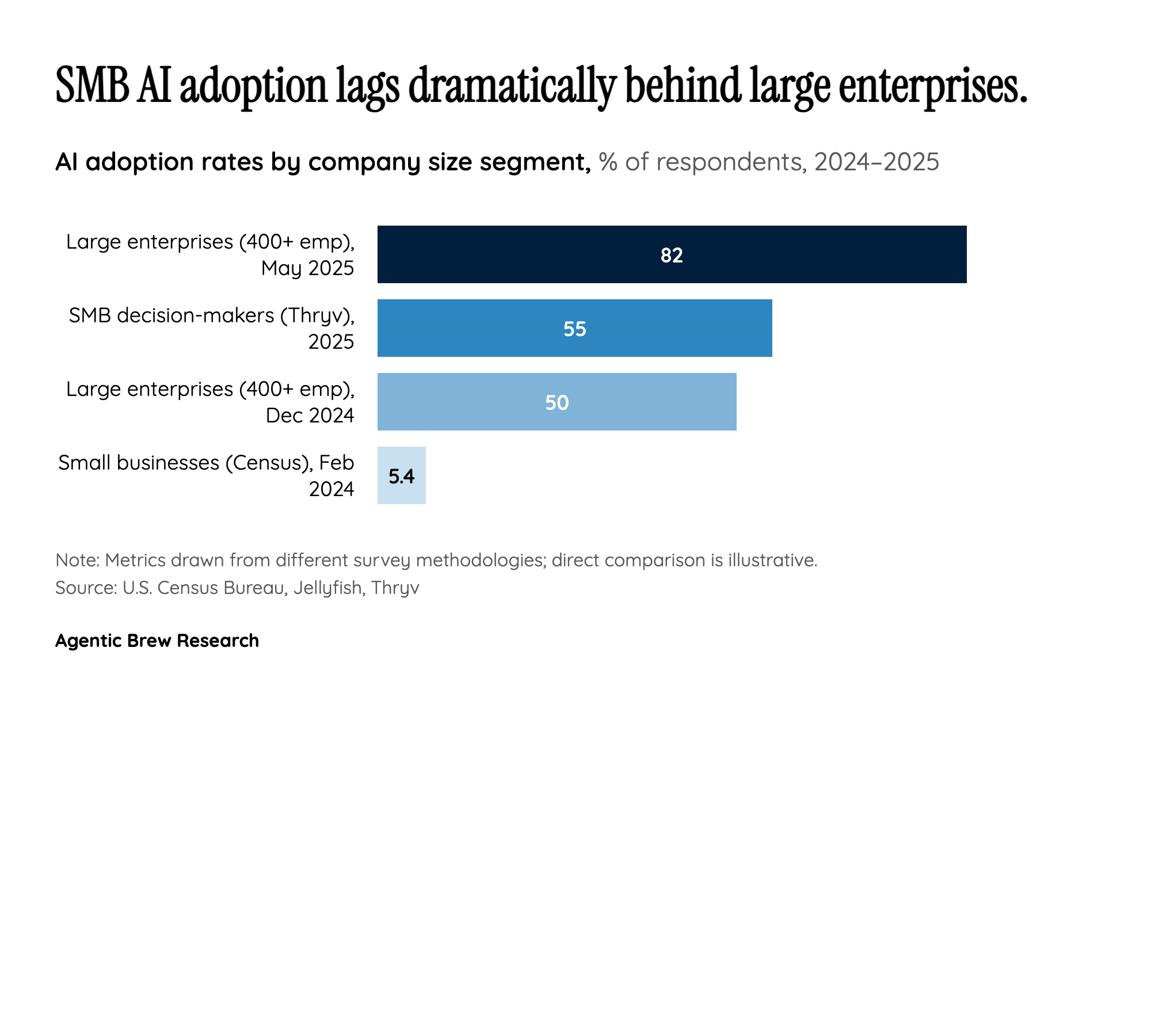
The SMB adoption gap is not simply a technology lag — it is a structural resource problem. Millions of companies with 1 to 500 employees lack both the budget to hire AI specialists and the internal bandwidth to experiment with AI tools while running their core operations. U.S. Census data from February 2024 showed only 5.4% of small businesses using AI at all, while large enterprises were simultaneously accelerating: agentic AI adoption among companies with 400+ employees jumped from 50% to 82% in just five months between December 2024 and May 2025. As AI drives productivity gains at large firms, SMBs that remain non-adopters face a compounding competitive disadvantage — not a static one. This is the core mechanism behind Cuban's warning that 'everybody else is going to fail.'