Alphabet Q1 2026 earnings and AI capex surge
TECH

Alphabet Q1 2026 earnings and AI capex surge

36+
Signals

Strategic Overview

  • 01.
    Alphabet posted Q1 2026 revenue of $109.9B (+22% YoY), beating the $107.1B consensus and delivering EPS of $5.11 against $2.62 expected.
  • 02.
    Google Cloud revenue jumped 63% YoY to $20.03B, with operating income tripling to $6.6B and backlog nearly doubling QoQ to $462B.
  • 03.
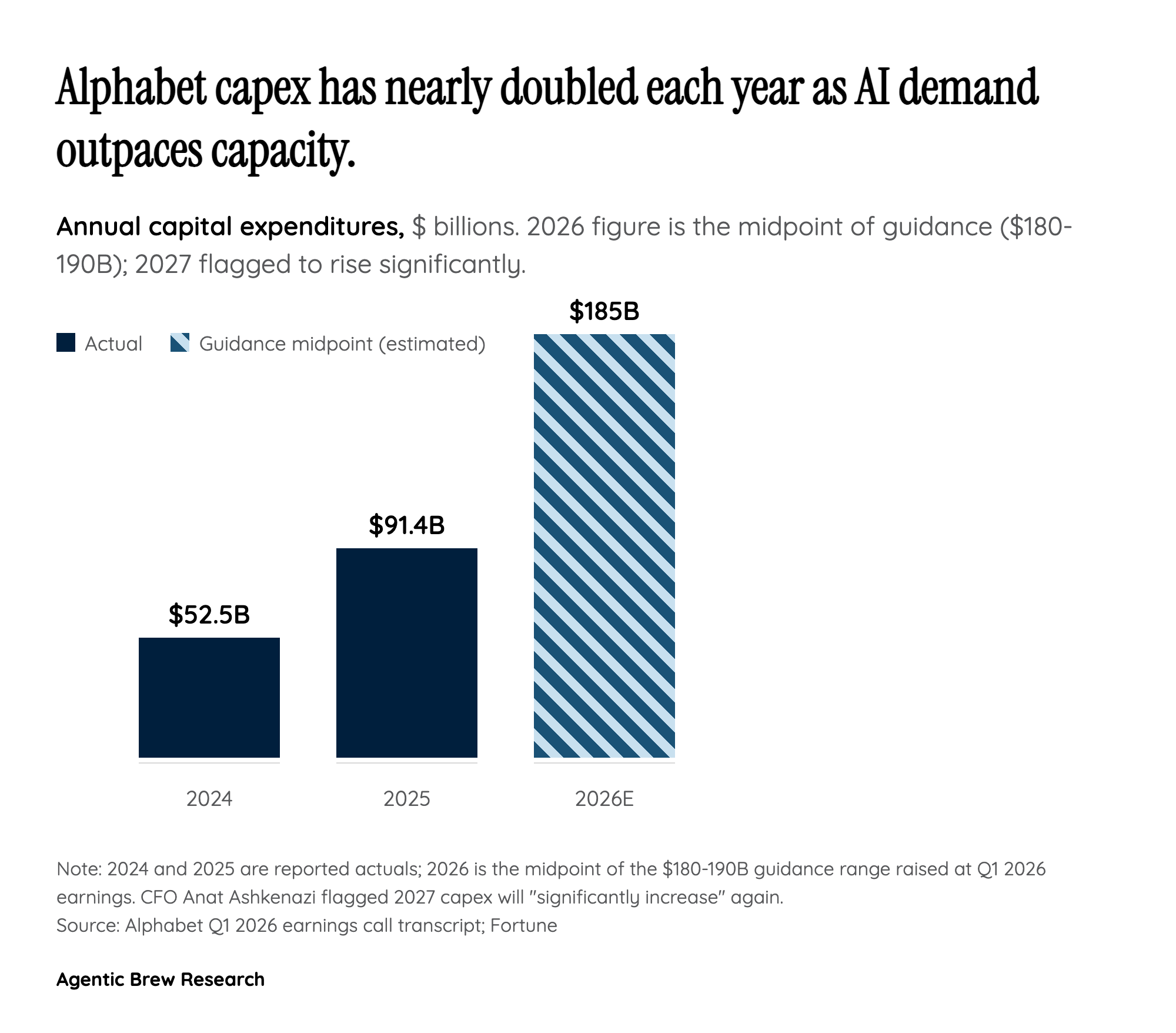
    Alphabet raised 2026 capex guidance to $180-190B (from $175-185B) and signaled 2027 capex will rise significantly again, focused on data centers, custom TPUs, and networking.
  • 04.
    CEO Sundar Pichai acknowledged Google Cloud is compute-constrained, saying revenue 'would have been higher if you were able to meet the demand.'

Deep Analysis

The compute ceiling is the real story: Google Cloud's growth is throttled by physics, not demand

The number that should anchor any read of this print isn't the 63% Cloud growth rate or even the $20B run rate — it's the $462B backlog, which nearly doubled quarter-over-quarter from roughly $240B at the end of 2025. Pichai's admission that 'cloud revenue would have been higher if you were able to meet the demand' isn't boilerplate caution; it's a structural statement about a business where the binding constraint has shifted from sales motion to silicon, power, and concrete. Management said they expect to work through about half of the backlog over the next 24 months, which means roughly $230B of contracted revenue is sitting on the other side of capacity that doesn't yet exist.

That reframes the entire capex argument. When a hyperscaler tells the market it's spending $180-190B in a year, the instinctive question is 'what if demand doesn't show up?' Alphabet's answer is that demand has already shown up — it's been signed, contracted, and queued — and the risk is on the supply side: how fast can data centers, custom TPUs, networking, and energy interconnects actually be deployed. That's a fundamentally different risk profile than speculative buildout, and it's the lens through which the 2027 capex 'significant increase' guidance should be read. The buildout is multi-year because the backlog is multi-year.
Why this capex is rewarded while Meta's is punished: visible, measurable ROI

Why this capex is rewarded while Meta's is punished: visible, measurable ROI
Alphabet annual capex 2024-2026E. 2024 $52.5B, 2025 $91.4B, 2026 guidance midpoint $185B (range $180-190B); 2027 flagged to rise further.

Hyperscalers are collectively committing roughly $700B in 2026 capex (Amazon ~$200B, Microsoft ~$190B, Alphabet $180-190B, Meta ~$135B), and yet the market is treating these dollars very differently depending on who's spending them. The reason Alphabet's spend is being cheered while comparable spend at Meta gets punished comes down to one word: receipts. Google Cloud's operating income tripled YoY to $6.6B from $2.2B, lifting operating margin to roughly 32.9% — meaning the AI infrastructure isn't just running, it's delivering accelerating unit economics. Generative-AI product revenue is up roughly 800% YoY, first-party API throughput hit 16B tokens per minute (from 10B in Q4 2025), and the new TPU 8i delivers 80% better performance per dollar on inference than its predecessor.

That's the execution premium. Investor communities discussing the print flagged this contrast directly — capex is rewarded specifically when growth visibly outpaces it, and punished when the spending narrative isn't tethered to revenue evidence. There is a contrarian counterpoint worth flagging: some retail investors argued that core operational EPS, stripping out paper gains on Alphabet's Anthropic and SpaceX stakes, was closer to $2.10 than the headline $5.11, which would have missed the $2.70 consensus. That EPS-quality debate didn't gain mainstream traction, but it's a useful reminder that GAAP earnings at a company with a large private-investment portfolio are noisier than they look. The Cloud operating-margin expansion, not the EPS line, is what's actually doing the analytical work here.

The vertical-stack bet: shipping TPUs into customer data centers redraws the cloud map

Buried in the earnings narrative is a strategic move that may matter more in two years than this quarter's revenue beat: Alphabet announced it will begin shipping custom TPU hardware to a select group of customers' own data centers, with most revenue recognition expected in 2027. This is a meaningful departure from the standard cloud model, where the hyperscaler owns the silicon and rents access. By placing TPUs on-prem at strategic customers, Google is effectively extending its full-stack thesis — Pichai's claim that 'we are the only provider to offer first-party solutions across the entire enterprise AI stack' — beyond the boundaries of Google Cloud regions.

The business logic is straightforward once you read it against the compute-constraint problem. If Alphabet cannot build data centers fast enough to serve the $462B backlog, one way to monetize the silicon advantage is to let large customers deploy TPUs themselves while Google retains the software, model, and tooling layers above. It also weaponizes Google's silicon roadmap against Nvidia in a way that pure cloud rentals never could: a customer running TPU 8i in its own facility is a customer that's much harder for AWS or Azure to recapture. The 2027 revenue-recognition timing also conveniently aligns with the CFO's guidance that 2027 capex will rise significantly — the same year the on-prem TPU revenue stream is expected to ramp materially.

The hyperscaler arms race: under-investing is now the existential risk

The cumulative ~$700B 2026 capex figure across the four big hyperscalers is the kind of number that used to belong to sovereign infrastructure budgets, and it reframes the strategic calculus for every cloud and AI competitor. CFO Anat Ashkenazi was explicit that 'the significant increase in our investment in technical infrastructure will continue to put pressure on the P&L in the form of higher depreciation expense and related data center operations costs such as energy' — meaning Alphabet itself is accepting near-term margin pressure as the price of staying in the game. When the CFO of one of the most profitable companies in history voluntarily takes margin pain, the implicit message is that under-investing carries a worse penalty: permanent share loss in a market that's compounding faster than capex cycles can correct.

This is also why Morgan Stanley's Brian Nowak frames Google Cloud as 'a significant driver for the company in 2027' that may not yet be reflected in the stock — the analyst view is that the market is still pricing Alphabet on 2026 P&L mechanics rather than 2027 backlog conversion. Search and Other revenue grew 19% to roughly $60B with AI Overviews and AI Mode driving queries to all-time highs, which quietly disproves the thesis that AI assistants would cannibalize Google's ad cash cow. YouTube ad revenue at $9.88B was the only soft line, slightly missing the $9.99B estimate, but it's increasingly a sideshow next to Cloud. The composite picture is a company where the legacy ad engine is funding a multi-year, multi-hundred-billion-dollar infrastructure bet whose payoff curve runs through 2027 and beyond.

Historical Context

2024-12-31
Alphabet's full-year 2024 capex totaled $52.5B — the baseline before the AI capex surge.
2025-07-23
Alphabet revised its 2025 capex from $75B initial guidance up to $85B, citing accelerating cloud and AI demand.
2025-12-31
Full-year 2025 capex landed near $91.4B, with Q4 2025 alone at $27.9B as Google Cloud's backlog reached roughly $240B.
2026-02-04
At Q4 2025 earnings, Alphabet first set 2026 capex guidance at $175-185B, roughly doubling 2025 spend and resetting the bar for AI infrastructure investment.
2026-04-29
At Q1 2026 earnings, Alphabet raised 2026 capex to $180-190B, flagged a further significant rise in 2027, and disclosed Cloud backlog had nearly doubled to $462B.

Power Map

Key Players
Subject

Alphabet Q1 2026 earnings and AI capex surge

SU

Sundar Pichai

CEO of Alphabet/Google; framed compute constraints as the binding limit on cloud growth and emphasized full-stack AI investment from silicon to applications.

AN

Anat Ashkenazi

CFO of Alphabet; raised 2026 capex range to $180-190B and warned of P&L pressure from depreciation and data-center operating costs.

GO

Google Cloud

Primary growth engine; enterprise AI is now its largest growth driver, but capacity-constrained — leaving demand on the table even at $20B/quarter.

MI

Microsoft, Amazon, Meta

Hyperscaler peers also racing on AI capex (Microsoft ~$190B, Amazon ~$200B, Meta ~$135B in 2026), creating the ~$700B competitive backdrop for Alphabet's spend.

BR

Brian Nowak (Morgan Stanley)

Sell-side analyst arguing Google Cloud could be a significant 2027 driver not yet fully priced into the stock at current levels.

GE

Gemini Enterprise customers

Paid monthly active users grew 40% QoQ, serving as the primary demand driver behind cloud growth and the TPU/GPU buildout.

Source Articles

Top 5

THE SIGNAL.

Analysts

"Argues enterprise AI has become Google Cloud's primary growth driver and that the full-stack approach across TPUs, Gemini, and infrastructure is producing measurable performance gains across the business."

Sundar Pichai
CEO, Alphabet

"Pitches Google Cloud's vertical integration down to silicon as a durable competitive advantage now that AI demand is structurally outstripping supply."

Sundar Pichai
CEO, Alphabet

"Warns that record infrastructure spending will pressure margins via higher depreciation and data-center operating costs even as it funds the company's growth runway."

Anat Ashkenazi
CFO, Alphabet

"Signals the AI buildout is multi-year, not peaking in 2026 — 2027 capex will rise meaningfully again as Alphabet works through a $462B backlog."

Anat Ashkenazi
CFO, Alphabet

"Believes Google Cloud could be a significant driver for Alphabet in 2027 and may not be fully priced into the stock at current levels, given the visible backlog."

Brian Nowak
Equity Analyst, Morgan Stanley
The Crowd

"Alphabet beats on revenue, with cloud booming 63% and topping $20 billion"

@u/Puginator1100

"Alphabet tops Q1 estimates on strong Google Cloud growth"

@u/internetmoney-352

"Alphabet, Microsoft, Amazon, and Meta report earnings TODAY. Which one will outperform?"

@u/Adept_Mountain953249
Broadcast
Alphabet 2026 Q1 Earnings Call

Alphabet 2026 Q1 Earnings Call

MAG 7 EARNINGS: GOOGL, MSFT, AMZN, META

MAG 7 EARNINGS: GOOGL, MSFT, AMZN, META

Alphabet's INSANE Quarter: Instant Reaction!

Alphabet's INSANE Quarter: Instant Reaction!