Alphabet Q1 2026 earnings and AI capex surge
TECH

Alphabet Q1 2026 earnings and AI capex surge

40+
Signals

Strategic Overview

  • 01.
    Alphabet posted Q1 2026 revenue of $109.9B (+22% YoY), its fastest growth quarter since 2022, with net income of $62.58B (+81% YoY) and EPS of $5.11.
  • 02.
    Google Cloud crossed $20B in quarterly revenue for the first time, growing 63% YoY, with operating income tripling to $6.6B and operating margin expanding from 17.8% to 32.9%.
  • 03.
    Cloud backlog nearly doubled sequentially to $462B, with just over half expected to convert to revenue within 24 months, while Alphabet raised 2026 capex guidance to $180-190B and signaled a significantly higher 2027 ramp.
  • 04.
    Search and Other revenue grew 19% YoY to $60.4B, defying the bear thesis on AI-chatbot disruption, with AI Overviews monetizing at rates similar to traditional Search.

Deep Analysis

Why Wall Street rewarded Alphabet and punished Meta for the same AI bill

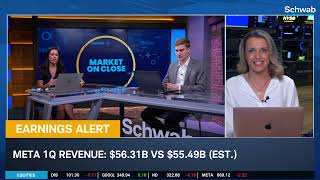
The clearest signal of the quarter wasn't Alphabet's $109.9B top line — it was the divergent stock reaction across hyperscalers that all raised capex on the same week. Alphabet jumped roughly 7% after-hours on a guide of $180-190B for 2026. Meta, which raised its own range to $125-145B, fell 6-7% and was promptly downgraded by JPMorgan to neutral over a 'challenging path' to AI returns. Microsoft, with $190B in guided capex, traded essentially flat. The differentiator is contracted demand: Alphabet can point to a $462B Google Cloud backlog and a 63% YoY cloud growth rate as the receivable side of its capital plan. Meta's AI build is funded by a single ad business and a hope that Llama and recommendation systems eventually drive enough engagement and ad pricing to clear the hurdle. Investors are no longer underwriting AI capex at the asset-class level — they're underwriting it issuer by issuer, and the presence or absence of a multi-year backlog is becoming the key discriminator.
The backlog-as-capex-justification mechanism

The backlog-as-capex-justification mechanism
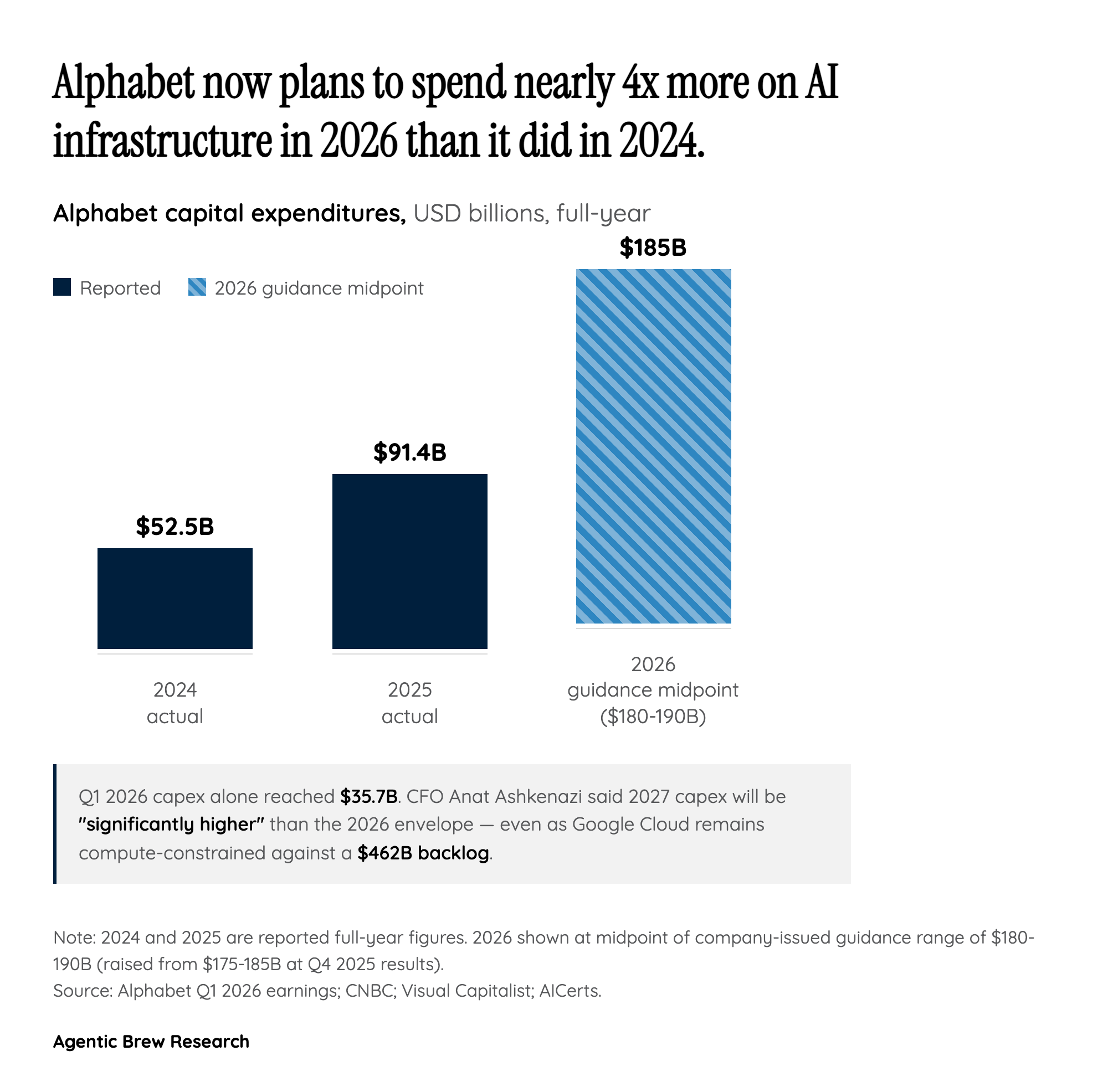
Alphabet capex trajectory: $52.5B (2024) -> $91.4B (2025) -> $185B (2026 guidance midpoint).

Google Cloud's $462B backlog is the load-bearing number of the entire quarter. It nearly doubled sequentially, and management said just over half is expected to convert to revenue over the next 24 months — implying roughly $230B of contracted cloud revenue is already on the books for the next two years. That is the math that makes a $180-190B capex year defensible: the spend isn't building data centers in hope of demand, it's building them against signed customer commitments Alphabet is currently failing to fully deliver against. Pichai's admission that Cloud 'would have been higher if we were able to meet that demand' inverts the usual capex critique. Instead of overbuild risk, the operative risk is under-build — every quarter Alphabet stays compute-constrained is a quarter of contracted revenue it's leaving on the table. That framing is exactly what Wall Street wants to hear when underwriting a capex line that's roughly tripled in two years, from $52.5B in 2024 to $91.4B in 2025 to a guided $180-190B in 2026, with 2027 explicitly higher.

TPU vertical integration becomes a product, not just a moat

The structural story sitting underneath the headline numbers is that Alphabet is converting its custom-silicon advantage from an internal cost lever into an external revenue stream. Pichai disclosed on the call that Google Cloud will begin selling its 8th-generation TPUs to a select group of customers for installation in their own data centers, with a small share of revenue recognized in 2026 and the bulk converting in 2027. Combined with the new Virgo Network fabric scaling to 1M+ chips per cluster and a generative-AI products revenue line growing roughly 800% YoY, this gives Alphabet a third leg of AI monetization beyond cloud rentals and consumer Search. It also explains the 'significantly higher' 2027 capex preview: the TPU sales channel can only scale if Alphabet manufactures and pre-stages enough silicon and networking to ship to outside customers without starving its own cloud. The 32.9% Google Cloud operating margin (up from 17.8% a year earlier) is the early proof that vertical integration is flowing to the bottom line.

The contrarian view: how much of the EPS beat is real?

Community discussion on r/wallstreetbets and r/google flagged a contrarian read worth surfacing: a meaningful portion of the $5.11 EPS print came from non-operating 'other income' of roughly $37.7B, much of which appears to be unrealized mark-to-market gains on Alphabet's equity stakes in private AI and space companies including Anthropic and SpaceX. Strip those gains out and the implied core EPS narrows toward the $2.00-$2.76 range, only modestly above the ~$2.63 analyst expectation. The reflexive concern raised in those threads — sometimes called the 'Anthropic infinite money glitch' — is that Alphabet invests in Anthropic, Anthropic spends a large share of that capital on Google Cloud compute, and the resulting equity appreciation flows back through Alphabet's income statement. None of this invalidates the operating story (cloud growth and backlog are GAAP revenue, not mark-to-market), but it does mean the headline 81% net income jump should be read as part operating leverage and part investment-portfolio revaluation.

Search resilience is the cash-flow cover for the entire AI build

Often overlooked in the cloud-and-capex headlines is that Search and Other revenue grew 19% YoY to $60.4B, with management saying AI Overviews monetize at rates similar to traditional Search. That single data point quietly resolves the multi-year bear thesis that generative AI would gut Google's ad business before its cloud business could grow into the gap. Instead, Search is accelerating, not decelerating, and remains the high-margin annuity that funds an AI infrastructure plan no other company except possibly Microsoft and Amazon could finance. YouTube ads at $9.88B (versus $8.93B a year earlier) reinforce the point. The strategic implication is that Alphabet is the rare AI-capex-heavy hyperscaler whose legacy cash machine is still expanding, which is why even bullish analysts who flagged free-cash-flow pressure from the 2026/2027 ramp didn't push back on the plan itself.

Historical Context

2024-12-31
Full-year 2024 capex was approximately $52.5B, the baseline before the AI infrastructure ramp.
2025-10-29
On the Q3 2025 earnings call, executives previewed a 'significant increase' in 2026 capex.
2025-12-31
Capex reached $91.4B for full-year 2025 after three upward revisions during the year, driven by AI demand.
2026-02-04
After Q4 2025 results, Alphabet first set 2026 capex guidance at roughly $185B and warned even that wouldn't be enough to meet AI demand.
2026-04-29
Q1 2026 print: revenue $109.9B, Google Cloud +63% to $20B, backlog $462B, capex guidance raised to $180-190B with 2027 to be significantly higher.

Power Map

Key Players
Subject

Alphabet Q1 2026 earnings and AI capex surge

SU

Sundar Pichai (Alphabet CEO)

Framed the quarter around a 'full-stack AI' narrative driving every business line, while warning that Google Cloud is compute-constrained and leaving revenue on the table.

AN

Anat Ashkenazi (Alphabet CFO)

Raised 2026 capex guidance to $180-190B and signaled a significantly higher 2027 spend, framing record cloud revenue and backlog growth as justification.

ME

Meta Platforms

Raised capex to $125-145B but saw shares drop ~6-7% after-hours, with JPMorgan downgrading the stock to neutral citing a 'challenging path' to AI returns.

MI

Microsoft

Guided to $190B in annual capex but stock was essentially flat as investors waited for clearer monetization signals.

AM

Amazon (AWS)

Backed its capex with $225B in Trainium chip commitments and a $364B AWS backlog, framing the spend as 'derisked' by signed customer deals.

WA

Wall Street equity investors

Rewarded Alphabet (~+7% after-hours) for visible AI monetization while penalizing Meta for unclear ROI on similar capex, creating a sharp divergence within the hyperscaler cohort.

Source Articles

Top 5

THE SIGNAL.

Analysts

"Argues Q1 2026 prints validate the bull thesis on hyperscaler AI capex and effectively kill the narrative that the spending is speculative."

Daniel Newman
CEO, Futurum Group

"Reads the cloud beat as evidence Google is taking AI market share and is competitively positioned versus rival hyperscalers."

Melissa Otto
Analyst, S&P Global

"Downgraded Meta to neutral from overweight, citing a 'challenging path' to generating returns on its heavy AI capex forecast even as Alphabet's similar spend was rewarded."

JPMorgan analysts
Sell-side equity research

"Says Google Cloud is compute-constrained in the near term and that revenue would have been higher if Alphabet could meet demand, framing the capex hike as a supply-side response."

Sundar Pichai
CEO, Alphabet

"Frames record cloud revenue and the surging backlog as direct evidence that AI investments are delivering, justifying the elevated capex envelope."

Anat Ashkenazi
CFO, Alphabet
The Crowd

"Alphabet beats on revenue, with cloud booming 63% and topping $20 billion"

@u/Puginator1794

"Alphabet tops Q1 estimates on strong Google Cloud growth"

@u/internetmoney-626

"Q1 Earnings Report"

@u/Yazzdevoleps361
Broadcast
Alphabet 2026 Q1 Earnings Call

Alphabet 2026 Q1 Earnings Call

Breaking Down Alphabet's Earnings and Spending Plans

Breaking Down Alphabet's Earnings and Spending Plans

MAG 7 EARNINGS: GOOGL, MSFT, AMZN, META

MAG 7 EARNINGS: GOOGL, MSFT, AMZN, META