Google Cloud Next 2026 enterprise AI announcements
TECH

Google Cloud Next 2026 enterprise AI announcements

39+
Signals

Strategic Overview

  • 01.
    Google retired the Vertex AI brand and unveiled the Gemini Enterprise Agent Platform, a single surface for building, governing, and scaling agents across the enterprise. The rebrand signals that Google views fragmented model APIs as a losing posture for the agentic era — instead wrapping model selection, DevOps, orchestration, and security into one control plane that customers must migrate onto if they want the roadmap.
  • 02.
    The announcement stack spans the full vertical: Workspace Intelligence as a semantic layer across Docs/Gmail/Meet, Chrome 'auto browse' as a worker-class web agent, an Agentic Data Cloud for real-time data action, and 8th-generation TPU 8t/8i chips scaling to 9,600-chip superpods. Packaged together, it positions Google as the only hyperscaler pitching silicon-to-seat integration.
  • 03.
    Beyond product, Google is spending to buy the channel. A $750 million partner fund targets Accenture, Deloitte, KPMG, McKinsey, and BCG — the firms that gate Fortune 500 platform decisions — alongside expanded NVIDIA Vera Rubin A5X infrastructure and the Wiz-powered Agentic Defense security suite.

Deep Analysis

The Vertex AI sunset is the real story — and it's a forced migration

Behind the branding exercise is a consolidation with teeth. Google's own announcement is explicit: 'all Vertex AI services and roadmap evolutions will be delivered exclusively through the Agent Platform.' That wording turns a product launch into a mandatory migration for every Vertex customer, and it reframes what Gemini Enterprise Agent Platform actually is — not a new SKU competing for budget, but the only supported path forward for existing workloads. For buyers who invested in Vertex pipelines, MLOps, and governance during 2024–2025, Next 2026 is less a set of announcements than a deadline. The payoff is genuine integration across model building, agent building, DevOps, orchestration, and security under one roof; the cost is another migration cycle, and a loss of the 'buy just the model API' option that some teams deliberately chose. That tradeoff — integration in exchange for lock-in — is the precise bargain Microsoft has been offering for decades, and it signals that Google now believes the agentic enterprise market rewards platforms, not primitives.
Chrome 'auto browse' is the flanking maneuver against Copilot

Workspace Intelligence grabs the headlines, but Chrome auto-browse is the more strategically interesting weapon. By turning the browser itself into an agentic surface — Gemini reads live tab context and executes multi-step web tasks on the user's behalf — Google is attacking the one layer of the enterprise stack Microsoft cannot easily match: the default worker browser. Every SaaS app a Fortune 500 employee uses runs inside Chrome, which means an auto-browsing Gemini agent can automate workflows across tools Microsoft doesn't own and never will. Crucially, Google is not pitching full autonomy. TechCrunch notes Google emphasized users 'must review and confirm key steps,' a deliberate human-in-the-loop posture that both addresses the governance anxieties practitioners keep flagging and neutralizes the obvious 'rogue agent' liability story. The result is an agent class that's legally conservative but functionally ambitious — and one that uses Chrome's install base as a go-to-market channel Copilot cannot replicate from inside the Edge browser.

The $750M fund reveals who Google thinks actually makes enterprise AI decisions

The partner fund is a tell. Google is not spending $750 million to subsidize end-customer Gemini usage; it is spending it on the consulting layer — Accenture, Deloitte, KPMG, McKinsey, and BCG — plus education across a 120,000-member partner ecosystem and 330,000+ trained consultants. That allocation only makes sense under one theory of the market: enterprise agentic AI adoption is gated by systems integrators, not by CIO evaluation of model benchmarks. Microsoft's Copilot advantage is distribution through existing E5 licensing; Google's counter-play is buying the advisors who tell Fortune 500 boards which platform to standardize on. It's also a tacit admission about where 2025's experimentation phase stalled. KPMG's claimed 90% employee adoption with 100+ agents, Macquarie Bank's 100,000+ reclaimed hours, and Signal Iduna's 37% faster insurance answers are the proof points Google wants the next wave of consulting engagements to reproduce — at scale, on Gemini Enterprise, with the billable hours that turn a platform launch into a multi-year revenue stream.

TPU v8 and the Vera Rubin deal are a hedge, not a contradiction

Announcing TPU 8t and 8i — with 8t superpods scaling to 9,600 chips, 2 petabytes of shared high-bandwidth memory, 3x Ironwood's processing power and 2x performance-per-watt — while simultaneously expanding the NVIDIA partnership with Vera Rubin NVL72 A5X instances looks contradictory, but it's Google doing silicon portfolio management. TPUs serve Google's own workloads (75% of all new code at Google is now AI-generated, 16 billion first-party API tokens per minute) and anchor-tenant customers like Thinking Machines Lab in a newly disclosed multibillion-dollar deal. NVIDIA instances serve the enormous cohort of enterprises whose model stacks, ML engineers, and ISV software assume CUDA. Positioning both means Google Cloud can win customers regardless of which accelerator religion they practice — and monetize the enterprise AI inference wave, where NVIDIA claims 10x lower cost per token and 10x higher throughput per megawatt versus the prior generation, without forcing a platform choice that would narrow the addressable market. It's the same integration logic Kurian applied to software: own the stack, but let customers bring their own components.

The commercial stakes are front-loaded into 2026

JPMorgan's Doug Anmuth quantifies the moment: Google Cloud's backlog surged 160% year-over-year to $240 billion in late 2025, and is expected to represent roughly 19% of Alphabet's total revenue in 2026. That backlog is the dry powder Next 2026 is designed to convert. Every announcement — the Agent Platform rebrand, Workspace Intelligence, Chrome auto-browse, the Agentic Data Cloud, TPU v8, the Wiz-powered security suite, the partner fund — maps to a distinct conversion lever on that committed spend. Usage signals inside Google Cloud corroborate the trajectory: nearly 75% of Google Cloud customers use Google AI products, 330 customers processed over 1 trillion tokens each in the past year with 35 reaching 10 trillion, Gemini Enterprise paid monthly active users grew 40% quarter-over-quarter in Q1, and 95% of the top 20 SaaS companies now use Gemini. Read as a single trajectory, Next 2026 is the productization event that a specific financial forecast requires — less a keynote about what AI will someday do, more a disclosure about how Alphabet intends to make this quarter's numbers hit.

Historical Context

2025-01
Google's $32 billion acquisition of Wiz closed earlier in the year, laying the technical and personnel groundwork for the Agentic Defense and AI Application Protection announcements that anchor Next 2026's security track.
2025-04-09
The prior year's Next delivered 229 announcements including the 7th-generation Ironwood TPU, Gemini 2.5, and the original Agent2Agent (A2A) protocol — framing 2025 as the year of AI experimentation and laying the product scaffolding that 2026 consolidates.
2026-04-22
Next 2026 pivoted the narrative from experimentation to enterprise-scale agentic systems, collapsing Vertex AI and Agentspace into the Gemini Enterprise Agent Platform, launching TPU 8t and 8i, and positioning the A2A protocol as already running in production at 150 organizations.

Power Map

Key Players
Subject

Google Cloud Next 2026 enterprise AI announcements

GO

Google Cloud / Alphabet

Host and platform provider unifying the stack under the Gemini Enterprise Agent Platform, with Sundar Pichai and Thomas Kurian framing the pitch as an integrated control plane rather than a model menu.

NV

NVIDIA

Core infrastructure partner behind the A5X bare-metal instances powered by Vera Rubin NVL72 rack-scale systems, plus Blackwell and Nemotron model availability on Google Cloud — with joint claims of 10x lower inference cost per token and 10x higher throughput per megawatt versus the prior generation.

AC

Accenture, Deloitte, KPMG, McKinsey, BCG

Consulting partners receiving early Gemini access and a share of the $750M partner fund; their sign-off is what converts Next 2026 announcements into Fortune 500 procurement.

WI

Wiz

The $32B acquisition is now operational as the engine behind Agentic Defense and AI Application Protection, reducing typical 30-minute alert investigations to roughly 60 seconds via the Triage Agent.

TH

Thinking Machines Lab (Mira Murati)

A newly-disclosed multibillion-dollar Google Cloud AI infrastructure customer, serving as high-profile validation for the TPU 8t/8i roadmap beyond DeepMind itself.

MI

Microsoft

The primary competitor Google is pricing and packaging against; Copilot's embedded Fortune 500 distribution is the structural advantage Google is trying to erode with Chrome auto-browse and Workspace Intelligence.

THE SIGNAL.

Analysts

"Kurian cast the agentic race as an integration problem, arguing competitors ship components while Google ships a platform. His framing — that rivals are 'handing you the pieces, not the platform' — is the throughline binding together Gemini Enterprise, TPU v8, Workspace Intelligence, and the Agentic Data Cloud into one sales story."

Thomas Kurian
CEO, Google Cloud

"Furrier reframes the enterprise AI contest as a fight for the control plane rather than for model quality, observing that 'Google is trying to build the operating system for the agentic enterprise.' In his five-way race reading, Microsoft owns distribution and AWS owns developer gravity — leaving Google to win on vertical integration across silicon, models, cloud, and distribution."

John Furrier
Co-founder, SiliconANGLE

"Anmuth named Alphabet a top pick ahead of Next 2026, reiterating an Overweight rating and a $395 price target. He expects Google Cloud to reach roughly 19% of Alphabet revenue in 2026, with the cloud backlog up 160% year-over-year to $240 billion in late 2025 — framing Next 2026 as the commercialization moment for that backlog."

Doug Anmuth
Analyst, JPMorgan

"In the Next 2026 theCUBE interview, Thiessen argued that governance and trust — not raw model capability — now gate Gemini Enterprise adoption at large organizations, echoing the platform's emphasis on DevOps, orchestration, and security wrappers around agents."

Mike Thiessen (PwC) with Rebecca Potts (Google) on theCUBE
Consulting and Google Cloud product leads
The Crowd

"5 ways AI agents will transform the way we work in 2026 (thread): 1. AI agents will help you be more productive 2. Agentic workflows will become a core part of business processes 3. Agents will bring five-star experiences to life"

@@googlecloud0

"[ITmedia AI+] Google Cloud Next 2026 announcement summary — toward autonomous AI agents"

@@itmedia0

"Google Cloud Next 2026 announcement summary — toward autonomous AI agents"

@@itm_aiplus0
Broadcast
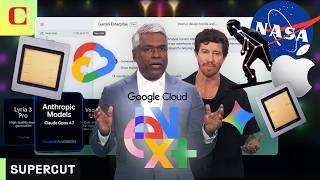
Everything Announced at Google Cloud Next in Under 13 Minutes

Everything Announced at Google Cloud Next in Under 13 Minutes

Google Cloud Next 2026: Opening Keynote

Google Cloud Next 2026: Opening Keynote

Mike Thiessen, PwC & Rebecca Potts, Google | Google Cloud Next 2026

Mike Thiessen, PwC & Rebecca Potts, Google | Google Cloud Next 2026