Anthropic shifts to per-token enterprise billing
TECH

Anthropic shifts to per-token enterprise billing

37+
Signals

Strategic Overview

  • 01.
    Anthropic replaced its flat enterprise seat (up to $200/user/month with bundled tokens) with a $20/user/month access fee plus standard API-rate usage billing on every token consumed across Claude, Claude Code, and Cowork.
  • 02.
    The transition began quietly in November 2025 as enterprise contracts came up for renewal, then consolidated in February 2026 into a single all-inclusive Enterprise seat; chat-only and Standard/Premium tiers were discontinued for new contracts.
  • 03.
    The new structure includes mandatory monthly spend commitments based on Anthropic's usage estimate — customers pay the commitment whether they hit the estimate or not — and eliminates the 10-15% API volume discounts large enterprises previously received.
  • 04.
    Anthropic's revenue run rate jumped from roughly $9B at the end of 2025 to about $30B by April 2026, with more than 1,000 customers paying over $1M annually — the cohort most directly affected by the repricing.

The End of the 175x Subsidy

To understand why Anthropic moved now, start with the math that made the old enterprise plan untenable. Under the flat model, a single $200/month Max-tier seat could deliver several thousand dollars of effective API credit to a heavy user. A single autonomous agent instance — the kind of always-on harness developers were stringing together with Claude Code and third-party tools like OpenClaw — could burn $1,000 to $5,000 in compute equivalents in a single day. Analysts have openly described this as a roughly 175x subsidy on the heaviest workloads: for every dollar Anthropic collected, it was shipping two orders of magnitude more compute.

That was viable when average usage stayed low and heavy users were rare. It stopped being viable when Claude Code weekly active users doubled between January and February 2026 and Blackwell GPU rental prices climbed 48% in two months. Adrien Laurent, CEO of IntuitionLabs, crystallized the mechanical change in one sentence: 'the seat fee no longer bundles any usage allowance at all. Every token gets billed at standard API rates on top of the base seat.' The $20 access fee isn't a price cut — it's a pure entitlement fee, separated from the compute bill. That separation is the whole point. It lets Anthropic price capacity at marginal cost while still selling a platform subscription, and it converts a growing contingent liability (tokens promised under flat plans) into a pass-through line item.

The Tokenmaxxing Feedback Loop

The Tokenmaxxing Feedback Loop
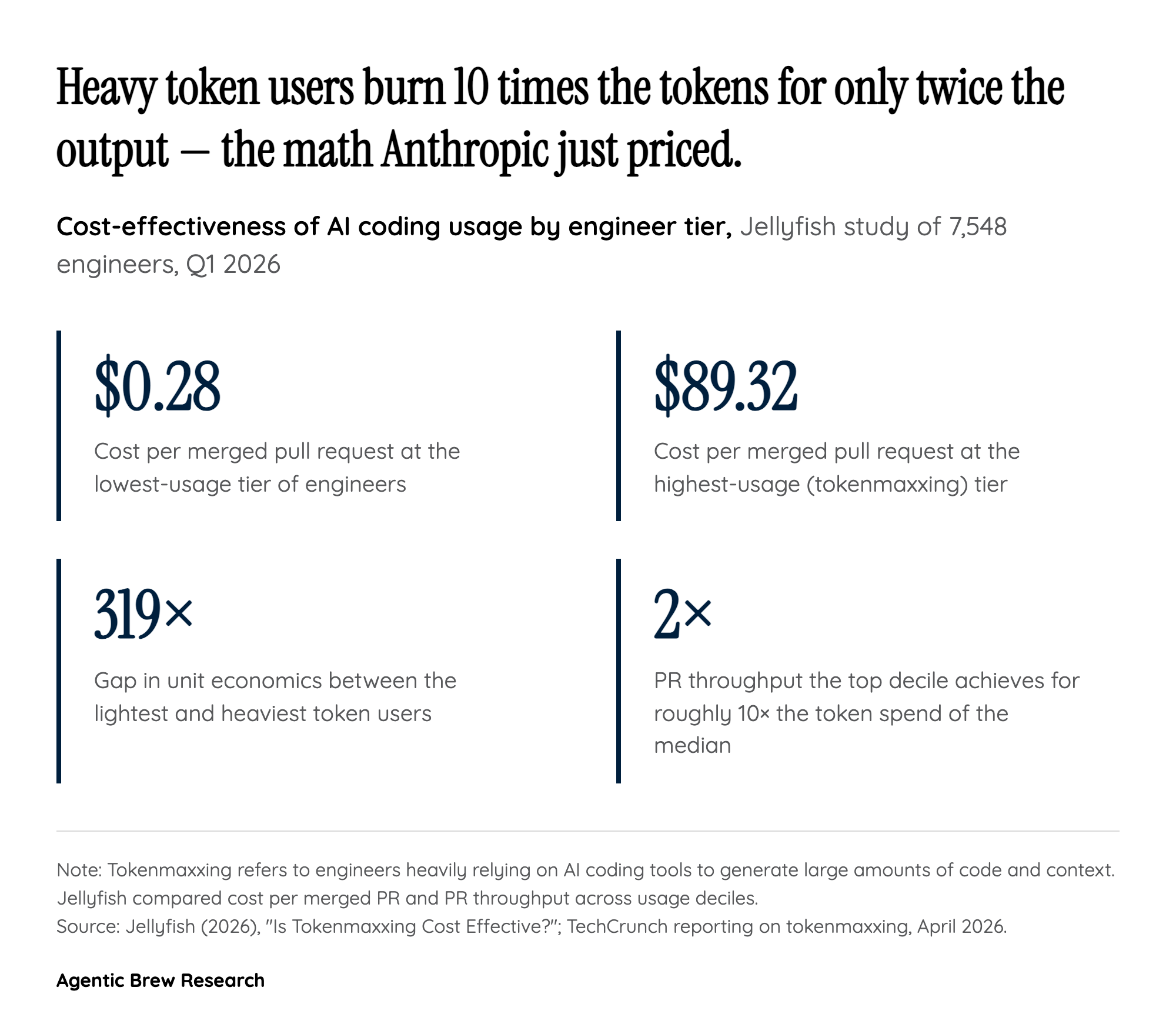
Cost per merged PR climbs 319x from the lightest to the heaviest token-users (Jellyfish Q1 2026 study of 7,548 engineers).

The uncomfortable subplot running underneath the pricing change is that the demand signals Anthropic is responding to may be partly fictitious. Gergely Orosz's reporting surfaced that engineers at Meta, Microsoft, and Salesforce are 'purposefully burning tokens (and money!) to inflate their AI usage' — tokenmaxxing — because internal performance reviews have been calibrated against AI-adoption metrics. A widely-shared scoop described a Meta internal leaderboard called 'Claudeonomics' logging more than 60 trillion tokens over a recent 30-day window. Some of that is real work; a lot of it is theatre.

Jellyfish's study of 7,548 engineers quantifies the distortion. The top decile of token users produced roughly twice the merged-PR throughput of the median while consuming about ten times the tokens. Cost per merged PR climbs from $0.28 at the lowest usage tier to $89.32 at the highest. In other words, the heaviest consumers are the least cost-effective producers — the exact cohort whose usage patterns were signaling runaway AI demand to infrastructure planners and capex committees. The feedback loop is sharp: tokenmaxxing inflated reported demand, inflated demand justified bigger capex (Alphabet alone is reportedly moving from ~$75B in 2025 toward $175-$185B in 2026), and the resulting cost structure forced Anthropic to reprice. The metered bill, by putting a dollar value on every token in plain sight, is also the first mechanism capable of breaking the loop — when tokens have a unit price visible to a finance team, the 'Claudeonomics' leaderboard becomes a budget line, not a bragging right.

The 150-User Cliff: Who Actually Pays

The sticker on the door — a $20 seat fee — makes this look like a price cut. Inside the building, procurement advisors see the opposite. NPI Financial warns that 'lower seat fees, separate usage billing and mandatory consumption commitments are expected to raise overall costs' because the shift strips two things out of the old pricing: bundled tokens and the 10-15% API volume discounts large enterprises used to receive. Redress Compliance's estimate — that heavy users could see bills double or triple — is the cleanest summary of the TCO math.

The pain is sharpest at a specific seat-count boundary. Customer posts on Claude-focused community forums describe a hard cliff at 150 users, where organizations graduate from the Team tier (which still bundles usage) onto Enterprise (which does not). One 800-user organization publicly modeled a $336K-$1.4M annual cost gap between the two plans; another team lead described being forced onto Enterprise after crossing the threshold and burning hundreds of dollars in rack API charges in the first hours. The community mood around the shift is sharply negative — customers describe feeling 'penalized for scaling' — though contrarian voices correctly note that this is simply how grown-up enterprise SaaS works: Team is a subsidized UI product; Enterprise is infrastructure with SSO, SCIM, and compliance, priced at marginal cost. Both reads can be true. What is unambiguously true is that mandatory monthly spend commitments, based on Anthropic's own usage estimate, transfer forecasting risk from vendor to buyer — enterprises pay the commitment whether they hit it or not.

Why November 2025, Not November 2024

The more interesting question isn't what Anthropic changed but why it changed now. The answer that ties the pieces together is Dario Amodei's public articulation of capex-timing risk. In a February 2026 Fortune interview he put it bluntly: 'If I'm just off by a year in that rate of growth, or if the growth rate is 5x a year instead of 10x a year, then you go bankrupt.' That is not the statement of a CEO with the latitude to keep underpricing compute. It is the statement of a CEO who needs every dollar of committed enterprise revenue he can get on the balance sheet — ideally in the form of mandatory monthly minimums that look like predictable ARR to investors and debt markets.

Broadcast coverage framing Anthropic as 'the only one being realistic' about AI demand lands in the same zone: if the industry is pricing infrastructure against inflated tokenmaxxing signals, a metered model is the one honest instrument available — it forces demand to reveal itself in dollars. There is a quieter second motivation worth naming. API uptime data cited by IT Brief shows Anthropic running at 98.95% over the 90 days ending April 8, 2026, versus a 99.99% industry norm. Capacity is genuinely tight, and metered billing is the cleanest form of demand management: when every token has a price, buyers self-ration. Boris Cherny's on-record framing — that Anthropic will 'prioritise our customers using our products and API' — makes the capacity-allocation priority explicit. Read together, this isn't a pricing tweak. It's Anthropic converting an unsustainable flat-rate business into a metered utility, on a timeline driven by the cost of being wrong about when the revenue shows up.

Historical Context

2025-07-28
Announces weekly rate limits for Pro and Max plans targeting the top ~5% of power users running Claude Code continuously — the first visible sign that flat plans were cross-subsidizing agentic workloads.
2025-11
Begins renewing enterprise customers onto the usage-based plan, quietly ending bundled-token seat deals for contracts coming up for renewal.
2026-02
Consolidates to a single all-inclusive $20/user/month Enterprise seat covering chat, Claude Code, and Cowork, with every token metered separately at standard API rates.
2026-02-14
In a Fortune interview, the Anthropic CEO articulates the 'off by a year, you go bankrupt' capex framing that underpins the drive toward committed, metered enterprise billing.
2026-04-04
Announces metered billing for heavy third-party agentic tools like OpenClaw on Claude subscriptions, extending the metering logic beyond enterprise contracts.
2026-04-14
Publishes the first high-profile report on the enterprise repricing, triggering broad trade-press coverage and pushing Anthropic's spokesperson to confirm the changes.
2026-04-16
Publishes a detailed breakdown confirming bundled tokens and enterprise volume discounts have been removed and that mandatory monthly spend commitments are now standard.

Power Map

Key Players
Subject

Anthropic shifts to per-token enterprise billing

AN

Anthropic

The vendor driving the shift. Restructures seat+token bundles into metered API billing to protect margins amid a compute crunch, rising GPU rental costs, and the capex-timing risk that CEO Dario Amodei has publicly framed as existential.

EN

Enterprise customers ($1M+/year)

The 1,000+ large accounts absorbing higher, less predictable bills. Advisors estimate heavy users face 2-3x cost increases, and mandatory spend commitments push financial risk from vendor to buyer.

CL

Claude Code power users

The cohort whose 24/7 agentic workflows exposed the subsidy. Anthropic first targeted them with weekly rate limits in August 2025 before the full pricing reset; their workflows are now metered individually.

IT

IT procurement advisors (NPI Financial, Redress Compliance)

Third-party firms translating the change for CIOs. They warn that lower seat fees do not offset lost API volume discounts, and that total cost of ownership will rise for most enterprises.

EN

Engineering leaders at hyperscalers

Meta, Microsoft, Salesforce teams whose internal AI-adoption KPIs reportedly drive 'tokenmaxxing' — purposefully burning tokens to hit performance targets — which both inflates Anthropic's demand curve and lands as line items on the new metered bill.

BO

Boris Cherny (Head of Claude Code, Anthropic)

Public-facing defender of the capacity-management logic, arguing that flat subscriptions were never designed for third-party agentic harnesses and that Anthropic will prioritize its own product and API customers.

THE SIGNAL.

Analysts

"Frames AI infrastructure investment as existentially timing-sensitive: a small miscalculation of revenue growth against capex can bankrupt a provider, justifying the shift toward committed, metered enterprise revenue. 'If I'm just off by a year in that rate of growth, or if the growth rate is 5x a year instead of 10x a year, then you go bankrupt.'"

Dario Amodei
CEO, Anthropic

"Argues the seat fee is now purely access: 'What's actually changing is that the seat fee no longer bundles any usage allowance at all. Every token gets billed at standard API rates on top of the base seat.' Warns that flat-rate consumer plans could eventually be deprecated once the enterprise metered model is entrenched."

Adrien Laurent
CEO, IntuitionLabs

"Estimates the repricing will 'double or even triple the cost for heavy users' — a material procurement impact that lower seat fees do not offset once bundled tokens and volume discounts are removed."

Fredrik Filipsson
Co-founder, Redress Compliance

"Defends the capacity-management rationale: 'Anthropic's subscriptions weren't built for the usage patterns of these third-party tools. Capacity is a resource we manage thoughtfully and we are prioritising our customers using our products and API.'"

Boris Cherny
Head of Claude Code, Anthropic

"Finds that 'tokenmaxxing can increase output, but it is not cost effective at the extremes' — the top decile burns roughly 10x the tokens of the median for only about 2x the PR throughput, with cost per merged PR scaling from $0.28 to $89.32 across usage tiers."

Jellyfish Research
Engineering data platform, Q1 2026 study of 7,548 engineers

"Describes tokenmaxxing as engineers at Meta, Microsoft, and Salesforce 'purposefully burning tokens (and money!) to inflate their AI usage,' distorting the demand signals that hyperscalers and AI labs are planning capex against."

Gergely Orosz
Author, The Pragmatic Engineer
The Crowd

"Exclusive: Meta employees are "tokenmaxxing" and competing on an internal leaderboard called "Claudeonomics" for status as a token legend. Over a recent 30-day period, total usage on the dashboard topped 60 trillion tokens."

@@jyoti_mann13414

"There is massive irony in how AI coding tools are starting to become TOO expensive for many enterprises - after eg Anthropic removed subsidizing AI subscriptions. We might go from "everyone use AI for everything!" to "you have $300/month AI budget; use your brain for the rest.""

@@GergelyOrosz3642

"Emad Mostaque says AI is turning into a money-making machine. Anthropic is already nearing 10 billion in revenue, OpenAI is accelerating, and per token pricing looks like open warfare. Mostaque even suggests Grok 5 could pay for all its GPUs by competing as the world's best"

@@JonhernandezIA151

"Claude Enterprise pricing - am I missing something, or are we literally being penalized for scaling?"

@u/skiller2b146
Broadcast
AI Demand Is Inflated And Only Anthropic Is Being Realistic

AI Demand Is Inflated And Only Anthropic Is Being Realistic

Why Anthropic Hiked Pricing

Why Anthropic Hiked Pricing

Is the Debate Over Anthropic's New Product About Price or Existential Dread?

Is the Debate Over Anthropic's New Product About Price or Existential Dread?