
Meta's AI Spending and Muse Spark Strategy Under Investor Scrutiny
TECH

Meta's AI Spending and Muse Spark Strategy Under Investor Scrutiny

39+
Signals

Strategic Overview

  • 01.
    Meta raised its 2026 capital expenditure forecast to $125-145 billion, up from $120-135 billion previously, blaming higher component pricing and additional data center costs, with total 2026 expenses guided to $162-169 billion.
  • 02.
    Meta Superintelligence Labs launched Muse Spark, a natively multimodal reasoning model with a parallel-agent 'Contemplating' mode, scoring 52 on the Artificial Analysis Intelligence Index versus 18 for the prior Llama 4 Maverick release.
  • 03.
    Muse Spark is closed source with no downloadable weights and only private API preview access, ending Meta's role as the leading U.S. champion of open-weights frontier models.
  • 04.
    Q1 2026 revenue grew 33% to $56.31 billion and net income jumped 61% to $26.77 billion, but shares fell more than 6% in after-hours trading on the raised capex outlook, leaving the stock roughly 28% below late-2025 highs near $780.

Deep Analysis

The Capex Cliff: Why $145 Billion Still Wasn't Enough
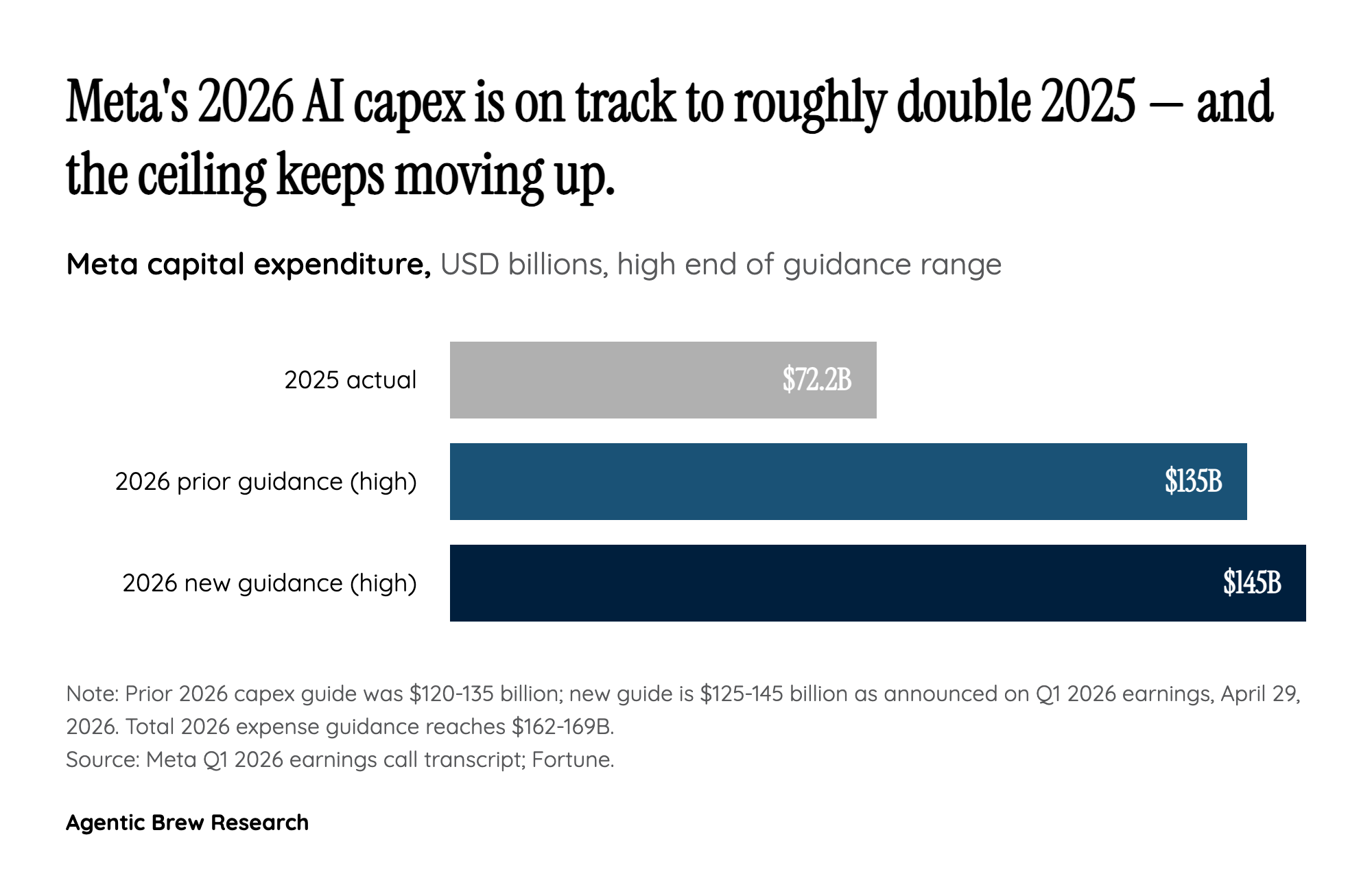
The Capex Cliff: Why $145 Billion Still Wasn't Enough
Meta 2026 AI capex is on track to roughly double 2025 spending, with each guidance revision climbing higher.

The most revealing line of Meta's Q1 2026 earnings call wasn't the raised guidance itself but CFO Susan Li's confession behind it: 'We have continued to underestimate our compute needs even as we have been ramping capacity significantly.' That admission reframes the new $125-145 billion 2026 capex range as a moving target rather than a ceiling. Meta is not simply spending more because it wants to; it is spending more because every previous internal model of how much compute frontier AI requires has come in low. Total 2026 expenses now reach $162-169 billion, a budget larger than the GDP of most countries and roughly double Meta's 2025 capex of $72.2 billion in a single year-over-year leap.

The market read this as a cliff, not a ramp. Revenue grew 33% to $56.31 billion and net income grew 61%, both numbers that in any other earnings cycle would have triggered a celebratory rally. Instead the stock fell more than 6% in after-hours trading, with shares already roughly 28% below late-2025 highs near $780 and down about 14% year-to-date. The implication is that investors are no longer modeling Meta's AI buildout as a discrete project with a defined budget; they are modeling it as an open-ended commitment whose annual line item could keep climbing every quarter Susan Li discovers another underestimate.


From Llama to Lockdown: The Open-Source Funeral

Muse Spark's technical resume is genuinely strong. The model scores 52 on the Artificial Analysis Intelligence Index, fourth globally behind Gemini 3.1 Pro and GPT-5.4 at 57 and Claude Opus 4.6 at 53, with 42.8 on HealthBench Hard and 58% on Humanity's Last Exam. Compared to Llama 4 Maverick's score of 18 just a year ago, this is a near-tripling of measured frontier capability and a vindication of the Superintelligence Labs reorganization that followed the roughly $14B Scale AI deal and Alexandr Wang's arrival as Chief AI Officer. The natively multimodal architecture and parallel-agent 'Contemplating' mode are real engineering progress, not marketing.

What changes with Muse Spark is the distribution model, and that change is structural. There are no downloadable weights, only a private API preview, and the editorial team at DeepLearning.AI's The Batch called Meta's pivot away from being 'the leading U.S. champion of open weights' a 'significant loss for the developer community.' On Reddit's r/LocalLLaMA the framing was blunter: developers mocked Meta's hedged 'we hope to open-source future versions' line and read the launch as a funeral for Llama. The strategic logic is straightforward — a closed API is a revenue line and a moat where open weights were a marketing expense — but the second-order effect is a developer ecosystem now scrambling for a new open-weights anchor that is not Meta.

8,000 Out, GPUs In: The Human Math of an AI Pivot

Meta's labor-for-compute swap is no longer a metaphor. HR head Janelle Gale's communication that the company is 'doing this as part of our continued effort to run the company more efficiently and to allow us to offset the other investments we're making' makes the trade explicit: roughly 8,000 employees leaving on May 20, 2026, plus 6,000 cancelled open roles, equal to roughly 10% of a workforce that ended 2025 around 78,865 people. Those salaries do not actually fund the data centers — capex and headcount sit on different lines — but the political economy of the cut is the point. Meta is signaling to Wall Street that humans are the variable cost being squeezed so AI infrastructure can be the fixed cost being expanded.

Internally, the cultural pressure is more uncomfortable. Reddit threads describe an internal 'Claudeonomics' leaderboard tracking AI token usage at 60.2 trillion tokens per month, with engineers reportedly running agents for no specific outcome simply to avoid being flagged as 'not AI-native.' Whether or not that practice is widespread, the fact that it is plausible enough to circulate among Meta employees tells you how the layoff round is being read inside the building: not as a routine efficiency exercise but as a loyalty test in which AI usage metrics are a survival signal. That is a difficult environment in which to run the careful product and safety work that turning Muse Spark into actual revenue will require.

Wall Street's Patience Window Is Closing

The most concrete near-term monetization story Meta can tell is Advantage+, the AI-powered campaign tool that small advertisers are adopting and that drove incremental ad revenue in the quarter. That is a real business, and Reddit defenders have argued the recent stock weakness is a 'valuation reset, not AI thesis challenge,' since ad targeting improvements feed directly into Meta's existing revenue engine. S&P Global's Melissa Otto captured the opposite view in two sentences that will define the next several quarters: 'I think the investment community is getting a little frustrated at the amount of cash they're burning,' and 'It raises this question about what is the real ROI on all this capex.' Sell-side firm MoffettNathanson went further, calling Meta's broader AI ambitions 'uncertain, and largely fantastical.'

The shadow over all of this is the Metaverse. Reddit shareholders openly compared the current AI buildout to Reality Labs' roughly $80 billion in cumulative losses, and the comparison is unkind precisely because it is structurally fair: another open-ended Zuckerberg conviction bet, another year of escalating spend, another set of promises about a long arc that ends well. The difference this time is that Muse Spark is a working frontier model with a credible API revenue path, not a headset nobody wanted. The similarity is that the patience window for Wall Street is finite, and with the stock down roughly 28% from its highs and capex still being revised upward each quarter, that window is visibly narrowing. The next two earnings calls — not the next two years — will likely decide whether 'personal superintelligence' is treated as a thesis or a punchline.

Historical Context

April 2025
Llama 4 Maverick launched scoring just 18 on the Artificial Analysis Intelligence Index, an outcome widely seen as botched and triggering Meta's strategic reset.
Mid-2025
Meta formed Superintelligence Labs after Alexandr Wang joined as Chief AI Officer following a roughly $14B Scale AI deal, signaling a reset of the company's AI strategy after the underwhelming Llama 4 debut.
December 31, 2025
Meta closed 2025 with $72.2 billion in capex and roughly 78,865 employees globally before the 2026 layoff round.
April 8, 2026
Meta unveiled Muse Spark, its first proprietary multimodal reasoning model since the Superintelligence Labs reorganization, currently powering the Meta AI app and rolling out to WhatsApp, Instagram, Facebook, Messenger, and AI glasses.
April 23, 2026
Meta announced approximately 8,000 layoffs (10% of workforce) effective May 20, plus 6,000 cancelled open roles, citing the need to fund AI investments.
April 29, 2026
Q1 2026 earnings showed revenue up 33% to $56.31B and net income up 61%, but a raised 2026 capex outlook to $125-145B sent shares down more than 6% after-hours.

Power Map

Key Players
Subject

Meta's AI Spending and Muse Spark Strategy Under Investor Scrutiny

MA

Mark Zuckerberg

Meta CEO defending aggressive AI spend and the Muse Spark roadmap as a step toward 'personal superintelligence,' absorbing investor pressure on ROI timing.

SU

Susan Li

Meta CFO who delivered the raised 2026 capex guidance to $125-145B and acknowledged the company has been underestimating its compute needs even while ramping capacity.

AL

Alexandr Wang

Chief AI Officer leading Meta Superintelligence Labs, which was formed mid-2025 after a roughly $14B Scale AI deal; rebuilt Meta's AI stack and oversees the Muse series and reorganized AI 'pods.'

JA

Janelle Gale

Meta HR head who communicated the layoff rationale, tying the May 20 cuts directly to offsetting AI investment costs.

OP

Open-source developer community

Builders who lost Meta's flagship open-weights releases as Llama gives way to closed-source Muse Spark, leaving downstream projects with uncertain upgrade paths.

ME

Meta investors and Wall Street analysts

Punishing the stock on capex hikes despite revenue beats and demanding a clearer AI monetization timeline.

Source Articles

Top 5

THE SIGNAL.

Analysts

"Otto says the investment community is getting frustrated with the cash burn and that the latest capex hike has reignited scrutiny over whether Meta can convert AI investment into measurable returns: 'I think the investment community is getting a little frustrated at the amount of cash they're burning,' and 'It raises this question about what is the real ROI on all this capex.'"

Melissa Otto
Head of Research, S&P Global Visible Alpha

"Zuckerberg defends the pace of model development and downplays specific 12-24 month ROI signposts as overly technical, saying 'I'm quite comfortable that the lab we're building is on track to be a leading lab.'"

Mark Zuckerberg
CEO, Meta

"Li justifies the upward capex revision by noting that compute demand keeps outpacing internal plans: 'We have continued to underestimate our compute needs even as we have been ramping capacity significantly.'"

Susan Li
CFO, Meta

"The editorial argues that even if Muse Spark is technically strong, Meta abandoning open-weights leadership is a major loss: its 'pivot away from being the leading U.S. champion of open weights is a significant loss for the developer community.'"

The Batch (DeepLearning.AI editorial)
AI industry newsletter from Andrew Ng's team

"MoffettNathanson is skeptical that Meta's enterprise and AI push will pay off near-term, calling current ambitions 'uncertain, and largely fantastical.'"

MoffettNathanson analysts
Sell-side research firm
The Crowd

"BIG TECH TO POUR $650B INTO AI IN 2026 $GOOGL, $AMZN, $META, and $MSFT plan to spend about $650 billion next year on data centers, chips, and infrastructure as the AI race intensifies — a level of investment unmatched this century. Spending is up roughly 60% year over year"

@@DeItaone0

"BIG TECH DOUBLES DOWN ON AI Meta and Microsoft continue ramping up AI spending. Meta guides $115B to $135B in 2026 capex, well above forecasts. That surge in data center demand could be a tailwind for Bitcoin miners."

@@coinbureau0

"UPDATE: $META Meta to Cut 10% Workforce Amid Heavy AI Spending Push. Key Highlights: Meta plans to lay off ~8,000 employees, about 10% of staff. Cuts scheduled for May 20, per internal memo. Company will not fill 6,000 open positions"

@@AIStockSavvy0

"What is meta trying to become with all this AI spending"

@u/AloneStaff5051179
Broadcast
Why Meta's New AI Model Is Such A Big Deal

Why Meta's New AI Model Is Such A Big Deal

AI Spending Worry: Meta, Microsoft Shares Fall on Data Center Investment Plans

AI Spending Worry: Meta, Microsoft Shares Fall on Data Center Investment Plans

Meta AI Muse Spark Is HERE – Testing Meta's New Frontier Model!

Meta AI Muse Spark Is HERE – Testing Meta's New Frontier Model!