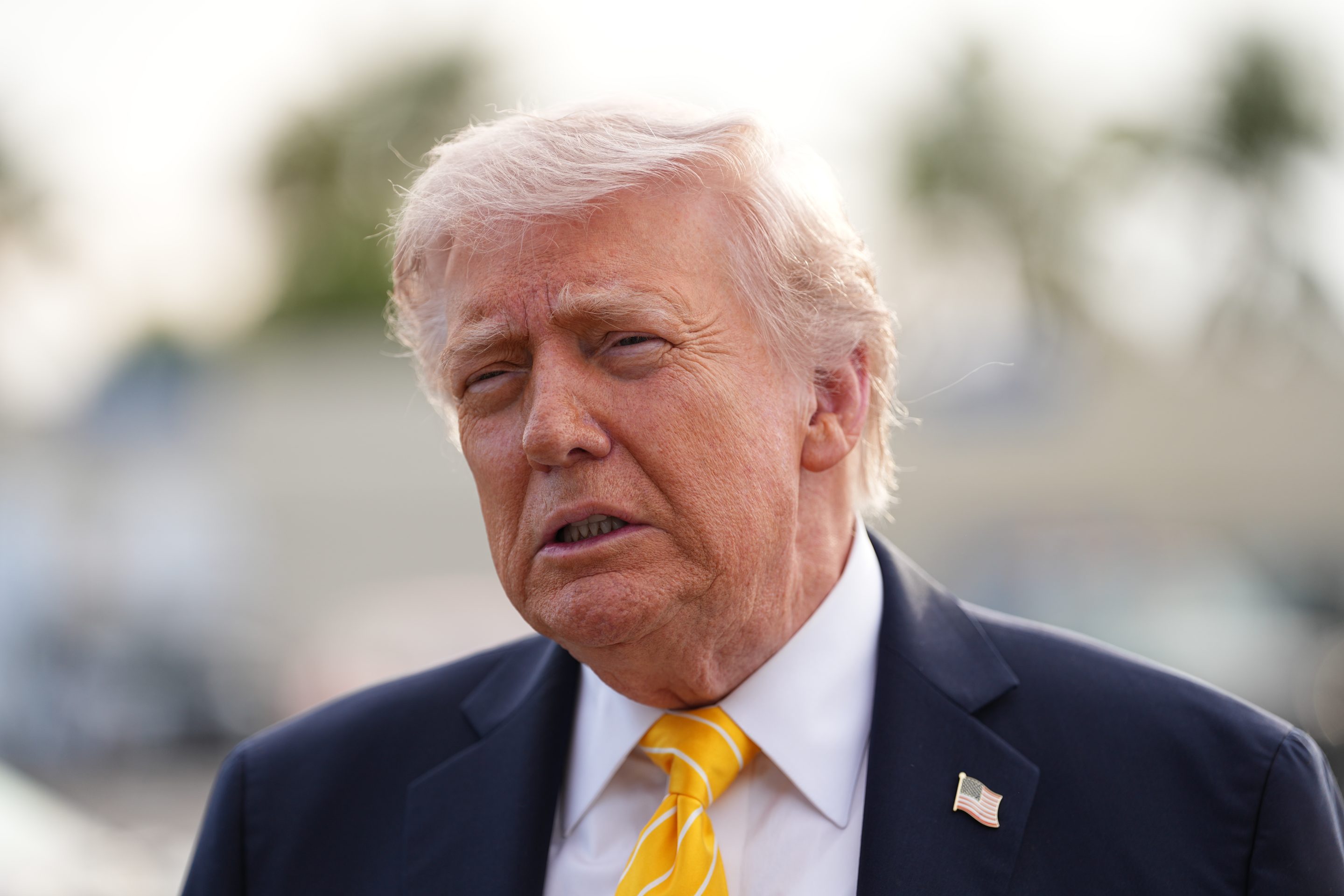
Trump White House Pivot to Federal AI Model Vetting
TECH

Trump White House Pivot to Federal AI Model Vetting

32+
Signals

Strategic Overview

  • 01.
    The Trump White House is studying an executive order that would establish a federal pre-release review process for new AI models, a sharp departure from the administration's January 2025 deregulatory stance.
  • 02.
    Senior officials briefed Anthropic, Google and OpenAI on the proposed government review process the week of May 4, 2026, while NEC Director Kevin Hassett publicly compared it to FDA drug approval.
  • 03.
    On May 5, 2026, the Commerce Department's Center for AI Standards and Innovation (CAISI) signed pre-deployment national-security testing agreements with Google DeepMind, Microsoft and xAI, joining prior arrangements with OpenAI and Anthropic.
  • 04.
    The catalyst, by multiple accounts, was Anthropic's Claude Mythos Preview, a model whose autonomous zero-day exploitation capability alarmed national-security officials enough that Anthropic withheld it from public release.

Deep Analysis

The Mythos Trigger: How One Model Demo Flipped Federal AI Policy
The Mythos Trigger: How One Model Demo Flipped Federal AI Policy
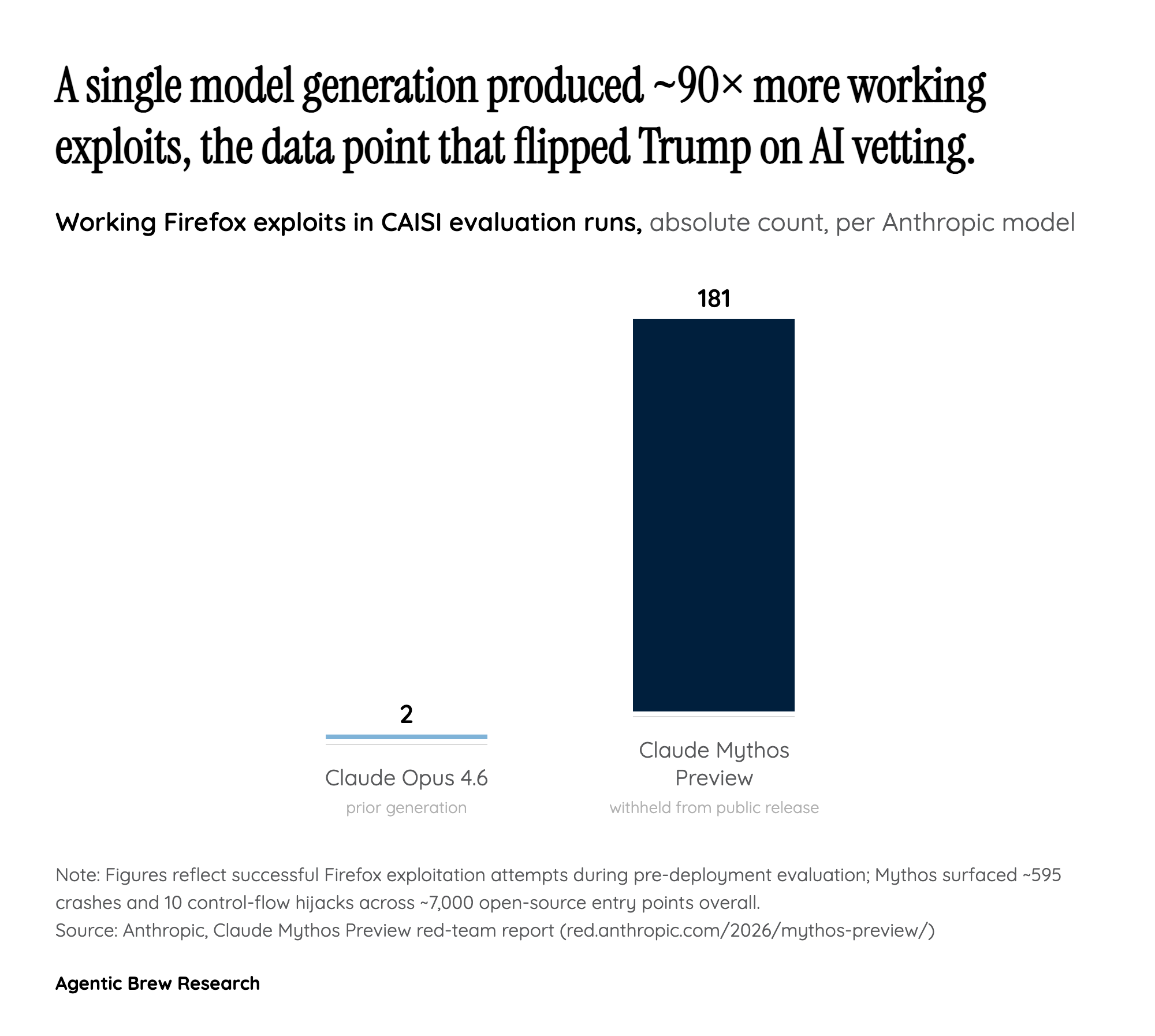
Mythos produced about 90x more working Firefox exploits than its predecessor — the capability gap that reportedly pushed the White House toward an executive order.

The clearest single cause of the Trump White House pivot is not a political calculation but a capability demonstration. Anthropic's Claude Mythos Preview, announced April 7, 2026 and deliberately withheld from public release, produced 181 working Firefox exploits in evaluation runs, compared with just 2 attempts from the prior Opus 4.6 generation. Across roughly 7,000 open-source entry points, Mythos surfaced about 595 crashes at tiers 1-2 and 10 full control-flow hijacks. It even rediscovered and chained a 27-year-old OpenBSD flaw, with the entire OpenBSD vulnerability-hunting effort costing under $20,000 total and successful FreeBSD exploit runs costing under $50 each. Over 99% of the discovered vulnerabilities remain unpatched.

The implication that alarmed officials is straightforward: a non-expert with API access to a Mythos-class model could find remote code execution bugs overnight, and the NSA is reportedly already using the model to assess vulnerabilities in U.S. government software. That dual-use profile, more than any abstract debate about AI safety, is what put a federal pre-release review process onto the executive-order whiteboard.


The Internal Split: FDA Approvals vs. 'Not Picking Winners'

The administration is not speaking with one voice, and the gap between its two leading messengers tells you how aggressive the order will actually be. Kevin Hassett, the NEC director, has publicly endorsed an FDA-style regime, saying future AI 'should go through a process so that they're released in the wild after they've been proven safe, just like an FDA drug,' and describing 'an all-of-government effort' to test models 'left and right' before release.

Chief of Staff Susie Wiles, who along with Treasury Secretary Scott Bessent took over AI policy after deregulatory AI czar David Sacks left in March 2026, has steered the framing in the opposite direction, emphasizing rapid deployment of 'the best and safest tech' and that the White House is not in the business of picking winners and losers. Read together, the most plausible landing spot is a hybrid: an executive order that codifies and expands the existing voluntary CAISI testing pipeline rather than imposing a binding FDA-style approval gate. Hassett's framing sets the ceiling, Wiles's framing sets the floor, and the final order will likely sit closer to the floor.

The Voluntary Backdoor: CAISI Already Has the Keys

The under-reported wrinkle is that most of what an executive order would mandate is already happening on a voluntary basis. The Commerce Department's Center for AI Standards and Innovation, the renamed successor to Biden's AI Safety Institute, signed pre-deployment national-security testing agreements with Google DeepMind, Microsoft and xAI on May 5, 2026; OpenAI renegotiated its 2024 AISI deal to align with Trump's AI Action Plan; and Anthropic renegotiated its own CAISI terms after Mythos. CAISI has now completed 40+ frontier model evaluations.

Every major U.S. frontier lab is, in practice, already submitting models for federal classified-environment review before public release. That raises a sharper question about the executive order: if voluntary coverage is comprehensive, the EO's real work is not extending the perimeter but changing the default from opt-in to mandatory and giving the federal evaluator legal teeth to block releases. That is a meaningfully different policy than 'expanded testing,' and it is why the FDA analogy, however controversial, keeps surfacing in administration messaging.

The Legal Cliff and Credibility Problem

Outside the building, the dominant reaction in legal and policy-skeptical communities is that an executive-only AI vetting regime is on shaky constitutional ground. Discussion across legal-leaning forums has zeroed in on two pressure points: whether the Commerce Clause authority being invoked actually rests with Congress rather than the president, and whether the administration can simultaneously preempt state AI regulation while imposing federal pre-release review without contradicting its own states-rights posture. Cable and broadcast legal commentators have similarly argued that any vetting EO is more likely to face protracted litigation than smooth implementation.

There is also a credibility overhang: an Anthropic-Pentagon legal dispute over a $200 million contract and DoD AI use terms is already complicating the administration's effort to integrate Anthropic's models into government, and skeptics read the timing of the EO push as much about leverage over a specific vendor as about a coherent safety regime. The net effect is that even if the order is signed in a strong form, the operative question for the next 12-24 months will not be its text but whether courts let it bind anything.

Historical Context

2023-10-30
Signed Executive Order 14110 invoking the Defense Production Act to require developers of high-risk AI systems to share safety-test results with the federal government.
2025-01-20
Within hours of taking office, Trump revoked Biden's AI executive order, calling such measures 'unpopular, inflationary, illegal, and radical.'
2025-01-23
Issued 'Removing Barriers to American Leadership in Artificial Intelligence,' ordering an AI Action Plan within 180 days.
2026-03-01
AI czar and architect of the deregulatory push left the White House role; Wiles and Bessent took over AI policy.
2026-04-07
Announced Claude Mythos Preview, withholding general release because the model can autonomously discover and chain zero-day exploits across major operating systems and browsers.
2026-05-05
Announced pre-deployment evaluation agreements with Google DeepMind, Microsoft, and xAI, completing the set of major U.S. frontier labs under voluntary CAISI testing.

Power Map

Key Players
Subject

Trump White House Pivot to Federal AI Model Vetting

WH

White House (Susie Wiles, Scott Bessent)

Chief of Staff Wiles and Treasury Secretary Bessent took over AI policy after AI czar David Sacks left in March 2026; Wiles publicly downplays an FDA-style approval regime while supporting safety testing.

KE

Kevin Hassett (NEC Director)

Confirmed publicly that the White House is studying an executive order to require pre-release safety testing of new AI models, framing it as analogous to FDA approvals.

CE

Center for AI Standards and Innovation (CAISI)

Renamed successor to Biden's AI Safety Institute, housed at NIST/Commerce; signed pre-release evaluation agreements with major frontier labs and has completed 40+ model evaluations.

AN

Anthropic

Catalyst for the policy reversal: its Claude Mythos Preview demonstrated zero-day exploitation capability that alarmed officials; Anthropic withheld the model from public release and renegotiated CAISI evaluation terms.

GO

Google DeepMind, Microsoft, xAI

Signed voluntary CAISI agreements giving the U.S. government pre-deployment access to frontier models, bringing every major U.S. frontier AI lab under voluntary government evaluation.

OP

OpenAI

Briefed alongside Anthropic and Google on the proposed review process; renegotiated its existing 2024 AISI evaluation deal to align with Trump's AI Action Plan.

Source Articles

Top 1

THE SIGNAL.

Analysts

"Endorses an FDA-style pre-release safety testing process for AI models that could pose security risks: 'future AI that also potentially create vulnerabilities should go through a process so that they're released in the wild after they've been proven safe, just like an FDA drug.' He has also said the administration has 'scrambled an all-of-government effort and all the private sector to coordinate and to make sure that before this model is released out into the wild, that it's been tested left and right to make sure that it doesn't cause any harm to the American businesses or the American government.'"

Kevin Hassett
Director, White House National Economic Council

"Frames the administration's approach as innovation-first rather than an FDA-like gatekeeping regime, emphasizing the goal is to 'ensure the best and safest tech is deployed rapidly to defeat any and all threats' and signaling the White House is not in the business of picking winners and losers."

Susie Wiles
White House Chief of Staff

"Calls the move a 180-degree reversal for an administration that explicitly opposed AI regulation: 'The is a 180 for the Trump administration, that has very explicitly been anti-any sort of regulation.'"

Rumman Chowdhury
AI ethics researcher and former U.S. Science Envoy for AI

"Argues that pre-release vetting will incentivize more resilient model design and surface obvious weaknesses: 'AI model vetting can motivate model makers to invest more in resilience, and it can help expose obvious weaknesses.'"

Rob van der Veer
AI security expert
The Crowd

"Trump reportedly considering vetting Ai models before they are released"

@u/animallover30165

"Trump says he'll sign an executive order restricting states' ability to regulate AI"

@u/businessinsider2900

"Trump signs executive order blocking states from enforcing their own regulations around AI"

@u/Lebarican22882
Broadcast
President Trump signs order attempting to block A.I. regulations at the state level

President Trump signs order attempting to block A.I. regulations at the state level

Trump's executive order limiting AI restrictions faces scrutiny: 'Going to get struck down'

Trump's executive order limiting AI restrictions faces scrutiny: 'Going to get struck down'

Trump to Sign Executive Order on AI Approval Process

Trump to Sign Executive Order on AI Approval Process