OpenAI launches GPT-Rosalind for life sciences
TECH

OpenAI launches GPT-Rosalind for life sciences

39+
Signals

Strategic Overview

  • 01.
    OpenAI launched GPT-Rosalind, its first domain-specific Life Sciences model, as a frontier reasoning system purpose-built for biology, drug discovery, and translational medicine.
  • 02.
    Access is limited to a research preview via ChatGPT, Codex, and API for qualified U.S. Enterprise customers under a trusted-access program, paired with high-precision bioweapon-risk flags.
  • 03.
    In an independent Dyno Therapeutics evaluation on unpublished RNA sequences, best-of-ten submissions scored above the 95th percentile of human experts on prediction and around the 84th percentile on sequence generation.
  • 04.
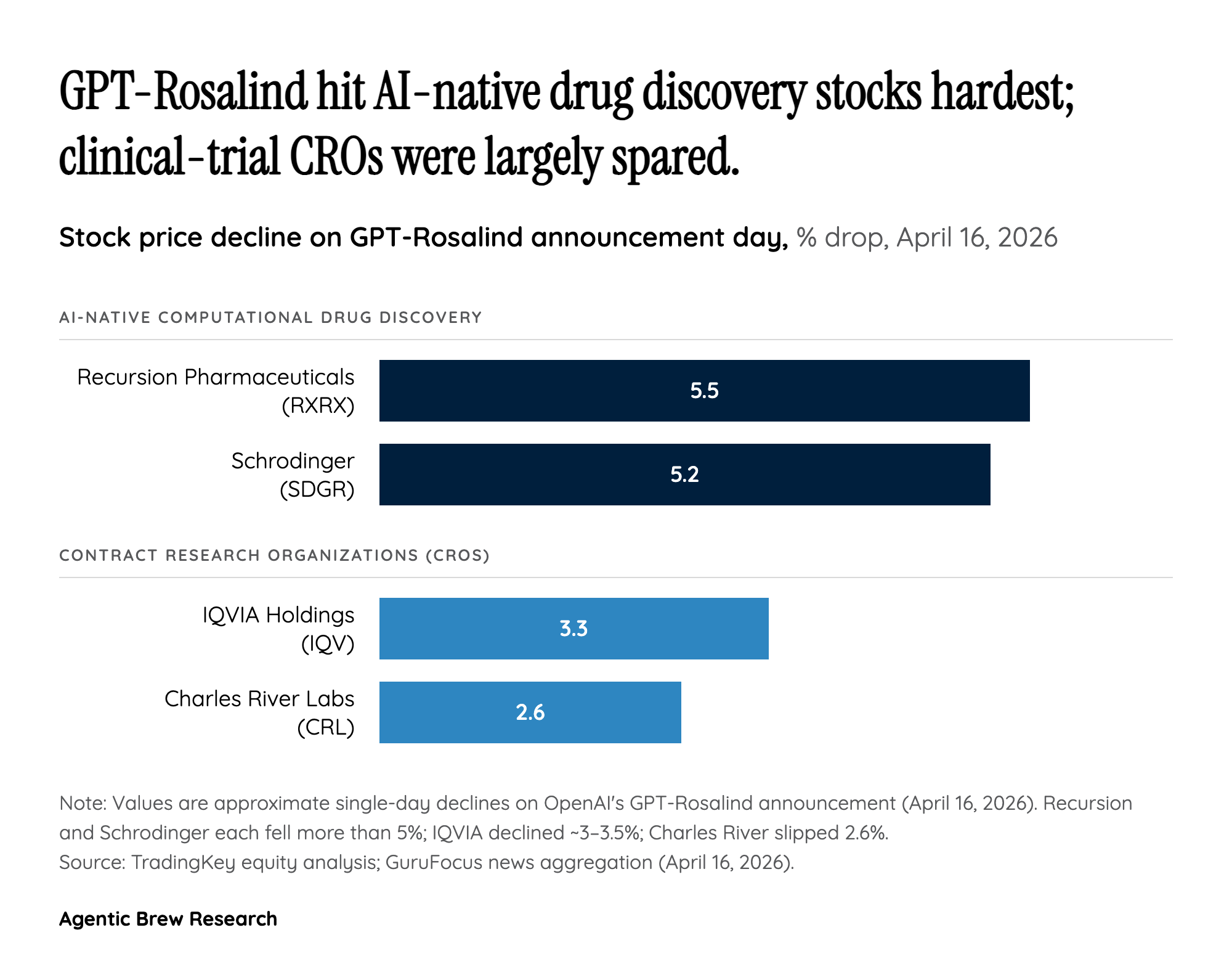
    Markets reacted immediately: Recursion Pharmaceuticals and Schrodinger each fell more than 5%, IQVIA dropped roughly 3-3.5%, and Charles River Laboratories slipped 2.6% on announcement day.

Deep Analysis

The naming paradox: a closed model wrapped in open-science iconography

OpenAI chose to name its most tightly gated model after Rosalind Franklin, the X-ray crystallographer whose diffraction images were used without her consent to crack DNA's structure. The symbolism is double-edged. Franklin is an icon of scientific openness precisely because her work was appropriated behind closed doors; invoking her name for a system restricted to vetted U.S. Enterprise customers, with a trusted-access program and bioweapon-risk flags gating every query, reads to many observers as a marketing choice at odds with its namesake.

The community response captured this tension quickly. The dominant critical read on Reddit debated whether naming a gatekept model after a figure synonymous with open access was appropriate, with the sharpest critiques arguing the branding launders restrictive commercial access as scientific homage. OpenAI's own framing leans on Franklin's foundational role in molecular biology, but the deeper signal is strategic: by tying the Life Sciences series to a Nobel-adjacent scientific identity while controlling who can use it, OpenAI is staking a claim to being the steward of scientific AI, not merely a vendor of it. That is a durable branding moat if regulators and enterprise buyers accept the premise; it is a reputational liability if they do not.

Why the Dyno RNA benchmark matters more than the headline LABBench2 score

GPT-Rosalind's public benchmarks span BixBench (0.751 pass rate, leading among published scores) and LABBench2, where it beat GPT-5.4 on 6 of 11 tasks. But the load-bearing number is buried in the Dyno Therapeutics evaluation: best-of-ten submissions scored above the 95th percentile of human experts on RNA prediction on unpublished sequences, and around the 84th percentile on sequence generation. The word that matters is 'unpublished.' Standard benchmarks are vulnerable to memorization; Dyno's held-out sequences were designed to rule that out.

That distinction reframes the competitive picture. Incremental gains over GPT-5.4 on LABBench2 are what practitioner forums have called underwhelming, and they are easy to wave away as iteration. But an unpublished, partner-validated test where the model beats 95% of human experts on RNA function prediction is a genuinely different claim — one that maps directly onto the most commercially valuable part of the pharma R&D stack: sequence-to-function inference for therapeutics like mRNA and AAV vectors. The benchmark disclosure pattern — general-purpose scores first, partner-specific capability scores second — looks deliberate: the first reassures enterprise buyers the model is frontier-grade, the second tells pharma exactly where it displaces existing work.

The CRO sell-off tells a sharper story than the headline drops

The CRO sell-off tells a sharper story than the headline drops
Announcement-day stock moves: AI-native drug discovery firms (Recursion, Schrodinger) fell 5%+, while CROs (IQVIA, Charles River) declined less than half as much.

The announcement-day moves were not uniform panic. Recursion Pharmaceuticals and Schrodinger, both AI-native computational drug discovery firms whose core product is exactly what GPT-Rosalind now offers as an API, fell more than 5%. IQVIA dropped roughly 3-3.5% and Charles River Laboratories slipped 2.6% — smaller declines that TradingKey analysts framed as sentiment contagion rather than mechanical disruption. That spread reveals how the market is pricing the threat model.

The sell-side read is that early-stage R&D outsourcing (literature synthesis, hypothesis generation, sequence design) is directly substitutable by a reasoning model with the right tools, while clinical-trial CROs and CDMOs are insulated because running human trials and manufacturing biologics requires physical infrastructure, regulatory relationships, and wet-lab throughput a language model cannot replicate. In their words, 'the moat for clinical CROs has actually widened.' That framing is the cleanest investor takeaway from the launch: GPT-Rosalind compresses the information-processing layer of pharma but leaves the physical and regulatory layers intact, which means the disruption wave is narrow and deep rather than wide and shallow. Expect multi-quarter multiple compression for preclinical computational pure-plays and a flight-to-quality into clinical-stage CRO names.

The bottleneck debate: is the rate-limiter intelligence, or wet-lab throughput?

The sharpest counter-narrative to OpenAI's launch came not from competitors but from practitioners. Across developer and research forums, the dominant skeptical thread argued that the real bottleneck in drug discovery is not model IQ — it is experimental time, robotics, cell-biology tooling, and the wall-clock cost of running assays. In this view, a model that can reason at the 95th percentile on RNA prediction still cannot compress the months it takes to validate a hit in living cells, run tox studies, or scale a manufacturing process. Smarter hypotheses arriving faster may simply lengthen the queue at the bench.

OpenAI has clearly anticipated this critique. The company's stated positioning — helping scientists explore more possibilities and surface connections that might otherwise be missed — is explicitly about expanding the hypothesis space rather than just speeding existing steps. The Codex Life Sciences plugin connecting to 50+ scientific tools and data sources extends the model from pure reasoning into orchestration: querying databases, parsing literature, and interacting with computational tools in a single interface. The open question is whether that orchestration layer is enough to move the bottleneck, or whether, as the contrarian read argues, the real unlock is still robotic wet labs and higher-throughput assays. This is the single most important empirical question about GPT-Rosalind's commercial trajectory, and one that partner deployments at Amgen, Moderna, and Thermo Fisher will answer within a year.

Why now: the competitive clock behind the launch

The timing is not incidental. DeepMind's AlphaFold team shared the 2024 Nobel Prize in Chemistry, converting scientific AI from a research curiosity into prestige infrastructure and handing Google a durable narrative advantage in biology. In March 2026, Eli Lilly committed $2.75 billion to Insilico Medicine, signaling that the largest pharma companies will pay nine-figure sums for proprietary AI-driven discovery pipelines — and that those budgets are being spent with specialized biotech-AI vendors, not with general-purpose chat providers. OpenAI launching GPT-Rosalind in April 2026 is a response to both pressures simultaneously: Google has the scientific prestige, specialized biotech-AI firms have the pharma contracts, and OpenAI risked being locked out of the most lucrative enterprise vertical in scientific AI.

The launch strategy reflects that urgency. Rather than a consumer-facing model, OpenAI released a restricted research preview tied to marquee partners — Amgen, Moderna, Thermo Fisher, Allen Institute, Los Alamos, and Novo Nordisk — designed to create immediate validation signal and case-study flow. The free Codex Life Sciences plugin is the distribution wedge: by seeding 50+ scientific tool integrations into Codex at no cost, OpenAI builds developer mindshare among computational biologists even at accounts that do not yet qualify for GPT-Rosalind access. This is a textbook enterprise land-and-expand play applied to a regulated scientific market, executed on a compressed timeline because the competitive window was closing.

Historical Context

2020
AlphaFold 2 solves the decades-old protein folding problem, establishing the template for domain-specific AI in biology and the scientific backdrop against which OpenAI now positions GPT-Rosalind.
2024-10
Google DeepMind's AlphaFold team shares the 2024 Nobel Prize in Chemistry, cementing AI's scientific legitimacy in life sciences and raising competitive pressure on OpenAI to field its own purpose-built scientific model.
2026-03
Eli Lilly commits $2.75 billion to Insilico Medicine for AI-driven therapeutic discovery, signaling that big pharma will pay nine-figure sums for specialized biotech-AI partnerships weeks before OpenAI's launch.
2026-04-16
OpenAI publicly launches GPT-Rosalind and a free Codex Life Sciences plugin connecting to 50+ scientific tools, opening a research preview to qualified U.S. Enterprise customers.

Power Map

Key Players
Subject

OpenAI launches GPT-Rosalind for life sciences

OP

OpenAI

Developer of GPT-Rosalind; operator of the trusted-access program and author of the bioweapon-risk safeguards that gate enterprise use.

DY

Dyno Therapeutics

Independent evaluator that tested GPT-Rosalind on unpublished RNA sequence-to-function tasks, producing the headline 95th-percentile RNA prediction benchmark that grounds OpenAI's scientific claims.

AM

Amgen

Flagship pharma launch partner applying GPT-Rosalind to drug development, positioned by its SVP of AI and Data as a way to accelerate medicine delivery.

MO

Moderna, Thermo Fisher Scientific, Allen Institute, Los Alamos National Laboratory

Qualified enterprise and research launch partners using the model for therapeutic research and scientific workflows under the trusted-access program.

RE

Recursion Pharmaceuticals and Schrodinger

AI-native drug discovery incumbents whose share prices each dropped more than 5% on the announcement as investors priced in direct OpenAI competition on their core computational turf.

IQ

IQVIA Holdings and Charles River Laboratories

Contract research organizations that sold off 2.6-3.5% on sentiment contagion, despite most of their revenue coming from clinical-trial and preclinical services less exposed to pure reasoning AI.

THE SIGNAL.

Analysts

"Frames the OpenAI collaboration as a way to apply advanced AI to accelerate drug delivery, while emphasizing that 'the life sciences field demands precision at every step' because 'the questions are highly complex, the data is highly unique, and the stakes are incredibly high.'"

Sean Bruich
Senior VP of AI and Data, Amgen

"Positions GPT-Rosalind as expanding researchers' hypothesis space rather than merely automating existing steps, describing the goal as helping scientists 'explore more possibilities, surface connections that might otherwise be missed, and arrive at better hypotheses sooner.'"

OpenAI (official statement)
Model developer

"Argue the disruption is sharply uneven: 'early-stage R&D outsourcing is under greater pressure, while the moat for clinical CROs has actually widened' because physical trial operations and manufacturing are not automatable by a reasoning model."

TradingKey equity analysts
Sell-side research
The Crowd

"Introducing GPT-Rosalind, our frontier reasoning model built to support research across biology, drug discovery, and translational medicine."

@@OpenAI11689

"Here's your news brief for today, 17th April 2026: Trump says deal with Iran 'looking very good' amid ceasefire; OpenAI to spend more than $20 billion on Cerebras chips; OpenAI launches AI model GPT-Rosalind for life sciences research"

@@MoniifyBusiness6

"Introducing GPT-Rosalind for life sciences research"

@u/GusBus135191

"OpenAI Introduces GPT-Rosalind: A Frontier Reasoning Model Built To Support Research Across Biology, Drug Discovery, And Translational Medicine."

@u/44th--Hokage102
Broadcast
AI News: Huge Updates From Anthropic, OpenAI and Google

AI News: Huge Updates From Anthropic, OpenAI and Google

OpenAI's GPT Rosalind: Specialized AI for Life Sciences - Full Demo & Analysis

OpenAI's GPT Rosalind: Specialized AI for Life Sciences - Full Demo & Analysis

Claude Opus 4.7 & GPT-Rosalind: The Next Era of AI Coding and Science

Claude Opus 4.7 & GPT-Rosalind: The Next Era of AI Coding and Science