Open-Source AI Agent Frameworks and Tools
TECH

Open-Source AI Agent Frameworks and Tools

46+
Signals

Strategic Overview

  • 01.
    The open-source AI agent ecosystem is undergoing rapid consolidation and institutionalization. The Linux Foundation launched the Agentic AI Foundation (AAIF) in December 2025, bringing together Anthropic's Model Context Protocol (MCP), Block's goose framework, and OpenAI's AGENTS.md under neutral governance with platinum members including AWS, Anthropic, Google, Microsoft, and OpenAI.
  • 02.
    Major technology companies are simultaneously open-sourcing enterprise-grade agent platforms. NVIDIA is launching NemoClaw, a hardware-agnostic agent platform, at GTC 2026. Alibaba open-sourced CoPaw, a personal agent workstation supporting local AI models. Microsoft unified AutoGen and Semantic Kernel into a single Agent Framework targeting GA by end of Q1 2026.
  • 03.
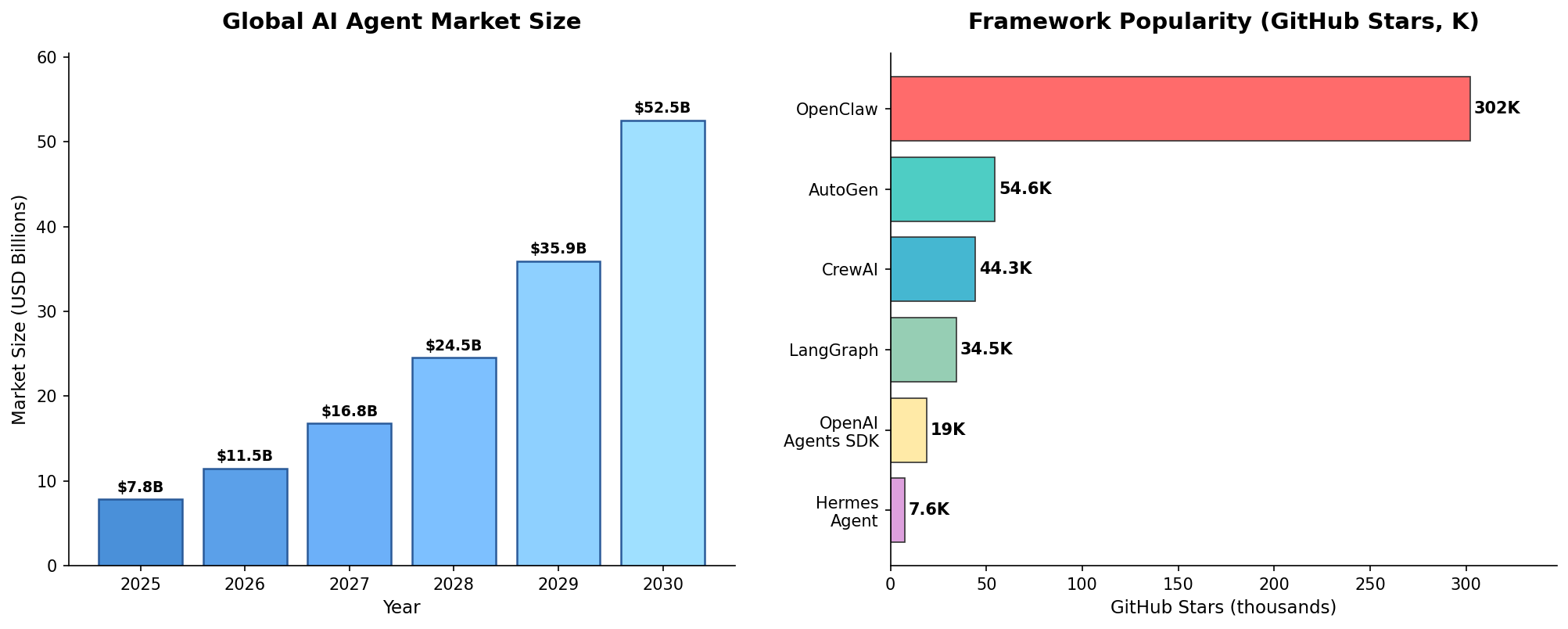
    The market is growing explosively, from .84 billion in 2025 to a projected .62 billion by 2030 (CAGR 46.3%). However, adoption is uneven: while 57.3% of organizations report having agents in production, Gartner predicts over 40% of agentic AI projects will be cancelled by 2027, and most leading models failed real-world workplace benchmarks.

Why This Matters

The open-source AI agent landscape has reached an inflection point where the competition is no longer about individual frameworks but about ecosystem control and standards governance. The formation of the Agentic AI Foundation under the Linux Foundation signals that major players -- Anthropic, OpenAI, Microsoft, Google, AWS -- have recognized that agent interoperability is a prerequisite for enterprise adoption. By contributing MCP, AGENTS.md, and goose to neutral governance, these companies are making a calculated bet that shared standards will expand the total addressable market faster than proprietary lock-in.

This matters because it fundamentally changes the developer experience. Instead of choosing between incompatible ecosystems, developers can now build agents that connect to 10,000+ MCP servers, follow AGENTS.md conventions adopted by 60,000+ projects, and deploy across multiple clouds. The network effects of open standards are creating a rising tide that lifts all agent platforms, but also threatens to commoditize the runtime layer itself.
How It Works: The Emerging Agent Stack

The modern open-source agent stack has converged on a layered architecture. At the bottom sits the model layer, increasingly dominated by smaller, domain-tunable reasoning models as IBM's Anthony Annunziata predicts. Above that, runtime frameworks like LangGraph, CrewAI, and the OpenAI Agents SDK provide orchestration, state management, and tool calling. The connection layer is anchored by MCP, which standardizes how agents discover and invoke external tools, databases, and APIs.

At the application layer, specialized agents are emerging for distinct use cases. CoPaw targets personal productivity with local-first privacy. Hermes Agent from Nous Research introduces a self-improving architecture through Skill Documents -- a memory system where the agent writes and refines its own capabilities over time. NemoClaw from NVIDIA targets enterprise deployment with built-in security and privacy guardrails. Browser automation agents like those from the Simular Agent S framework (which won Best Paper at ICLR 2025) are enabling computer-use capabilities that let agents interact with arbitrary web applications. The key architectural insight is that the stack is becoming modular: developers pick a runtime, connect tools via MCP, and deploy using standardized configuration via AGENTS.md.

By The Numbers

The statistics paint a picture of explosive growth tempered by serious growing pains. The global AI agent market stands at .84 billion in 2025 and is projected to reach .62 billion by 2030, representing a compound annual growth rate of 46.3%. Framework adoption metrics are equally striking: OpenClaw has amassed 302,000+ GitHub stars, LangGraph processes 34.5 million monthly downloads across approximately 400 production companies, and MCP has grown from zero to 10,000+ published servers in just one year.

However, the counterdata is sobering. The LangChain survey reveals that quality (32%) and latency (20%) remain the top barriers to production deployment. Gartner predicts that while 40% of enterprise apps will feature AI agents by end of 2026, more than 40% of agentic AI projects will be cancelled by 2027. A RAND study cited on Reddit suggests 80-90% of agent projects fail. And security remains a real concern: 13% of OpenClaw marketplace skills were found to have critical vulnerabilities. These numbers suggest the ecosystem is in a classic hype-cycle pattern where adoption outpaces reliability.

Impacts and What's Next

The immediate impact is a democratization of agent development. Tools like Cline CLI 2.0 now offer free model access, removing the API cost barrier entirely. CoPaw and Hermes Agent run on local models, enabling privacy-sensitive deployments. The AAIF's governance structure ensures that standards remain open and vendor-neutral, reducing the risk of platform lock-in that plagued earlier AI tooling ecosystems.

Looking ahead, several trends are converging. First, the Microsoft Agent Framework GA (expected Q1 2026) will bring enterprise-grade multi-agent orchestration to Azure's massive customer base. Second, NVIDIA's NemoClaw being hardware-agnostic is a significant strategic pivot that could accelerate agent deployment beyond CUDA-dependent infrastructure. Third, the self-improving agent paradigm (exemplified by Hermes Agent's Skill Documents) points toward agents that get better through use rather than requiring manual engineering. The biggest risk is fragmentation: despite standardization efforts, the sheer number of frameworks (the 'framework fatigue' noted on Reddit) may slow enterprise adoption as teams struggle to evaluate and commit to specific toolchains.

The Bigger Picture

Open-source AI agents represent a fundamental shift in how software is built and deployed. The move from models to agents -- as one Dev.to article titled it, 'Open-Source AI Just Pivoted from Models to Agents' -- signals that the AI industry's center of gravity is shifting from training better foundation models to building better systems around those models. This is where open source has historically excelled: Linux, Kubernetes, and React all became dominant by enabling composability and community contribution at the systems layer.

The real-world impact is already measurable. Klarna's agent replaced 853 employees and saved million, demonstrating that agents can deliver concrete business value at scale. But the cautionary voices are equally loud: TechCrunch's workplace benchmark showed most agents failing at complex professional tasks, and Reddit's practitioner community reports that direct LLM API calls often outperform elaborate agent abstractions. The truth likely lies in the middle -- agents excel at well-defined, repetitive workflows but struggle with the ambiguity and judgment that characterize knowledge work. The frameworks that win will be those that help developers find and stay within that sweet spot of reliable automation.

Historical Context

2023-09
Microsoft releases AutoGen, which grows to 54,600+ GitHub stars and becomes one of the earliest widely adopted multi-agent frameworks.
2024-01
CrewAI launches, rapidly reaching 44,300+ stars and 5.2 million monthly downloads by establishing a role-based multi-agent paradigm.
2024-11
Anthropic launches Model Context Protocol (MCP) as a universal standard for connecting AI agents to tools and data sources.
2025-03
OpenAI releases the Agents SDK, replacing the experimental Swarm framework with a production-ready agent runtime.
2025-08
OpenAI releases AGENTS.md, a standardized agent configuration format adopted by 60,000+ open-source projects within months.
2025-12
The Linux Foundation forms the Agentic AI Foundation (AAIF) with 47 member organizations, institutionalizing open-source agent standards.
2026-02
Alibaba open-sources CoPaw personal agent workstation, supporting local AI models and MCP integration.
2026-03
NVIDIA prepares to unveil NemoClaw at GTC 2026, a hardware-agnostic open-source enterprise agent platform.

Power Map

Key Players
Subject

Open-Source AI Agent Frameworks and Tools

LI

Linux Foundation / AAIF

Neutral governance body for open-source agentic AI standards with 47 member organizations, anchoring MCP, goose, and AGENTS.md under a shared foundation.

NV

NVIDIA

Launching NemoClaw, a hardware-agnostic open-source enterprise agent platform with built-in security and privacy tools, marking a strategic shift away from CUDA lock-in.

AN

Anthropic

Contributed MCP, which has reached 10,000+ published servers within one year, establishing a de facto standard for tool-agent connections.

OP

OpenAI

Contributed AGENTS.md (adopted by 60,000+ projects) and the Agents SDK (19K GitHub stars, 10.3M downloads), providing standardized agent configuration and runtime.

MI

Microsoft

Merged AutoGen (54,600+ stars) with Semantic Kernel into a unified Microsoft Agent Framework, targeting general availability by end of Q1 2026.

AL

Alibaba (Tongyi Lab)

Open-sourced CoPaw personal agent workstation in February 2026, supporting local models via Ollama/llama.cpp, MCP servers, and ClawHub skills.

LA

LangChain

LangGraph leads enterprise adoption with 34.5 million monthly downloads and approximately 400 production companies, providing the most mature stateful workflow engine.

NO

Nous Research

Developed Hermes Agent (v0.2.0), a self-improving open-source agent with 7.6K GitHub stars, 40+ tools, and a unique Skill Documents memory system.

THE SIGNAL.

Analysts
The Crowd

"BREAKING: The Qwen team just shipped their official agent framework and it has everything. No stitching together third-party libraries. No fighting abstractions. Qwen-Agent gives you: Native function calling built directly into the framework. Secure code interpreter"

@@abxxai3600

"Simular's founders left Google DeepMind to build Agent S, an open source framework for AI agents that use computers like humans. That framework won Best Paper at ICLR 2025. Their Agent S3 scored 72.6% on OSWorld."

@@aakashgupta1100

"You can now run open source AI coding agents without paying for API keys. Cline CLI 2.0 just dropped with free access to Minimax M2.5. Runs from your terminal. Parallel agents. Works with any editor. Any model you want. 100% Open Source"

@@dr_cintas1900

"Seriously, can LLM agents REALLY work in production?"

@u/unknown350
Broadcast
7 new open source AI tools you need right now

7 new open source AI tools you need right now

LangChain vs LangGraph: A Tale of Two Frameworks

LangChain vs LangGraph: A Tale of Two Frameworks

AutoGen vs CrewAI vs LangGraph - Best AI Agent Framework In 2025!

AutoGen vs CrewAI vs LangGraph - Best AI Agent Framework In 2025!