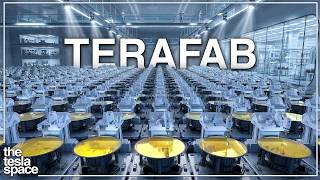
Elon Musk Announces Terafab Chip Fabrication Plant
TECH

Elon Musk Announces Terafab Chip Fabrication Plant

44+
Signals

Strategic Overview

  • 01.
    Elon Musk officially launched TERAFAB on March 21, 2026 at Austin's defunct Seaholm Power Plant, calling it 'the most epic chip-building exercise in history by far' — a joint venture between Tesla, SpaceX, and xAI estimated at $20-25 billion.
  • 02.
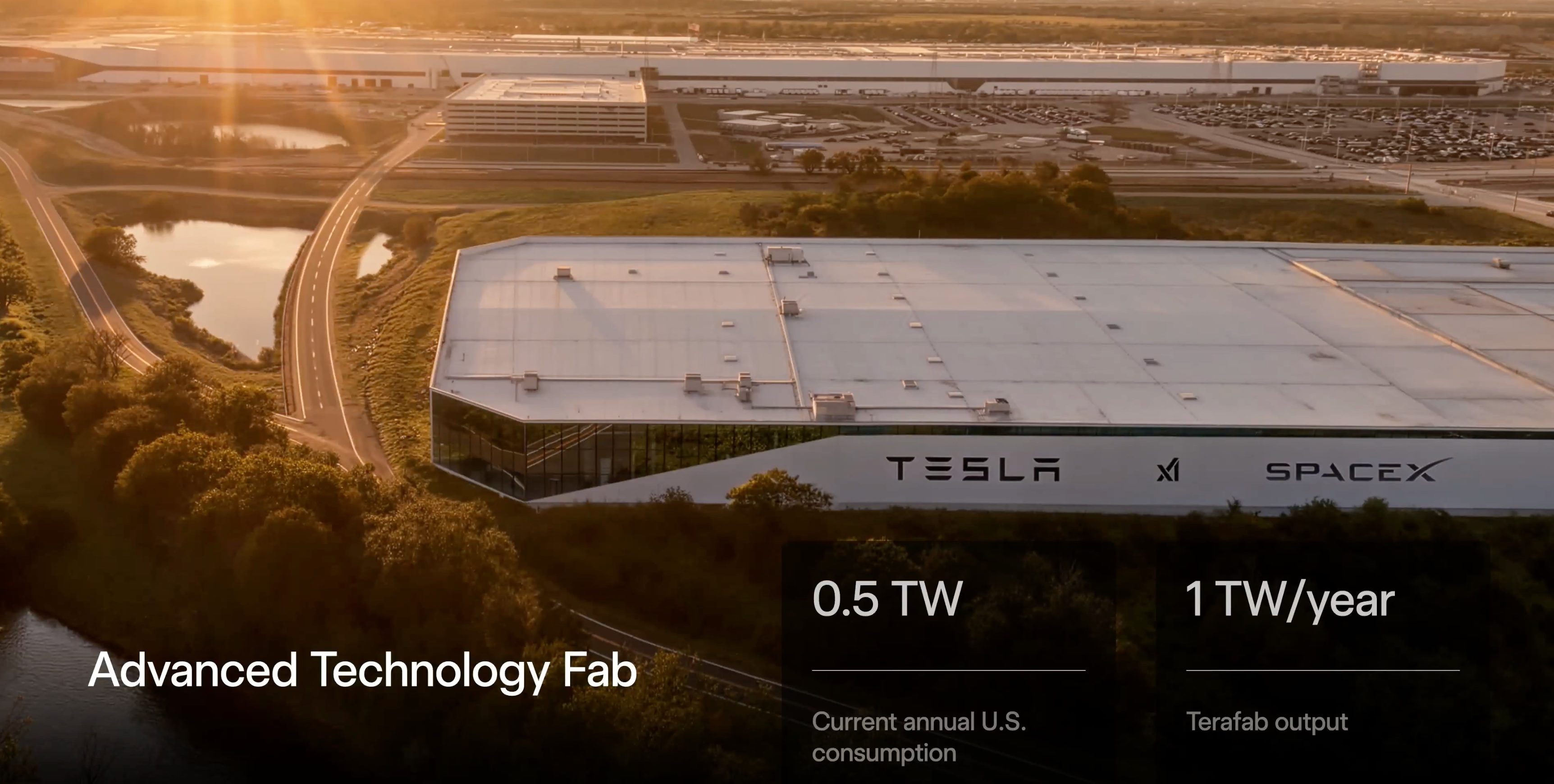
    The facility, planned for the North Campus of Giga Texas in eastern Travis County, aims to consolidate every stage of semiconductor production — from chip design and lithography to fabrication, memory production, advanced packaging, and testing — targeting 2-nanometer process technology using GAAFET architecture.
  • 03.
    Terafab will produce inference chips for Tesla vehicles, Cybertruck robotaxis, and Optimus humanoid robots, as well as radiation-hardened D3 chips custom-designed for SpaceX's planned orbital AI satellite constellation, with small-batch AI5 chip production expected in 2026 and volume production projected for 2027.
  • 04.
    Community and analyst sentiment is overwhelmingly skeptical, with experts questioning whether $20-25 billion is sufficient given that TSMC spent $165 billion on six Arizona fabs and that only three firms globally (TSMC, Samsung, Intel) currently manufacture at the targeted scale.

Deep Analysis

Why This Matters

The Terafab announcement represents the most ambitious vertical integration play in semiconductor history by a non-semiconductor company. If realized at anything close to its stated scale, it would fundamentally alter the global chip supply chain that currently depends on a handful of foundries — primarily TSMC, Samsung, and Intel — for advanced node manufacturing. Musk's stated motivation is straightforward: his companies collectively need more chips than the market can supply, particularly for autonomous driving inference, humanoid robotics, and orbital computing. With current global fab capacity at approximately 2% of what Musk claims his enterprises will need, the strategic logic for self-supply is clear even if the execution path is not.

The timing is equally significant. The announcement arrives as SpaceX prepares for a summer 2026 IPO targeting a $1.5-1.75 trillion valuation and a $50 billion raise — the largest in history. A bold manufacturing vision encompassing AI, space, and robotics serves as a narrative catalyst for that valuation. Meanwhile, Tesla faces declining vehicle sales, making the pivot toward AI infrastructure and robotics an existential strategic shift rather than an incremental expansion. The Terafab is not merely a factory announcement; it is a statement about what Musk's companies intend to become over the next decade.

How It Works

Terafab is designed as a vertically integrated semiconductor campus consolidating chip design, lithography, fabrication, memory production, advanced packaging, and testing under one roof at the North Campus of Giga Texas. The facility targets 2-nanometer process technology, requiring a generational shift from FinFET to Gate-All-Around Field-Effect Transistor (GAAFET) architecture — the same bleeding-edge transition that TSMC and Samsung are navigating with decades of accumulated expertise. Initial capacity is planned at 100,000 wafer starts per month, scaling to 1 million wafer starts per month, which would represent roughly 70% of TSMC's entire current global output.

The chip portfolio splits into two product lines. The first is inference chips (AI5 and successors) optimized for edge computing in Tesla vehicles, Cybertruck robotaxis, and Optimus humanoid robots — chips that must process neural network workloads efficiently at low power in physically constrained environments. The second is the D3 chip family, custom-designed for radiation-hardened operation aboard SpaceX's planned orbital AI satellite constellation. SpaceX has filed an FCC application to launch one million satellites for what it describes as an 'orbital data center,' with 80% of Terafab's compute output destined for space applications and 20% for ground use. The AI5 chip is expected in small-batch production in 2026, with volume manufacturing targeted for 2027.

By The Numbers

By The Numbers
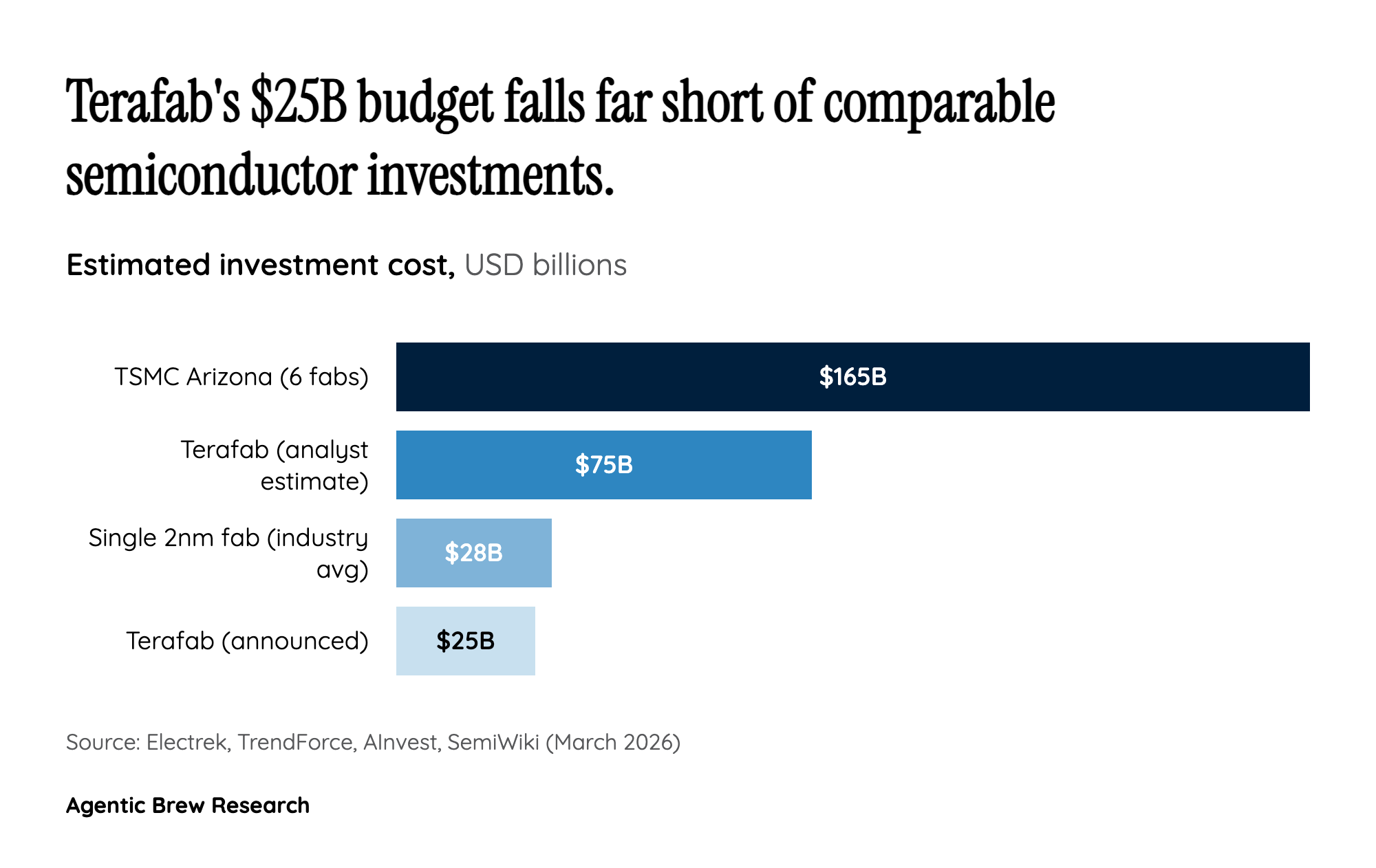
Comparison of semiconductor investment costs: Terafab announced budget vs. industry benchmarks

The financial and operational scale of Terafab invites scrutiny. The $20-25 billion estimated cost is ambitious but may be significantly understated: TSMC has committed $165 billion for six fabs in Arizona, and a single 2nm facility typically costs approximately $28 billion. Industry forums and analysts suggest the true cost could reach $50-100 billion once equipment procurement, yield ramp, workforce training, and the inevitable delays of greenfield fab construction are factored in. U.S. fab construction timelines average approximately 38 months, making the 2027 volume production target extremely aggressive.

The output targets are staggering. Terafab aims to produce 100-200 billion custom AI and memory chips annually, generating 1 terawatt of AI computing capacity — versus approximately 20 gigawatts of current global AI compute. High-bandwidth memory (HBM) demand is surging 70% year-over-year with prices spiking 80-90% and spot prices jumping approximately 700%, underscoring the supply crunch Musk cites as motivation. Tesla stock slipped overnight following the announcement, reflecting investor uncertainty about capital allocation. On social media, the announcement generated significant engagement: Tesla's official YouTube video drew 267,000 views and 14,700 likes, while Musk's own X post garnered 36,000 likes, though Reddit and forum communities expressed overwhelming skepticism about feasibility.

Impacts & What's Next

The immediate market impact centers on TSMC and the broader foundry ecosystem. TrendForce analysts assess minimal short-term threat to TSMC's dominance but acknowledge that Terafab could shift customer bargaining dynamics — even the credible threat of a major customer building captive capacity alters negotiating leverage. Samsung, already expanding its Tesla chip partnership near Austin, may see its role evolve as either a bridge supplier or a potential technology partner. For Micron and other memory suppliers, Terafab's stated goal of in-house memory production represents a direct competitive threat, though one that is years from materialization.

The next critical milestones are the AI5 chip tape-out and first silicon in 2026, followed by the SpaceX IPO in summer 2026 where Terafab will feature prominently in the growth narrative. Construction timelines, equipment procurement announcements (particularly EUV lithography systems from ASML), and any government subsidies under the CHIPS Act will serve as leading indicators of execution seriousness. Simon Sharwood's observation about declining global helium production — down 30% and critical for semiconductor manufacturing — introduces a supply chain vulnerability that could affect all fabs, including Terafab. The project's binary nature means that partial success (e.g., advanced packaging only, as TrendForce suggests is most viable) could still deliver meaningful strategic value even if full-scale 2nm fabrication proves elusive.

The Bigger Picture

Terafab sits at the intersection of three defining technology trends: the insatiable demand for AI compute, the militarization and commercialization of space, and the geopolitical drive to reshore semiconductor manufacturing to the United States. Musk's vision of vertically integrated chip production echoes historical precedents — IBM, AT&T, and early Intel all manufactured their own chips — but occurs in an era where semiconductor complexity has driven the industry toward extreme specialization. The question is whether Musk's companies can compress decades of institutional knowledge into a few years, or whether they will, like Tesla's Battery Day promises, announce a revolutionary vision and deliver incremental progress.

The skepticism is well-founded. Only three companies in the world manufacture at the targeted scale. Zero semiconductor fabrication experience exists within the Musk corporate ecosystem. The track record on manufacturing promises — Battery Day's 2% achievement rate — is a direct and uncomfortable precedent. Yet dismissing the ambition entirely ignores the pattern of Musk ventures eventually delivering transformative results on delayed timelines: SpaceX's reusable rockets, Tesla's EV market dominance, and Starlink's satellite internet all faced identical skepticism. The semiconductor industry, with its capital intensity, precision requirements, and deep physics knowledge, may prove to be a fundamentally different challenge — or it may prove to be exactly the kind of 'impossible' manufacturing problem that Musk's organizations are structurally optimized to attack. The answer will reshape the AI chip landscape either way, whether through Terafab's success or through the competitive responses it provokes from TSMC, Samsung, and Intel.

Historical Context

2020-09-01
Tesla held Battery Day, promising massive 4680 battery cell production that ultimately reached only approximately 2% of stated manufacturing targets, establishing a precedent for ambitious factory announcements.
2025-10-01
Samsung began expanding its chip manufacturing role for Tesla near Austin, Texas, deepening an existing semiconductor partnership.
2025-11-01
Tesla neared tape-out of its AI5 chip and began preliminary work on the next-generation AI6 chip design.
2026-01-01
Musk first publicly stated that Tesla needs to build a 'TeraFab' to meet its future semiconductor requirements, signaling vertical integration plans.
2026-02-01
SpaceX acquired xAI in an all-stock deal, consolidating Musk's AI and space ventures under one corporate entity ahead of SpaceX's planned summer 2026 IPO.
2026-03-21
Elon Musk officially launched the TERAFAB project at Austin's Seaholm Power Plant, unveiling plans for a $20-25 billion semiconductor fabrication facility on the Giga Texas campus.

Power Map

Key Players
Subject

Elon Musk Announces Terafab Chip Fabrication Plant

TE

Tesla

Co-owner of Terafab and primary consumer of inference chips for vehicles, Cybertruck robotaxis, and Optimus humanoid robots; provides Giga Texas campus as the facility site

SP

SpaceX

Co-owner and consumer of radiation-hardened D3 chips for orbital AI satellites; planning IPO for summer 2026 at approximately $1.5-1.75 trillion valuation to raise ~$50 billion

XA

xAI

Wholly-owned SpaceX subsidiary since February 2026 acquisition; operates Grok chatbot and serves as consumer of AI data center chips produced at Terafab

TS

TSMC

Current primary chip supplier to Musk's companies; full Terafab scale would represent approximately 70% of TSMC's current global output, potentially shifting bargaining dynamics

SA

Samsung

Existing chip manufacturing partner with Tesla near Austin since October 2025; expanding role in Tesla's semiconductor supply chain

GO

Governor Greg Abbott

Texas Governor who publicly endorsed the Terafab project at the launch event, signaling state-level political and regulatory support

THE SIGNAL.

Analysts

"Called the Terafab announcement 'Battery Day on steroids' while noting it 'reeks of desperation' given Tesla's declining vehicle sales and the timing of SpaceX's upcoming IPO. Drew a pointed comparison to Tesla's 2020 Battery Day, where the company reached only approximately 2% of its stated 4680 cell manufacturing goals, suggesting a pattern of over-promising on manufacturing ambitions."

Fred Lambert
Editor-in-Chief, Electrek

"Assessed that Terafab poses minimal short-term threat to TSMC's dominance, noting that advanced packaging is likely the most viable entry point for Musk's semiconductor ambitions. The real impact, they argued, would be on customer bargaining power rather than technological displacement of established foundries."

TrendForce Analysts
Semiconductor Market Research, TrendForce

"Highlighted the logistical impossibility of placing a terawatt of computing in space, calculating it would require approximately 50,000 Starship launches per year. Also flagged a critical supply chain vulnerability: the 30% decline in global helium production, which is essential for semiconductor manufacturing processes."

Simon Sharwood
Journalist, The Register

"Characterized Terafab as a 'binary bet' where execution risk is the single determining factor. If Musk delivers on manufacturing targets, the vertical integration could transform multiple industries; if not, the capital expenditure becomes a massive write-down across Tesla and SpaceX balance sheets."

AInvest Analysts
Investment Research, AInvest

"Provided contextual analysis comparing Terafab's ambitions to TSMC's 40-year journey and $100+ billion cumulative investment to achieve current manufacturing capabilities, questioning whether Musk's accelerated timeline is realistic given the established industry learning curves."

Aakash Gupta
Tech Analyst, X.com
The Crowd

"That will be one hell of a building! Quote: @niccruzpatane: This would roughly be the scale of the Tesla/SpaceX TERAFAB compared to Tesla's Giga Texas factory, which is already one of the largest buildings in the world. We are talking about an unprecedented amount of scale."

@@elonmusk36000

"ELON MUSK: 'Even when we estimate the best case scenario for chip production from our suppliers, it is still not enough. So I think we may have to do a Tesla TeraFab. It is like Giga but way bigger. I cannot see any other way to get to the volume of chips that we are looking for.'"

@@cb_doge2900

"The math on Terafab should scare every chipmaker on Earth. TSMC made 122 billion in revenue last year. It controls 70% of the global foundry market. It took nearly four decades, over 100 billion in cumulative capex, and the concentrated talent of an entire island to build that..."

@@aakashgupta359

"Terafab 21 March 2026 - SemiWiki Semiconductor Forum Discussion"

@u/user_nl0
Broadcast
TERAFAB

TERAFAB

Elon Musk Reveals Tesla TeraFab Chip Factory

Elon Musk Reveals Tesla TeraFab Chip Factory

Elon Stuns: Terafab Project launches in 7 days

Elon Stuns: Terafab Project launches in 7 days