Why now: REPLIQA is the academic shoe dropping after Willow's quantum advantage claim
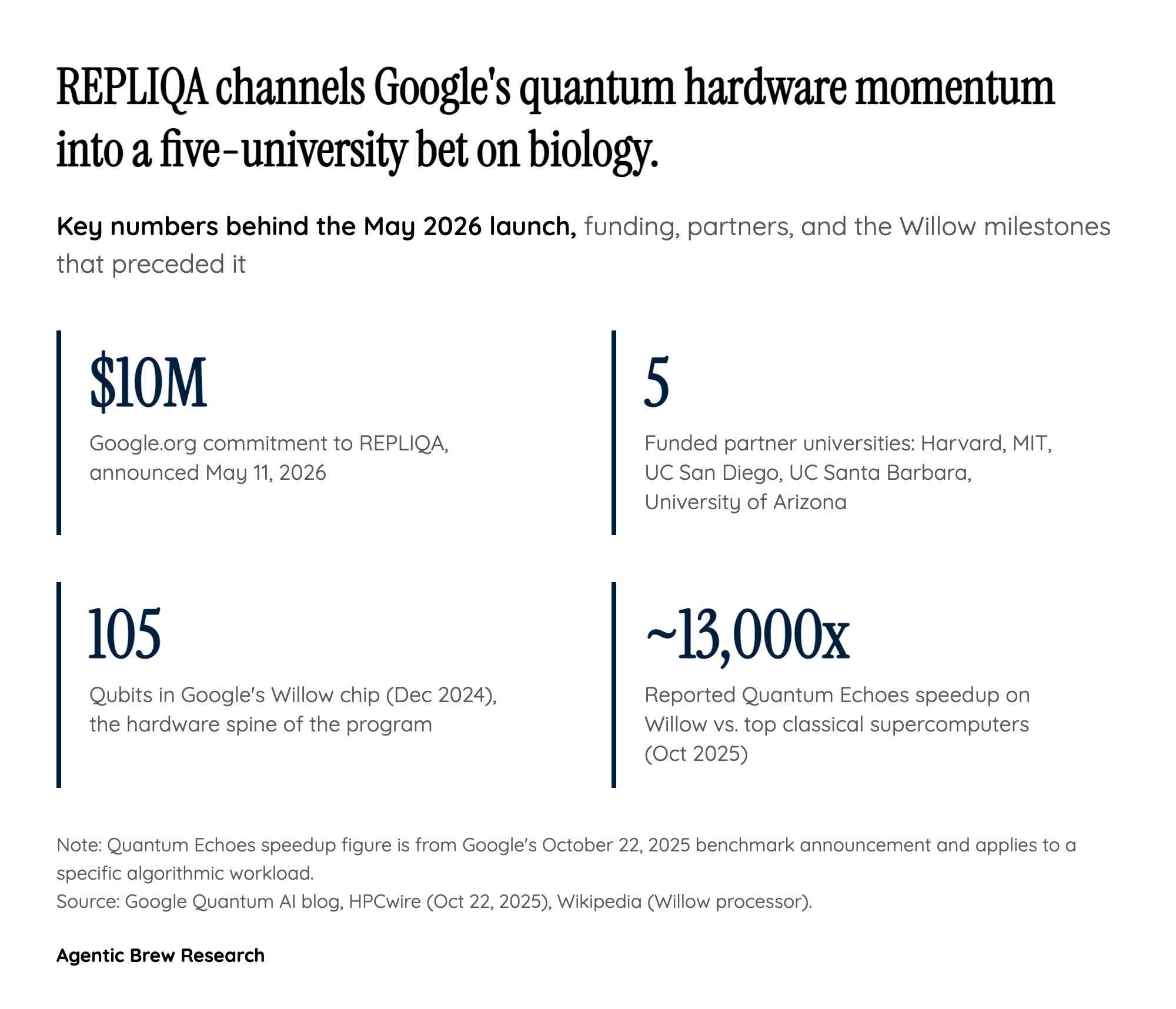
The timing of REPLIQA is the single most informative thing about it. In December 2024 Google unveiled Willow, a 105-qubit superconducting processor that demonstrated below-threshold quantum error correction [7][8]. Less than a year later, in October 2025, Google claimed a verifiable quantum advantage on Willow using a Quantum Echoes algorithm reported as roughly 13,000x faster than the leading classical supercomputers, and framed the result publicly as a step toward drug discovery utility [6]. REPLIQA, announced on May 11, 2026 [1], is the academic-ecosystem counterpart to that hardware narrative: now that Google has a chip and a benchmark it is willing to defend in public, it needs domain scientists who can write the chemistry and biology problems onto it. Read in that sequence, the program is less a surprise philanthropic gesture than a deliberate handoff from internal hardware milestones to outside life-science groups, with Google.org's grant money as the lubricant. Glitchwire makes this connective tissue explicit, noting that Hartmut Neven has been quietly seeding quantum-biology work inside Google since 2014 [3], so REPLIQA also retrospectively turns a personal research interest of Google's quantum lead into a five-university institutional program.