ChatGPT Personal Finance Feature
TECH

ChatGPT Personal Finance Feature

27+
Signals

Strategic Overview

  • 01.
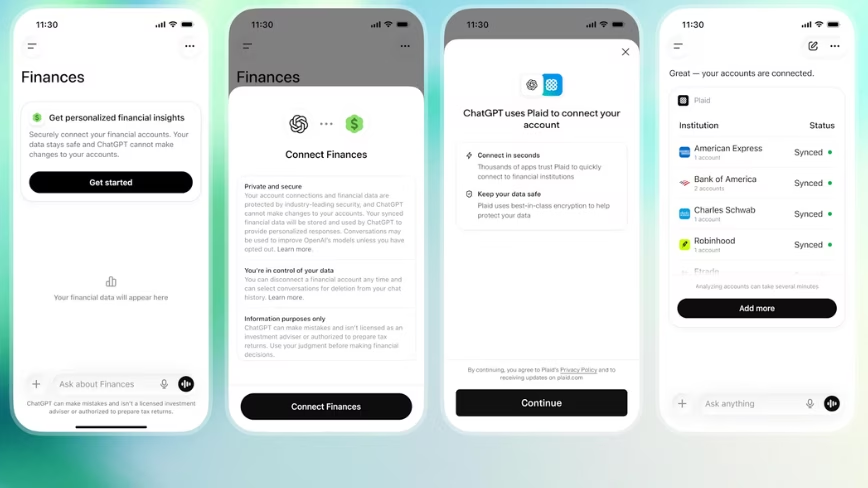
    OpenAI launched a personal finance experience in preview for U.S. ChatGPT Pro subscribers on web and iOS, letting them connect bank, credit card, and investment accounts via Plaid and ask context-grounded financial questions.
  • 02.
    Connections route through Plaid and reach more than 12,000 financial institutions including Schwab, Fidelity, Chase, Robinhood, American Express, and Capital One.
  • 03.
    The product is powered by GPT-5.5, which OpenAI says is stronger at the contextual reasoning needed for multi-account financial questions, with Intuit support planned for tax and credit-card-approval analysis.
  • 04.
    Access is read-only — ChatGPT can see balances, transactions, investments, and liabilities but cannot view full account numbers or move money — and synced finance data is deleted within 30 days after a user disconnects an account.

The Six-Month M&A Sprint That Shipped This Product

The preview that landed on May 15 is not a green-field OpenAI build — it is the visible output of a two-step acqui-hire campaign executed in roughly six months. In October 2025, OpenAI brought in Sujith Vishwajith, co-founder and CEO of the personal-finance app Roi, in what was its first PFM-focused acqui-hire of the cycle [3]. Six months later, in April 2026, OpenAI absorbed Hiro Finance, a roughly ten-person startup co-led by Ethan Bloch and Rushabh Doshi and backed by Ribbit Capital, General Catalyst, and Restive; Hiro's consumer service was wound down on April 20 with server data deletion by May 13 [3].

The sequencing matters. OpenAI did not buy a brand or a user base — it bought a senior PFM founder, a complete product team, and the wind-down of a competing consumer app, all stitched together so that a credible bank-linked experience could ship inside ChatGPT roughly four weeks after Hiro's servers went dark [1][3]. Combined with GPT-5.5's stronger contextual reasoning, this is what allowed OpenAI to skip the multi-year fintech build cycle and arrive at a Plaid-backed dashboard on day one [1].

A Conversational Layer Above Banking — Who Actually Gets Disintermediated

Plaid's CTO Will Robinson frames complete institutional coverage as 'table-stakes' for AI-driven finance, and the 12,000-institution footprint is what lets ChatGPT pull together checking accounts at Chase, brokerage positions at Schwab and Fidelity, cards at AmEx and Capital One, and crypto-adjacent balances at Robinhood into a single conversational surface [1][2]. Javelin Research's Dylan Lerner reads the strategy plainly: OpenAI is not trying to become a bank — it is trying to own 'share of mind' in consumer finance, sitting above the providers as the default interface [4].

The disruption thesis that follows is uncomfortable for two cohorts. First, the PFM dashboard layer — Mint-style aggregators and budgeting apps — loses its core wedge once a chat surface with 200M monthly finance-curious users can ingest the same Plaid feed and answer in natural language [1][2]. Second, banks and brokerages themselves risk being abstracted away: a Chase or Schwab login becomes plumbing rather than the destination, and the customer relationship migrates upstream to whoever holds the conversation. The upcoming Intuit integration extends the same pressure to tax prep and credit decisioning, the two adjacent surfaces where consumers still bother to leave their main finance app [1][5].

The Trust Gap: Hallucination, Read-Only Plaid, and a Skeptical Public

Community reception to the launch was strikingly hostile for a product debut from OpenAI, and the dominant objection is structural rather than aesthetic. Tom's Guide captured the prevailing mood with the framing 'what sane individual feels comfortable giving this level of access to OpenAI' [8]. On Reddit, even the OpenAI-friendly subreddit led with hallucination-and-money risk, with the next most upvoted retorts being 'Plaid is read-only anyway' and 'Mint already does this,' while r/BetterOffline mocked the launch as a 'guessing machine' touching bank balances. r/ChatGPT's reaction skewed toward privacy and ad-targeting fears rather than excitement about features. Practitioner-creator YouTube — a CPA walking through the Plaid connector, a CFO-focused channel stress-testing GPT-5.5 on real finance work — has been measurably warmer, splitting the audience along a hands-on-versus-skeptical line.

Underneath the snark sits a real accountability gap. ChatGPT is not a fiduciary, and analysts in TheNextWeb's coverage flag that there is no legal recourse if the model gives bad guidance — a contrast with human advisers bound to act in clients' best interests [4]. OpenAI's defenses are narrow but real: Plaid access is strictly read-only (balances, transactions, investments, liabilities — no full account numbers, no money movement), and disconnecting an account wipes the synced data within 30 days [6][7]. The bet is that those guardrails plus a small preview cohort buy enough time for trust to catch up with capability before the rollout widens beyond Pro [6].

Ads, Finance Data, and 200 Million Monthly Conversations on One Platform

Ads, Finance Data, and 200 Million Monthly Conversations on One Platform
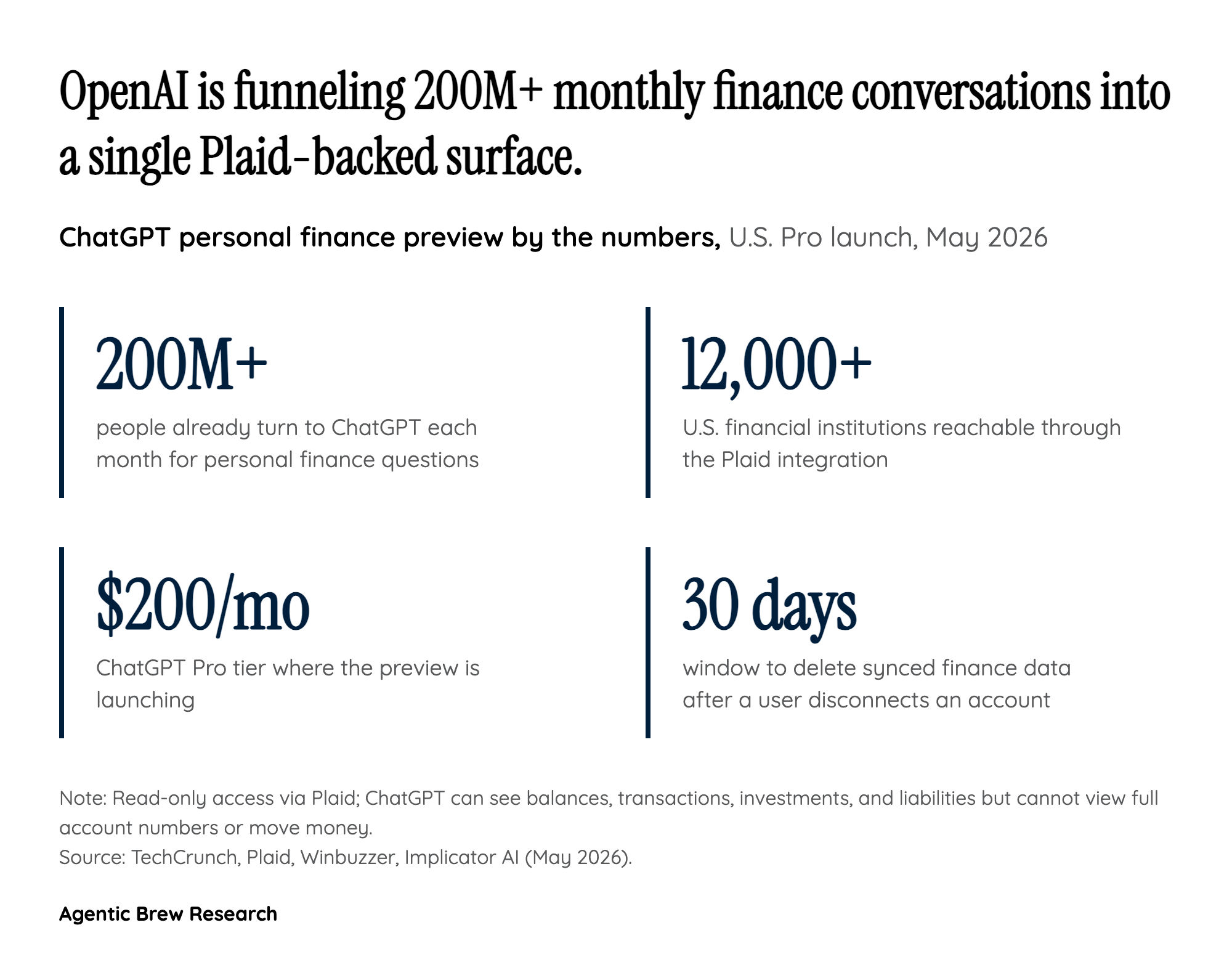
ChatGPT personal finance preview: headline numbers from the May 2026 U.S. Pro launch.

The privacy critique cuts deeper than 'should I trust a chatbot with my balance.' TheNextWeb's analysis highlights an emerging conflict of interest: the same platform now hosts ads, ingests linked-account financial data, and handles more than 200 million finance-related conversations per month [2][4]. Regulators and privacy advocates are flagged in that coverage as the natural next constituency to scrutinize the combination, and the question is no longer hypothetical — it is shipping in preview on the $200/month Pro tier [4][9].

The contrarian counter on X, voiced by accounts in the AI ecosystem including OpenAI's Greg Brockman, frames the same data concentration as the feature: a 'personal agent' is only useful if it actually sees your life, and finance is the highest-leverage context. That framing collides directly with the Reddit sentiment, and the resolution is not a debate OpenAI can win with a blog post. It will be decided by whether the next twelve months produce a high-profile hallucination-meets-money incident, a regulatory action on cross-use of financial data, or — the bullish case — a quiet expansion from Pro to Plus with no headline failure.

Historical Context

2024
Hiro Finance was founded by co-CEOs Ethan Bloch and Rushabh Doshi, backed by Ribbit, General Catalyst, and Restive.
2025-10
OpenAI hired Sujith Vishwajith, co-founder/CEO of personal finance app Roi, in its first PFM-focused acqui-hire of the cycle.
2026-04-13
OpenAI acquired Hiro Finance; the Hiro service was scheduled to wind down on April 20 with server data deletion by May 13.
2026-05-15
OpenAI publicly launched the personal finance preview in ChatGPT for U.S. Pro subscribers with Plaid, and announced upcoming Intuit support.

Power Map

Key Players
Subject

ChatGPT Personal Finance Feature

OP

OpenAI

Product owner and distributor; turns its 200M+ monthly finance-question users into a wedge to make ChatGPT the conversational personal-finance interface layer above existing banks and apps.

PL

Plaid

Account-connectivity backbone aggregating data from 12,000+ institutions; gives consumers per-app share controls via the Plaid Portal and positions itself as the default rail for AI-native finance apps.

IN

Intuit

Announced future partner; planned integration would unlock tax-impact analysis on stock sales and credit-card approval odds, extending ChatGPT into TurboTax and Credit Karma's core territory.

HI

Hiro Finance

Acqui-hired by OpenAI in April 2026; the ~10-person personal-finance startup brought the product and domain expertise that underpinned this roughly four-week-later launch.

RI

Ribbit Capital, General Catalyst, Restive

Former venture backers of Hiro Finance whose investment seeded the talent and IP now embedded inside OpenAI's PFM stack.

BA

Banks and fintechs (Chase, Schwab, Fidelity, Robinhood, Capital One, AmEx)

Underlying account providers whose own dashboards risk being abstracted away by a ChatGPT conversational layer that sits above them and aggregates context they previously owned.

Fact Check

9 cited
  1. [1] OpenAI launches ChatGPT for personal finance, will let you connect bank accounts
  2. [2] A new personal finance experience in ChatGPT, powered by Plaid
  3. [3] OpenAI has bought AI personal finance startup Hiro
  4. [4] OpenAI's ChatGPT is now a personal finance tool — Plaid is its backbone
  5. [5] OpenAI Launches ChatGPT Finance Dashboard With Linked Bank Accounts For Pro Users
  6. [6] ChatGPT will offer personalized financial advice if you connect your bank account
  7. [7] OpenAI Launches ChatGPT for Personal Finance With Plaid Bank Connections
  8. [8] ChatGPT can now be your financial advisor — but the reactions are pretty telling
  9. [9] OpenAI Adds Personal Finance Tools to ChatGPT Pro With Plaid Bank Connections

Source Articles

Top 3

THE SIGNAL.

Analysts

"Full institutional coverage is table-stakes for AI-driven personal finance, and the long-term winners will deliver hyper-personalized intelligent finance built on top of that complete data picture."

Will Robinson
Chief Technology Officer, Plaid

"OpenAI's fintech acquisitions and product moves are aimed at owning 'share of mind' in consumer finance rather than becoming a bank itself."

Dylan Lerner
Analyst, Javelin Research

"Personal finance is one of the most talked-about use cases for generative AI, attracting outsized investment and product attention from incumbents and startups alike."

Rudy Yang
Senior Analyst, PitchBook
The Crowd

"Understand and manage your personal finances in ChatGPT. A further step towards ChatGPT becoming your personal agent, operating on your behalf 24/7, for helping you at home and work."

@@gdb0

"OpenAI is partnering with Plaid to let ChatGPT users connect their bank accounts, credit cards, investment accounts, and other financial accounts directly to the chatbot. The feature gives ChatGPT a real-time view of your balances, transactions, stock portfolio, and liabilities"

@@TFTC210

"So OpenAI literally kill*d many fintech startups today. OpenAI launched a personal finance feature in ChatGPT for Pro users in the US. You connect your bank accounts via Plaid, get a spending dashboard, and can ask GPT-5.5 questions grounded in your actual transaction data"

@@kimmonismus0

"OpenAI launches ChatGPT for personal finance, will let you connect bank accounts"

@u/ThereWas489
Broadcast
攜手Plaid打兣1.2萬家銀行 OpenAI強調不取代專業顧問!Perplexity AI也推金融工具|非凡財經新聞|20260516

攜手Plaid打兣1.2萬家銀行 OpenAI強調不取代專業顧問!Perplexity AI也推金融工具|非凡財經新聞|20260516

ChatGPT 5.5 for Finance is INSANE

ChatGPT 5.5 for Finance is INSANE

ChatGPT Finance (Connect your banks!)

ChatGPT Finance (Connect your banks!)