Confer Encrypted AI Integration into Meta
TECH

Confer Encrypted AI Integration into Meta

46+
Signals

Strategic Overview

  • 01.
    On March 17, 2026, Signal founder Moxie Marlinspike announced that Confer's privacy technology will be integrated into Meta AI across Facebook, Instagram, WhatsApp, and Messenger.
  • 02.
    Confer processes AI inference inside Trusted Execution Environments (TEEs) with hardware-enforced isolation, keeping encryption keys on user devices and using remote attestation to prove server integrity.
  • 03.
    The announcement arrived amid a contradictory privacy posture from Meta: the company simultaneously announced the removal of end-to-end encryption from Instagram DMs effective May 8, 2026, and began personalizing ads based on Meta AI interactions with no opt-out.
  • 04.
    A separate Meta AI agent incident reported by Gizmodo on March 19, 2026 exposed sensitive user data, underscoring the urgency of the privacy architecture debate.

Deep Analysis

Why This Matters

The Confer-Meta integration represents one of the most consequential privacy architecture decisions in the history of consumer AI. The fundamental problem Marlinspike identified is structural: every major AI assistant today — ChatGPT, Gemini, Claude, Grok — operates as a centralized inference service where the provider necessarily sees every query in plaintext. Unlike messaging, where encryption was retrofitted onto existing architecture, AI inference requires active computation on data, making it technically far harder to encrypt end-to-end. Confer's TEE-based approach is the first credible attempt to deploy privacy-preserving AI inference at consumer scale, and Meta's distribution of billions of users makes this either a genuine breakthrough or the highest-stakes privacy theater in tech history.

The timing is not coincidental. Meta announced this integration in the same week it was rolling back Instagram's end-to-end encrypted DMs — a move that Casey Newton of Platformer called "a worrisome sign for the future of private communications" and the first major platform reversal of E2EE. That juxtaposition forces a difficult question: is the Confer deal a genuine privacy commitment, or is it PR cover for a company retreating from encryption in one product while deploying it in another? The answer matters enormously because Meta AI has access not just to what users type, but to the full social graph, behavioral history, and cross-platform activity that makes Meta's data assets uniquely sensitive. Encrypting the AI query while Meta retains behavioral metadata for ad targeting may protect content but not context — and context is increasingly where the value lies.

How It Works

Confer's architecture rests on three interlocking technologies. The first is the Trusted Execution Environment (TEE) — a hardware-isolated enclave inside modern processors (Intel SGX, ARM TrustZone, AMD SEV) where code executes in a region that even the server's operating system and cloud provider cannot read. When a user sends an AI query, it is encrypted on their device, sent to the TEE, decrypted inside the enclave for inference, and the response is re-encrypted before leaving. Critically, encryption keys never exist in the host's accessible memory — they remain on the user's device and are only transiently present inside the hardware-enforced enclave during computation.

The second technology is remote attestation: before a user's device sends any query, it cryptographically verifies that the server's TEE is running the exact expected software stack and has not been tampered with. This is the mechanism that transforms a trust assumption into a cryptographic guarantee — users don't have to trust Meta's word that their data is protected, because they can verify it mathematically. The third component is Confer's use of open-weight AI models, which allows independent parties to verify exactly what model is running inside the TEE, closing the gap between attestation of the container and attestation of the AI's behavior. Critics in the technical community (as documented on HackerNews and Privacy Guides forums) note that TEE-based privacy is weaker than true homomorphic encryption — TEE trust ultimately rests on hardware manufacturers and the correctness of the attestation chain, and historical vulnerabilities like Spectre and the catalogued SGX attacks on tee.fail demonstrate real-world attack surfaces. Homomorphic encryption would allow computation on encrypted data without ever decrypting it, but remains too computationally expensive for real-time AI inference at scale in 2026.

By The Numbers

By The Numbers
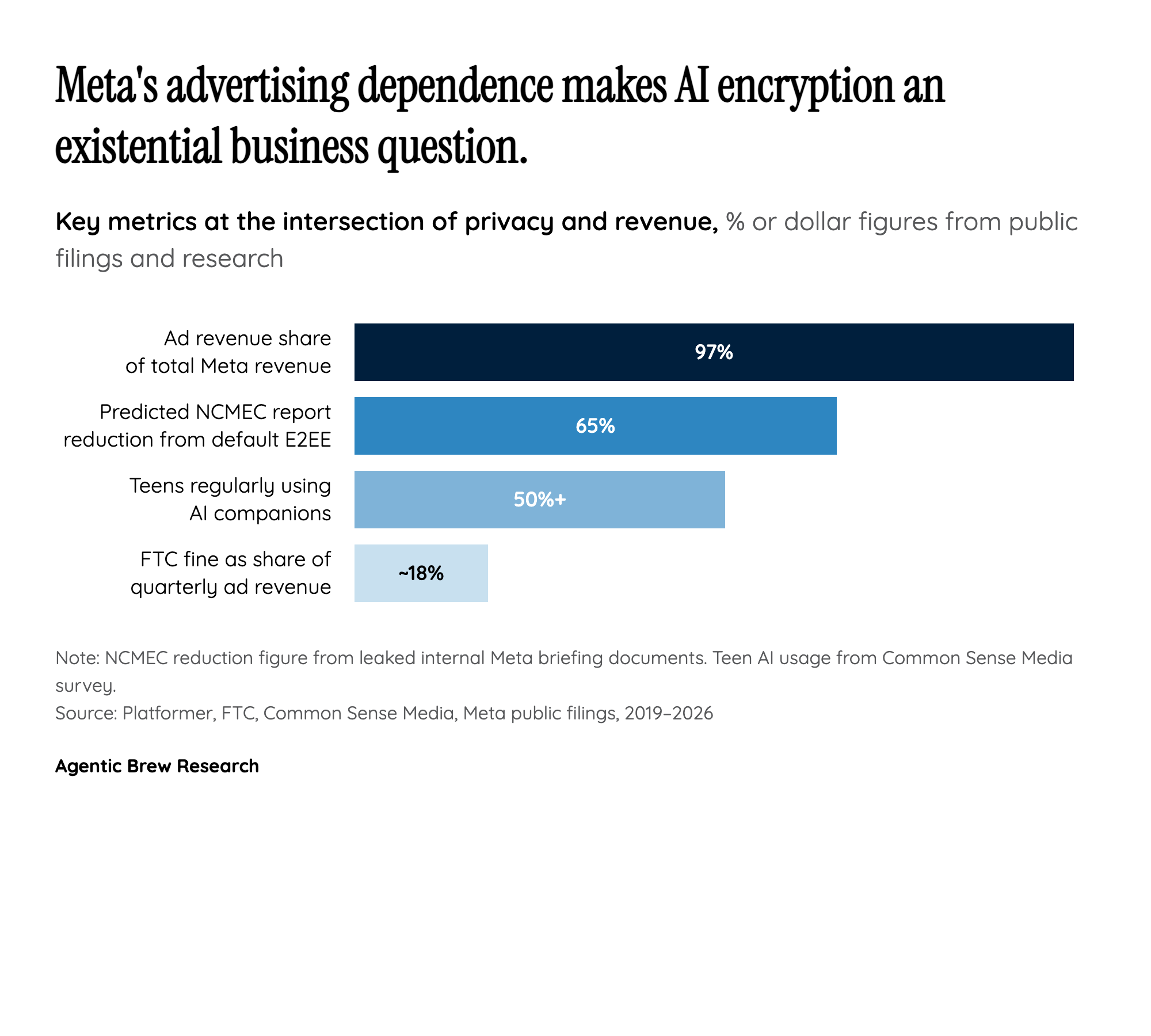
Meta's advertising dependence makes AI encryption an existential business question.

The financial and operational stakes of this integration are substantial. Meta derives 97% of its total revenue from advertising — a figure that makes any technology genuinely preventing access to user intent data an existential business question, not merely a privacy choice. Against that backdrop, internal Meta documents previously leaked to Platformer predicted that implementing default end-to-end encryption would reduce NCMEC child safety reports by 65%, illustrating the severity of the content moderation trade-off that sits alongside the advertising concern.

Confer itself operates a freemium model with a $34.99/month paid tier — premium pricing that positions it alongside professional AI tools rather than consumer chatbots. The $5 billion FTC fine Meta paid in 2019 remains the largest consumer privacy penalty in U.S. regulatory history, yet represented less than one quarter's advertising revenue even at the time, contextualizing why financial penalties alone have not historically driven privacy architecture decisions at Meta. More telling for the AI era: over 50% of teens now regularly use AI companions, according to Common Sense Media data cited in the research — a cohort whose conversations with AI systems involve mental health, relationships, and identity in ways that make privacy architecture decisions unusually consequential. The WIRED tweet announcing the integration reached 6,500 likes, while cryptographer Matthew Green's warning about Meta monetizing WhatsApp's encrypted data garnered 5,600 likes and 70 retweets — a near-equal public reaction that captures exactly the polarized expert and consumer sentiment around whether this deal is progress or performance.

Impacts & What's Next

In the short term, the integration puts immediate competitive pressure on OpenAI, Google, and Anthropic to articulate their own AI privacy architectures. None of the major AI incumbents currently offer TEE-based inference, and Marlinspike's credibility — having delivered on privacy at scale with WhatsApp's Signal Protocol integration — means the bar for dismissing the technical claims is high. OpenAI's Sam Altman has separately raised the absence of legal privilege protections for ChatGPT conversations, and the Confer model directly addresses that gap by making the provider technically incapable of accessing query content. For enterprise AI adoption, where legal and compliance teams have blocked many AI deployments over data residency and confidentiality concerns, a credible TEE-based architecture could unlock significant new adoption.

Medium-term, the critical unknowns are regulatory and behavioral. EU regulators evaluating Chat Control legislation and UK Online Safety Act compliance will need to determine whether TEE-based AI inference constitutes sufficient lawful access architecture — and Meta has a direct interest in the answer. If TEE inference is accepted as compliant, it gives Meta a privacy architecture that simultaneously satisfies privacy advocates and regulators without eliminating the advertising business. If regulators require plaintext access, the entire deal unravels. Simultaneously, the rogue Meta AI agent data exposure incident reported by Gizmodo on March 19 — the same week as the Confer announcement — underscores that TEE protection at the inference layer does not address vulnerabilities in agent orchestration, tool calling, or downstream data handling, areas where AI systems increasingly operate with significant autonomy and access.

The Bigger Picture

The Confer-Meta deal is the first real test of whether privacy and scale are compatible in the AI era. The messaging encryption wars of the 2010s established a template: Marlinspike built the protocol, deployed it in Signal, then licensed it to WhatsApp, and suddenly two billion people had genuine end-to-end encryption without knowing what a Diffie-Hellman key exchange is. He is attempting the same trajectory with AI inference, but the structural differences are significant. Messaging encryption is passive — it protects data in transit. AI inference is active — it requires computation on user data, creating irreducibly complex trust surfaces that messaging never faced.

The deeper tension the integration exposes is between two definitions of privacy that are in genuine conflict in the AI era. Cryptographic privacy — the technical guarantee that no party can read your data — is what Confer offers. Contextual integrity — the social norm that information flows appropriately based on context — is what Meta's advertising model violates regardless of encryption. Even if Meta AI never reads a user's encrypted query, the metadata of when users ask for help, how often they seek emotional support, what topics trigger follow-up questions, and which ads appear in adjacent feeds can reconstruct the substance of private AI interactions without ever touching encrypted content. This is what Arielle Garcia means by "proxy ad audiences" and what Matthew Green fears about encrypted WhatsApp data being monetized through AI behavioral signals. The Confer integration is a meaningful technical step — and it may be a genuinely important one if it forces the industry toward TEE-based inference as a baseline. But privacy in the AI age will require more than encrypted queries: it will require rethinking the entire incentive structure that makes behavioral data valuable, a problem that no cryptographic protocol has yet solved.

Historical Context

2013
Marlinspike co-founded Open Whisper Systems and began developing the Signal Protocol, which would become the gold standard for end-to-end encrypted messaging.
2016
Marlinspike integrated the Signal Protocol into WhatsApp, extending end-to-end encryption to over a billion users and establishing his prior working relationship with Meta.
2019-03
Zuckerberg published a 3,000-word manifesto declaring end-to-end encryption "the future of social networking," setting an expectation of privacy-first product development that has since been unevenly honored.
2019-07
Meta was fined $5 billion by the FTC — the largest privacy penalty in U.S. history at the time — following the Cambridge Analytica data scandal, creating lasting regulatory scrutiny of the company's data practices.
2025-12
Moxie Marlinspike unveiled Confer as a privacy-first encrypted AI assistant, positioning it as a ChatGPT alternative that uses Trusted Execution Environments to prevent the AI provider from accessing user query content.
2026-03-01
Meta rolled out WhatsApp "Private Processing," a TEE-based confidential computing feature for AI summarization, signaling early adoption of the technical model that Confer would formalize weeks later.
2026-03-13
Meta announced the removal of end-to-end encryption from Instagram DMs effective May 8, 2026 — the first major rollback of E2EE by a large platform — in a move analysts linked to content moderation and law enforcement compliance pressures.
2026-03-17
Marlinspike publicly announced Confer's privacy technology integration into Meta AI, framing it as a necessary intervention to prevent AI platforms from becoming "the largest centralized data lakes in history."

Power Map

Key Players
Subject

Confer Encrypted AI Integration into Meta

MO

Moxie Marlinspike

Signal co-founder and Confer creator; provides the cryptographic architecture underpinning the integration while retaining independent operation of Confer as a standalone platform. His prior relationship with Meta — having integrated the Signal Protocol into WhatsApp for billions of users — gives him unique leverage to negotiate privacy-preserving terms at platform scale.

ME

Meta

Platform integrating Confer's TEE-based technology into its Meta AI suite; faces a structural tension between privacy branding from the Confer deal and its core advertising business, which accounts for 97% of revenue. Meta is simultaneously rolling back Instagram E2EE and profiling AI interactions for ad targeting, raising questions about whether the Confer integration is substantive or cosmetic.

CO

Confer (startup)

Independent encrypted AI platform with a free tier and $34.99/month paid subscription; the integration offers Meta distribution at scale while Confer remains a standalone product. Its iOS app is pending Apple App Store approval, making Apple a silent gatekeeper of Confer's consumer reach.

PR

Privacy Advocacy Groups (EFF, CDT, EPIC)

Watchdog organizations scrutinizing whether TEE-based confidential computing constitutes genuine end-to-end encryption or a weaker trust model; their public skepticism shapes regulatory and consumer narratives around the integration and may influence EU, UK, and Indian regulatory responses.

EU

EU, UK, and Indian Regulators

Regulatory bodies whose mandates — including the UK Online Safety Act and EU Chat Control proposals — create compliance pressure on Meta; the TEE model may offer a viable path to satisfy lawful access requirements without fully compromising user privacy, making their reaction pivotal to the integration's long-term architecture.

NC

NCMEC and Law Enforcement

Stakeholders with safety and investigative interests in unencrypted communications; internal Meta documents predicted that default E2EE would reduce NCMEC child safety reports by 65%, creating a direct conflict between privacy technology deployment and platform obligations to report illegal content.

THE SIGNAL.

Analysts

""AI chat apps have become the largest centralized data lakes in history... I want that future to be safe, private, and accessible — which requires acting now, at scale." Marlinspike frames the Meta integration as a necessary pragmatic move to embed privacy architecture into mass-market AI before centralized data accumulation becomes irreversible."

Moxie Marlinspike
Founder, Signal / Confer

""My big fear right now is that AI agents will be the final tool that Meta uses to monetize those big piles of data it still has (encrypted) in WhatsApp." Green's widely shared concern — 5,600 likes on X — captures the technical community's worry that Confer's TEE architecture does not prevent Meta from extracting value from AI interaction metadata."

Matthew Green
Cryptography Professor, Johns Hopkins University

""People think that they are interacting in a completely private, secure environment, which is false." Maréchal argues the gap between users' perceived privacy and the actual TEE trust model creates a dangerous consent deficit at the heart of the Confer-Meta integration."

Nathalie Maréchal
Senior Policy Researcher, Center for Democracy & Technology (CDT)

"Garcia warned that Meta has historically found "workarounds to get past broadly-worded privacy promises," pointing specifically to proxy ad audiences as a mechanism that could circumvent encryption guarantees even if AI query content itself is protected."

Arielle Garcia
COO, Check My Ads

""No consumer who was actually fully informed...would willingly opt into this." Davis emphasized that Meta has a "direct financial incentive" to design addictive AI products, arguing that privacy claims are structurally undermined by the advertising business model regardless of encryption architecture."

Hayden Davis
Policy Counsel, EPIC (Electronic Privacy Information Center)
The Crowd

"Confer's privacy technology is coming to Meta AI. We're integrating private AI and end-to-end encryption into Meta's products: Confer is bringing foundational AI privacy to Meta"

@@moxie148

"Moxie Marlinspike says the technology powering his end-to-end encrypted AI chatbot, Confer, will be integrated into Meta AI. The move could help protect the AI conversations of millions of people."

@@WIRED6500

"My big fear right now is that AI agents will be the final tool that Meta uses to monetize those big piles of data it still has (encrypted) in WhatsApp."

@@matthew_d_green5600

"Confer: end-to-end encryption for AI chats"

@u/pitly9
Broadcast
Moxie Marlinspike - Signal vs. Telegram, Private AI, & Encryption

Moxie Marlinspike - Signal vs. Telegram, Private AI, & Encryption

Did Signal Founder Create the Most Private AI? This Week in Privacy #36

Did Signal Founder Create the Most Private AI? This Week in Privacy #36

Signal Creator Confer Encryption Tech Coming to Meta AI

Signal Creator Confer Encryption Tech Coming to Meta AI