OpenAI Codex Chronicle memory feature launch
TECH

OpenAI Codex Chronicle memory feature launch

32+
Signals

Strategic Overview

  • 01.
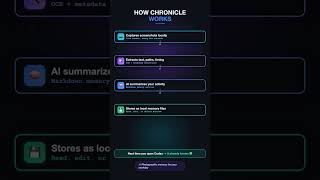
    OpenAI released Chronicle as an opt-in research preview that extends Codex memories with recent screen context — frames, OCR text, timing, and file paths — so Codex can resume work without users restating background.
  • 02.
    Availability is tightly scoped: ChatGPT Pro subscribers only, Apple Silicon Macs running macOS 14+, with Screen Recording and Accessibility permissions required; not available in the EU, UK, or Switzerland.
  • 03.
    Screen captures are processed on OpenAI servers for OCR and summarization, stored temporarily on-device under $TMPDIR/chronicle/screen_recording/, and deleted after 6 hours; OpenAI states captures are not retained server-side after processing or used for training.
  • 04.
    Generated memories are saved locally as unencrypted Markdown at ~/.codex/memories_extensions/chronicle/, and OpenAI warns that Chronicle burns through rate limits quickly because sandboxed Codex sessions continuously summarize captures.

Recall for developers — with a weaker crypto posture

Chronicle is philosophically close to Microsoft Recall: a background agent that captures your screen, OCRs it, and stores summaries so an assistant can reason over what you've been doing. But the implementation diverges in a consequential way. Recall invested heavily in an encrypted, hardware-bound local database after its rocky debut; Chronicle writes memories as plain-text Markdown under ~/.codex/memories_extensions/chronicle/, readable by any local process that can see the user's home directory.

Short-lived screen capture files live in $TMPDIR/chronicle/screen_recording/ and are garbage-collected after 6 hours, but the distilled memories persist. For a product targeted at developers — who routinely have API keys, private repo paths, and production incident details on screen — unencrypted at-rest storage is a notable choice. It is also why the feature is gated to $100/month Pro users on Apple Silicon with macOS 14+: OpenAI is limiting the blast radius while it iterates.
Memory is the new moat — even if it costs rate limits

Analyst Aakash Gupta's read is that Chronicle exists because the memory layer has overtaken raw model quality as the differentiator between coding agents. If every major lab can ship a frontier model, the agent that remembers what you were doing yesterday — which branch, which stack trace, which Figma frame — wins the next session.

That framing explains an otherwise odd economic choice: OpenAI openly warns that Chronicle 'burns through rate limits quickly' because sandboxed Codex sessions continuously summarize captures in the background. OpenAI is effectively subsidizing always-on summarization compute to build a persistent context graph of each Pro user's work. Against Anthropic's Claude Code — the competitive foil cited in TechCrunch's framing of OpenAI's April 16 Codex expansion — that persistent graph is the asset model swaps cannot replicate.

Opt-in surveillance and the prompt-injection surface

Chronicle asks developers to grant Screen Recording and Accessibility permissions and let a background agent watch their monitor in exchange for escaping the chore of restating context. OpenAI is transparent about the trade: the docs explicitly flag prompt-injection risk because any rendered web page or chat window Codex sees becomes eligible input, and recommend pausing Chronicle before meetings or when viewing sensitive material.

The feature also uploads screens to OpenAI servers for OCR and summarization — OpenAI commits to not retaining them post-processing or training on them, but the pipeline still constitutes continuous exfiltration of whatever is on screen. Developer YouTube explainers note the pause/resume control lives in the macOS menu bar, which makes the opt-out ergonomics acceptable but puts the burden of discretion squarely on the user.

Regional fragmentation and the open-source counter-current

Chronicle's unavailability in the EU, UK, and Switzerland is not incidental. The Next Web reads it as tacit acknowledgment that continuous screen capture, even with on-device memory persistence, sits awkwardly against GDPR purpose-limitation and data-minimization norms. That regional split is becoming a familiar pattern for ambient-memory products.

It also feeds a counter-current visible in community reaction: developers are surfacing open-source analogs that perform similar screen-to-memory capture and arguing that a proprietary vendor launch doesn't foreclose the category — it legitimizes it. The contrarian read is that auditable, self-hostable screen-memory tools become more attractive precisely because Chronicle is closed, server-dependent, and geographically gated. OpenAI has validated the problem; whether it owns the solution for privacy-sensitive and non-US developers is an open question.

Historical Context

2026-02-02
Launched the Codex desktop app for macOS, establishing the client that Chronicle now extends.
2026-03-04
Added Windows support for the Codex desktop app, broadening the client footprint ahead of memory features.
2026-04-16
Published 'Codex for (almost) everything' with computer use, in-app browser, image generation, 90+ plugins, and the memory preview that Chronicle now extends.
2026-04-20
Released Chronicle as an opt-in research preview for Codex Pro macOS users, layering screen-context memory on top of the week-old memories preview.

Power Map

Key Players
Subject

OpenAI Codex Chronicle memory feature launch

OP

OpenAI

Launched Chronicle as a research-preview extension of Codex memories; controls server-side OCR/summarization, rollout, and regional gating.

CH

ChatGPT Pro subscribers on macOS

Sole eligible user group ($100+/month) who can opt into Chronicle on Apple Silicon Macs running macOS 14+; bear privacy and prompt-injection exposure.

EU

EU, UK, and Switzerland regulators

Geographic exclusion effectively acknowledges GDPR friction with always-on screen capture; blocks OpenAI from shipping Chronicle into these markets without redesign.

GR

Greg Brockman (OpenAI President)

Public champion of the launch, framing Chronicle as experimental but 'surprisingly magical' recent visual memory for Codex.

AN

Anthropic / Claude Code

Competitive backdrop; Codex's rapid expansion (computer use, plugins, memories, Chronicle) is positioned as OpenAI's push to catch and surpass rival coding agents.

THE SIGNAL.

Analysts

"Characterizes Chronicle as an experimental feature that gives Codex recent visual memory of the user's screen, producing automatic full-context handoffs that feel effective in practice. "Chronicle is an experimental feature giving Codex the ability to see and have recent memory over what you see, automatically giving it full context on what you're doing. Feels surprisingly magical to use.""

Greg Brockman
President, OpenAI

"Argues the memory layer — not raw model quality — is now the real competitive moat for coding agents, which is why OpenAI is willing to run compute-heavy background agents that watch users' screens continuously. "OpenAI is burning compute on background agents watching your screen 24/7 because the memory layer has become the real moat in coding agents, above model quality.""

Aakash Gupta
Product growth advisor / independent analyst

"Notes Chronicle's unencrypted local Markdown store contrasts with Microsoft Recall's encrypted database, and interprets the EU/UK/Switzerland exclusion as tacit admission of GDPR incompatibility. "Geographic limitation strongly suggests OpenAI recognises the feature's incompatibility with GDPR's requirements.""

The Next Web (editorial analysis)
Tech publication
The Crowd

"Last week, we released a preview of memories in Codex. Today, we're expanding the experiment with Chronicle, which improves memories using recent screen context. Now, Codex can help with what you've been working on without you restating context."

@@OpenAIDevs3100

"OpenAI just gave Codex a screen-grounded memory system that can remember what you were working on without you restating it. Before this, Codex mostly knew the current thread, so prompts like 'fix this' or 'sync that draft' often broke unless you rebuilt the missing context"

@@rohanpaul_ai0

"OpenAI just launched Chronicle for Mac. An experimental Codex tool that takes periodic screenshots to build memory of your projects, errors, and workflow. So when you say 'fix this,' it already knows the context. Key details: Stores memories locally as markdown files..."

@@TechieUltimatum82

"Chronicles is basically what I open-sourced last week, is it even worth continuing?"

@u/Objective_River_521841
Broadcast
Codex 2.0 + NEW CRAZY Free Tier: OpenAI has COOKED with NEW & FREE Codex!

Codex 2.0 + NEW CRAZY Free Tier: OpenAI has COOKED with NEW & FREE Codex!

Your AI Now Watches Your Screen and Remembers Everything (Chronicle)

Your AI Now Watches Your Screen and Remembers Everything (Chronicle)

OpenAI Codex Complete Guide — It's No Longer Just a Coding Tool (2026)

OpenAI Codex Complete Guide — It's No Longer Just a Coding Tool (2026)