Jensen Huang Challenges US Chip Export Controls on China
TECH

Jensen Huang Challenges US Chip Export Controls on China

40+
Signals

Strategic Overview

  • 01.
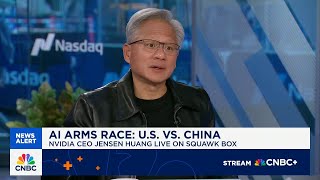
    Nvidia CEO Jensen Huang appeared on the Dwarkesh Patel podcast (episode released April 15, 2026), where he argued against U.S. export controls on AI chips to China and warned that restrictions could push China to build a competing tech stack.
  • 02.
    Huang rejected Dario Amodei's prior comparison of selling advanced chips to China to selling nuclear weapons to North Korea, calling the analogy 'lunacy' and saying chips are not enriched uranium.
  • 03.
    Huang warned that bifurcating the AI world into a closed American stack and an open foreign stack would be a strategic mistake for the U.S.
  • 04.
    Dwarkesh Patel pushed back during the interview, arguing that on a flops basis China has roughly 10% of the compute the U.S. has and that selling H20-class chips shortens the timeline for offensive cyber capability.
  • 05.
    Huang praised China's contribution to open source AI and argued that dialogue between U.S. and Chinese AI researchers is essential.

Deep Analysis

The Jensen Paradox: Why Nvidia's CEO Is Fighting for the Policy Most Likely to Create Huawei

Jensen Huang's central contention on the Dwarkesh podcast is that U.S. export controls will backfire by forcing China onto a Huawei-plus-open-source stack that eventually competes globally. It is a defensible argument. What makes it paradoxical is the messenger. Nvidia just reported $215.9B in fiscal 2026 revenue, up 65% year over year, while effectively zero of that comes from China's AI GPU market, down from roughly 95% share. Huang himself volunteered that statistic at the FT Future of AI Summit last October, when he also said 'China is going to win the AI race.'

The corporate logic is transparent: the Chinese data-center buyer is Nvidia's single largest foregone customer, and Chinese domestic production has already risen to 1.65 million AI GPUs, pushing Nvidia's in-country share below 60% even in the segments where it can still sell. Huang's policy argument and Nvidia's balance-sheet argument are, for now, the same argument. That is the weakest possible posture for a CEO trying to speak for national interest, and it is why critics like Dmitri Alperovitch wrote that Huang 'blatantly admits that his jihad against export controls is simply all about Nvidia selling more chips worldwide.' The paradox is not hypocrisy — Huang may well believe every word — but the fact that the one person best positioned to describe the competitive stakes is also the least credible witness.
Ecosystem Lock-In: Is This x86/Arm or EVs and Smartphones?

Underneath the policy fight is a technology-history argument. Huang's worldview is implicitly the x86/Arm analogy: once a developer ecosystem coalesces around an instruction set and toolchain (CUDA, in Nvidia's case), the switching cost is so high that exclusion is self-defeating. Cut China off from CUDA, the argument goes, and you do not stop Chinese AI — you hand the next generation of Chinese developers to Huawei's CANN runtime and whatever stack DeepSeek-style open-source labs build on top. Huang's warning that it would be 'extremely foolish to create two ecosystems' — one open-source on a foreign stack, one closed on the American stack — is that thesis in one sentence.

The opposing view, pressed by Chris McGuire at CFR and Gregory C. Allen at CSIS, is closer to the EV and smartphone analogy: once Chinese industrial policy plus scale plus cheap energy target a vertical, incumbent Western suppliers get ejected no matter how generous the access regime was along the way. On this reading, keeping the Chinese market open merely subsidizes the training run that teaches China's stack to stand on its own.

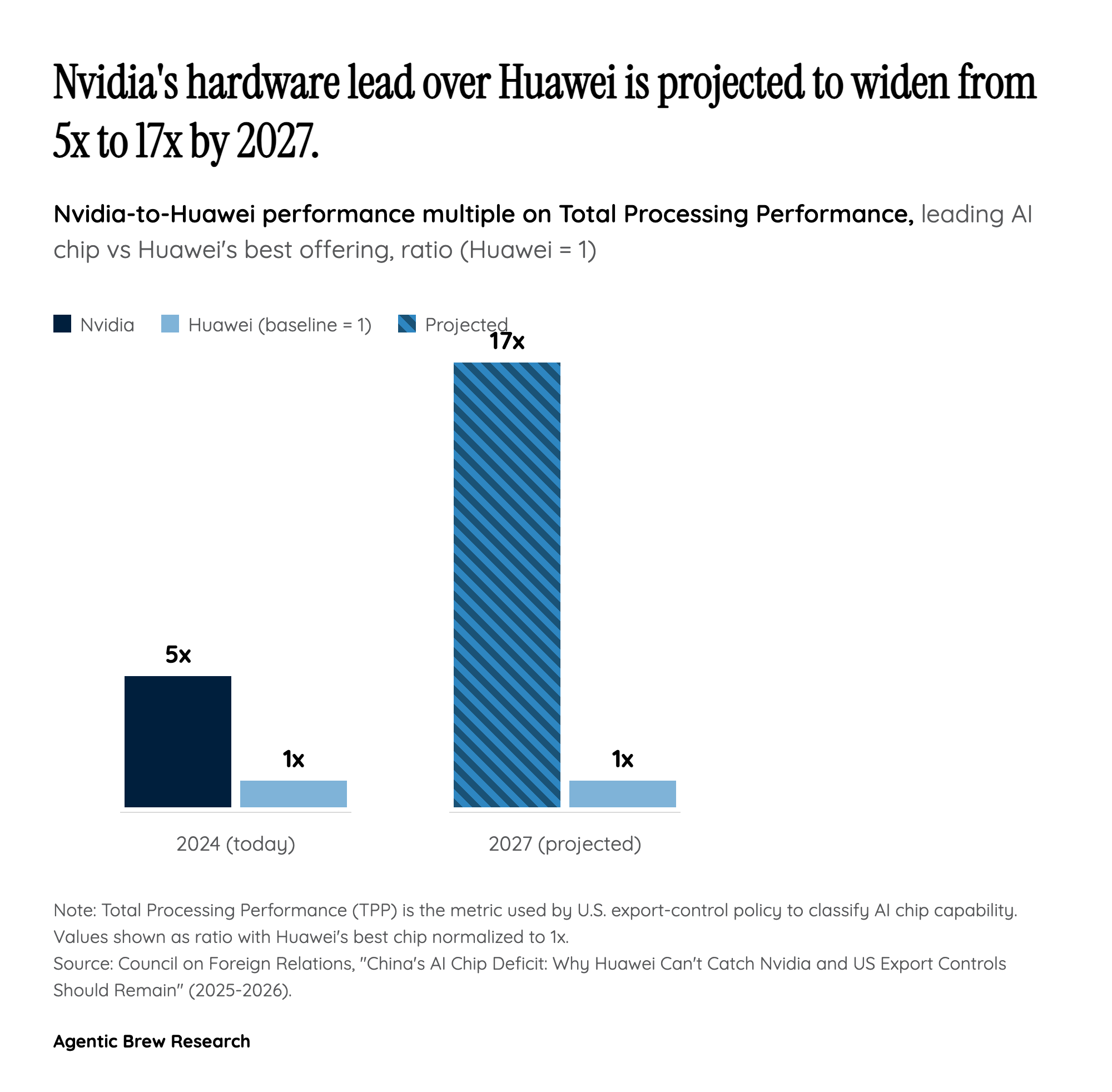
The evidence cuts both ways. DeepSeek's progress, much of it on Nvidia silicon smuggled before 2023 corrections, argues that access is what enabled the catch-up. Huawei's best chip still trails Nvidia's by roughly 5x on Total Processing Performance, with CFR projecting the gap to widen to 17x by 2027 — arguing that denial is working. The honest answer is that nobody knows which analogy holds, and the policy is being made with that uncertainty unresolved.

The Amodei-Huang Feud: A $10B Investor and Its Portfolio Company at War

The most uncomfortable subplot is that Nvidia has invested more than $10 billion in Anthropic, and Anthropic's CEO is the single most effective public advocate for policies that cost Nvidia its largest lost market. On the podcast, Huang rejected Amodei's earlier analogy of selling frontier chips to China as comparable to selling nuclear material to North Korea, calling it 'lunacy.' Amodei's January 2025 essay 'On DeepSeek and Export Controls' argued that 'well-enforced export controls are the only thing that can prevent China from millions of chips,' and in February 2026 he ran a Washington 'Hill blitz' pressing lawmakers to tighten rather than loosen the regime.

The frame Amodei pushes is asymmetric: a few years of preserved U.S. lead can compound into a durable one, so the marginal chip shipped matters. Huang's frame is symmetric: compute is a growing pie, China will build its own if denied, so the marginal chip does not matter. They cannot both be right, and the fact that both men are drawing on the same technical facts to reach opposite conclusions tells you this is ultimately a bet about compounding dynamics rather than a disagreement about the current state of play. That Nvidia keeps writing checks to the CEO lobbying against it is, in its own way, the clearest evidence that even Huang is hedging his public position.

Policy Whiplash Arithmetic: 15 Percent, Then a Ban, Then Approval, Then 25 Percent

The Trump administration's execution layer makes the substantive debate harder to litigate because the policy itself keeps changing. The timeline of the last twelve months: April 2025, H20 exports to China halted on national-security grounds; July 2025, reversal under which Nvidia could resume shipments in exchange for an unprecedented 15% revenue fee on China chip sales; late 2025/early 2026, H200 exports greenlit for approved Chinese customers after months of lobbying; April 16, 2026 — the day after Huang's podcast dropped — a 25% tariff imposed on those H200 shipments under a separate national-security order.

This is not a coherent export-control regime; it is a revenue-extraction regime wearing the uniform of one. A 15% fee plus a 25% tariff functions as a partial tax on Nvidia's China sales while explicitly permitting the chips Amodei's camp most wants denied. For Huang, the policy creates the worst of both worlds: he still cannot sell his best chips freely, Nvidia's China market share is still collapsing to domestic substitutes, and Washington has discovered that his company is a profitable choke point to tax. That is the context in which to read his podcast outburst. He is not just losing the argument on the merits to Amodei; he is losing it in a policy format that simultaneously bleeds Nvidia and fails to accomplish the strategic denial the hawks want.

The Technical Gap Is the Hawk's Best Card — and the Clock Is Their Enemy

The Technical Gap Is the Hawk's Best Card — and the Clock Is Their Enemy
Nvidia's Total Processing Performance lead over Huawei is projected to widen from 5x today to 17x by 2027.

The single most important number in this debate is the performance delta between Nvidia and Huawei. CFR estimates Nvidia chips are roughly 5x more powerful than Huawei's best on Total Processing Performance today, with the gap widening to 17x by 2027 if current trajectories hold. That gap is the entire basis of the export-control hawks' confidence that denial works. Chris McGuire has argued that exporting three million H200 chips to China in 2026 would hand Beijing compute it otherwise could not build domestically until 2028 or 2029 — a two-to-three-year strategic gift.

Gregory Allen at CSIS has documented that Huawei's catch-up to date depended on TSMC manufacturing more than two million Ascend 910B logic dies through shell companies before 2024 enforcement tightened — meaning the Chinese stack Huang now points to as evidence of inevitability was itself built on export-control failure, not export-control futility.

The counter-risk the hawks must confront is time. Huawei's largest revenue year in company history, a domestic GPU industry already at 1.65 million units shipped, and a Chinese government explicitly directing data centers to buy domestic, all argue that the 17x projected gap assumes static Chinese effort. If controls harden and Beijing responds with a Manhattan-scale push — exactly the scenario Huang is warning about — the hardware gap could close faster than CFR models. This is the unresolved empirical question under the entire Huang-Amodei debate, and it is why every additional month of policy whiplash is expensive: it denies neither side a clean test of its theory.

Historical Context

2022-10
Initial round of AI-chip export controls on China; Nvidia subsequently created H800/A800 variants, and over $9B of those chips reached China before tighter 2023 corrections.
2025-01
Publishes 'On DeepSeek and Export Controls' essay arguing DeepSeek's performance makes export controls even more existentially important.
2025-04
Halts Nvidia H20 exports to China, citing national-security concerns.
2025-07
Administration reverses H20 ban, assuring Nvidia it can resume shipments in exchange for an unprecedented 15% revenue fee on chip sales to China.
2025-08
Publicly rebukes Huang, calling his characterization of Anthropic's position 'the most outrageous lie I've ever heard.'
2025-10
At Financial Times Future of AI Summit, Huang said 'China is going to win the AI race' and noted Nvidia's China market share had fallen from 95% to near zero.
2026-02
Amodei conducts Washington 'Hill blitz' lobbying lawmakers to preserve and tighten the China chip ban as Huang lobbies the opposite direction.
2026-04-15
Dwarkesh Patel podcast episode released; Huang's 40-minute defense of selling chips to China becomes the week's biggest tech/policy debate.
2026-04-16
Days after approving H200 exports to approved Chinese customers, administration imposes a 25% tariff on those same shipments under a national-security order.

Power Map

Key Players
Subject

Jensen Huang Challenges US Chip Export Controls on China

JE

Jensen Huang / Nvidia

Nvidia CEO arguing against export controls; has major commercial incentive to access China, which once accounted for ~20-25% of data center revenue and saw Nvidia's China market share fall from ~95% to near zero under curbs.

DA

Dario Amodei / Anthropic

Anthropic CEO who has led the case for strict export controls, arguing they are the critical tool preventing China from obtaining millions of advanced chips and preserving U.S. AI lead; publicly clashed with Huang despite Nvidia being a >$10B investor in Anthropic.

DW

Dwarkesh Patel

Podcast host whose persistent pushback on national-security implications during the 40-minute China segment generated the viral exchange now driving the debate.

HU

Huawei

Chinese alternative supplier whose Ascend 910C and successor chips are the primary domestic substitute Huang says China will standardize on if U.S. chips remain banned; had its largest revenue year in company history.

DE

DeepSeek

Chinese open-source AI lab cited by both sides: Huang points to it as evidence China's stack is viable without Nvidia; Amodei cites it as proof that export controls are more important than ever.

TR

Trump administration / Commerce Department

Policy-setter; in 2025 halted then resumed H20 sales with a 15% revenue fee, and in late 2025/early 2026 greenlit H200 exports to approved Chinese customers before imposing a 25% tariff on those shipments.

THE SIGNAL.

Analysts

"Argues export controls are existentially important to preserve the U.S. AI lead; says DeepSeek's progress makes controls more, not less, essential and that a temporary American lead can become durable. Quote: 'Well-enforced export controls are the only thing that can prevent China from millions of chips.'"

Dario Amodei
CEO, Anthropic

"Contends the U.S. holds a commanding and growing lead in AI hardware, and exporting 3M H200 chips to China in 2026 would give Beijing compute it otherwise could not build domestically until 2028-2029. Quote: 'The United States holds a commanding lead in AI hardware production, and that lead is growing. There is no strategic rationale for giving it away.'"

Chris McGuire
Senior Fellow for China and Emerging Technologies, Council on Foreign Relations

"Argues export controls have real bite but suffer from enforcement gaps; DeepSeek's efficiency gains continue existing trends rather than representing a paradigm break, and Huawei's TSMC loophole (2M+ Ascend dies) was the real strategic threat."

Gregory C. Allen
Senior Adviser, Wadhwani AI Center, CSIS

"Called Huang's interview 'extraordinary and embarrassing,' arguing that under tough questioning Huang resorted to dishonest and bullying responses typical of self-interested corporate leadership. Quote: 'When he actually faces tough questions, Huang becomes a dishonest angry bully.'"

Matt Stoller
Antitrust advocate, American Economic Liberties Project

"Accused Huang of framing export-control opposition as national-security strategy when it is actually about maximizing Nvidia sales worldwide. Quote: 'He blatantly admits that his jihad against export controls is simply all about Nvidia selling more chips worldwide, not about national security or winning the AI race against China.'"

Dmitri Alperovitch
Co-founder, Silverado Policy Accelerator

"Characterized Huang's answer as misleading because the relevant security question is marginal compute delivered to Chinese AI labs, not whether China can build lower-end chips itself."

Alec Stapp
Co-founder, Institute for Progress
The Crowd

""You're not talking to someone who woke up a loser" - Jensen Huang. Jensen nearly lost his composure during a heated debate about selling chips to China, despite showing tremendous patience in response to the pushback."

@@The_AI_Investor4400

"Jensen Huang just made the most direct argument of his career about why banning Nvidia from China is not a national security strategy but rather a national security failure. Dwarkesh asks why Nvidia should be allowed to sell chips to China at all, if China would just use Huawei..."

@@MilkRoadAI154

"The most tense moment - Jensen on China vs US. Dwarkesh (playing Dario++) — "Export controls matter, China is behind, let it be that way." China's chips (Huawei 910C) are half to a third the performance of Nvidia's H200 in flops/bandwidth/memory..."

@@bookwormengr89

"Jensen Huang – TPU competition, why we should sell chips to China, & Nvidia's supply chain moat"

@u/141_133779
Broadcast
Jensen Huang – TPU competition, why we should sell chips to China, & Nvidia's supply chain moat

Jensen Huang – TPU competition, why we should sell chips to China, & Nvidia's supply chain moat

Nvidia CEO Jensen Huang on AI race vs. China: Overall we're not far ahead

Nvidia CEO Jensen Huang on AI race vs. China: Overall we're not far ahead

NVIDIA CEO Jensen Huang Warns: China May Outperform the U.S. in Tech | Full Interview | AI1G

NVIDIA CEO Jensen Huang Warns: China May Outperform the U.S. in Tech | Full Interview | AI1G