Nvidia GTC 2026: Jensen Huang keynote and $1 trillion AI chip market projection
TECH

Nvidia GTC 2026: Jensen Huang keynote and $1 trillion AI chip market projection

45+
Signals

Strategic Overview

  • 01.
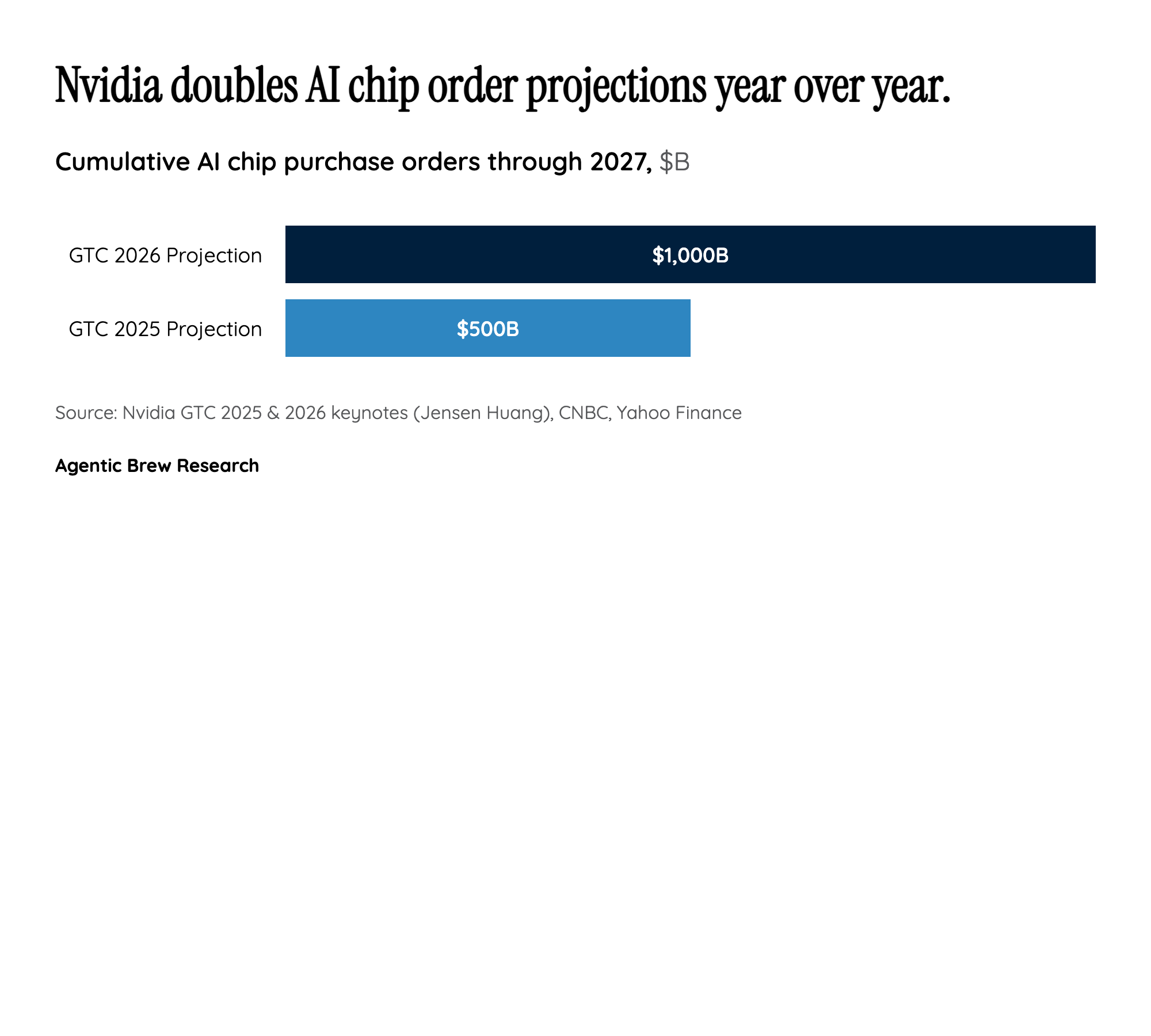
    At Nvidia GTC 2026 in San Jose (March 16-19), CEO Jensen Huang projected $1 trillion in cumulative AI chip purchase orders through 2027, doubling the prior year's $500 billion estimate, driven by Blackwell and Vera Rubin platform demand.
  • 02.
    Nvidia unveiled the Vera Rubin platform integrating seven co-designed chips — including the Rubin GPU at 3.6 ExaFLOPS FP4 and the Groq 3 LPU from its $17-20 billion Groq acquisition — delivering 10x inference throughput per watt versus Blackwell at one-tenth the cost per token.
  • 03.
    Jensen Huang declared every company needs an OpenClaw strategy, as OpenClaw surpassed 100,000 GitHub stars and 2 million visitors in its first week, while Nvidia launched NemoClaw as the enterprise-secure variant built on Nemotron models.
  • 04.
    The conference featured 450+ sponsors, 1,000+ sessions, and 2,000+ speakers, with major announcements spanning physical AI for robotics, the Feynman architecture roadmap for 2028, DLSS 5 neural frame generation, and Space-1 orbital data center modules.

Deep Analysis

Why This Matters

Nvidia's $1 trillion projection is not merely a forecast — it is a demand signal that reshapes capital allocation across the entire technology industry. When the world's dominant AI chip supplier doubles its cumulative order estimate in a single year, it forces hyperscalers, sovereign AI programs, and enterprise buyers to recalibrate procurement timelines and infrastructure budgets. The projection implies that AI compute demand is not decelerating post-training-boom but actually accelerating as inference workloads — powering agents, retrieval systems, and real-time applications — begin to dwarf training in total FLOP consumption.

The strategic incentive structure is clear: Nvidia is positioning itself as the indispensable infrastructure layer for an inference-dominated era. By acquiring Groq and integrating its LPU technology, Nvidia preemptively neutralized a potential competitive threat in low-latency inference while adding a differentiated product line. The OpenClaw strategy further deepens lock-in by making Nvidia's platform the default runtime for open-source AI models, creating a flywheel where developer adoption drives hardware demand. For hyperscalers like AWS (1M+ GPUs deployed) and Microsoft Azure, the cost of not being on Nvidia's roadmap now exceeds the cost of dependency.
How It Works

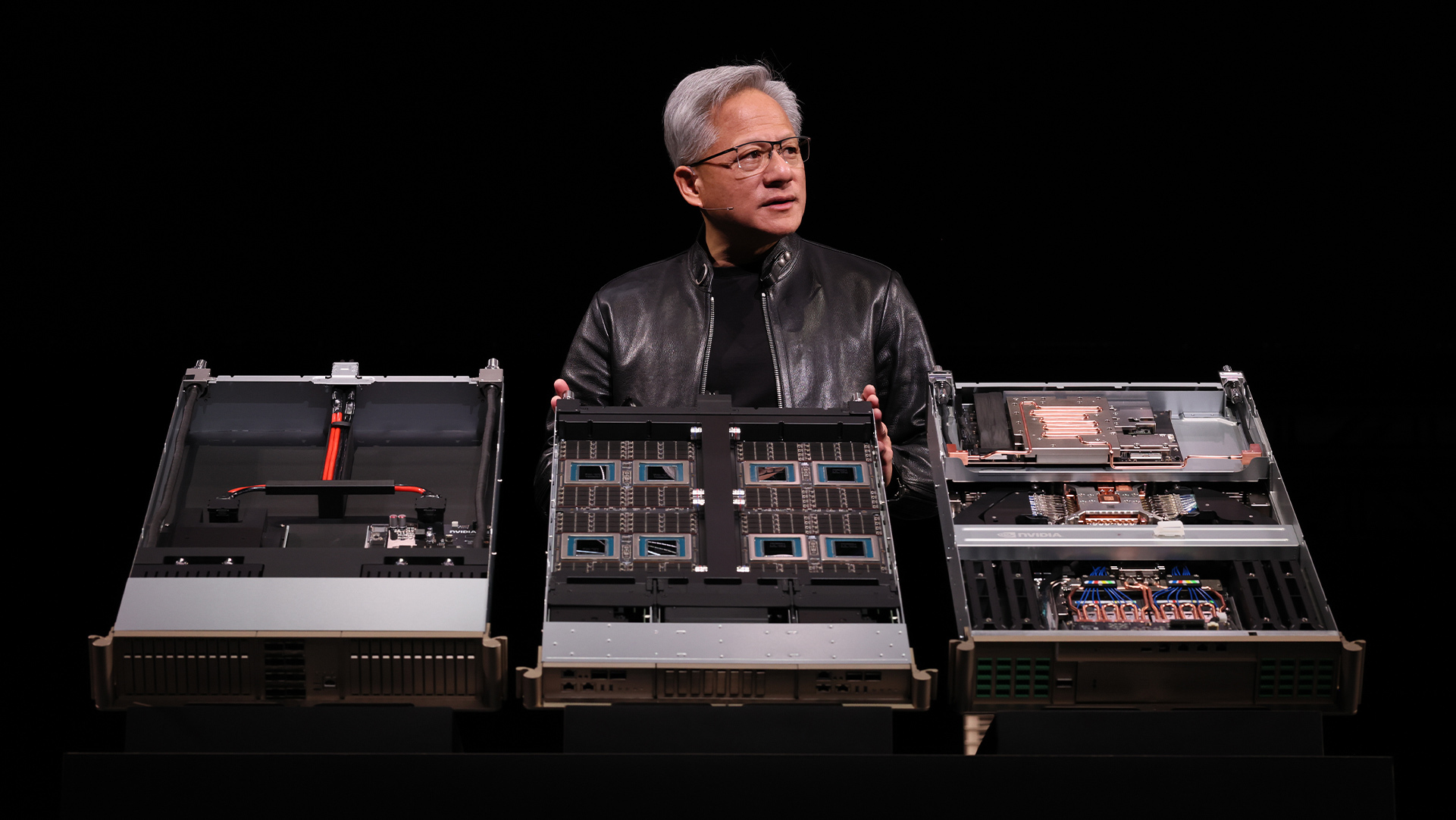
The Vera Rubin platform represents Nvidia's most ambitious full-stack design, integrating seven co-designed chips into five rack-scale systems. At its core, the Rubin GPU delivers 3.6 ExaFLOPS of FP4 compute — a 2.5x increase over Blackwell's 1.44 ExaFLOPS — with HBM4 memory bandwidth reaching approximately 22 TB/s compared to Blackwell's 8 TB/s. The NVLink 6 interconnect provides 3.6 TB/s per GPU, enabling trillion-parameter models to be served across disaggregated racks without the latency penalties of traditional network fabrics. The Vera CPU brings 88 Olympus ARM cores per socket, with racks scaling to 256 CPUs and 400TB of shared memory.

The Groq 3 LPU integration is architecturally significant. Unlike GPUs optimized for parallel matrix operations, the LPU uses a deterministic, SRAM-based architecture designed for sequential token generation — the bottleneck in autoregressive inference. The LPX rack packs 256 LPUs with 128GB of on-chip SRAM and 640 TB/s internal bandwidth, achieving 35x higher inference throughput per megawatt than GPU-based alternatives. This disaggregated approach allows Nvidia to offer training-optimized (GPU) and inference-optimized (LPU) hardware within a unified platform, connected via NVLink 6 — a first in the industry. The DGX Station GB300 brings 748GB of coherent memory and 20 PFLOPS FP4 to workstation form factors, supporting trillion-parameter model experimentation without datacenter access.

By The Numbers

By The Numbers
Nvidia doubled its cumulative AI chip order projection from $500B at GTC 2025 to $1T at GTC 2026.

$1 trillion in projected cumulative AI chip orders through 2027, doubled from $500 billion the prior year. Nvidia's trailing 12-month data center revenue reached $192 billion, up 66% year-over-year. The Vera Rubin platform delivers 10x inference throughput per watt and 1/10th cost per token versus Blackwell. The Rubin GPU produces 50 PFLOPS per chip with 3.6 ExaFLOPS FP4 at rack scale, while HBM4 bandwidth reaches 22 TB/s — nearly 3x Blackwell's 8 TB/s.

The Groq 3 LPX rack achieves 35x higher inference throughput per megawatt compared to GPU-based inference. OpenClaw reached 100,000 GitHub stars and 2 million unique visitors in its first week. AWS alone has deployed more than 1 million Nvidia GPUs. Nvidia stock trades at approximately 38x trailing earnings, 69% above the sector median, reflecting market confidence in the growth trajectory. Computing demand has increased by a factor of one million in recent years, according to Huang. The NVL72 Rubin rack is estimated at $3.5-4 million per unit, according to technical breakdowns on Reddit's r/hardware community.

Impacts & What's Next

In the short term (2026), the Vera Rubin platform's production ramp will test global supply chains — particularly TSMC's advanced packaging capacity and HBM4 supply from SK Hynix and Samsung. Hyperscalers will race to deploy Groq 3 LPU racks for inference-heavy workloads, potentially reshaping cloud pricing for AI API services. NemoClaw's launch addresses the enterprise security gap that Reddit's r/LocalLLaMA community flagged, where exposed OpenClaw instances created vulnerability concerns.

In the medium term (2027-2028), the Feynman architecture's 3D die stacking and optical NVLink will push compute density beyond what current thermal and power delivery systems can support, likely requiring liquid cooling at every deployment scale. The automotive partnerships — Uber's 28-city robotaxi target, BYD and Hyundai on Drive Hyperion — position Nvidia to capture recurring revenue from physical AI deployments beyond the datacenter. The Space-1 orbital module, while niche, signals Nvidia's ambition to be the compute provider for satellite constellations and edge inference in connectivity-limited environments.

Long term, the $1 trillion projection raises a structural question: can hyperscaler capital expenditure sustain this pace? Reddit's r/stocks community expressed skepticism about cash flow sustainability, and even bullish analysts like Goldman Sachs felt compelled to address investor anxiety directly. If inference economics improve as dramatically as Vera Rubin promises (10x throughput/watt), the total addressable compute market expands — but the revenue per FLOP may compress, creating a volume-versus-margin tension Nvidia will need to navigate.

The Bigger Picture

GTC 2026 crystallizes a fundamental shift in the AI industry from a training-first to an inference-first paradigm. The Groq acquisition and LPU integration signal that Nvidia recognizes inference — not training — as the volume workload of the AI era. Every chatbot query, every agent action, every autonomous vehicle decision is an inference event, and the cumulative compute demand for inference is on track to exceed training by orders of magnitude. Nvidia's disaggregated architecture, with GPUs for training and LPUs for inference connected via unified NVLink fabric, is designed to capture both sides of this market.

The OpenClaw strategy represents Nvidia's most aggressive platform play since CUDA. By establishing OpenClaw as the default open-source AI runtime — and then offering NemoClaw as the enterprise upgrade — Nvidia replicates the open-core business model that drove adoption for companies like Red Hat and MongoDB, but at infrastructure scale. The 100K GitHub stars in one week suggest genuine developer momentum, though Reddit skeptics rightly note the difference between stars and production deployments. If OpenClaw achieves the ubiquity Huang envisions, it becomes the Linux of AI inference — and Nvidia becomes the hardware layer that every OpenClaw deployment requires.

Broader, the conference underscores that AI infrastructure is becoming a geopolitical asset. Sovereign AI initiatives, Microsoft's Azure Local for sovereign deployments, and even the Space-1 orbital module all point toward a world where compute capacity is a strategic resource comparable to energy reserves. Nvidia's position at the center of this buildout — supplying chips, software stacks, and reference architectures to every major economy — gives it unprecedented influence over the pace and direction of AI deployment globally.

Historical Context

2024-03-18
At GTC 2024, Jensen Huang unveiled the Blackwell GPU architecture and first projected a multi-hundred-billion-dollar AI infrastructure buildout, setting the stage for the accelerated roadmap.
2025-03-17
GTC 2025 introduced the Vera Rubin roadmap and projected $500 billion in cumulative AI chip orders, which would be doubled one year later.
2025-12-01
Nvidia completed the acquisition of Groq for approximately $17-20 billion in an asset deal, bringing Groq's low-latency inference LPU technology in-house.
2026-03-16
Jensen Huang delivered the GTC 2026 keynote projecting $1 trillion in AI chip orders through 2027 and unveiling the full Vera Rubin platform with integrated Groq 3 LPUs.
2026-03-16
Nvidia announced NemoClaw as the enterprise-secure version of OpenClaw, alongside OpenClaw surpassing 100K GitHub stars within its first week.
2026-03-17
Nvidia published the Feynman architecture roadmap targeting 2028 with 3D die stacking, Rosa CPU, optical NVLink, and TSMC A16 1.6nm process technology.

Power Map

Key Players
Subject

Nvidia GTC 2026: Jensen Huang keynote and $1 trillion AI chip market projection

NV

Nvidia

Dominant AI chip maker; unveiled Vera Rubin platform, projected $1T in AI chip orders, and set the industry roadmap through Feynman (2028)

OP

OpenAI

Leading AI lab and major Nvidia customer; CEO Sam Altman publicly endorsed Vera Rubin for scaling models and agents

AN

Anthropic

AI safety-focused lab; CEO Dario Amodei validated Vera Rubin's compute and networking design for agentic AI workloads

HY

Hyperscale cloud providers (AWS, Microsoft Azure, CoreWeave, Oracle)

Primary deployment channel for Nvidia silicon; AWS alone has deployed 1M+ Nvidia GPUs, with all major clouds integrating Vera Rubin and Groq 3 LPUs

AU

Automotive OEMs (Uber, BYD, Hyundai, Nissan, Geely, Isuzu)

Adopting Nvidia Drive Hyperion for L4 autonomous vehicles; Uber targeting robotaxi fleets across 28 cities by 2028

IN

Industrial robotics firms (ABB, FANUC, KUKA, Universal Robots)

Integrating Nvidia's physical AI platform for next-generation industrial automation and robot intelligence

THE SIGNAL.

Analysts

"Projected $1 trillion in cumulative AI chip purchase orders through 2027, calling it 'the greatest infrastructure buildout in history.' Declared that 'every single company in the world today has to have an OpenClaw strategy' and characterized OpenClaw as 'the most popular open source project in history of humanity.'"

Jensen Huang
CEO, Nvidia

"Endorsed the Vera Rubin platform, stating 'With NVIDIA Vera Rubin, we'll run more powerful models and agents at massive scale,' signaling OpenAI's continued deep reliance on Nvidia hardware for frontier model training and inference."

Sam Altman
CEO, OpenAI

"Praised Vera Rubin for providing 'the compute, networking and system design' needed to power agentic AI workflows, validating Nvidia's full-stack approach to inference-era infrastructure."

Dario Amodei
CEO, Anthropic

"Called the GTC announcements a 'confidence boost' for investors, asserting that Nvidia stands 'alone at the top of the AI mountain,' reinforcing his bullish thesis on AI infrastructure spending."

Dan Ives
Senior Analyst, Wedbush Securities

"Highlighted that the STX architecture enables a 'critical performance boost needed to exponentially scale agentic AI efforts,' underscoring the inference-first design philosophy's relevance for open-weight model developers."

Timothée Lacroix
CTO, Mistral AI
The Crowd

"MAJOR INTERVIEW: Jensen Huang joins the Besties! The @nvidia CEO joins to discuss: -- Nvidia future, roadmap to $1T revenue -- Physical AI $50T market -- Rise of the agent, OpenClaw inflection moment -- Inference explosion, Groq deal -- AI PR Crisis, Anthropic comms"

@@theallinpod1000

"Jensen Huang on OpenClaw at NVIDIA GTC 2026. OpenClaw is the number one, most popular open source project in the history of humanity, and it did so in just a few weeks. It exceeded what Linux did in 30 years."

@@rohanpaul_ai345

"Andrej Karpathy lab has received the first DGX Station GB300 -- a Dell Pro Max with GB300. We cant wait to see what youll create @karpathy"

@@NVIDIAAIDev4400

"Nvidia GTC 2026: CEO Jensen Huang sees $1 trillion in orders for Blackwell and Vera Rubin through 27"

@u/unknown187
Broadcast
NVIDIA GTC Keynote 2026

NVIDIA GTC Keynote 2026

NVIDIA GTC 2026 Keynote: Everything That Happened in 12 Minutes

NVIDIA GTC 2026 Keynote: Everything That Happened in 12 Minutes

NVIDIA CEO Jensen Huang Leaves Everyone SPEECHLESS (GTC Supercut)

NVIDIA CEO Jensen Huang Leaves Everyone SPEECHLESS (GTC Supercut)