OpenAI-AWS partnership ends Microsoft's exclusive cloud reseller hold
TECH

OpenAI-AWS partnership ends Microsoft's exclusive cloud reseller hold

30+
Signals

Strategic Overview

  • 01.
    On April 28, 2026, AWS and OpenAI expanded their partnership to bring OpenAI's latest models, the Codex coding agent, and Amazon Bedrock Managed Agents (powered by OpenAI) to Bedrock in limited preview.
  • 02.
    OpenAI's total commitment to AWS now stands at roughly $138 billion after a $100 billion expansion on top of the original $38 billion seven-year deal signed in November 2025.
  • 03.
    Microsoft's previously exclusive license to OpenAI IP transitioned to a nonexclusive license through 2032, and AWS becomes the exclusive third-party cloud distribution provider for OpenAI Frontier.
  • 04.
    Amazon committed to invest up to $50 billion in OpenAI ($15B initial, $35B contingent), and OpenAI committed to consume approximately 2GW of AWS Trainium capacity across Trainium3 and the upcoming Trainium4 chips expected in 2027.

Deep Analysis

Strategy followed physics: Azure simply ran out of room

The official narrative casts the AWS deal as OpenAI choosing multi-cloud independence and Microsoft graciously letting go. The more grounded read, surfaced in community discussion on r/microsoft and r/singularity, is that the deal was forced by capacity, not strategy: Microsoft's data centers physically could not rack enough GPUs fast enough to satisfy OpenAI's compute appetite once the Stargate program, the $300B Oracle partnership, and an additional $138B AWS commitment were stacked on top of existing Azure consumption. Exclusivity is a luxury you can only afford if you can deliver the hardware.

This reframes the April 27 restructure from a competitive concession into a logistical settlement. Microsoft kept what it could defend — equity, an IP license through 2032, and a revenue-share stream from OpenAI — while giving up an exclusivity clause it could no longer operationally enforce. Read this way, AWS did not pry OpenAI loose; it absorbed the overflow, then formalized that role with the 'exclusive third-party cloud distribution' designation. The buried implication for the rest of the AI industry is that even hyperscaler-scale capex is now a binding constraint on frontier-model strategy, and contractual exclusivity with a single cloud has a short half-life when training-cluster demand is doubling year over year.

The cash-flow reversal nobody is leading with

The widely-reported headline is that Microsoft 'lost' exclusivity. The buried lede is that the direction of money flowing between Microsoft and OpenAI flipped. Under the original arrangement, Microsoft paid OpenAI a revenue share on certain product revenues, with termination triggers tied to the formal declaration of AGI — a clause whose ambiguity was a live source of legal risk. Under the new contract, those AGI-linked exit triggers are gone, replaced with a hard 2032 end-date on Microsoft's nonexclusive IP license; OpenAI continues paying Microsoft a (now-capped) revenue share through 2030; and Microsoft retains roughly a 27% equity stake.

In other words: the patron became a royalty recipient with an equity ride. Barclays' read that the deal frees Microsoft capital for Copilot expansion captures only half the story — Microsoft is no longer financially carrying the AGI bet, it is collecting on it. Reddit threads on r/microsoft were the first to articulate this clearly, noting that the AGI-clause neutralization alone — converting a probabilistic termination event into a fixed calendar — meaningfully changes the option value of Microsoft's position. For OpenAI, the trade is mobility: a revenue share to Microsoft is the price of being allowed to sell directly through every other cloud, and the cap means that price is bounded.

Follow the money: $440B in compute promises against a $25B annual burn

Follow the money: $440B in compute promises against a $25B annual burn
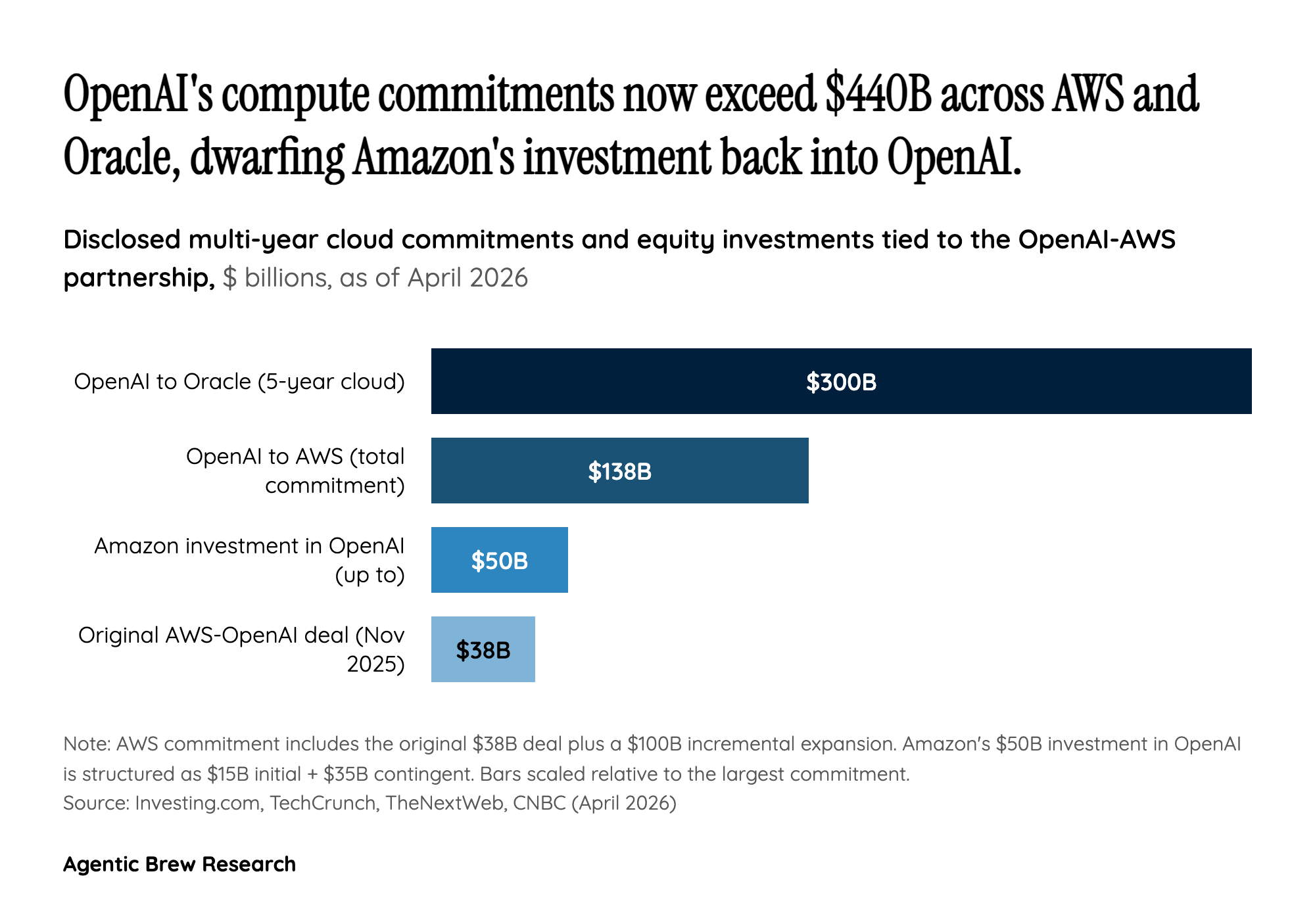
OpenAI's disclosed multi-year cloud commitments (AWS $138B + Oracle $300B) dwarf Amazon's up-to-$50B investment back into OpenAI.

Stack OpenAI's disclosed multi-year cloud commitments and the scale problem becomes obvious. OpenAI has committed roughly $138B to AWS (an original $38B seven-year deal plus a $100B incremental expansion), $300B to Oracle over five years, and continues to spend on Azure — for a disclosed compute liability that exceeds $440B before counting Microsoft. Against that, OpenAI is reportedly tracking toward roughly $25B of cash burn in 2026 versus a $30B revenue target. The contracts are denominated in real cloud capacity; the revenue is not yet there to pay for it.

This is what makes Amazon's up-to-$50B investment back into OpenAI structurally important rather than symbolic: it is partial financing of the very commitment OpenAI is making to AWS — $15B upfront and $35B contingent on conditions, an arrangement that lets Amazon recognize cloud revenue while underwriting the customer's ability to pay for it. The same circular structure exists in the Oracle and Microsoft relationships. Every named voice that publicly cheered the deal — Morgan Stanley raising Amazon's price target to $300, AWS leadership framing growth as 'de-risked,' D.A. Davidson calling it essential for enterprise viability — is implicitly assuming OpenAI's revenue catches up to the compute it has booked. If it does not, the chart below describes the largest concentration of counterparty risk in the AI infrastructure market.

AWS Trainium just got the anchor tenant the GPU-alternative thesis needed

Buried inside the dollar figures is a silicon-strategy story that may matter more long-term than the headline cloud share. OpenAI committed to consume approximately 2GW of AWS Trainium capacity, spanning the current Trainium3 chips and the upcoming Trainium4 expected in 2027. Until now, the entire frontier-training market has been a Nvidia monopoly with a thin layer of Google TPU usage at Google itself. OpenAI — the most prestigious training workload in the industry — running production capacity on Trainium is the first credible external endorsement of a non-Nvidia, non-Google AI chip at scale.

This is the part of the deal Bloomberg's coverage and the official AWS panel on agentic AI emphasized but financial commentary largely skipped. If Trainium3 / Trainium4 prove out on OpenAI workloads, the implications cascade: AWS gains margin recovery on a workload class where Nvidia currently captures most of the economics, hyperscaler capex models no longer assume permanent Nvidia gross-margin compression, and other labs' Trainium adoption stops looking idiosyncratic. The risk is symmetric: a publicly visible underperformance on OpenAI workloads would be the loudest negative signal Trainium could receive. Either way, the 2GW number is the data point to watch over the next 18 months.

The contrarian read: Microsoft may have actually won

Mainstream financial press — Bloomberg's segments on the severed exclusive pact, CNBC's coverage of the AWS launch — framed Microsoft as the strategic loser, and commentary on X largely echoed that, including one widely-shared post characterizing the move as Sam Altman's 'software-patch breakup.' The Reddit conversation on r/microsoft and r/OpenAI, and Barclays' equity note, point the opposite direction. Microsoft (a) keeps a roughly 27% equity stake in what is being treated as a multi-trillion-dollar company, (b) stops paying OpenAI a revenue share, (c) starts collecting a capped revenue share from OpenAI through 2030, (d) retains a nonexclusive IP license through 2032 that includes model and product rights, and (e) is freed to invest in alternative model providers — most obviously Anthropic inside Copilot — without contractual friction.

What Microsoft gave up was a piece of paper that, per the capacity argument above, it could not have enforced anyway. What it kept is the financial upside of the AGI bet without the capex obligation to feed it. The pragmatic, analytical tone in the r/microsoft thread — focused on Microsoft's MAI agents, Copilot direction, and the cash-flow reversal — captures this read better than the headlines do. The genuine open question is whether Microsoft can convert its newfound model-agnosticism into a product story enterprise customers prefer over a Bedrock-mediated OpenAI experience. Copilot's next 18 months of feature velocity is the test.

Historical Context

2025-11-03
OpenAI signed an initial $38B seven-year cloud deal with AWS to access hundreds of thousands of Nvidia GB200 and GB300 chips via EC2 UltraServers — the first time OpenAI committed material capacity outside Microsoft Azure.
2026-02
After OpenAI announced the headline Amazon investment, Microsoft asserted that Azure remained the exclusive cloud provider of stateless OpenAI APIs, opening a legal front over the new partnership's scope.
2026-04-27
OpenAI and Microsoft restructured commercial terms: exclusive reselling rights were dropped, the IP license became nonexclusive through 2032, and the cash-flow direction on revenue share reversed.
2026-04-28
One day after the Microsoft restructure, AWS launched OpenAI models, Codex (via CLI, desktop, and a VS Code extension), and Bedrock Managed Agents in limited preview.

Power Map

Key Players
Subject

OpenAI-AWS partnership ends Microsoft's exclusive cloud reseller hold

OP

OpenAI

Gains multi-cloud distribution by selling its frontier models, Codex, and Managed Agents directly through AWS Bedrock while continuing to operate on Microsoft Azure, Oracle, and Google. The shift converts OpenAI from a de facto Microsoft-tethered vendor into a horizontal AI distributor.

AM

Amazon Web Services

Becomes the exclusive third-party cloud distribution provider for OpenAI Frontier and locks in a $138B multi-year compute commitment that anchors AWS's growth narrative and validates Trainium as a credible Nvidia alternative.

MI

Microsoft

Loses exclusive reselling rights to OpenAI products but retains a nonexclusive IP license through 2032, keeps its roughly 27% equity position, and is freed from paying OpenAI a revenue share — converting the relationship from cost-bearing patron to net royalty recipient through 2030.

AN

Andy Jassy (Amazon CEO)

Public face of the agreement, framing AWS Bedrock as the new direct on-ramp for OpenAI models rather than Microsoft's stack — a positioning that reframes Bedrock from a model-aggregator to the default enterprise distribution layer.

BO

Box

Named launch enterprise customer for Bedrock Managed Agents powered by OpenAI, signaling that production agent deployment, not chat, is the wedge AWS is selling.

Source Articles

Top 4

THE SIGNAL.

Analysts

"Framed the deal as direct OpenAI access through AWS Bedrock, removing the requirement to go through Microsoft's stack: "Starting 'in the coming weeks,' you'll access OpenAI models directly through AWS Bedrock instead of being forced into Microsoft's ecosystem.""

Andy Jassy
CEO, Amazon

"Argued the restructure was essential for OpenAI to expand beyond a single hyperscaler: "The new deal with Microsoft was essential for OpenAI to be successful in the enterprise market.""

Gil Luria
Analyst, D.A. Davidson

"Raised Amazon's price target to $300 and lifted AWS growth forecasts to 29% (2026) and 32% (2027), arguing the OpenAI commitment "effectively de-risks the AWS growth narrative for the next several years.""

Morgan Stanley equity research
Equity research, Morgan Stanley

"Read the deal as a positive for Microsoft as well: it frees up capital previously committed to OpenAI revenue share for Copilot expansion and other cloud capacity investments."

Barclays equity research
Equity research, Barclays

"Highlighted enterprise demand for production-scale agent deployment using Bedrock-hosted OpenAI models: "Enterprises are currently looking to deploy agents to deliver solutions...developers can build optimized, production-scale AI applications.""

Ben Kus
CTO, Box
The Crowd

"To meet the rapid pace of innovation, we've announced the next phase of our partnership with @Microsoft. Here are the toplines: 1. Microsoft is still OpenAI's primary cloud partner, with first access 2. Microsoft will have a non-exclusive license to OpenAI IP 3. Microsoft..."

@@OpenAINewsroom0

"BIG NEWS from #WhatsNextWithAWS: Amazon announced a major expansion of our partnership with @OpenAI. Starting today, @awscloud and OpenAI are bringing the latest OpenAI models to Amazon Bedrock, launching Codex on Amazon Bedrock, and launching Amazon Bedrock Managed Agents,"

@@amazon0

"Sam announced a breakup and framed it like a software patch. "We have updated our partnership." That's it. That's the whole announcement. What it actually says. Microsoft put in $13B for exclusive cloud access to OpenAI. That exclusivity is now gone. Revenue share payments are..."

@@aaditsh0

"OpenAI ends its exclusive partnership with Microsoft"

@u/JackFisherBooks388
Broadcast
OpenAI Drops Exclusivity Deal with Microsoft | Bloomberg Tech 4/27/2026

OpenAI Drops Exclusivity Deal with Microsoft | Bloomberg Tech 4/27/2026

Microsoft, OpenAI Sever Their Exclusive AI Pact

Microsoft, OpenAI Sever Their Exclusive AI Pact

What's Next with AWS - AWS and OpenAI leaders on Agentic AI | Amazon Web Services

What's Next with AWS - AWS and OpenAI leaders on Agentic AI | Amazon Web Services