Nvidia loses China AI chip market share
TECH

Nvidia loses China AI chip market share

38+
Signals

Strategic Overview

  • 01.
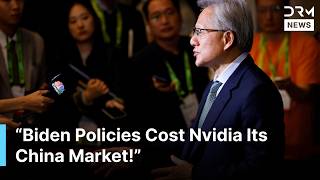
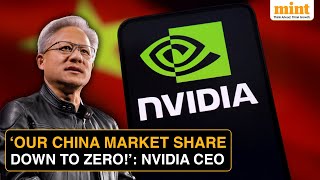
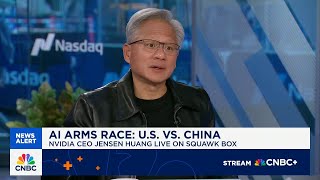
    Nvidia CEO Jensen Huang says the company's AI chip market share in China has fallen from roughly 95% to 0%, attributing the wipeout to U.S. export restrictions.
  • 02.
    Despite a U.S. license in February 2026 to ship H200 chips to China with a 25% revenue tax to the U.S. government, Nvidia generated no H200 revenue from China and projects zero China revenue for Q1 FY2026.
  • 03.
    Beijing has reportedly instructed Chinese tech companies to limit Nvidia chip use to overseas operations and prefer domestic alternatives, contributing to a customs-clearance stalemate for H200 shipments.
  • 04.
    Nvidia generated $19.67 billion in full fiscal-year 2026 revenue from China and Hong Kong, but Huang warns that losing the market would materially harm the company and accelerate a bifurcated global AI ecosystem.

Deep Analysis

How 95% Became Zero in Two Years

The collapse Huang described did not come from a single ban. It came from a slow strangulation of every product Nvidia tried to sell into China and a parallel push from Beijing telling its biggest buyers to look elsewhere. The H100 and A100 were blocked outright in August 2022. Nvidia responded by designing the H800, a clipped variant. That worked for less than a year before October 2023 rules expanded to cover the H800 and L40S as well. Nvidia then designed the H20 specifically for China. In April 2025, the H20 was itself put under a license requirement, triggering a $5.5B inventory charge — and an even bigger Q2 FY2026 revenue hole estimated at $8B by the company. By August 2025, Nvidia and AMD had agreed to remit 15% of China-chip revenue to the U.S. Treasury in exchange for licenses. By February 2026, that toll had climbed to 25% for the H200.

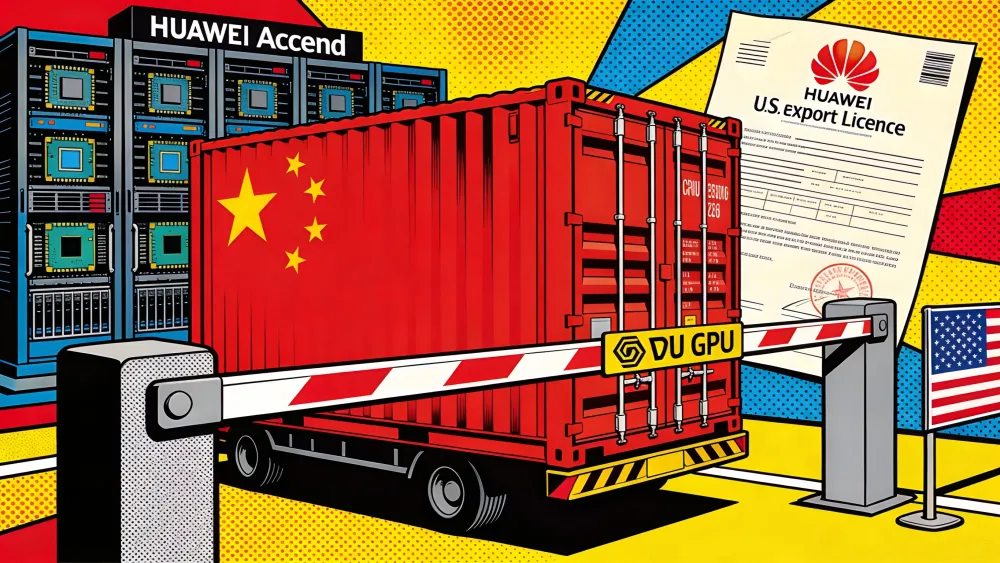
The paper licenses turned out to be theater. Commerce Secretary Howard Lutnick confirmed the H200 chips never actually shipped to Chinese customers. Reporting cited by Tom's Hardware shows Beijing has instructed Chinese tech companies to limit Nvidia chips to their overseas operations and prioritize domestic silicon at home, leaving H200 inventory stuck in customs limbo. Huang's '95 to 0' isn't shorthand — it's an accurate description of what happens when an exporter gets a license that the destination country no longer wants to honor. Nvidia's $19.67B in FY2026 China + Hong Kong revenue is now the high-water mark; the company is forecasting zero China revenue in Q1 FY2026.
Why CUDA, Not the Silicon, Is the Real Prize

The conventional read of this story is that China lost Nvidia's transistors. The sharper read, articulated most clearly by Bob O'Donnell of TECHnalysis Research, is that Nvidia is losing something far more valuable: the developer ecosystem on top of CUDA. 'It's increasingly about the software and the models,' O'Donnell told Yahoo Finance. 'The bigger concern ultimately in China going to be whether or not CUDA gets replaced, more so than the chips themselves.' Hardware advantage is a snapshot; toolchain lock-in is a moat. For 15 years CUDA has been the default substrate for AI research because every paper, every kernel, every optimization assumed it. Strip that assumption out of the world's second-largest AI market and the moat starts draining.

Huang's own language during the interview betrays exactly this fear. He warned against 'two ecosystems: the open-source ecosystem [that] only runs on a foreign tech stack, and a closed ecosystem that runs on the American tech stack.' Translated: if Chinese open-source models — already used by a striking share of U.S. AI startups according to Huang — only run cleanly on Huawei or Cambricon, then American AI builders eventually need a translation layer or a parallel stack just to use them. Nvidia's own 10-K filing makes the same admission in regulatory prose: 'Our effective foreclosure from the China market helped our competitors build larger developer and customer ecosystems to challenge us worldwide.' That sentence is the entire policy critique in one line, written under penalty of securities law.

Huawei Eats the Table

Huawei Eats the Table
Huawei AI chip revenue is climbing 60% as Nvidia's China revenue collapses to zero, with ByteDance alone committing $5.6B in 2026 Ascend orders.

Every dollar Nvidia is forced to leave on the table is being picked up by a small set of Chinese vendors, with Huawei eating the largest share. Huawei's AI chip revenue is projected to jump from $7.5B in 2025 to roughly $12B in 2026, a 60% surge driven directly by orders that would have gone to Nvidia. Production targets for the Ascend 950PR alone reach about 750,000 units in 2026. ByteDance has committed $5.6B in Ascend orders for the year. Cumulative domestic Chinese AI GPU deliveries have already crossed 1.65 million units, and Cambricon — a second-tier player — pulled $423M in a single quarter. Morgan Stanley projects China's AI chip market will hit $67B by 2030, with more than 80% captured by domestic firms.

The demand-side signal that ties this together is DeepSeek V4. The 1.6 trillion-parameter mixture-of-experts model launched on April 24, 2026 was deliberately optimized for Huawei and Cambricon silicon, with no Nvidia kernel path. When the most-cited Chinese open-source lab releases its frontier model on domestic hardware, every downstream Chinese deployer has both a permission slip and a working blueprint to skip Nvidia. An ML hardware sourcing engineer noted in a top Reddit thread that 'two years ago nobody even considered Chinese GPUs. Now they're on every shortlist' — a sentiment that, taken across hyperscaler procurement teams, explains why Bernstein's bearish 8% projection got blown through to 0% inside a year.

The Policy Paradox: A Backfire Admitted in the 10-K

The most damning critique of U.S. export controls is no longer coming from Huang's stage performances — it's in Nvidia's own SEC filing, which states that 'effective foreclosure from the China market helped our competitors build larger developer and customer ecosystems to challenge us worldwide.' That is the textbook definition of a backfired sanction: the target country built the capability the sanction was meant to deny it, and then started exporting it. Huang's blunter version on stage was that 'conceding an entire market the size of China probably doesn't make a lot of strategic sense' and that the policy 'has already largely backfired.' The 25% revenue toll on the H200 is a particularly absurd manifestation — Washington taxes a chip China refuses to buy.

Community reaction across r/technology and adjacent forums has converged on the same read with unusual clarity. The dominant framing in the highest-upvoted threads treats the export regime as having 'speedrun' the Chinese GPU industry into existence, with one widely circulated comment summarizing it as 'America lost even more, and now China has built its own domestic chips to fill those massive orders.' The contrarian voices that do exist push narrower points: that Chinese chips still trail Nvidia by roughly 4x on raw performance, and that Huang sidestepped harder questions about whether keeping Nvidia in China would actually have slowed Beijing's chip program. Both are fair caveats. Neither rebuts the central data point — the share went to zero, and the policy goal of constraining Chinese AI did not materialize.

Historical Context

2022-08-31
U.S. blocked exports of A100 and H100 chips to China; Nvidia disclosed up to $400M in lost Q3 sales.
2023-03-21
Nvidia introduced the H800, a China-compliant variant of the H100, to keep selling under tightening rules.
2023-10-17
Tightened export rules expanded to A100, A800, H100, H800, and L40S, prompting Nvidia to design the China-only H20.
2025-04-15
H20 and equivalent-bandwidth chips placed under license requirement; Nvidia took a $5.5B charge on H20 inventory.
2025-08-10
Nvidia and AMD agreed to remit 15% of China-chip revenue to the U.S. government in exchange for H20/MI308 export licenses.
2026-02
Nvidia received an H200 export license to China carrying a 25% revenue tax to the U.S. government, but no chips actually moved.
2026-04-24
DeepSeek launched V4, a 1.6T-parameter MoE model optimized for Huawei Ascend chips, signaling explicit Nvidia-stack decoupling.
2026-04-30
Huang publicly disclosed Nvidia's China AI chip market share had collapsed from ~95% to 0% and called the export-control policy a strategic backfire.

Power Map

Key Players
Subject

Nvidia loses China AI chip market share

NV

Nvidia / Jensen Huang

U.S. AI chip leader whose CEO is publicly lobbying against export controls, citing zero China revenue, displaced ecosystem influence, and CUDA's eroding moat as existential risks.

U.

U.S. Commerce Department / BIS

Architect of escalating export controls since 2022, granting conditional H200 licenses with a 25% revenue tax in 2026 even as the policy hands China to domestic chipmakers.

HU

Huawei

Leading Chinese domestic AI chip maker (Ascend 910/950PR/950DT) and primary beneficiary of Nvidia's exit, with revenue projected to climb from $7.5B in 2025 to ~$12B in 2026.

DE

DeepSeek

Chinese AI lab whose 1.6T-parameter V4 MoE model is deliberately optimized for Huawei and Cambricon silicon, signaling explicit decoupling of model development from Nvidia's stack.

BY

ByteDance, Alibaba Cloud, Tencent Cloud

Major Chinese hyperscaler buyers redirecting GPU orders to Huawei Ascend; ByteDance alone has committed $5.6B in 2026 Ascend purchases.

CA

Cambricon, Moore Threads, MetaX

Second-tier Chinese chipmakers building domestic AI silicon and software stacks; cited in Nvidia's 10-K as competitors gaining ground globally.

Source Articles

Top 3

THE SIGNAL.

Analysts

"Earlier projected Nvidia's China AI GPU share would fall from 66% in 2024 to roughly 8%; the actual outcome (0%) significantly overshot even bearish forecasts."

Bernstein
Wall Street equity research

"Argues the long-term risk for Nvidia in China is software displacement: 'The bigger concern ultimately in China going to be whether or not CUDA gets replaced, more so than the chips themselves.'"

Bob O'Donnell
Chief Analyst, TECHnalysis Research

"Projects China's AI chip market reaching $67 billion by 2030, with domestic Chinese firms capturing more than 80% of that spend."

Morgan Stanley
Sell-side equity research

"Acknowledges the strategic cost: 'Our effective foreclosure from the China market helped our competitors build larger developer and customer ecosystems to challenge us worldwide.'"

Nvidia 10-K disclosure
Nvidia SEC filing

"Confirmed that despite the H200 export license, the chips have not actually been sold to Chinese companies — capturing the gap between policy on paper and on-the-ground reality."

Howard Lutnick
U.S. Commerce Secretary
The Crowd

"Jensen Huang: "We (Nvidia) are 100% out of China. We went from 95% market share to 0%. I can't imagine any policymaker thinking that's a good idea." Chinese AI labs like DeepSeek now have to use Chinese chips for both inference and training. Chinese chips will inevitably rise"

@@Yuchenj_UW0

"Nvidia CEO Jensen Huang said last week that the company's share of China's advanced AI accelerator market has collapsed from roughly 95% to zero as US export controls continue to bite."

@@tomshardware0

"NVIDIA CEO JENSEN HUANG: WE ARE 100% OUT OF CHINA. "At the moment, we are 100% out of China. We went from 95% market share to 0%. I can't imagine any policymaker thinking that that's a good idea. That whatever policy we implemented caused America to lose one of the largest [markets in the world].""

@@MarioNawfal0

"Nvidia CEO Jensen Huang 'nearly lost his composure' when pressed on selling chips to China — 'You're not talking to someone who woke up a loser'"

@u/Logical_Welder346718000
Broadcast
Nvidia CEO Jensen Huang on AI race vs. China: Overall we're not far ahead

Nvidia CEO Jensen Huang on AI race vs. China: Overall we're not far ahead

"We Had 95%, Now Zero!" — Nvidia’s Jensen Huang Slams Biden Over China Chips Ban | AI1G

"We Had 95%, Now Zero!" — Nvidia’s Jensen Huang Slams Biden Over China Chips Ban | AI1G

US-China Trade War HITS NVIDIA: CEO Huang Says Market Share Drops From 95% to 0 | Here’s Why

US-China Trade War HITS NVIDIA: CEO Huang Says Market Share Drops From 95% to 0 | Here’s Why