Amazon Q1 2026 earnings: AWS AI growth and custom silicon momentum
TECH

Amazon Q1 2026 earnings: AWS AI growth and custom silicon momentum

31+
Signals

Strategic Overview

  • 01.
    AWS posted $37.6 billion in Q1 2026 revenue, up 28% year-over-year — its fastest growth pace in 15 quarters and a sharp reversal of multi-quarter deceleration.
  • 02.
    Amazon's custom silicon portfolio — Graviton, Trainium and Nitro — crossed a $20 billion annualized run rate, growing triple-digits year-over-year and roughly 40% quarter-over-quarter.
  • 03.
    AWS AI revenue surpassed a $15 billion run rate in the first three years of the AI wave — nearly 260 times AWS's $58 million run rate at the same stage of its original cloud build-out.
  • 04.
    Q1 capex hit $44.2 billion versus $25 billion a year earlier, and Amazon now expects roughly $200 billion of full-year 2026 capex, primarily for AWS AI infrastructure.

Deep Analysis

The 15-quarter high: what actually flipped at AWS

AWS's 28% Q1 2026 print is the segment's fastest growth pace since late 2022, and it landed on a base that has roughly tripled since then. The mechanical drivers Amazon disclosed are unusually concrete for an AI narrative: a $364B backlog (excluding the freshly signed $100B+ Anthropic deal), Bedrock customer spend up 170% quarter-over-quarter, and an AI revenue run rate above $15B. Bedrock processed more tokens in Q1 than in all prior years combined, suggesting the reacceleration is real workload throughput, not deferred-revenue accounting.

The second flip is competitive. For most of 2024-2025, AWS was the slowest-growing of the three big Western hyperscalers; this quarter, with Azure at 31% and Google Cloud at 28%, AWS is no longer the laggard on a percentage basis and is by far the largest in absolute dollars. Combine that with a 37.7% AWS operating margin and $14.2B of AWS operating income, and Amazon is doing something rivals are not — sustaining hyperscaler-grade margins while ramping AI capacity. The reacceleration is therefore better read as a vertical-integration dividend than as a one-quarter beat.

Trainium and the quiet emergence of a top-three datacenter chip business

The most strategically important number in the print is not AWS revenue — it is the $20B+ run rate for Amazon's custom silicon stack of Graviton, Trainium and Nitro, growing triple-digits year-over-year and roughly 40% quarter-over-quarter. Andy Jassy went further: if the chips were sold the way merchant vendors sell theirs, the run rate would be closer to $50B annually, putting Amazon among the top three datacenter chip businesses globally. Graviton is already used by 98% of AWS's top 1,000 EC2 customers and offers ~40% better price-performance than x86; Trainium2 is cited at ~30% better price-performance than 'comparable GPUs,' with Trainium3 layering on another 30-40%.

The demand side validates the claim. Trainium revenue commitments now exceed $225B across major AI labs and enterprises, Trainium3 is nearly fully subscribed, and much of Trainium4 is already reserved. Roughly 80% of Bedrock inference now runs on Trainium. Jassy's hint that AWS may eventually sell racks of its silicon to third parties — 'There's so much demand for our chips that it's quite possible we'll sell racks of them to third parties in the future' — would mark Amazon's first real merchant-silicon move and would land directly on Nvidia's and Intel's datacenter franchises.

Locking in both frontier labs: the Anthropic-OpenAI duopoly anchor

AWS is the only hyperscaler that has now anchored both leading frontier-model labs into its silicon and its model marketplace. Anthropic's deepened relationship — up to 5 GW of Trainium capacity, $100B+ of AWS spend over 10 years, and an additional $5B Amazon investment that takes the total stake to $13B — gives AWS a multi-decade workload baseline against which it can underwrite Trainium fab and datacenter commitments. The Q1 net income line carried a $16.8B mark-to-market gain on Anthropic stakes, a reminder that the partnership is also a balance-sheet asset.

OpenAI's roughly 2 GW Trainium commitment, paired with GPT-5.4 going live in Bedrock and GPT-5.5 inbound, is arguably the more surprising move. It converts a one-time competitive threat into a Bedrock distribution channel — and aligns OpenAI's training silicon roadmap, at the margin, with Trainium rather than purely with Nvidia. With Meta committing tens of millions of Graviton cores for agentic workloads and Uber adopting Trainium3 plus Graviton4, AWS is building the thing rivals lack: a portfolio where the leading labs and a credible enterprise tail both depend on the same custom silicon.

Capex up, free cash flow down 95%: why the market sold the beat

Capex up, free cash flow down 95%: why the market sold the beat
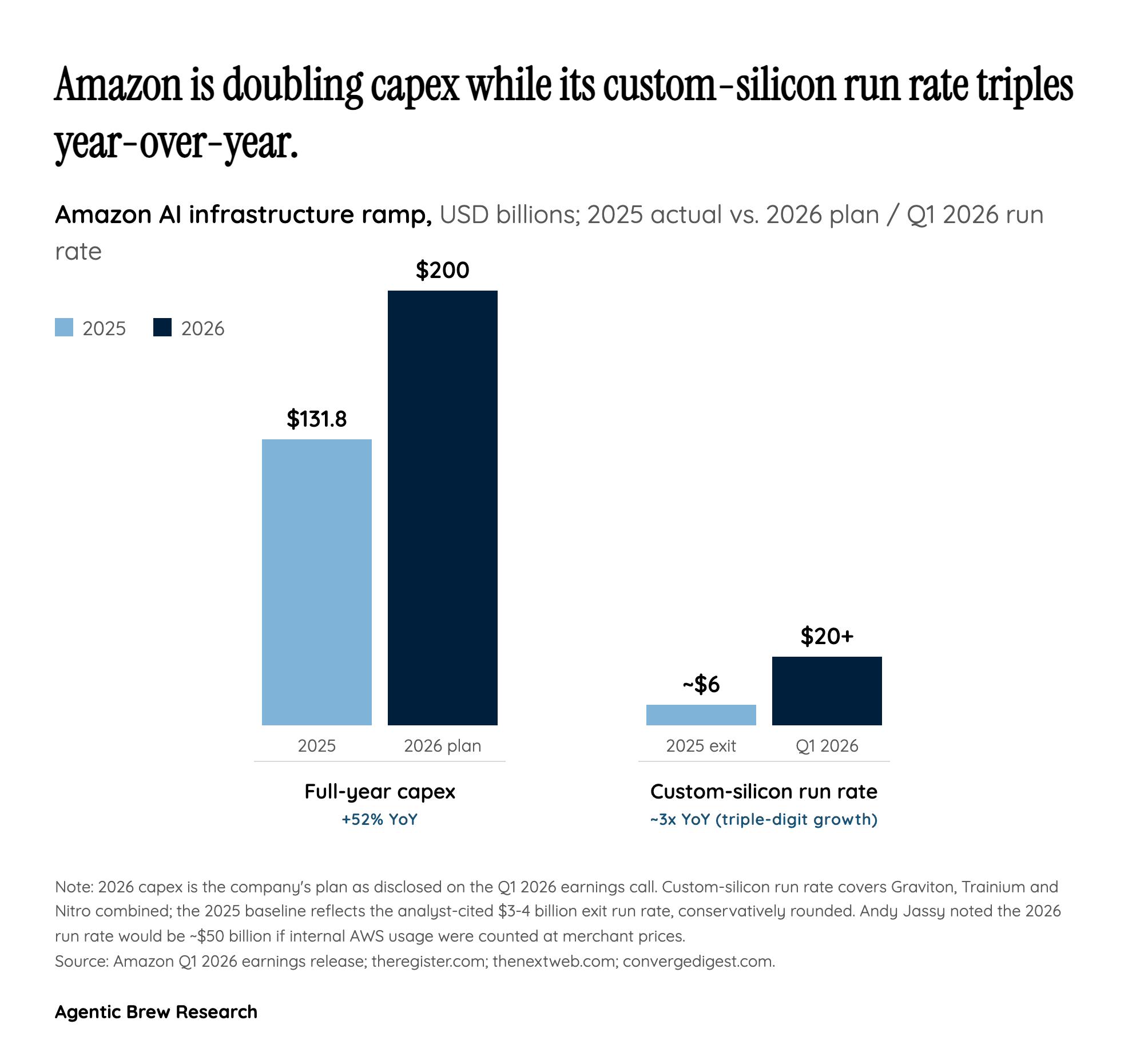
Amazon AI infrastructure ramp: full-year capex (USD billions) and custom-silicon run rate, 2025 actual vs. 2026 plan / Q1 2026 run rate.

The bear case lives in the cash-flow statement. Q1 2026 capex hit $44.2B versus $25B in Q1 2025, and Amazon now expects roughly $200B of capex for full-year 2026 — up from $131.8B in 2025. Trailing-twelve-month free cash flow has collapsed to about $1.2B, a roughly 95% year-over-year decline. Even a clean EPS beat of $2.78 against $1.64 consensus and total revenue of $181.5B (+17% YoY) was not enough to prevent a roughly 3% after-hours sell-off. The market is pricing the multi-year capital intensity, not the quarter.

The risk is structural rather than cyclical. Combined 2026 capex across Microsoft, Alphabet, Meta, Amazon and Apple is on track to exceed $650B, and Sundar Pichai's framing of the cycle as 'compute constrained in the near term' explains why hyperscalers are willing to take the FCF hit — but it does not eliminate the overbuild risk if frontier-model demand growth slows. For AWS specifically, the $364B backlog and $225B+ Trainium commitments provide an unusually concrete demand floor; the question investors are now underwriting is whether that floor holds across a full Trainium4 cycle.

The contrarian read: hyperscaler comparisons and the human cost narrative

Two contrarian threads run beneath the headline beat. The first is hyperscaler-rank arithmetic. While the equity-research framing celebrates AWS no longer being the slowest grower, investor discussion online has flagged a different comparison: at 28% growth AWS is being outpaced by Google Cloud's tripled-base print and by Azure on a percentage basis, even as it leads in absolute dollar adds and operating income. That tension — biggest in dollars, slowest in percent against the smallest peer — is shaping the next several quarters of analyst debate.

The second thread is the human-capital story embedded in the AI build-out. Alongside the $200B capex announcement, AWS has committed to hiring 11,000 people in 2026, a number Amazon presents as growth-aligned. Inside Amazon's employee-facing communities, the framing is sharply less celebratory: workers read the hiring plan against ongoing rebalancing of senior roles toward more junior and offshore positions. Neither thread undermines the financial story, but together they complicate the clean 'vertical integration is winning' narrative — and they are the angles most likely to surface in the next earnings cycle, when comparable AWS reacceleration becomes harder to repeat.

Historical Context

2022-12-01
Last time AWS grew at this pace before Q1 2026 — segment growth had decelerated for several quarters as Azure pulled ahead.
2025-12-31
Amazon's full-year 2025 capex came in at $131.8B, the prior baseline before the 2026 ramp to roughly $200B.
2026-01-15
Trainium3 began shipping in early 2026, claiming 30-40% better price-performance than Trainium2.
2026-02-01
Amazon and OpenAI consummated a prior arrangement involving a $50B investment within OpenAI's $110B funding round, paving the way for GPT-5.4 to land on Bedrock.
2026-04-20
Amazon invested an additional $5B in Anthropic (total to $13B); Anthropic pledged $100B+ on AWS over 10 years and reserved up to 5 GW of Trainium capacity.

Power Map

Key Players
Subject

Amazon Q1 2026 earnings: AWS AI growth and custom silicon momentum

AN

Anthropic

Anchor Trainium customer with up to 5 GW of capacity reserved and a $100B+ AWS commitment over 10 years; received an additional $5B Amazon investment, taking Amazon's total stake to $13B.

OP

OpenAI

Committed roughly 2 GW of Trainium capacity for frontier-model training; GPT-5.4 went live in Bedrock with GPT-5.5 expected soon, turning a former rival into a flagship Bedrock model.

ME

Meta

Deploying tens of millions of Graviton cores for CPU-intensive agentic AI workloads, validating Graviton beyond classic web-scale workloads.

UB

Uber

Adopted Trainium3 and Graviton4 across its ride and delivery platform, signaling enterprise — not just AI-lab — pull for AWS custom silicon.

AN

Andy Jassy

Amazon CEO; reframed AWS as a top-three datacenter chip business and tied the $200B 2026 capex plan to concrete demand rather than AI speculation.

BR

Brian Olsavsky

Amazon CFO; disclosed $43.2B of Q1 cash capex tied primarily to AWS and generative-AI capacity, contextualizing the FCF compression.

Source Articles

Top 5

THE SIGNAL.

Analysts

"Argues Amazon's custom silicon would generate roughly $50B/yr if sold like a standalone chip company: 'If our chips business was a standalone business and sold chips produced this year to AWS and other third parties as other leading chip companies do, our annual revenue run rate would be $50 billion.'"

Andy Jassy
CEO, Amazon

"Defends the 2026 spending ramp by anchoring it to bookings rather than forecasts: 'We're not investing approximately $200 billion in capex in 2026 on a hunch.'"

Andy Jassy
CEO, Amazon

"Opens the door to selling AWS silicon outside its own cloud: 'There's so much demand for our chips that it's quite possible we'll sell racks of them to third parties in the future.'"

Andy Jassy
CEO, Amazon

"Frames hyperscaler revenue this cycle as supply-bound, not demand-bound, calling the industry 'compute constrained in the near term' — context that helps explain AWS's multi-gigawatt take-or-pay deals."

Sundar Pichai
CEO, Alphabet

"Notes AWS's 28% reacceleration combined with retail-margin and ad growth is unusual, and that AWS 'is no longer the slowest-growing hyperscaler' relative to Azure (31%) and Google Cloud (28%)."

Heygotrade analyst desk
Equity research commentary
The Crowd

"BREAKING: Amazon Q1 2026 earnings are in."

@@amazon0

"amazon is without doubt the best asymmetric ai bet in the stock market right now and it is not even close - trainium ai chips sold out for 2026, anthropic using 1 MILLION of them to train claude - owns 21% of anthropic worth $80B - 23% compounding growth on $69B revenue (aws)"

@@cryptopunk72130

"Anthropic securing up to 5 GW of $AMZN Trainium capacity is exactly the kind of tailwind I have been pointing to for $ALAB and why it remains a top 10 position for me. This deal effectively pulls forward a decade-long architectural roadmap for the part of the AI stack Astera is"

@@StockSavvyShay0

"GOOGL, AMZN, MSFT and META: Hyperscalers Growth, CapEx, FCF and Revenue Backlog // NVDA mentions in earnings calls"

@u/Not69Batman195
Broadcast
BIG TECH EARNINGS REPORT! META, GOOGLE, AMAZON, MICROSOFT | Q1 CALL

BIG TECH EARNINGS REPORT! META, GOOGLE, AMAZON, MICROSOFT | Q1 CALL

Pressure Points: Amazon 1Q 26 Earnings

Pressure Points: Amazon 1Q 26 Earnings

Buy Amazon, Sell Apple? My Exact Earnings Predictions for Big Tech

Buy Amazon, Sell Apple? My Exact Earnings Predictions for Big Tech