AI Agents and the Rise of Context and Harness Engineering
TECH

AI Agents and the Rise of Context and Harness Engineering

70+
Signals

Strategic Overview

  • 01.
    57.3% of organizations now have AI agents running in production, up from 51% in 2025, while 95% of software engineers use AI tools weekly or more frequently and 75% use AI for at least half their work.
  • 02.
    Context engineering has replaced prompt engineering as the defining discipline of AI agent development, focusing on curating the optimal set of tokens in a model's limited context window rather than simply crafting prompts.
  • 03.
    Harness engineering has emerged as a complementary discipline, formalizing the equation Agent = Model + Harness, where the harness encompasses tools, permissions, state, tests, logs, retries, checkpoints, guardrails, and evals surrounding the model.
  • 04.
    The role of the software engineer is shifting from writing foundational code to orchestrating AI agents, with tools like Claude Code (the most-used and most-loved AI coding tool at 46%) and GStack (10,000+ GitHub stars in 48 hours) defining the new workflow.

Why This Matters

Context engineering represents a paradigm shift in how AI agents are built and optimized. Where prompt engineering focused on crafting better instructions to a model, context engineering encompasses the entire information environment surrounding the model. As Anthropic defines it, context engineering is "the art and science of curating what will go into the limited context window from that constantly evolving universe of possible information." This shift matters because it decouples agent performance from model capability: LangChain proved this by lifting Terminal Bench scores from 52.8% to 66.5% through harness improvements alone, without changing the underlying model.

The economic stakes are massive. Gartner recorded a 1,445% surge in multi-agent system inquiries from Q1 2024 to Q2 2025, and the AI agent market is projected to grow from $7.8 billion to over $52 billion by 2030. With 57.3% of organizations already running agents in production and 95% of engineers using AI tools weekly, this is not an emerging trend but a structural transformation already underway. Bloomberg reported that AI coding agents like Claude Code are fueling a "productivity panic" in the tech industry, as engineers who master agent orchestration can produce output previously requiring entire teams. Garry Tan's demonstration of averaging 10,000 lines of code and 100 pull requests per week using GStack illustrates the magnitude of this productivity shift.
How It Works

Two new engineering disciplines have crystallized to define how AI agents are built and optimized. Context engineering, as defined by Anthropic, focuses on curating the optimal set of high-signal tokens for the model's context window. IBM Technology frames this as the evolution beyond prompt engineering: instead of merely crafting better text instructions, engineers now orchestrate memory systems, manage persistent state, configure RAG pipelines, and coordinate tool access to maximize the signal-to-noise ratio in the model's context window.

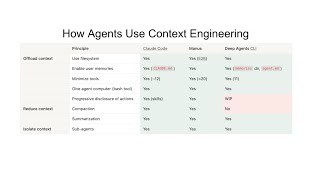
LangChain's analysis across leading agent frameworks (Claude Code, Manus, DeepAgents) identifies three core context management strategies: (1) Offload -- move information out of the active context window into external storage and retrieve on demand; (2) Reduce -- compress, summarize, or filter context to keep only high-signal tokens, following Anthropic's principle of finding the smallest set of tokens that maximize desired outcomes; and (3) Isolate -- run subtasks in separate context windows so each agent thread operates on a focused, relevant slice of information.

Harness engineering, formalized by LangChain, captures everything surrounding the model: tools, permissions, state management, tests, logs, retries, checkpoints, guardrails, and evaluations. The equation Agent = Model + Harness crystallizes a crucial insight: "The model contains the intelligence and the harness is the system that makes that intelligence useful." Birgitta Boeckeler of Thoughtworks emphasizes that when an agent struggles, it should be treated as a signal to identify what is missing from the harness rather than a limitation of the model itself. Manus AI demonstrates the economic dimension through KV-cache optimization: cached input tokens cost $0.30 per million tokens versus $3.00 for uncached ones on Claude Sonnet, making cache-aware context design a 10x cost multiplier.

By The Numbers

The quantitative evidence for the AI agent engineering revolution spans adoption, tooling, performance, and market metrics. LangChain's State of Agent Engineering survey of over 1,300 professionals found 57.3% of organizations have agents in production (up from 51% in 2025), with another 30.4% actively developing agents for deployment. On the tooling front, The Pragmatic Engineer's 2026 survey reveals that 95% of software engineers use AI tools weekly or more frequently, 75% use AI for at least half their software engineering work, and 55% regularly use AI agents specifically, rising to 63.5% among Staff+ engineers.

Claude Code has emerged as the dominant tool in this space, named the most-used and most-loved AI coding tool by 46% of engineers, with Anthropic's Opus and Sonnet models receiving more mentions for coding tasks than all other models combined. GStack's viral adoption, gaining over 10,000 GitHub stars in just 48 hours, underscores the appetite for agent orchestration frameworks. On the enterprise side, Gartner reported a 1,445% surge in multi-agent system inquiries from Q1 2024 to Q2 2025, and the AI agent market is projected to surge from $7.8 billion to over $52 billion by 2030. Meanwhile, 89% of organizations have implemented agent observability and 62% have detailed tracing, indicating that production agent monitoring is becoming standard practice. The cost optimization dimension is equally compelling: the 10x price differential between cached and uncached tokens on Claude Sonnet means effective context engineering directly translates to dramatic infrastructure cost savings at scale.

Impacts and What Is Next

The immediate impact is a reshaping of engineering workflows and team structures. As Lalit Wadhwa articulates: "The engineer of 2026 will spend less time writing foundational code and more time orchestrating a dynamic portfolio of AI agents and reusable components." This is already visible in the data -- with 95% of engineers using AI weekly and 75% using it for half their work, the shift from writing code to orchestrating agents is a documented reality. Gergely Orosz's survey reveals that engineers who use agents are nearly twice as enthusiastic about AI (61%) compared to non-agent users (36%), suggesting a widening gap between early adopters and those yet to make the transition.

The YC Root Access data from Dexter Horthy reveals the next frontier: a three-phase workflow (Research, Planning, Implementation) enabled a 35,000-line modification to a 300,000-line Rust codebase in just 7 hours. But with context utilization in production agents often under 40%, massive efficiency gains remain unlocked. Multi-agent systems are emerging as the next wave, with Gartner's 1,445% inquiry surge indicating intense enterprise interest. On X.com, Guri Singh's "The Agency" project -- featuring 147 specialized AI agents across 12 divisions with 50,000 GitHub stars -- previews a future where agent teams collaborate autonomously. The self-improving agent paradigm, demonstrated by prateek's Agent Orchestrator where AI agents rewrote their own orchestrator, tested, reviewed code, and fixed CI failures autonomously, hints at engineering loops that become increasingly self-sustaining. Meanwhile, OpenAI's acquisition of Promptfoo for agent security and Google's provision of AI agents to the Pentagon signal that safety and governance are becoming critical infrastructure for the next phase of adoption.

The Bigger Picture

What is unfolding is not simply a new set of developer tools but a fundamental rethinking of the relationship between human engineers and software production. The emergence of context engineering and harness engineering as distinct disciplines marks the transition from the "model era" to the "systems era" of AI. In the model era (2022-2024), competitive advantage came from access to better models. In the systems era, the model is an input and competitive advantage comes from the harness: how you orchestrate memory, manage state, configure retrieval, and coordinate tools around the model.

This is the meta-narrative connecting all the signals: LangChain proving that harness optimization beats model upgrades (52.8% to 66.5% without changing the model), Manus showing that cache-aware context design delivers 10x cost reduction, Anthropic codifying the principles, IBM Technology positioning context engineering as the successor discipline to prompt engineering, and Martin Fowler's publication of Boeckeler's harness engineering work signaling recognition by the software architecture community. The common thread is that intelligence is in the system design, not the model weights.

As Yichao 'Peak' Ji's metaphor captures: "If model progress is the rising tide, we want Manus to be the boat, not the pillar stuck to the seabed." The companies and engineers who master the art of building effective harnesses and engineering optimal context will define the next era of software development, while the underlying models continue to improve beneath them.

Historical Context

2025-07-18
Published influential blog post on context engineering lessons from building production AI agents, introducing KV-cache hit rate optimization and append-only context design.
2025-09-29
Published foundational guide on effective context engineering for AI agents, establishing the discipline's core principles around treating context as a finite resource with diminishing marginal returns.
2025-11-01
Conducted State of Agent Engineering survey of 1,300+ professionals, finding 51% of organizations already had agents in production.
2026-02-26
Reported that AI coding agents like Claude Code are fueling a productivity panic in the tech industry, marking a mainstream media inflection point for agentic AI.
2026-03-09
Acquired Promptfoo, an AI security startup, to safeguard AI agents, signaling the growing importance of agent security infrastructure.
2026-03-10
Published 'The Anatomy of an Agent Harness,' formalizing the Agent = Model + Harness equation and demonstrating that harness optimization alone improved Terminal Bench 2.0 scores from 52.8% to 66.5%.
2026-03-14
Released GStack as open-source on GitHub, a role-based Claude Code configuration that gained 10,000+ stars in 48 hours and ignited widespread debate about AI-augmented development workflows.

Power Map

Key Players
Subject

AI Agents and the Rise of Context and Harness Engineering

AN

Anthropic

Creator of Claude Code, the most-used AI coding tool, and Claude models (Opus/Sonnet) that dominate coding tasks with more mentions than all other models combined. Published foundational research on context engineering for AI agents.

LA

LangChain

Leading AI agent framework provider that published the State of Agent Engineering survey (1,300+ respondents) and formalized the Agent = Model + Harness equation. Demonstrated that harness optimization alone moved their coding agent from Top 30 to Top 5 on Terminal Bench 2.0. Identified three core context management strategies: offload, reduce, and isolate.

GA

Garry Tan / Y Combinator

YC President who open-sourced GStack, a role-based Claude Code configuration that gained 10,000+ GitHub stars in 48 hours, demonstrating the AI agent orchestration paradigm. Averaged 10,000 lines of code and 100 pull requests per week over 50 days.

MA

Manus AI

AI agent company that published influential lessons on context engineering for production agents, including KV-cache optimization strategies achieving a 10x cost reduction (cached $0.30/MTok vs uncached $3.00/MTok).

OP

OpenAI

Launched Codex coding agent and OpenAI Frontier platform for building AI agents. Acquired Promptfoo for AI agent security, signaling the growing importance of agent safety infrastructure.

GO

Google

Providing AI agents to the Pentagon for unclassified work, signaling enterprise and government adoption of agentic AI at scale.

THE SIGNAL.

Analysts

"Context must be treated as a finite resource with diminishing marginal returns. LLMs have an attention budget, and effective context engineering means finding "the smallest set of high-signal tokens that maximize the likelihood of your desired outcome." Context engineering is "the art and science of curating what will go into the limited context window from that constantly evolving universe of possible information.""

Anthropic Applied AI Team
Applied AI Team, Anthropic

"Harness engineering requires constraining the solution space with specific patterns, enforced boundaries, and standardized structures. Agent failures should be reframed as context engineering opportunities: "When the agent struggles, we treat it as a signal: identify what is missing.""

Birgitta Boeckeler
Distinguished Engineer, Thoughtworks

"Context engineering should prioritize KV-cache optimization as the single most important metric for production agents. Errors should be left in context so models learn from mistakes. His guiding philosophy: "If model progress is the rising tide, we want Manus to be the boat, not the pillar stuck to the seabed.""

Yichao 'Peak' Ji
Manus AI

""The engineer of 2026 will spend less time writing foundational code and more time orchestrating a dynamic portfolio of AI agents and reusable components." This represents a fundamental shift in what it means to be a software engineer."

Lalit Wadhwa
EVP and CTO, Encora

"AI agent usage has a transformative effect on developer sentiment. "Using agents seems to make people nearly twice as enthusiastic about AI (61%) as those who do not use them (36%)," suggesting that hands-on agent experience converts skeptics."

Gergely Orosz
Author, The Pragmatic Engineer
The Crowd

"NEW POST - Powerful context engineering is becoming a huge part of the developer experience of modern LLM tools. Birgitta Boeckeler explains the current state of context configuration features, using Claude Code as an example."

@@martinfowler627

"BREAKING: Someone just open sourced a complete AI agency and it hit 50K GitHub stars in under two weeks. It's called The Agency. And it's not a prompt template. It's 147 specialized AI agents across 12 divisions -- engineering, design, marketing, product, QA, support..."

@@heygurisingh2300

"I built an AI system that builds itself. Not metaphorically. The AI agents literally rewrote their own orchestrator, tested it, reviewed their own code, fixed their own CI failures, and shipped it. Introducing Agent Orchestrator. Open source. Link below."

@@agent_wrapper522
Broadcast
Advanced Context Engineering for Agents

Advanced Context Engineering for Agents

Context Engineering vs. Prompt Engineering: Smarter AI with RAG & Agents

Context Engineering vs. Prompt Engineering: Smarter AI with RAG & Agents

How Agents Use Context Engineering

How Agents Use Context Engineering