Sanders-AOC AI Data Center Moratorium Bill
TECH

Sanders-AOC AI Data Center Moratorium Bill

41+
Signals

Strategic Overview

  • 01.
    Senator Bernie Sanders and Representative Alexandria Ocasio-Cortez introduced the Artificial Intelligence Data Center Moratorium Act on March 25, 2026, proposing a nationwide pause on new AI data center construction exceeding 20 megawatts until comprehensive federal AI safety and environmental regulations are enacted.
  • 02.
    The moratorium can only be lifted after Congress passes laws requiring government pre-release review of AI systems, protections against electricity price increases and climate harm, job displacement prevention, and economic gains shared with workers.
  • 03.
    The bill also bans U.S. exports of AI computing infrastructure hardware to countries without adequate safety frameworks, and arrives amid a groundswell of local opposition, with at least 63 local moratorium actions introduced and 54 already passed across the country.
  • 04.
    The legislation is widely considered unlikely to advance in either chamber of Congress, but it reflects growing bipartisan populist concern as 57% of registered voters say AI risks outweigh benefits according to a recent NBC News poll.

Deep Analysis

Why This Matters

The Sanders-AOC AI Data Center Moratorium Act represents the most ambitious federal legislative attempt to constrain the explosive growth of AI infrastructure in the United States. While the bill is widely considered unlikely to pass in either chamber, its introduction marks a significant escalation from what has been a largely local and state-level pushback against data center expansion into a formal congressional proposal with national scope. The bill arrives at a moment when major tech companies have collectively committed approximately $700 billion to AI infrastructure spending in 2026 alone, making the stakes of any regulatory intervention enormous.

The political significance extends beyond the bill's immediate prospects. An NBC News poll from late February/early March 2026 found that 57% of registered voters agreed that AI risks outweigh benefits, suggesting the sponsors are tapping into genuine public anxiety. The emergence of what Bloomberg has described as a populist alliance between progressives and conservatives on this issue could reshape the political landscape around AI regulation, even if this particular bill stalls. The fact that at least 63 local moratorium actions have been introduced -- with 54 already passed -- and 12 states have filed statewide moratorium bills demonstrates that the constituency for restraining data center growth is broad and already achieving results at the grassroots level.

How It Works

The bill defines an AI data center as any facility with a peak power load exceeding 20 megawatts that relies on high-performance server racks or liquid cooling systems. This threshold is designed to target large-scale AI training and inference facilities while exempting smaller conventional data centers. The moratorium would impose an immediate nationwide pause on new construction of qualifying facilities.

The construction pause cannot be lifted until Congress passes comprehensive legislation meeting four specific conditions: government review and approval of AI systems before public release, protections ensuring data centers do not raise electricity prices or worsen climate change, measures to prevent job displacement from AI, and requirements that economic gains from AI are shared with workers. The bill also includes an international dimension, banning U.S. exports of AI computing infrastructure hardware to countries that lack adequate safety frameworks. This export restriction component adds a trade policy layer to what is primarily framed as a domestic environmental and labor protection measure.

By The Numbers

By The Numbers
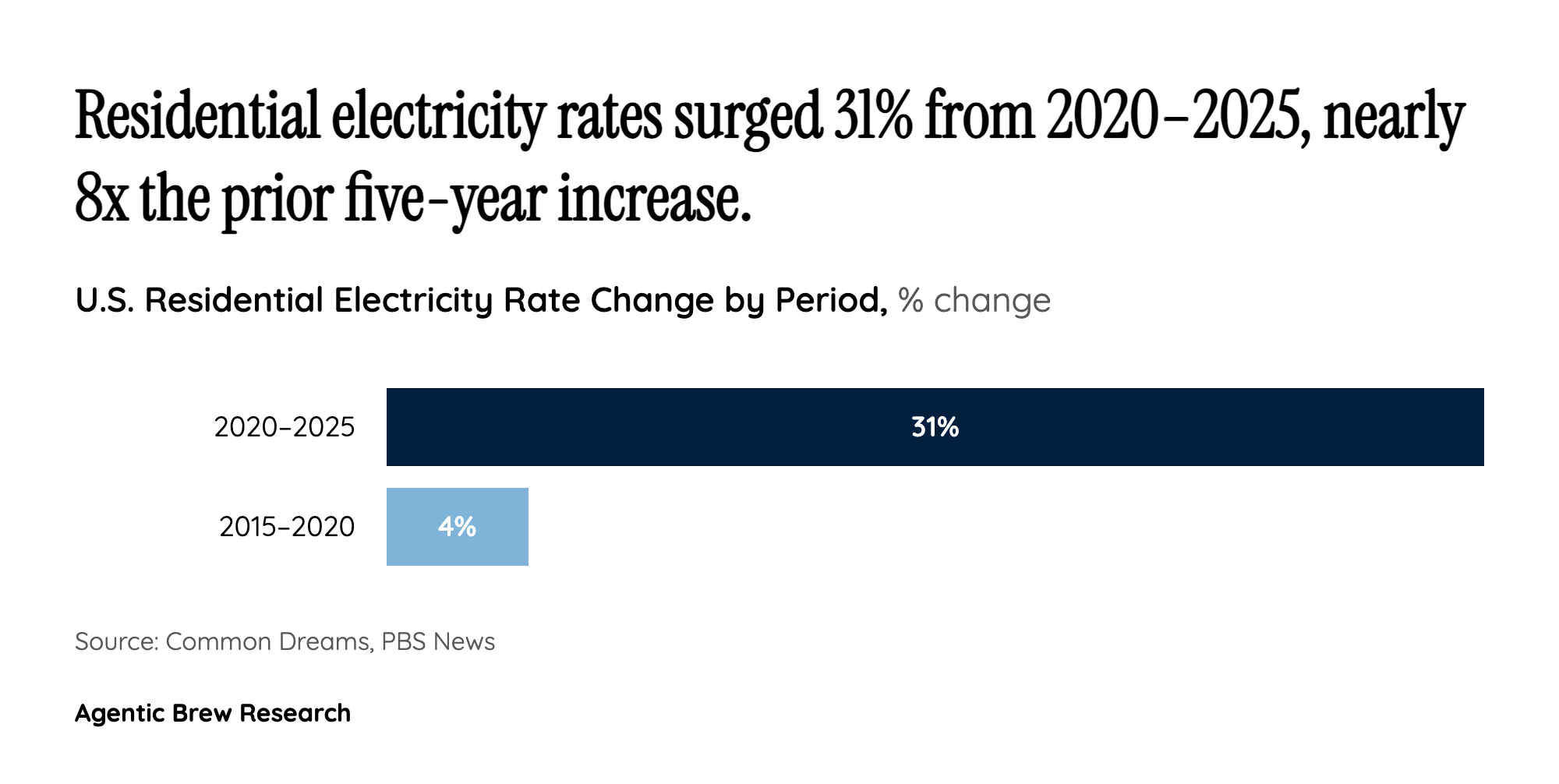
U.S. residential electricity rate changes: 31% increase from 2020-2025 vs. 4% from 2015-2020

The scale of AI data center impact is captured in several striking statistics from the research. A typical AI data center consumes electricity equivalent to 100,000 households, while hyperscale facilities can consume the equivalent of up to 2 million households. Residential electricity rates increased 31% from 2020 to 2025, compared to just 4% from 2015 to 2020, a trend that data center critics attribute in part to surging demand from AI facilities.

Water consumption presents another dimension of concern: by 2028, AI data centers could use water equivalent to 18.5 million households. On the economic side, local opposition has already blocked or delayed $64 billion in data center projects between May 2024 and March 2025. The grassroots movement has produced at least 63 local moratorium actions, with 54 already passed, plus 12 statewide moratorium bills. Meanwhile, the tech industry's planned $700 billion in AI infrastructure spending for 2026 illustrates the enormous commercial forces pushing in the opposite direction.

Impacts & What's Next

The immediate political reaction has been sharply divided, even within the Democratic Party. Senator Mark Warner of Virginia called the moratorium "idiocy" and warned it would cede AI leadership to China, while Senator John Fetterman of Pennsylvania described restrictions as a "surrender flag" to China. The Data Center Coalition, an industry group, warned the moratorium would limit internet capacity, slow critical services, eliminate hundreds of thousands of jobs, and drain billions in tax revenue. The Trump Administration has also signaled opposition, instead urging streamlined permitting and federal preemption of state-level AI regulations.

Despite the bill's slim odds of passage, its introduction could have several downstream effects. It elevates the national conversation about AI infrastructure governance and provides a rallying point for the environmental and labor coalitions that have been fighting data centers at the local level. Cornell engineering professor Fengqi You acknowledged that the concerns are legitimate while suggesting the better path is to put strong safeguards in place quickly rather than imposing a blanket moratorium. The bill may also influence ongoing state-level efforts and could pressure the tech industry to make voluntary concessions on environmental and community impact standards to forestall more aggressive future regulation.

The Bigger Picture

This legislation sits at the intersection of several converging forces: the breakneck pace of AI development, growing energy and water scarcity concerns, rising populist skepticism of Big Tech, and an ongoing debate about whether the United States can regulate AI without ceding competitive advantage to China. The bill's framing explicitly connects AI infrastructure to kitchen-table economic concerns like electricity bills and job security, reflecting a strategic choice to ground abstract technology policy in tangible impacts on working families.

The broader context includes a 2023 letter signed by over 1,000 AI industry leaders calling for a development pause, suggesting that concerns about the pace of AI advancement are not limited to politicians. The emerging populist alignment between progressives and conservatives on data center issues, as reported by Bloomberg, hints at the possibility of a realignment in technology politics that cuts across traditional partisan lines. Whether or not this particular bill advances, it signals that the era of largely unregulated AI infrastructure expansion may be approaching its limits, as communities, environmental groups, and now federal legislators push back against the assumption that AI growth should proceed without constraint. The 230-plus environmental organizations that signed a letter calling for a national construction pause in December 2025 represent an institutional base that will continue to press these issues regardless of this bill's fate.

Historical Context

2023-03-01
Over 1,000 AI industry leaders signed a letter calling for a six-month pause on AI development, establishing a precedent for moratorium-style proposals in the AI space.
2025-03-01
Between May 2024 and March 2025, local opposition blocked or delayed $64 billion in data center projects across the United States, reflecting growing grassroots resistance.
2025-12-09
Over 230 environmental groups signed a letter calling for a national pause on data center construction, escalating the issue from local to national advocacy.
2025-12-16
Congressional Democrats began investigating data centers' impact on consumer power bills, laying groundwork for legislative action.
2026-02-06
Bloomberg reported on an emerging populist alliance between progressives like Sanders and conservatives like DeSantis against data center expansion, signaling bipartisan momentum.
2026-03-25
The Artificial Intelligence Data Center Moratorium Act was formally introduced in both chambers of Congress, proposing a nationwide construction pause on AI data centers exceeding 20 megawatts.

Power Map

Key Players
Subject

Sanders-AOC AI Data Center Moratorium Bill

SE

Sen. Bernie Sanders (I-VT)

Lead Senate sponsor of the AI Data Center Moratorium Act

RE

Rep. Alexandria Ocasio-Cortez (D-NY)

Lead House sponsor of the AI Data Center Moratorium Act

SE

Sen. Mark Warner (D-VA)

Democratic critic of the moratorium who warns it would cede AI leadership to China

DA

Data Center Coalition

Industry group opposing the moratorium, warning it would limit internet capacity, eliminate jobs, and drain tax revenue

MA

Major tech companies (Meta, Amazon, Microsoft, Google, OpenAI, Oracle, xAI)

Primary targets of the moratorium, collectively planning approximately $700 billion in AI infrastructure spending in 2026

TR

Trump Administration

Opposes the moratorium and urges streamlined permitting and preemption of state AI regulations

THE SIGNAL.

Analysts

""Concerns about rapid expansion of AI data centers are legitimate, especially around energy demand, water use, local environmental impacts and who bears the costs. The better path is to put strong safeguards in place quickly.""

Fengqi You
Zak Professor in Energy Systems Engineering, Cornell University

""Rapid data center expansion is causing both direct and indirect harm to many communities.""

Frank Pasquale
Professor of Law, Cornell Tech and Cornell Law

""AI and robotics are going to bring cataclysmic changes to our society. Sadly, Congress has done virtually nothing. AI must work for working families, not the billionaires.""

Sen. Bernie Sanders
Lead Senate sponsor, Independent Senator from Vermont

"Called the moratorium "idiocy," warning it would cede AI leadership to China."

Sen. Mark Warner
Democratic Senator from Virginia

"Described the data center industry as "aggressive, profit-hungry" and supports the moratorium as desperately needed while Americans' energy bills skyrocket."

Mitch Jones
Policy Director, Food & Water Watch
The Crowd

"AI and robotics are going to bring cataclysmic changes to our society. Sadly, Congress has done virtually nothing. AI must work for working families, not the billionaires. Today, I'm introducing a moratorium on new data centers until we protect working people."

@@SenSanders2700

"We cannot sit back and allow a handful of billionaire Big Tech oligarchs to make decisions that will reshape our economy, our democracy and the future of humanity."

@@RollingStone2000

"Bernie Sanders and Alexandria Ocasio-Cortez' AI Data Center Moratorium Act contains a moratorium on all US datacenter upgrading and construction, as well as a ban on the export of all US-origin GPU's. Press conference this afternoon."

@@AndrewCurran_234
Broadcast
We need a moratorium on AI data centers NOW. Here's why.

We need a moratorium on AI data centers NOW. Here's why.

LIVE: Introducing the AI Data Center Moratorium Act

LIVE: Introducing the AI Data Center Moratorium Act

Bernie Sanders, AOC announce AI data center moratorium bill

Bernie Sanders, AOC announce AI data center moratorium bill