Anthropic Agent-Building Playbook and AI Reliability Tools
TECH

Anthropic Agent-Building Playbook and AI Reliability Tools

31+
Signals

Strategic Overview

  • 01.
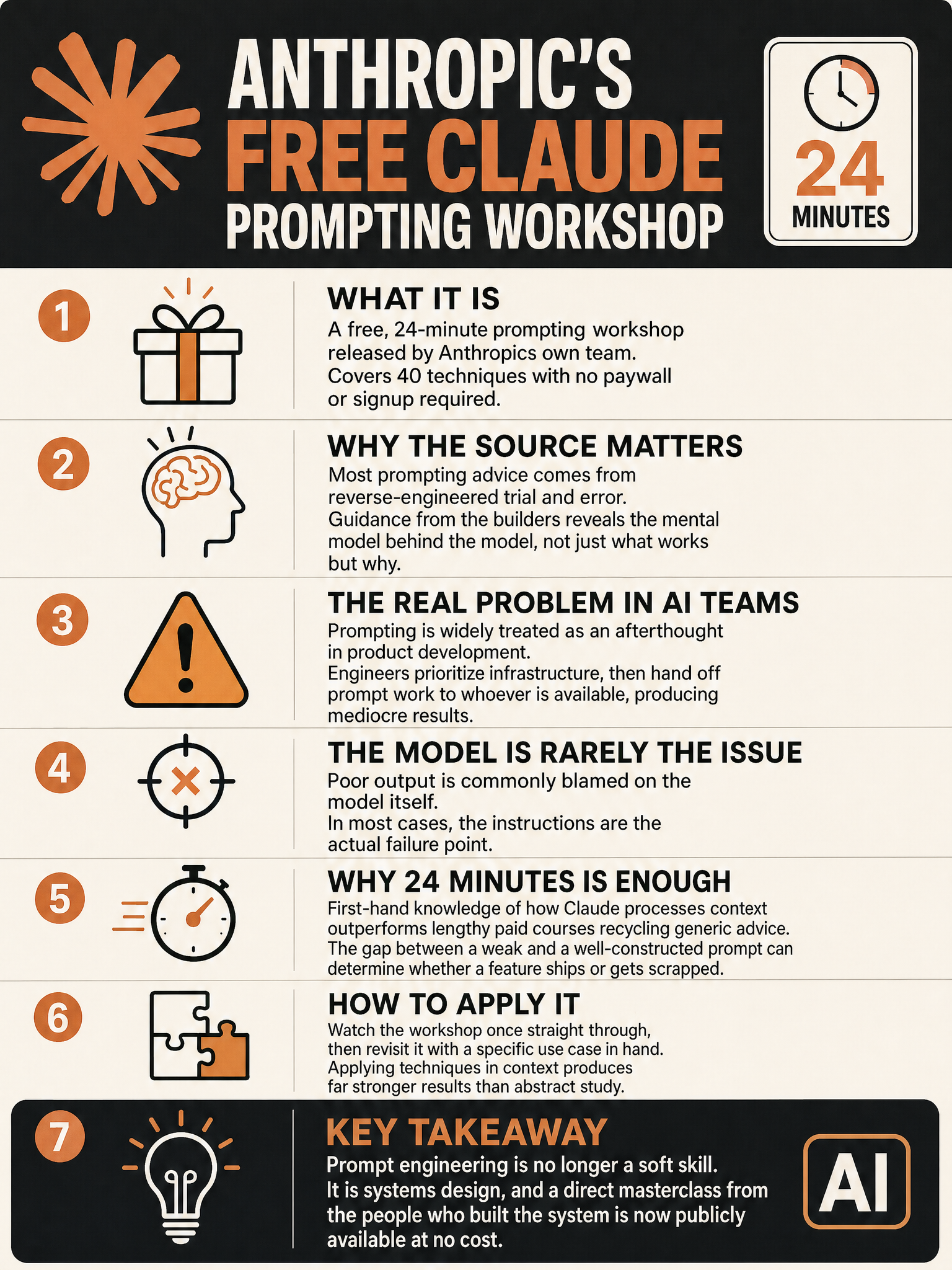
    Anthropic's Applied AI team released a free, no-signup 24-minute Prompting 101 workshop covering 40 techniques, taught by the engineers who actually build Claude. It coincides with the company's broader 2026 reliability push — including the Managed Agents API launched April 10, 2026 — that handles sandboxing, permissions, state, and error recovery as managed infrastructure.
  • 02.
    Giga published a Hallucination Correction system that runs a parallel reasoning detector during streaming, dropping voice-agent hallucination rates from a 4-5% baseline to under 1% in production — measured across 1.2 million conversational turns — with zero added user-facing latency.
  • 03.
    Anthropic's foundational guidance for builders favors simplicity, transparency, and well-crafted tool interfaces over complex frameworks, with separate harness research recommending planner/generator/evaluator splits because agents tend to over-approve their own work.
  • 04.
    A competing real-time guardrail layer from Intelligence Factory AI — Buffaly, using Ontology-Guided Augmented Retrieval — reports over 30% reduction in hallucinations and unmet objectives, signaling that real-time hallucination correction is becoming a distinct product category rather than a research curiosity.

The mechanism: exploiting the speed gap between text generation and speech
The mechanism: exploiting the speed gap between text generation and speech
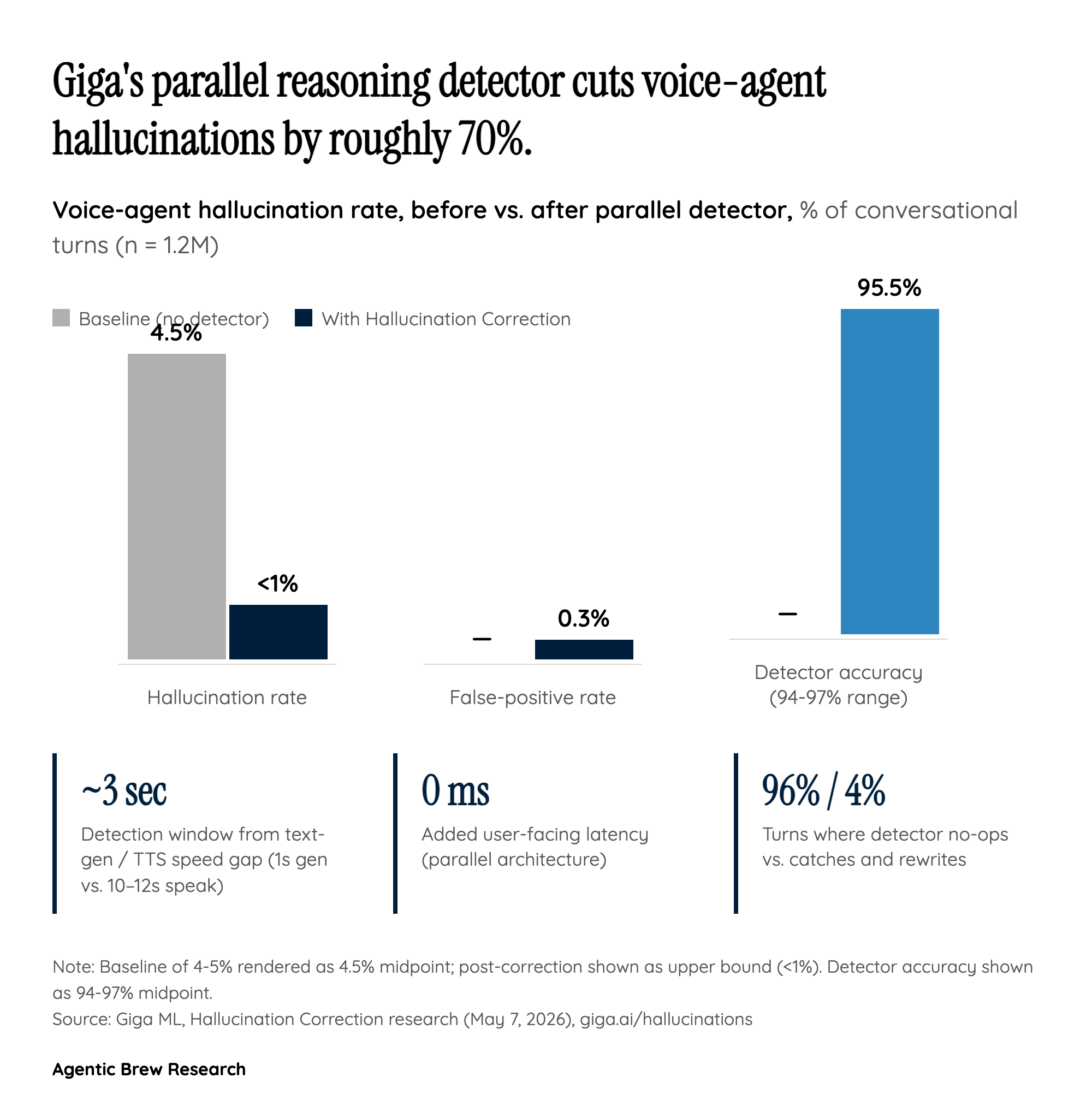
Giga reports a roughly 70% drop in voice-agent hallucinations (4-5% baseline to under 1%), measured across 1.2M turns. Detector accuracy is 94-97% with sub-0.3% false positives and zero added user-facing latency.

The clever insight in Giga's Hallucination Correction system is structural rather than purely model-based. LLMs generate text far faster than voice models can speak it: a roughly 30-word response is generated in about 1 second but takes 10-12 seconds to actually play through TTS. That mismatch is normally just dead time, but Giga turned it into a budget — leaving roughly 3 seconds in which a parallel reasoning model can evaluate the chunk and intercept it before the user hears anything.

The architecture is two LLMs running concurrently: the primary generator streams a response, while a reasoning detector reads the same chunk against the system prompt, retrieved context, and prior turns to flag instruction contradictions, context contradictions, and fabrications. Because the detector runs in parallel rather than in series, there is zero added user-facing latency. The reported numbers — hallucination rate dropping from a 4-5% baseline to under 1% across 1.2 million conversational turns, detector accuracy of 94-97% across hallucination types, and a false-positive rate below 0.3% — only matter because the design lets you run an expensive reasoning check without the user noticing.

A second non-obvious detail: when the detector catches an error, the corrective hint must be dropped from context after the chunk is fixed. Otherwise the primary model learns from the visible patch and starts hedging on every subsequent answer. The fix has to leave no trace, or the cure deforms the model.

Why a prompting workshop, a managed runtime, and a parallel detector all dropped in the same window

Three reliability moves have surfaced almost simultaneously, and they target three different layers of the agent stack. Anthropic's free 24-minute Prompting 101 workshop, taught by Hannah Moran and Christian Ryan from the team that builds Claude, attacks reliability at the prompt layer — codifying 40 techniques and an explicit 5-element prompt structure (task description, dynamic content, detailed instructions, examples, reminder of critical points), with XML tags as the recommended delimiter. The April 10, 2026 launch of Anthropic's Managed Agents API attacks reliability at the runtime layer — taking sandboxing, permissions, state management, and error recovery off the developer's plate. Giga's Hallucination Correction attacks reliability at the architecture layer — adding a second model running concurrently as a verifier.

This convergence is not coincidence. It reflects a shared diagnosis that single-model agents over-approve their own work. Anthropic's own harness research has been pointing toward separating planner, generator, and evaluator roles for exactly this reason. The prompting playbook is upstream prevention; the managed runtime is operational resilience; the parallel detector is downstream interception. None of these alone is sufficient at production scale, which is why all three are arriving as a bundle.

The practical consequence for builders is that 'reliability' has stopped being a single thing you tune and become a stack you assemble. The era of one heroic prompt fixing everything is being replaced by composed defenses with measurable contributions at each layer.

Money and competitive positioning: voice AI puts a price on reliability

Giga's $61M Series A in November 2025, led by Redpoint Ventures, is what makes the Hallucination Correction post more than a research note. The company is YC-backed, ships voice agents to enterprise customers including DoorDash (cited at 80% deflection rate, with over 90% resolution accuracy in production), and is now publishing the techniques that justify those numbers. The publication is recruiting and category-defining at once: the post foregrounds Esha Dinne (co-founder/CTO), Rishi Alluri, and Arnab Maiti as the authors, anchoring Giga as a research-credible vendor rather than a wrapper.

The competitive angle is that real-time hallucination correction is rapidly becoming a category, not a feature. Intelligence Factory AI, with CTO Matt Furnari, is shipping Buffaly — a guardrail layer using Ontology-Guided Augmented Retrieval (OGAR) — and reports over 30% reduction in hallucinations and unmet objectives in trial deployments. Giga's reasoning-model approach and Buffaly's ontology-guided approach represent two different bets on what the right substrate is, but they agree on the product wedge: enterprise voice traffic is the place where hallucinations have direct, measurable revenue cost, and there is willingness to pay for layers that catch them.

That economic gravity also explains Anthropic's positioning. By bundling the prompting workshop, the Managed Agents API, and Agent Skills as an open standard, Anthropic is making a platform play that frames Claude as the substrate on top of which vertical reliability layers like Giga's get built — rather than competing with them directly.

The contrarian read: enthusiasm laced with snark, and tradeoffs nobody's resolving

Community reaction to the workshop is enthusiastic but pointedly skeptical of the 'just dropped' framing. The video was originally presented at Code w/ Claude in May 2025 and is now being recirculated as if it were new; practitioners notice. Sentiment across community discussions is hungry for the content — particularly grounding techniques to reduce hallucination — and frustrated that evergreen Anthropic resources keep being repackaged as launches. There is also pushback on specific guidance, including doubts that role-prompting still helps with current Claude generations and a recurring complaint that some of the workshop is 'basic 101' relative to what production teams already do.

More substantively, the techniques being promoted carry tradeoffs that are not surfaced in the workshop itself. Practitioner threads distill three Anthropic-recommended instructions for reducing hallucination — explicitly allow 'I don't know,' verify with citations, and use direct quotes — and note a concrete cost: citation constraints have been observed to reduce creative output by roughly 15-20% per arXiv 2307.02185. There is also a tension between the 'use direct quotes' guidance and Anthropic's own deployed copyright posture, which constrains exactly that behavior in many shipping products.

Giga's parallel detector design has a parallel tension. The instruction to drop correction hints from context after use is precisely what prevents the detector from poisoning the generator with hedging — but it also means the generator is not learning from its own corrections in any persistent way. Reliability is being purchased per-turn, not banked. Builders should adopt these techniques, but with eyes open: each layer of the new reliability stack ships with its own quiet tax.

Historical Context

2024-08
Anthropic released its open-source Prompt Engineering Interactive Tutorial (9 chapters plus appendix) on GitHub, establishing the educational baseline that Prompting 101 builds on.
2025-05-22
The Prompting 101 workshop was originally presented at Code w/ Claude in San Francisco; the 24-minute video was published to YouTube and recirculated widely in 2026.
2025-11-05
Giga raised a $61M Series A led by Redpoint Ventures to scale enterprise voice AI, with DoorDash as a flagship customer.
2026-04-10
Anthropic launched its Managed Agents API, providing managed sandboxing, permissions, state, and error recovery for agentic workloads — the runtime half of the reliability story.
2026-04-28
The free 24-minute prompting workshop with 40 techniques recirculated and was widely covered as a reliability and onboarding asset for production teams.
2026-05-07
Giga published its Hallucination Correction research, claiming a roughly 70% drop (from 4-5% baseline to under 1%) in voice agent hallucinations measured across 1.2 million conversational turns with a sub-0.3% false-positive rate.

Power Map

Key Players
Subject

Anthropic Agent-Building Playbook and AI Reliability Tools

AN

Anthropic (Applied AI Team)

Released the free 24-minute Prompting 101 workshop with 40 techniques as part of Code w/ Claude, normalizing prompt-engineering best practices for production builders and pairing the educational asset with infrastructure releases like the Managed Agents API.

HA

Hannah Moran & Christian Ryan

Anthropic Applied AI engineers presenting the workshop, who walk through prompt evolution on a real customer case (Swedish car-accident insurance forms) and argue prompts should be treated as structured documents rather than sentences.

GI

Giga (Giga ML)

YC-backed enterprise voice-AI company that introduced the Hallucination Correction system; raised a $61M Series A led by Redpoint Ventures in November 2025, with DoorDash as a flagship reference customer cited at 80% deflection.

ES

Esha Dinne, Rishi Alluri, Arnab Maiti

Authors of Giga's Hallucination Correction post (May 7, 2026); Esha Dinne is co-founder/CTO at Giga and the technical lead on the parallel detector design.

IN

Intelligence Factory AI (Matt Furnari, CTO)

Builds Buffaly, a competing real-time hallucination guardrail using Ontology-Guided Augmented Retrieval (OGAR) that reports over 30% reduction in hallucinations and unmet objectives in trial deployments.

DO

DoorDash

Reference customer for Giga's voice agents at 80% deflection rate (DWR), illustrating concrete enterprise demand that justifies investing in real-time hallucination correction.

Source Articles

Top 1

THE SIGNAL.

Analysts

"A great prompt should be treated as a structured document, not a sentence. Anthropic recommends organizing prompts around 5 core elements — task description, dynamic content, detailed instructions, examples, and a reminder of critical points — with XML tags as the top-recommended delimiter. Static knowledge belongs in the system prompt, and Extended Thinking should be a diagnostic tool to identify which steps to encode rather than a permanent crutch."

Hannah Moran & Christian Ryan
Applied AI Team, Anthropic

"Builders should start with simple prompts, optimize them with comprehensive evaluation, and add multi-step agentic systems only when simpler solutions clearly fall short. The most successful production implementations weren't using complex frameworks but composable patterns built on well-crafted tool interfaces."

Anthropic (Building Effective Agents)
Anthropic Engineering / Research

"Reasoning models substantially outperform lightweight classifiers for hallucination detection because catching instruction and context contradictions requires semantic understanding — Giga reports 94-97% detection accuracy across hallucination types. A critical implementation detail: correction hints must be dropped from context after use, otherwise the model learns to hedge everything."

Giga research team (Dinne, Alluri, Maiti)
Giga ML

"Real-time guardrails should make agents 'provably correct, or they ask for clarification' rather than relying on confidently phrased language. Ontology-guided detection at Buffaly cut hallucinations and unmet objectives by over 30% across trial deployments."

Matt Furnari
CTO, Intelligence Factory AI
The Crowd

"GigaML has cut voice AI hallucination rates from 4-5% to under 1% in production without adding any latency. The fix runs a reasoning model detector in parallel with audio playback, using the gap between text generation speed and speaking speed as the detection window."

@@IndianTechGuide0

"Anthropic's Prompting 101 Workshop: What They Got Right, What They Missed. The Applied AI team at Anthropic put out a 24-minute video of how to prompt. I give an example using a practical scenario e.g. analyzing Swedish car accident report forms and sketches for insurance claims."

@@BrianRoemmele0

"Anthropic's applied AI team just showed how to actually prompt agents properly. 30 minutes. free. from the people who built Claude Code. watch the workshop. bookmark it. you've been prompting Claude without these 40 templates. I built a skill that applies them for you."

@@Av1dlive0

"Anthropic just dropped the best free masterclass on prompt engineering."

@u/Beautiful_Rope7839371
Broadcast
How We Build Effective Agents: Barry Zhang, Anthropic

How We Build Effective Agents: Barry Zhang, Anthropic

Prompting 101 | Code w/ Claude

Prompting 101 | Code w/ Claude

Anthropic Just Dropped the New Blueprint for Long-Running AI Agents.

Anthropic Just Dropped the New Blueprint for Long-Running AI Agents.