OpenAI Desktop Superapp Consolidating ChatGPT, Codex, and Atlas
TECH

OpenAI Desktop Superapp Consolidating ChatGPT, Codex, and Atlas

36+
Signals

Strategic Overview

  • 01.
    OpenAI is building a unified desktop superapp that merges ChatGPT, its Codex coding agent, and the Atlas AI browser into a single macOS application, with the mobile ChatGPT app remaining unchanged.
  • 02.
    The consolidation was announced via an internal memo by Chief of Applications Fidji Simo on March 17, 2026, describing the company as operating in code red and citing Anthropic's enterprise success as a direct catalyst.
  • 03.
    The superapp's architectural foundation is the standalone Codex desktop app released in Q1 2026, which already supports multi-agent parallelism, worktrees, and scheduled automations.
  • 04.
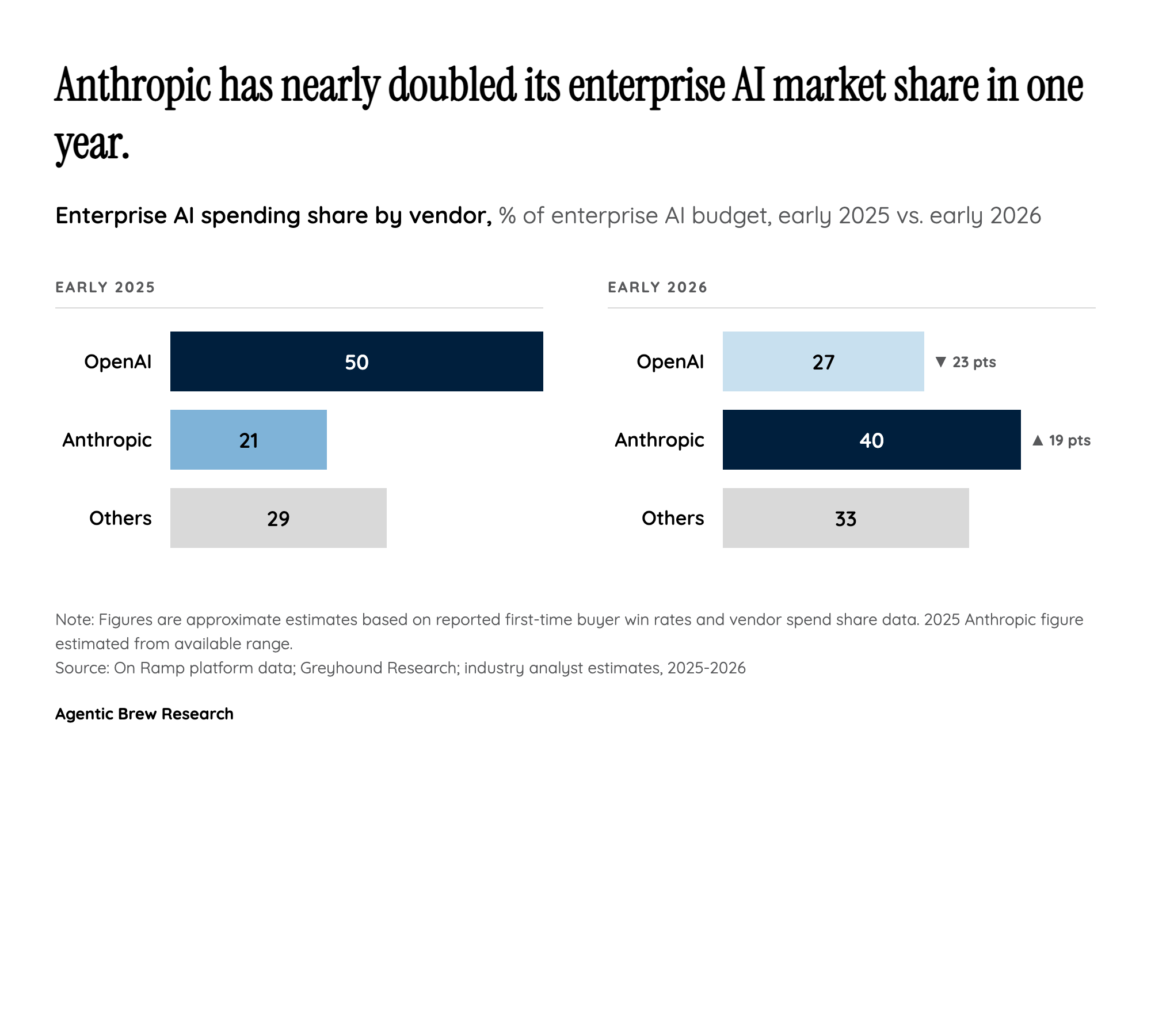
    OpenAI's enterprise AI spending share declined from approximately 50% to 27% in one year while Anthropic's climbed to approximately 40%, with Anthropic winning roughly 70-73% of head-to-head enterprise deals among first-time AI buyers.

Deep Analysis

Why This Matters

OpenAI's superapp announcement represents a fundamental strategic reversal. For most of 2025, the company operated on a ship-everything philosophy, launching Sora, Atlas, Codex, and numerous standalone tools in rapid succession. The implicit thesis was that breadth of product coverage would entrench OpenAI across every AI use case. Instead, it created a fragmented user experience that enterprise customers found difficult to standardize on, and gave Anthropic an opening to win on the one dimension enterprises value most: reliability and focus.

The stakes are existential on two fronts. Internally, OpenAI is projecting $14B in losses for 2026 with no positive cash flow until 2030, while carrying a $730B valuation and fresh investor commitments from SoftBank, Nvidia, and Amazon. Externally, its enterprise AI spending share has collapsed from approximately 50% to 27% in a single year while Anthropic's has climbed to approximately 40%. The superapp is not an organic product evolution; it is a forced convergence designed to stop the bleeding and rebuild enterprise credibility ahead of a potential IPO.
How It Works

The superapp's architecture is sequential rather than simultaneous. The first phase, already completed, was releasing the standalone Codex desktop app in Q1 2026. This app established the agentic foundation: multi-agent parallelism allowing several AI tasks to run concurrently, worktree support for isolated coding environments, and scheduled automations for recurring tasks. Crucially, Codex represents OpenAI's agentic AI bet, meaning autonomous multi-step task execution rather than single-turn conversation.

The second phase involves extending Codex's agentic capabilities further, then merging ChatGPT and Atlas into it as a unified interface. The Atlas browser contributes web navigation and research capabilities; ChatGPT contributes the consumer brand and conversational interface. The result is designed to be a single desktop workspace where a developer or enterprise user can move fluidly between conversation, coding, browser-based research, and automated task execution, all within one application. The mobile ChatGPT app remains untouched, suggesting the superapp is primarily a professional and enterprise play rather than a consumer pivot.

By The Numbers

By The Numbers
Enterprise AI spending share shift: OpenAI declined from 50% to 27% while Anthropic climbed to 40% in one year.

The quantitative picture behind the superapp decision is stark. OpenAI's enterprise AI spending share declined from approximately 50% to 27% in roughly one year, a 23-percentage-point collapse. Over the same period, Anthropic's share climbed to approximately 40%. On Ramp platform data shows that one year ago, roughly 1-in-25 businesses had paid for Anthropic; that ratio is now nearly 1-in-4. Anthropic wins approximately 70-73% of head-to-head enterprise deals among first-time AI buyers. Claude Code VS Code daily installs nearly doubled from 17.7M in January 2026 to 29M by March 2026.

OpenAI's own metrics tell a mixed story. The company has 900M weekly active users, 50M+ consumer subscribers, and 9M+ business subscribers, representing massive scale. Annualized revenue reached approximately $25B as of February 2026. But the company is projecting $14B in losses for 2026 and does not expect positive cash flow until 2030. The Polymarket probability of a 2026 OpenAI IPO dropped from approximately 55% to 35% in recent weeks, reflecting market skepticism about whether the consolidation can reverse the enterprise share trajectory in time to support a public offering.

Impacts and What's Next

For enterprise customers and developers, the superapp removes the need to maintain separate accounts, contexts, and workflows across ChatGPT, Codex, and Atlas. If executed well, it could meaningfully reduce the friction that caused many enterprises to standardize on Anthropic's simpler stack. However, the transition period itself is a vulnerability: any instability, feature regression, or UI disruption during the merge could accelerate the enterprise exodus rather than arrest it. Community sentiment on Reddit is predominantly skeptical, with the top-voted comment being a sardonic one-liner: the product is easier to ignore as one than as three.

For Microsoft, the superapp creates quiet competitive tension. Microsoft is OpenAI's largest investor and has embedded OpenAI technology throughout its Copilot suite. A unified OpenAI desktop experience that handles coding, browsing, and task automation is structurally in competition with Copilot for developers and enterprise workers. For Google, the Atlas browser's integration into a broader agentic workspace intensifies competition with Chrome and Gemini in enterprise browsing. No specific launch timeline has been announced, but GPT-5.4 mini's release alongside the announcement, achieving 54.4% on SWE-Bench Pro and supporting 400K token context, suggests a coordinated product sequence targeting Q4 2026.

The Bigger Picture

The superapp pivot reflects a broader pattern in enterprise software: the market consistently punishes fragmentation and rewards focused platforms. Salesforce, Slack, and Notion all faced versions of this inflection, moments when build-everything strategies had to be consolidated into coherent platform narratives. OpenAI is now at that inflection, but with uniquely high stakes: it is executing a forced consolidation under competitive pressure, financial losses, and pre-IPO scrutiny simultaneously.

The Anthropic counter-model is instructive. By concentrating on Claude Code and Cowork for enterprise developers, Anthropic gave buyers a clear mental model: one product, one pricing structure, one integration surface. OpenAI's brand recognition and user scale remain enormous advantages. Nine hundred million weekly active users is not a base Anthropic can match in the near term. But brand recognition alone does not convert into enterprise contracts when the product experience is fragmented. The superapp is OpenAI's attempt to match Anthropic's clarity with its own scale. Whether consolidation can outrun the competitive momentum Anthropic has built, and whether it can do so before IPO windows close, is the defining question of OpenAI's 2026.

Historical Context

2025-09-01
Sora video generator launched, briefly reached App Store number one but usage quickly declined, an early signal of OpenAI's fragmented product-release problem.
2025-10-01
Atlas AI browser launched (Chromium-based) but failed to gain meaningful consumer traction, exemplifying the fragmentation strategy that the superapp now seeks to reverse.
2025-12-01
Anthropic reached approximately $9B in annualized revenue, driven primarily by Claude Code and Cowork, establishing the focused single-product strategy that would pressure OpenAI.
2026-01-01
OpenAI released the standalone Codex desktop app in Q1 2026, featuring multi-agent parallelism, worktrees, and scheduled automations, which now serves as the architectural foundation for the superapp.
2026-03-17
Fidji Simo circulated an internal memo announcing the superapp consolidation strategy, describing the competitive situation as code red and explicitly citing Anthropic's success as the catalyst.
2026-03-19
CNBC, Reuters, and multiple outlets confirmed the superapp plans; OpenAI acknowledged the consolidation effort publicly.

Power Map

Key Players
Subject

OpenAI Desktop Superapp Consolidating ChatGPT, Codex, and Atlas

FI

Fidji Simo

Chief of Applications at OpenAI; primary architect of the superapp consolidation strategy, author of the internal code red memo.

SA

Sam Altman

CEO of OpenAI; jointly evaluating with Mark Chen which product initiatives to deprioritize as part of the broader consolidation.

AN

Anthropic

Primary competitor whose focused single-product strategy (Claude Code and Cowork) served as the direct competitive catalyst for OpenAI's consolidation pivot.

EN

Enterprise customers and developers

Primary target users of the superapp; the battleground segment where OpenAI has lost significant share to Anthropic over the past year.

MI

Microsoft

Major investor and partner whose Copilot suite is implicitly in competition with the superapp for enterprise developer mindshare, creating potential partner-channel tension.

SO

SoftBank, Nvidia, and Amazon

Recent investors in OpenAI's $110B round at approximately $730B pre-money valuation; revenue commitments tied to this capital partly drive the urgency of the consolidation.

THE SIGNAL.

Analysts

"Described Anthropic's success as a wake-up call and stated the company is operating in code red. Said OpenAI cannot miss this moment because we are distracted by side quests and called consolidation the opportunity to combine the strongest AI consumer app and brand with strongest agentic app. Also stated: Companies go through phases of exploration and phases of refocus; both are critical. But when new bets start to work, like we're seeing now with Codex, it's very important to double down on them."

Fidji Simo
Chief of Applications, OpenAI

"Characterized the move as not a clean enterprise pivot but a forced convergence driven by internal fragmentation, competitive pressure, and the need to monetize where value is actually realized. Warned that the biggest constraint on agentic AI is not capability but control, and raised the risk of diluting the very clarity that made ChatGPT dominant."

Sanchit Vir Gogia
Chief Analyst and CEO, Greyhound Research

"Coined the competitive contrast: OpenAI is shipping everything; Anthropic is perfecting one thing, arguing that OpenAI's rapid-fire product releases across 2025 directly created the fragmentation problem now being reversed."

Sherwood News
Tech analysis, Sherwood News

"Framed the superapp as part of a coordinated pre-IPO empire rebuild, noting that GPT-5.4 alongside the superapp represents a deliberate strategic sequence targeting Q4 2026 IPO readiness."

xpert.digital analysts
Digital strategy analysts, xpert.digital
The Crowd

"Companies go through phases of exploration and phases of refocus; both are critical. But when new bets start to work, like we're seeing now with Codex, it's very important to double down on them and avoid distractions. Really glad we're seizing this moment."

@@fidjissimo203

"SCOOP - OpenAI is planning to simplify its product experience and launch one superapp -- part of its broader effort to instill more discipline and focus into the business, and beat back the threat posed by Anthropic"

@@berber_jin115

"OpenAI is building a desktop super app that merges ChatGPT, its AI browser, and the Codex coding tool into one place. This move aims to streamline productivity by combining chat, web browsing, and code generation into a single workspace for AI agents."

@@rohanpaul_ai44

"OpenAI Superapp to Merge ChatGPT, Codex, and Atlas Browser"

@u/unknown0
Broadcast
AI NEWS - March 19, 2026 | OpenAI Desktop Superapp, Hollywood & Generative AI

AI NEWS - March 19, 2026 | OpenAI Desktop Superapp, Hollywood & Generative AI

OpenAI just made your entire tech stack obsolete...

OpenAI just made your entire tech stack obsolete...

Introducing the Codex app

Introducing the Codex app