
Google TurboQuant LLM Compression Reshapes AI Memory Economics
TECH

Google TurboQuant LLM Compression Reshapes AI Memory Economics

33+
Signals

Strategic Overview

  • 01.
    Google Research published TurboQuant on March 24-25, 2026, a training-free vector quantization algorithm that compresses LLM key-value caches from 16-bit to approximately 3 bits per value, achieving at least 6x memory reduction and up to 8x attention-computation speedup on NVIDIA H100 GPUs with zero accuracy loss.
  • 02.
    The algorithm uses a two-stage approach combining PolarQuant (Cartesian-to-polar coordinate transformation) with 1-bit QJL error correction, requiring zero calibration data, and operates within 2.7x of the information-theoretic lower bound for compression.
  • 03.
    Memory chip stocks fell sharply following the announcement — SK Hynix dropped approximately 6%, Samsung 5%, Micron 3.4-10%, and SanDisk 14% — though multiple analysts characterized the sell-off as an overreaction driven by headline reading rather than technical analysis.
  • 04.
    TurboQuant remains pre-production as of April 2026 with no official code release, though community implementations in PyTorch and Triton/vLLM already exist on GitHub, and production integration is estimated for Q2 2026.

Deep Analysis

Wall Street's Headline-Reading Problem: Why SanDisk Lost 14% Over an Algorithm That Doesn't Touch NAND
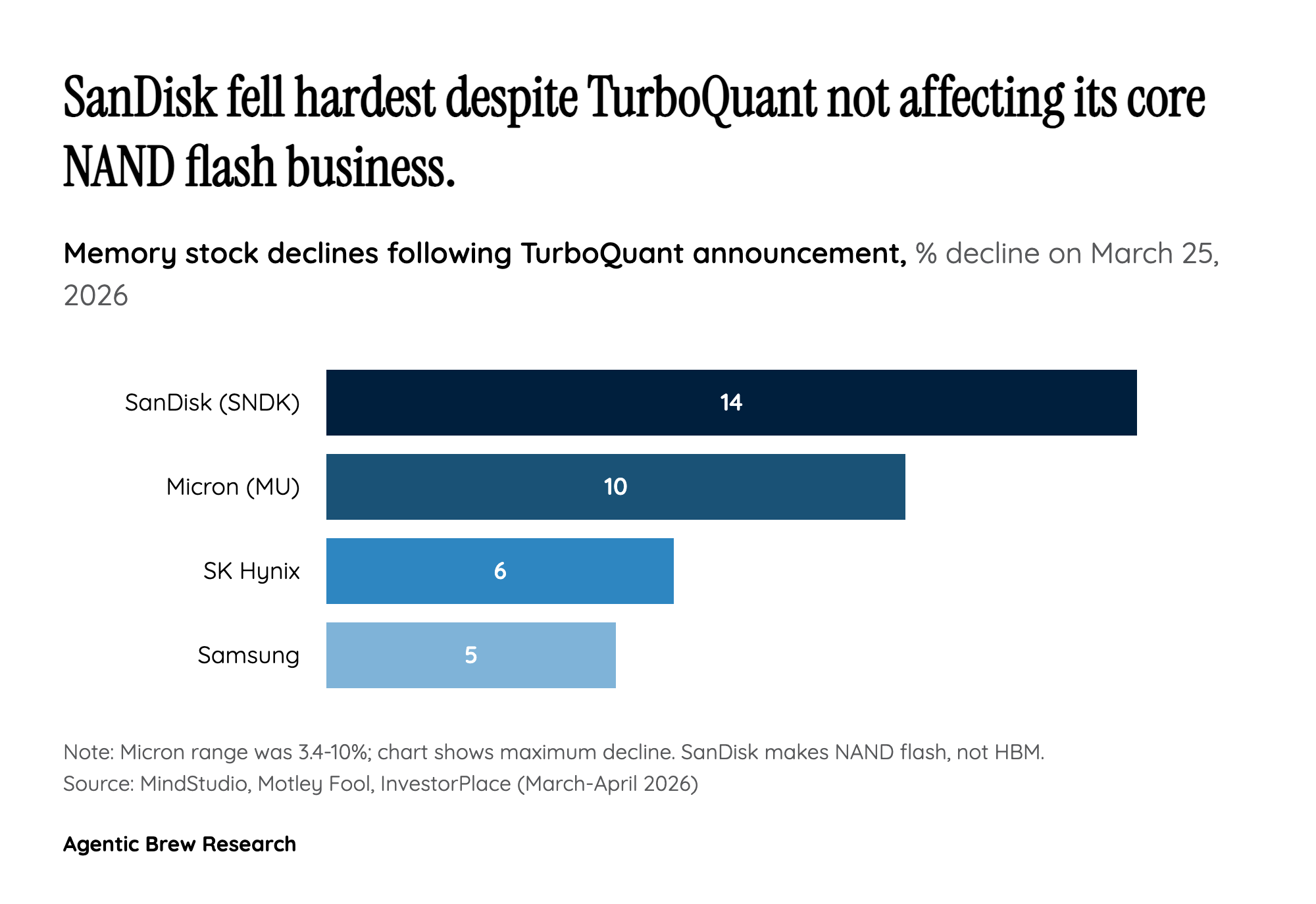
Wall Street's Headline-Reading Problem: Why SanDisk Lost 14% Over an Algorithm That Doesn't Touch NAND
Memory stock declines following TurboQuant announcement, showing SanDisk (NAND flash) fell hardest despite the algorithm targeting HBM.

The most telling detail in the TurboQuant sell-off is not the stocks that fell, but the one that fell the most. SanDisk (SNDK) dropped 14% — more than double SK Hynix's decline — despite the fact that TurboQuant targets HBM (High Bandwidth Memory) used in GPU caches, a technology entirely separate from the NAND flash storage that constitutes SanDisk's core business. Analysts at InvestorPlace called the sell-off 'analytically indefensible,' and the episode exposes a recurring pattern in how markets process AI efficiency news: traders react to the category label ('memory') rather than the technical substance.

This indiscriminate selling mirrors a broader structural problem in how financial markets metabolize deep-tech research. When Google publishes a paper about KV cache compression, the signal travels through a chain of simplification — research blog to tech press to financial media to trading desk — and at each step, nuance is stripped away. By the time it reaches the algorithmic trading systems and retail investors who drive short-term price action, 'LLM memory compression' becomes 'less memory needed' becomes 'sell all memory stocks.' The result is that SanDisk, trading at 15x earnings with a PEG ratio of 0.01, gets punished for a development in a market segment it barely participates in. For institutional investors with the technical literacy to distinguish HBM from NAND, these mispricings represent exactly the kind of inefficiency that fundamental analysis is designed to exploit.


The Jevons Paradox Redux: From 1865 Coal to 2026 KV Caches

In 1865, economist William Stanley Jevons observed something counterintuitive: James Watt's steam engine, which used coal far more efficiently than its predecessors, did not reduce England's coal consumption. It tripled it. The mechanism was straightforward — cheaper energy per unit of work made entirely new applications economically viable, and the expansion of use cases overwhelmed the per-unit savings. One hundred and sixty-one years later, the same dynamic is playing out in AI infrastructure, and the market is making the same mistake it made with DeepSeek just fourteen months ago.

The bull case for memory demand post-TurboQuant rests on observable behavior, not speculation. When Llama 3.1 8B at 128K context drops from 16GB to 3.5GB of KV cache, the immediate effect is not that data centers buy fewer GPUs — it is that use cases previously gated by memory constraints become viable. A 35B parameter model running on a single 24GB consumer GPU was not possible before TurboQuant. Longer context windows, larger batch sizes, and real-time inference for applications that previously required queuing all become feasible. Mizuho's Vijay Rakesh, SemiAnalysis' Ray Wang, and Morgan Stanley's research team all converge on the same conclusion: efficiency will spur more spending, not less. The DeepSeek precedent is instructive — the initial stock panic in January 2025 was followed by hyperscalers increasing, not decreasing, their capital expenditure on AI infrastructure. The pattern suggests that investors who sold memory stocks on the TurboQuant headline may find themselves buying them back at higher prices within quarters.

From Data Center to Desktop: The 35-Billion-Parameter Model on Your Gaming GPU

While the financial press fixated on stock prices, the local LLM community was running experiments. Within days of TurboQuant's publication, developers on Reddit's r/LocalLLaMA reported achieving 4.6x KV cache compression with custom Metal kernels on Apple Silicon, running Qwen 32B at 98% of FP16 speed on an M4 Pro with 48GB of unified memory. On X, a developer demonstrated Qwen3.5-35B-A3B passing needle-in-a-haystack tests across context lengths up to 64.2K tokens with perfect accuracy at every quantization level after implementing TurboQuant in MLX. These are not theoretical benchmarks from a research lab — they are real-world results from consumer hardware.

The consumer impact numbers tell a striking story of democratization. Llama 3.1 8B at 128K context previously required approximately 16GB of KV cache memory alone, putting it beyond the reach of most consumer GPUs when accounting for model weights and other overhead. TurboQuant compresses that to roughly 3.5GB, making long-context inference viable on mainstream hardware. More dramatically, Llama 2 7B at 128K context drops from approximately 64GB to 12-14GB, moving from server-class hardware to a single consumer GPU. YouTube creator Alex Ziskind's video titled 'After This, 16GB Feels Different' captured the sentiment, drawing 266K views. The implication extends beyond hobbyist tinkering: if businesses can run capable LLMs on commodity hardware rather than renting cloud GPU instances, the economics of AI deployment shift fundamentally. This is the supply-side expansion that makes the Jevons Paradox argument so compelling — when the floor drops out of inference costs, entirely new categories of AI applications become commercially viable.

The Open Publication Gambit and the Race to Production Integration

Google chose to publish TurboQuant as open research rather than keep it as a proprietary advantage, a decision that carries strategic weight. By releasing the algorithm openly and scheduling it for ICLR 2026, Google ensures the technique becomes an industry standard rather than a competitive moat for a single cloud provider. This mirrors the playbook that has made Transformer architectures, attention mechanisms, and numerous other Google Research contributions into shared infrastructure — the value accrues not from owning the algorithm but from being the organization that runs it best at scale. Cloudflare CEO Matthew Prince's characterization of TurboQuant as 'Google's DeepSeek moment' captures this dynamic: like DeepSeek, the contribution is less about what one company can do and more about what the entire ecosystem can now build.

The gap between publication and production, however, remains significant. As of April 2026, Google has not released official code, and the community implementations on GitHub — including a PyTorch from-scratch version and a Triton/vLLM integration — are early-stage efforts. Production integration is estimated for Q2 2026, and the path from research benchmark to production deployment is littered with edge cases around numerical stability, hardware-specific kernel optimization, and integration with existing serving stacks. Notably, a competitive alternative called RotorQuant appeared within days on r/LocalLLaMA, claiming 10-19x faster performance via Clifford rotors with 44x fewer parameters — a reminder that TurboQuant may be the starting gun rather than the finish line for this generation of KV cache compression. The real question is not whether TurboQuant works (the benchmarks across LongBench, Needle In A Haystack, ZeroSCROLLS, RULER, and L-Eval are convincing) but how quickly the inference serving ecosystem — vLLM, TensorRT-LLM, and Apple's MLX — can ship production-grade implementations.

Historical Context

1865-01-01
Economist Jevons observed that James Watt's more efficient steam engine paradoxically tripled coal consumption in England, establishing the Jevons Paradox.
2025-01-01
DeepSeek demonstrated that LLMs could be trained far more efficiently than previously assumed, triggering a GPU and memory stock panic that later reversed as hyperscalers increased capital expenditure.
2026-03-24
Google Research published TurboQuant, a training-free vector quantization algorithm compressing LLM KV caches to 3 bits per value with zero accuracy loss, scheduled for presentation at ICLR 2026.
2026-03-25
Memory stocks fell sharply in reaction to TurboQuant — Samsung dropped 5%, SK Hynix 6%, Micron 3.4-10%, and SanDisk 14% — as investors feared reduced demand for AI memory hardware.

Power Map

Key Players
Subject

Google TurboQuant LLM Compression Reshapes AI Memory Economics

GO

Google Research

Algorithm developer and publisher; authored TurboQuant as an open research contribution scheduled for ICLR 2026

NV

NVIDIA

GPU platform provider; TurboQuant benchmarks run on H100 GPUs with TensorRT-LLM integration expected

MI

Micron Technology

HBM memory manufacturer whose stock fell 3.4-10% on TurboQuant announcement fears despite trading at 17x earnings with PEG ratio of 0.04

SK

SK Hynix

Leading HBM supplier whose stock dropped approximately 6% in Korea following the announcement

SA

Samsung

Memory chip manufacturer whose stock fell approximately 5% amid the broader memory sector sell-off

OP

Open-source inference ecosystem (vLLM, MLX community)

Community developers already building TurboQuant integrations, with implementations achieving 4.6x KV cache compression on Apple Silicon

THE SIGNAL.

Analysts

"Argued TurboQuant 'will enable larger [LLMs], faster inference and better tokenomics, spurring more spending,' framing the compression breakthrough as demand-generative rather than demand-destructive for memory chips."

Vijay Rakesh
Analyst, Mizuho

"Stated it is 'hard to avoid higher usage,' suggesting that efficiency gains from TurboQuant will translate into expanded AI workloads rather than reduced hardware demand."

Ray Wang
Analyst, SemiAnalysis

"Concluded that 'TurboQuant leads to more intense computing rather than dimming demand,' reinforcing the Jevons Paradox thesis that efficiency breeds consumption."

Morgan Stanley Research
Research team, Morgan Stanley

"Called TurboQuant 'Google's DeepSeek moment,' drawing a direct parallel to the January 2025 efficiency shock that initially spooked markets but ultimately preceded increased infrastructure spending."

Matthew Prince
CEO, Cloudflare

"Stated that 'These methods don't just work well in real-world applications; they are provably efficient,' emphasizing the theoretical rigor underpinning TurboQuant's practical results."

Amir Zandieh and Vahab Mirrokni
Researchers, Google Research
The Crowd

"Introducing TurboQuant: Our new compression algorithm that reduces LLM key-value cache memory by at least 6x and delivers up to 8x speedup, all with zero accuracy loss, redefining AI efficiency."

@@GoogleResearch0

"Just implemented Google's TurboQuant in MLX and the results are wild! Needle-in-a-haystack using Qwen3.5-35B-A3B across 8.5K, 32.7K, and 64.2K context lengths: 6/6 exact match at every quant level. TurboQuant 2.5-bit: 4.9x smaller KV cache. TurboQuant 3.5-bit: 3.8x"

@@Prince_Canuma0

"This is potentially the biggest news of the year. Google just released TurboQuant. An algorithm that makes LLMs smaller and faster, without losing quality. Meaning that 16gb Mac Mini now can run INCREDIBLE AI models. Completely locally, free, and secure."

@@AlexFinn0

"Google Research TurboQuant: Redefining AI efficiency with local LLM deployment"

@u/unknown0
Broadcast
After This, 16GB Feels Different

After This, 16GB Feels Different

TurboQuant will change Local AI for everyone.

TurboQuant will change Local AI for everyone.

Google's TurboQuant Crashed the AI Chip Market

Google's TurboQuant Crashed the AI Chip Market