OpenAI launches ChatGPT Images 2.0 (GPT-Image-2)
TECH

OpenAI launches ChatGPT Images 2.0 (GPT-Image-2)

73+
Signals

Strategic Overview

  • 01.
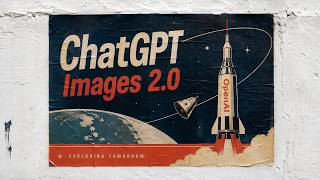
    OpenAI launched ChatGPT Images 2.0 on April 21, 2026, powered by the new GPT-Image-2 model, rolling out across ChatGPT Free/Go/Plus/Pro, Codex, and the API, with 'thinking' features reserved for paid tiers.
  • 02.
    The model is positioned as OpenAI's first image generator with native 'thinking' capabilities — it can invoke real-time web search, self-check outputs, and produce up to eight coherent images in a single prompt with character and object continuity.
  • 03.
    Technical headline features: up to 2K resolution, aspect ratios from 3:1 to 1:3, 99% typography accuracy, roughly 2x the generation speed of GPT-Image-1, and markedly improved non-Latin text rendering (Japanese, Korean, Chinese, Hindi, Bengali).
  • 04.
    GPT-Image-2 swept all three Image Arena leaderboards on launch day, including a record-breaking +242 ELO lead over Google's Nano Banana 2 in Text-to-Image, a margin LM Arena called the largest it has ever measured.

The 242-Point Gap That Rewrites the Image Leaderboard
The 242-Point Gap That Rewrites the Image Leaderboard
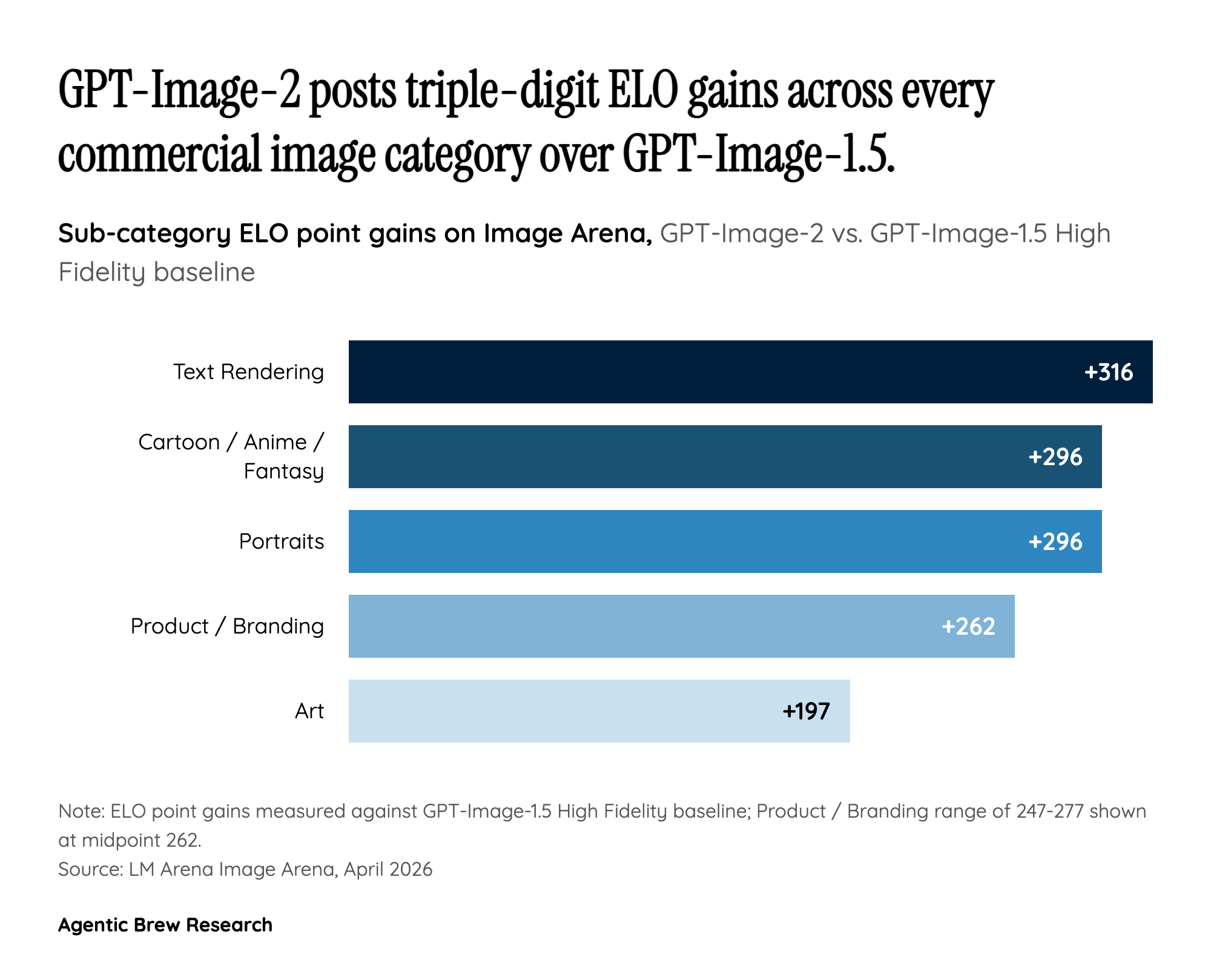
GPT-Image-2 posts record-breaking ELO gains across every commercial image category versus GPT-Image-1.5. Source: LM Arena Image Arena, April 2026.

In ELO-scored benchmarks, a 50-point lead is decisive and a 100-point lead is rare. GPT-Image-2 launched with a +242 lead over Google's Nano Banana 2 in Text-to-Image (1,512 vs 1,270), a +125 lead in Single-Image Edit (1,513), and a +90 lead in Multi-Image Edit (1,464). LM Arena's own commentary — 'No model has dominated Image Arena with margins this wide' — is the story: this isn't GPT-Image-2 narrowly beating the field, it's a model playing a different sport than its peers on the day it shipped.

The sub-category breakdown reveals where that gap actually comes from. Over the prior GPT-Image-1.5 High Fidelity baseline, Images 2.0 posted gains of +316 on Text Rendering, +296 on both Cartoon/Anime/Fantasy and Portraits, +247 to +277 on Product and Branding imagery, and +197 on Art. In other words, the largest jumps are in categories where workflow buyers — marketers, designers, publishers — are actually spending money, not the photorealism categories hobbyists argue about on Reddit. The leaderboard sweep isn't a generic 'better model' win; it's a targeted knockout of the commercial use cases Google and Adobe have been competing for.
Why OpenAI Is Gating Reasoning Instead of Pixels

OpenAI split Images 2.0 into two modes: Instant, available to all ChatGPT tiers, and Thinking, restricted to Plus, Pro, and Business subscribers. The Instant/Thinking split isn't a quality gate in the traditional sense — resolution, 2K output, and aspect ratios are table-stakes across tiers. What the paywall actually gates is reasoning: the ability to invoke real-time web search mid-generation, produce multiple distinct candidates from one prompt, and self-check outputs before returning them. This is a deliberate product choice that mirrors how OpenAI gates text reasoning in o-series models, and it says something about where OpenAI thinks image-gen margins will live going forward.

The economics underneath back this up. At the API level, a 1024x1024 image costs $0.006 in low-quality mode but $0.211 in high-quality mode — a 35x spread — and text tokens billed at $5 in / $10 out per million indicate that the 'thinking' variant is consuming a meaningful reasoning budget per image. OpenAI is effectively betting that workflow buyers (agencies producing infographics, publishers generating manga panels, e-commerce teams generating product pages) will pay reasoning-model prices per image because a single correct multi-image set replaces hours of designer work. Pure generation competes on cents; reasoning competes on the value of the workflow it replaces.

The Nerfing Playbook, and Why Redditors Are Already Worried

The loudest community thread on launch day wasn't celebration — it was a r/OpenAI post from a user who had access to a GPT-Image-2 preview for two days, generated a 'Yorkshire pub amateur photo' convincing enough to fool viewers into thinking it was real, and then watched their access silently revert to the previous model. Top comments on the official launch thread on r/OpenAI praised the +200 design arena lead but repeatedly flagged a concern that has become a folk theory in the community: that OpenAI previews an unconstrained version of a model, wins the benchmark battle, then quietly nerfs the production build for safety, cost, or compute reasons.

This creates a tension the sharing_metadata cannot paper over. The benchmark sweep was achieved by arena preview models (maskingtape-alpha, gaffertape-alpha, packingtape-alpha) tested in early April. The production model now shipping to Free, Go, Plus, and Pro users is not guaranteed to be the exact system that scored 1,512. Cost-sensitive developers have already re-routed to fal.ai, which hosts GPT-Image-2 at roughly $0.01 per 2560x1440 image versus ~$0.20 on the OpenAI API, and Adobe is offering unlimited low/medium Images 2.0 generations inside its $20/month Firefly bundle. The second-order effect is that OpenAI wins the launch-day headline but cedes marginal-cost image generation to resellers — a repeat of the wholesale-model dynamic that has already played out in text APIs.

From Photorealism Arms Race to Workflow Intelligence

The most under-appreciated shift in the launch is rhetorical. OpenAI's own positioning — 'visual thought partner,' 'Renaissance,' and an unnamed researcher's line that 'it's an AI that you interactively talk to, and it responds' — deliberately moves the category away from 'most photorealistic model' and toward 'most useful end-to-end image worker.' The tell is the demo set: full magazine spreads, infographics, slide decks, maps, and manga panels — artifacts defined by typography, layout, and multi-panel continuity, not by whether skin pores look real.

That framing is a bet against where Google's Nano Banana franchise built its 10M-user surge, which was rooted in single-image consumer virality (one photo, one Ghibli-style transformation, one share). By contrast, Images 2.0's headline capabilities — 99% typography accuracy, non-Latin script rendering in Japanese, Korean, Chinese, Hindi, and Bengali, up to eight coherent images per prompt with character continuity — are only valuable if users are producing structured documents rather than one-off memes. A r/ChatGPT user's 10x10 grid of 100 labeled tech topics landing coherently on day one is the proof point OpenAI wants. The risk is that consumer virality still drives top-of-funnel adoption, and a 'workflow-intelligent' model is harder to meme than a Ghibli filter. OpenAI appears to be accepting that tradeoff in exchange for a commercial moat.

Historical Context

2025-03-25
Shipped native image generation inside ChatGPT (Images 1.0), drawing 1M new sign-ups in the first hour and triggering the Ghibli-style meme wave that defined consumer AI image culture for 2025.
2025-12-16
Pushed a faster, cheaper ChatGPT Images update explicitly positioned against Google's Nano Banana and Adobe — foreshadowing that the image-model fight was becoming OpenAI's next major front.
2026-04-04
Three anonymous image models — maskingtape-alpha, gaffertape-alpha, packingtape-alpha — briefly appeared on Image Arena and outperformed the field; they were later identified as GPT-Image-2 previews, signalling OpenAI's arena-testing playbook.
2026-04-21
Launched ChatGPT Images 2.0 alongside Codex Labs, a new enterprise developer-training service — bundling the model release with a monetizable enterprise motion rather than treating it as a standalone consumer drop.

Power Map

Key Players
Subject

OpenAI launches ChatGPT Images 2.0 (GPT-Image-2)

OP

OpenAI

Launcher and framer of the release, positioning Images 2.0 as a 'visual thought partner' and the 'Renaissance' step after DALL-E and Images 1.0.

GO

Google (Gemini / Nano Banana 2)

Primary competitor displaced from the #1 Image Arena slot; its Nano Banana launch previously drew 10M new Gemini users and briefly pushed Gemini to the top App Store slot.

SA

Sam Altman

OpenAI CEO and public face of the livestream, framing the jump as 'going from GPT-3 to GPT-5 all at once.'

CH

ChatGPT Plus / Pro / Business subscribers

Gated audience for the 'Thinking' mode — the reasoning, web-search, and self-check features that define the model's differentiator are paid-only.

FA

fal.ai

Third-party hosting platform offering GPT-Image-2 at lower per-image prices than OpenAI's direct API, pulling cost-sensitive developers.

LM

LM Arena

Independent benchmark validator whose leaderboards provided the framing statistic of OpenAI's launch day — the +242 ELO gap.

THE SIGNAL.

Analysts

"Framed Images 2.0 as a generational leap in image AI, saying 'Images 2.0 is a huge step forward; this is like going from GPT-3 to GPT-5 all at once.'"

Sam Altman
CEO, OpenAI

"Analogized the progression as 'If we think of Dall-e as cave drawings, and Images 1.0 as ancient art, then Images 2.0 is the Renaissance,' and emphasized 'an unprecedented level of specificity and fidelity... small text, iconography, UI elements.'"

OpenAI (corporate positioning)
Launch communications

"Reframed the product as a conversational partner rather than a prompt box: 'It's an AI that you interactively talk to, and it responds.'"

OpenAI researcher (unnamed)
Member of the Images 2.0 team

"Explained the underlying reason prior models butchered text: diffusion systems try to 'reconstruct a given input,' treating writing as 'a very, very tiny part' of the overall image — context for why Images 2.0's 99% typography accuracy is a structural, not cosmetic, improvement."

Asmelash Teka Hadgu
Founder, Lesan AI

"Stated 'No model has dominated Image Arena with margins this wide,' treating the GPT-Image-2 sweep as a historically anomalous result."

LM Arena
Independent benchmark operator
The Crowd

"Introducing ChatGPT Images 2.0 A state-of-the-art image model that can take on complex visual tasks and produce precise, immediately usable visuals, with sharper editing, richer layouts, and thinking-level intelligence."

@@OpenAI11000

"gpt image is here, available today in the API and Codex. The most capable image generation model yet, built for production-grade workflows with stronger text rendering, layout, editing, resolution, and multilingual rendering."

@@OpenAIDevs1100

"Exciting news - GPT-Image-2 by @OpenAI has claimed the #1 spot across all Image Arena leaderboards! A clean sweep with a record-breaking +242 point lead in Text-to-Image - the largest gap we've seen to date. - #1 Text-to-Image (1512), +242 over #2 (Nano-banana-2 with web-search)"

@@arena761

"GPT Image 2 preview"

@u/Groundbreaking_Tap851715
Broadcast
Introducing ChatGPT Images 2.0

Introducing ChatGPT Images 2.0

This is ChatGPT Images 2.0

This is ChatGPT Images 2.0

Thinking & Intelligence with ChatGPT Images 2.0

Thinking & Intelligence with ChatGPT Images 2.0