Meta-AWS Graviton CPU deal for agentic AI
TECH

Meta-AWS Graviton CPU deal for agentic AI

45+
Signals

Strategic Overview

  • 01.
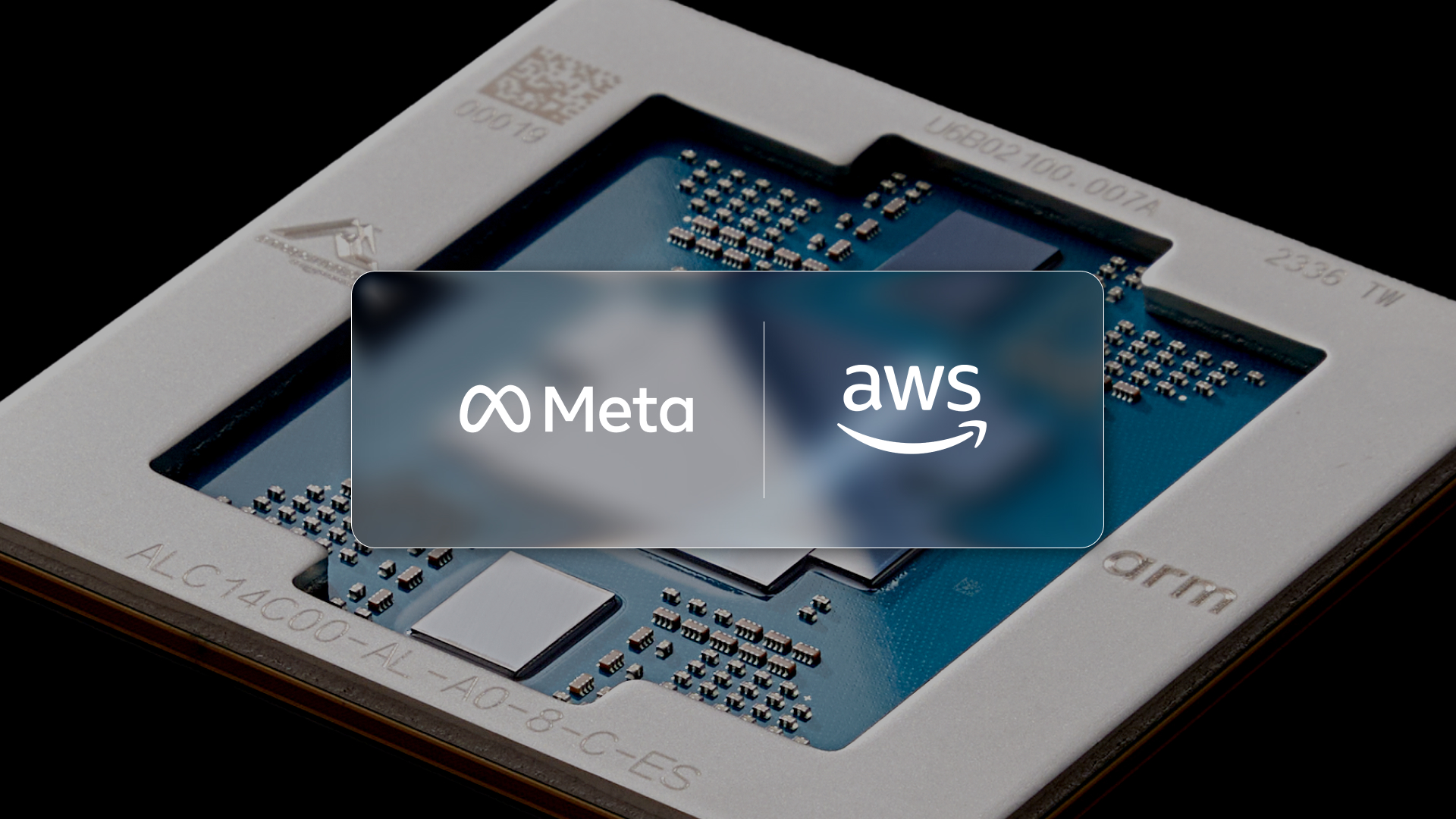
    Meta signed a multibillion-dollar, multi-year agreement with AWS to deploy tens of millions of Graviton5 CPU cores for agentic AI workloads, with a duration of at least three years and room to expand.
  • 02.
    Graviton5 is built on a 3nm process with 192 Arm Neoverse V3 cores, an L3 cache 5x larger than the prior generation, up to 25% better performance than Graviton4, and inter-core delays reduced by up to 33%.
  • 03.
    Amazon shares hit an intraday record high of $258.79 on the news (the first record since the prior November) and closed up roughly 3-3.5% as investors rerated AWS's AI infrastructure positioning.
  • 04.
    The AWS deal arrives on top of roughly $48B in recent Meta AI infrastructure commitments and over $200B in total hardware deals across Nvidia, AMD, CoreWeave, Nebius, Broadcom, and Amazon, against Meta's 2026 capex guidance of $115B-$135B.

Deep Analysis

Agentic AI is a CPU story, not just a GPU story

The most consequential reframing in this deal comes straight from Andy Jassy: 'Agentic AI is becoming almost as big a CPU story as a GPU story.' Until now, the AI infrastructure narrative has been GPU-centric — training runs, dense matrix math, Nvidia's stack. Agents flip the workload profile. Multi-step reasoning, code generation, search, and the orchestration of long-running tasks are CPU-intensive: branchy logic, state management, and high-throughput inter-process coordination rather than tight tensor loops.

AWS engineered Graviton5 directly for that profile, with 192 Arm Neoverse V3 cores, an L3 cache 5x larger than the prior generation, and inter-core communication delays cut by up to 33% — the bottleneck-relief metrics that matter when an agent is juggling tool calls, not training a model. Meta's Santosh Janardhan made the operational point bluntly: Graviton lets Meta 'run the CPU-intensive workloads behind agentic AI with the performance and efficiency we need at our scale.' The takeaway is that the binding constraint of the next AI cycle may not be H100 supply — it may be CPU cores per agent-second.


Even $135B capex isn't enough — Meta is leasing what it can't build

Meta's 2026 capex guidance of $115B-$135B is nearly double the $72B it spent in 2025, and it has committed $600B to US infrastructure through 2028. Yet the AWS Graviton deal — on top of roughly $48B in other recent AI hardware commitments and a $10B Google Cloud agreement from August 2025 — shows Meta still cannot self-build enough compute fast enough. Tens of millions of cores is not a side bet; it is a structural admission that hyperscale agentic AI requires capacity arbitrage across every available supplier.

Matt Kimball of Moor Insights frames Meta's posture not as picking winners but as 'assembling a heterogeneous system' across AWS, Nvidia, AMD, Arm, and Meta's own MTIA silicon. At Meta's scale, even small per-workload efficiency gains compound into billions of dollars, which is why the company is willing to fragment its stack rather than standardize. The unanswered question, raised by Info-Tech's Nabeel Sherif, is the demand-side one: 'What are they going to do with all this capacity?' Meta has not publicly mapped tens of millions of cores to specific user-facing services.

ARM's silent coup in the server room

Beyond the Meta-AWS headline lies a structural shift: ARM-based CPUs are quietly displacing x86 in AI infrastructure. Counterpoint's David Wu projects that ARM-based designs will reach 90% of the AI ASIC server CPU market by 2029 — a near-total inversion from today. Graviton5 (192 Arm Neoverse V3 cores on a 3nm process) is one vector; Meta's parallel disclosure that it is adopting Arm's new 136-core AGI CPU is another; and Nvidia's own Vera CPU is also ARM-based.

The Meta-AWS deal isn't a one-off architectural choice — it is an inflection point that hardens a multi-year migration. The pressure on Intel and AMD's x86 server franchise is now coming from two directions at once: hyperscaler custom silicon (Graviton) and merchant-market Arm designs (Arm AGI, Nvidia Vera). The contrarian read circulating among CPU-focused investor communities — that CPU supply of any kind is the new bottleneck, with reports of Intel reselling discontinued chips to meet demand — only reinforces how acute the architectural transition has become.

AWS's $20B silicon business gets a marquee proof point

AWS's custom-silicon portfolio (Graviton, Trainium, Nitro) was already running at a $20B+ annualized rate with triple-digit YoY growth before this deal. Meta's commitment is the marquee validation — a hyperscale-native customer with its own chip program (MTIA) choosing Graviton anyway. Markets responded immediately: Amazon shares hit an intraday record of $258.79 (the first record since the prior November) and closed up roughly 3-3.5% at $263.99.

Investor sentiment crystallized quickly into a 'CPUs Are Cool Again' rerating thesis: capital flowing out of AI software and into the physical infrastructure layer — CPUs, GPUs, networking. Retail investor commentary on AMZN was vocally bullish, with the news triggering a wave of upside price-target chatter. There is also a constraint signal worth flagging: reports surfaced that two large customers wanted essentially all of AWS's 2026 Graviton capacity, hinting that smaller AWS users may face tighter availability as hyperscalers monopolize the new generation. The same supply pressure that made Nvidia an investor darling is now showing up in CPU silicon.

Heterogeneity as a hedge — and a message to Nvidia

The strategic subtext of this deal is that Meta no longer believes any single architecture optimally serves every AI workload. Its portfolio now spans AWS Graviton (CPU), Nvidia GPUs, AMD accelerators, Arm AGI CPUs, and its own MTIA silicon — a heterogeneous system, in Matt Kimball's framing, where 'heterogeneity is critical to long term success.' That is a direct shot at Nvidia's preferred narrative of an integrated, GPU-centric stack.

Graviton5 specifically competes with Nvidia's ARM-based Vera CPU, and the Meta deal signals hyperscalers are willing to lock in CPU capacity outside Nvidia's ecosystem rather than wait for Vera supply or pay the Nvidia margin. The competitive picture: Nvidia retains GPU dominance for training, but the agentic-inference layer — orchestration, tool use, real-time reasoning — is now openly contested. For AWS, the deal is also strategic insulation: with multiple AI customers anchored on AWS infrastructure, AWS is funding its Nvidia challenge using revenue from customers that themselves depend on Nvidia, a circularity that quietly reshapes the AI capital stack.

Historical Context

2025-08
Meta signed a $10 billion, 6-year cloud deal with Google Cloud, marking an earlier diversification beyond its own data centers and previewing the multi-cloud strategy now extending to AWS.
2026-04
In the weeks leading up to the AWS announcement, Meta inked roughly $48B in AI infrastructure commitments as part of a broader $200B+ in hardware deals spanning Nvidia, AMD, CoreWeave, Nebius, Broadcom, and Amazon.
2026-04-24
Meta and AWS announced the multibillion-dollar Graviton5 agreement covering tens of millions of cores for agentic AI workloads, with Meta becoming one of the largest Graviton customers in the world.
2026-04-24
Amazon shares hit an intraday record of $258.79, the first record since the prior November, with the stock rallying roughly 3-3.5% on the news as investors rerated AWS's AI infrastructure positioning.

Power Map

Key Players
Subject

Meta-AWS Graviton CPU deal for agentic AI

ME

Meta Platforms

Buyer and one of the largest Graviton customers in the world; pursuing a heterogeneous compute portfolio spanning AWS, Nvidia, AMD, Arm, and its in-house MTIA silicon to scale agentic AI infrastructure.

AM

Amazon Web Services (AWS)

Supplier of Graviton5 CPU capacity hosted in AWS data centers; positioning its custom silicon stack (Graviton, Trainium, Nitro) as a $20B+ annualized chips business growing at triple-digit YoY rates.

AN

Andy Jassy (Amazon CEO)

Public face of the deal; framed agentic AI as a CPU story comparable to the GPU story and pitched AWS chips as competitive with Nvidia and Intel.

SA

Santosh Janardhan (Meta Head of Infrastructure)

Spokesperson for Meta on the deal; framed Graviton expansion as a strategic diversification move to handle CPU-intensive agentic workloads at scale.

NV

Nvidia

Incumbent AI chip leader pressured by the deal; agentic AI shifting more compute to ARM-based CPUs (including Nvidia's own Vera CPU) signals hyperscalers are willing to lock in capacity outside Nvidia's stack.

AR

Arm Holdings

Underlying ISA for Graviton; Meta also disclosed adopting Arm's new 136-core AGI CPU, reinforcing ARM-on-server momentum across hyperscale data centers.

Source Articles

Top 5

THE SIGNAL.

Analysts

"Agentic AI is becoming almost as big a CPU story as a GPU story."

Andy Jassy
CEO, Amazon

"As we scale the infrastructure behind Meta's AI ambitions, diversifying our compute sources is a strategic imperative. AWS has been a trusted cloud partner for years, and expanding to Graviton allows us to run the CPU-intensive workloads behind agentic AI with the performance and efficiency we need at our scale."

Santosh Janardhan
Head of Infrastructure, Meta

"This isn't just about chips; it's about giving customers the infrastructure foundation, as well as data and inference services, to build AI that understands, anticipates, and scales efficiently to billions of people worldwide."

Nafea Bshara
VP and Distinguished Engineer, Amazon

"This is about assembling a heterogeneous system, not picking a single winner. In fact, I think for most, heterogeneity is critical to long term success."

Matt Kimball
VP and Principal Analyst, Moor Insights & Strategy

"While x86 architectures currently maintain a significant presence in AI server infrastructure, our generation-by-generation analysis suggests this established stronghold is swiftly transitioning toward proprietary Arm-based designs."

David Wu
Analyst, Counterpoint Research

"What are they going to do with all this capacity?"

Nabeel Sherif
Principal Advisory Director, Info-Tech Research Group
The Crowd

"Another exciting development in our chips business as Meta has decided to bet big on Graviton, our leading CPU chip—committing to tens of millions of Graviton cores. Agentic AI is becoming almost as big a CPU story as a GPU story."

@@ajassy0

"Meta just signed a deal with Amazon to deploy tens of millions of AWS Graviton CPU cores into its AI infrastructure and Andy Jassy himself called it out as one of the most important signals in tech right now. "Agentic AI is becoming almost as big a CPU story as a GPU story.""

@@MilkRoadAI0

"Today we're announcing an agreement with Amazon Web Services to bring tens of millions of AWS Graviton cores to our compute portfolio. This partnership marks an expansion of our diversified AI infrastructure and will help scale systems behind Meta AI and agentic experiences."

@@AIatMeta0

"Meta will adopt hundreds of thousands of AWS Graviton chips in latest AI infrastructure grab"

@u/Relative-Button-340546
Broadcast
Meta will adapt hundreds of thousands of AWS Graviton chips in latest AI infrastructure grab

Meta will adapt hundreds of thousands of AWS Graviton chips in latest AI infrastructure grab

CPUs Are Cool Again

CPUs Are Cool Again

Meta Taps Amazon CPUs to Power Agentic AI at Scale

Meta Taps Amazon CPUs to Power Agentic AI at Scale