AI chip startups raise record funding to challenge Nvidia
TECH

AI chip startups raise record funding to challenge Nvidia

35+
Signals

Strategic Overview

  • 01.
    AI chip startups have raised roughly $8.3 billion globally in 2026, with U.S. companies accounting for $4.7 billion and European entrants contributing about $800 million.
  • 02.
    Cerebras closed a $1 billion Series H on February 3, 2026 at a ~$23 billion post-money valuation, roughly 3x its valuation six months earlier, led by Tiger Global.
  • 03.
    Three U.S. challengers — MatX, Ayar Labs, and Etched — each raised $500 million within a five-week window, targeting inference efficiency, co-packaged optics, and transformer-only ASICs respectively.
  • 04.
    Nvidia still retains roughly 80-90% of the AI accelerator market, anchored by a CUDA ecosystem with 100 million+ installations and more than 4 million developers.

Deep Analysis

The inference inflection: why GPU architecture is newly contestable

The 2026 funding surge is not a generic bet against Nvidia — it is a targeted bet on inference. Deloitte now pegs inference at roughly two-thirds of AI compute in 2026, up from about one-third in 2023, as frontier labs shift from training new models to serving billions of tokens a day. Nvidia's GPU was architected for massively parallel training — thousands of fungible matrix multiplications — but inference is latency-sensitive, memory-bandwidth bound, and benefits from deterministic dataflow. That is the opening NATO Innovation Fund's Patrick Schneider-Sikorsky names directly when he says "the current GPU architecture was not designed for [inference] in the most significant ways at scale."

Each of the marquee 2026 raises is a different answer to that gap: Etched's Sohu hardcodes the transformer architecture and claims a Llama-70B server runs ~500,000 tokens/sec versus ~23,000 on eight H100s; MatX aims for a 10x LLM performance lift with a cleaner sheet than Nvidia's training-era designs; Cerebras's wafer-scale engine keeps the whole model on-die to eliminate interconnect latency. The thesis is consistent across all four: the most valuable workload in AI has silently migrated to terrain where the incumbent's design choices are liabilities.

Nvidia's co-opetition play: why it's backing its own challengers

The most revealing data point in this cycle is not who Nvidia is trying to beat, but who it is writing checks to. Nvidia participated in Ayar Labs' $500M Series E alongside AMD, and has reportedly deployed more than $4B into photonics suppliers like Coherent and Lumentum. Developer-facing YouTube and investor-interview videos this cycle hit the same note from different angles — inference is "not one size fits all," and Nvidia itself is signaling it can't dominate every AI workload.

This is classic platform co-opetition: the scale-up bottleneck in modern AI data centers is no longer raw compute, it is moving bits between thousands of GPUs without melting the rack. Ayar Labs CTO Vladimir Stojanovic frames the ambition plainly: "10,000 GPU dies connected in a scale-up domain, while keeping the rack power and power density to around 100kW." Those GPU dies are, overwhelmingly, Nvidia's. By owning equity in the interconnect layer, Nvidia protects its own system-level roadmap even as ASIC challengers chip away at single-node workloads. That is a signal, not a hedge — the incumbent is quietly conceding that the next battleground is above the chip, at the fabric.

The scale gap: what $800M in Europe still can't buy

The scale gap: what $800M in Europe still can't buy
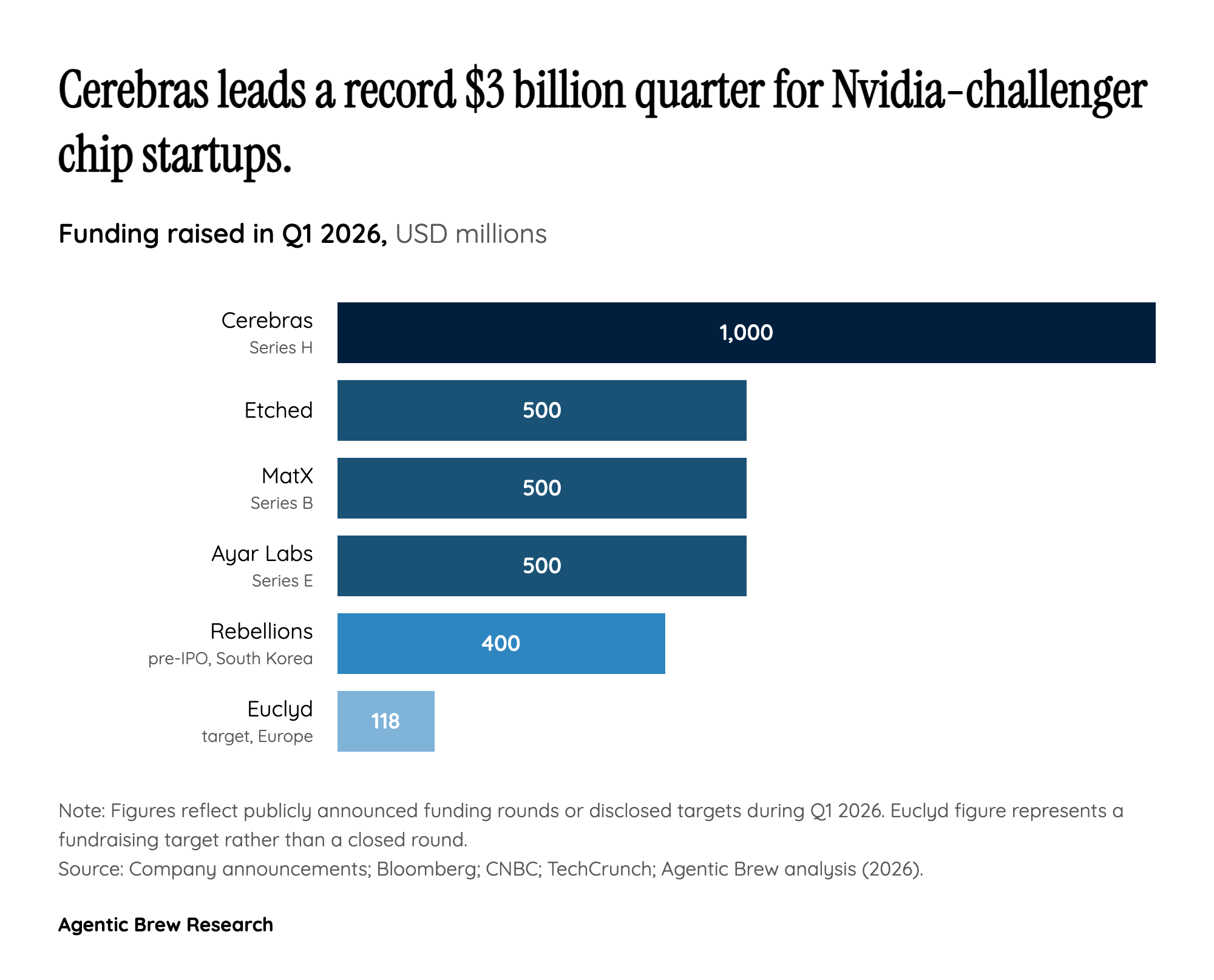
Cerebras's $1B Series H leads a $3B+ quarter of AI chip startup funding; Euclyd's €100M target shows the European scale gap.

Europe's entire AI chip startup ecosystem raised about $800M year-to-date; U.S. peers raised $4.7B. That nearly 6x delta explains why Euclyd is publicly negotiating a €100M round while Cerebras is closing $1B in a single tranche. But capital is only half the gap. The harder constraints are structural: CUDA has 100M+ installations, 4M+ developers, and 3,000+ optimized applications — a software moat accumulated over nearly two decades that no 2026 Series B can buy.

And even with funding, fabrication capacity is rationed. Technical communities watching the MatX raise zeroed in on exactly this: can a $500M Series B actually secure TSMC advanced-node slots when Nvidia, AMD, and Broadcom hold priority bookings? Seedcamp's Carlos Espinal argues chip investing has moved from "fringe" to "central aspect of how people conceptualize AI infrastructure," and that is true — but centrality in VC portfolios doesn't translate into leading-edge wafers. Euclyd's claim of 100x energy efficiency versus Nvidia's Vera Rubin is striking; whether it matters depends on whether the company can ever tape out at volume behind customers who pre-booked TSMC years ago.

Community skepticism: the Graphcore ghost and the bubble read

The contrarian voices aren't dismissing the technology — they are questioning the exit math. Technical forums have been debating, with real depth, why Nvidia's recent chip-startup dealmaking has favored easier-to-integrate architectures over the wafer-scale wildcards, reading the pattern as a tell about what incumbents actually value when they move from competitor to acquirer. Commenters repeatedly invoke Graphcore — the British AI-chip darling that raised hundreds of millions and ultimately exited at a steep discount — as the cautionary template for well-capitalized silicon that still got suffocated by software ecosystems and HBM allocations.

The cross-platform tension is sharp. Bloomberg and VC-tracker accounts on X reported the raises in bullish, factual tones; partners at European funds call chips "central." But the technically literate retail community is pattern-matching to previous chip-startup cycles where the strategic exit (a Xilinx-style acquisition rather than independence) looked more likely than a durable standalone platform. Both readings can be true at once — the funding is real, the inference opportunity is real, and so is the graveyard of companies that built excellent silicon and still lost.

Historical Context

2022
Founded by three Harvard dropouts (Gavin Uberti, Chris Zhu, Robert Wachen) to build a transformer-only ASIC.
2023
Founded by ex-Google TPU engineers Reiner Pope and Mike Gunter to build LLM-specialized processors.
2024-06
Raised $120M Series A to fabricate its first Sohu chips at TSMC.
2024
Founded in the Netherlands by former ASML executive Bernardo Kastrup with backing from ex-ASML CEO Peter Wennink.
2026-02-03
Closed $1B Series H at $23B valuation, roughly 3x the $8.1B valuation just six months earlier.
2026-02-24
Announced $500M Series B led by Jane Street and Situational Awareness, with participation from Stripe's Collison brothers.
2026-03-03
Closed $500M Series E led by Neuberger Berman at a ~$3.8B valuation, with Nvidia and AMD participating.
2026-04-17
Founder Bernardo Kastrup told CNBC the company is seeking at least €100M to scale its Craftwerk inference architecture.

Power Map

Key Players
Subject

AI chip startups raise record funding to challenge Nvidia

CE

Cerebras Systems

Wafer-scale AI chip maker; closed $1B Series H at $23B valuation with a multi-year $10B+ OpenAI compute deal attached.

MA

MatX

Founded 2023 by ex-Google TPU engineers Reiner Pope and Mike Gunter; $500M Series B led by Jane Street and Situational Awareness; targets 10x LLM performance vs Nvidia GPUs.

AY

Ayar Labs

Co-packaged optics startup; $500M Series E led by Neuberger Berman at ~$3.8B valuation, with Nvidia, AMD, MediaTek, and Alchip participating.

ET

Etched

Harvard-dropout founded transformer-only ASIC maker (Sohu); raised $500M at ~$5B valuation led by Stripes, with Peter Thiel, Positive Sum, and Ribbit Capital.

EU

Euclyd

Dutch inference-chip entrant founded in 2024 by ex-ASML executive Bernardo Kastrup; seeking at least €100M for its Craftwerk multi-chiplet architecture.

NV

Nvidia

Incumbent GPU leader with ~80-90% AI accelerator share; also a participant in the Ayar Labs round and a multi-billion-dollar photonics investor (Coherent, Lumentum).

THE SIGNAL.

Analysts

"Inference is the key focus now, and the current GPU architecture was not designed for it in the most significant ways at scale."

Patrick Schneider-Sikorsky
Director, NATO Innovation Fund

"The heat generated by [current chips] is becoming a significant issue. We firmly believe that photonics platforms will represent the next paradigm."

Taavet Hinrikus
Partner, Plural

"It's no longer a fringe investment. It's evolving into a central aspect of how people conceptualize AI infrastructure."

Carlos Espinal
Managing Partner, Seedcamp

"We want to be able to scale up to 10,000 GPU dies connected in a scale-up domain, while keeping the rack power and power density to around 100kW."

Vladimir Stojanovic
CTO, Ayar Labs
The Crowd

"AI chip provider Cerebras has raised about $1 billion in a new funding round, bolstering the company's efforts to compete with Nvidia Corp. Cerebras Raises $1 Billion in Funding at $23 Billion Valuation"

@@business18

"MatX, an AI chip startup founded in 2022 by CEO Reiner Pope and CTO Mike Gunter, has raised more than $500 million in a new funding round as it aims to challenge Nvidia in the fast-growing market for AI processors, according to Bloomberg. The round was led by Jane Street and Situational Awareness."

@@TradedVC281

"Ayar Labs raised $500 million in a Series E round at a $3.8 billion valuation, with backing from investors including NVIDIA and AMD, alongside Neuberger Berman, MediaTek, the Qatar Investment Authority, Alchip Technologies, ARK Invest, Insight Partners, Sequoia Capital, and 1789 Capital."

@@TradedVC373

"Nvidia acquired Groq, but why not Cerebras? Cerebras is 3x times faster than Groq, while maximum 1.5x the price. Anyone can explain?"

@u/Conscious_Warrior272
Broadcast
The Nvidia Groq Acquisition Explained

The Nvidia Groq Acquisition Explained

NVIDIA Challenger on Why Inference is the Next Multi-Trillion Dollar AI Market

NVIDIA Challenger on Why Inference is the Next Multi-Trillion Dollar AI Market

Euclyd's Craftwerk SiP: Europe's Game-Changer in AI Inference

Euclyd's Craftwerk SiP: Europe's Game-Changer in AI Inference