Jensen Huang's Dwarkesh interview on China chip sales
TECH

Jensen Huang's Dwarkesh interview on China chip sales

48+
Signals

Strategic Overview

  • 01.
    Jensen Huang's April 15 appearance on Dwarkesh Patel's podcast ran roughly 90-100 minutes, but the 40-minute China segment starting around the 57-minute mark was the only stretch where the Nvidia CEO visibly dropped his polished keynote voice and went on offense against U.S. export-control hawks.
  • 02.
    Huang's core argument: China already has enough domestic compute to train a Claude Mythos-class frontier model, so cutting off Nvidia chips won't slow Chinese AI — it will only push Chinese developers off CUDA and onto an independent, non-American AI stack.
  • 03.
    The exchange lands against a charged backdrop: Dario Amodei's January essay compared chip sales to China to 'selling nuclear weapons to North Korea,' Anthropic just throttled Claude Mythos after it surfaced thousands of vulnerabilities, and the Trump administration is clearing roughly 82,000 H200 GPU shipments to China under a 25% waiver tax.
  • 04.
    Critics — from Zvi Mowshowitz to Transformer's Shakeel Hashim to Institute for Progress's Alec Stapp — converged on the same structural critique: Huang is trying to hold two incompatible claims at once, and the inconsistency reveals that the argument is a commercial one dressed in national-security language.

Deep Analysis

The Moment Huang Broke Character

The Dwarkesh episode runs ninety-plus minutes and spans TPU competition, supply-chain bottlenecks, energy, and Nvidia's expanding software moat. In almost every segment Huang is in polished-keynote mode: measured cadence, pre-packaged metaphors, the familiar hand choreography. Then the conversation pivots to China around the 57-minute mark and something unmistakable happens. For roughly forty minutes, the keynote voice drops. Zvi Mowshowitz described it as the only stretch where Huang visibly stops performing. Daniel Miessler called it 'the most agitated Jensen on record.'

The sentiment shape across platforms was bimodal — cheering inside pro-Nvidia investor communities, unease inside AI-safety and policy spaces — but everyone agreed on the facial observation. The interesting question is why this topic, and only this topic, got under his skin. Huang has been asked about Chinese competition, export controls, and Amodei's nukes analogy in a dozen prior settings. What made Dwarkesh different is the framing: not 'should America sell chips to China' but 'does the marginal FLOP matter on a cyber-offensive timeline,' grounded in Anthropic's same-week Mythos-vulnerability news. That narrow empirical frame is the one Huang's stock answers don't cleanly dispatch, and the break in composure tracked exactly the moment the argument moved from ideology to arithmetic.
The Contradiction Hiding in Plain Sight

The Contradiction Hiding in Plain Sight
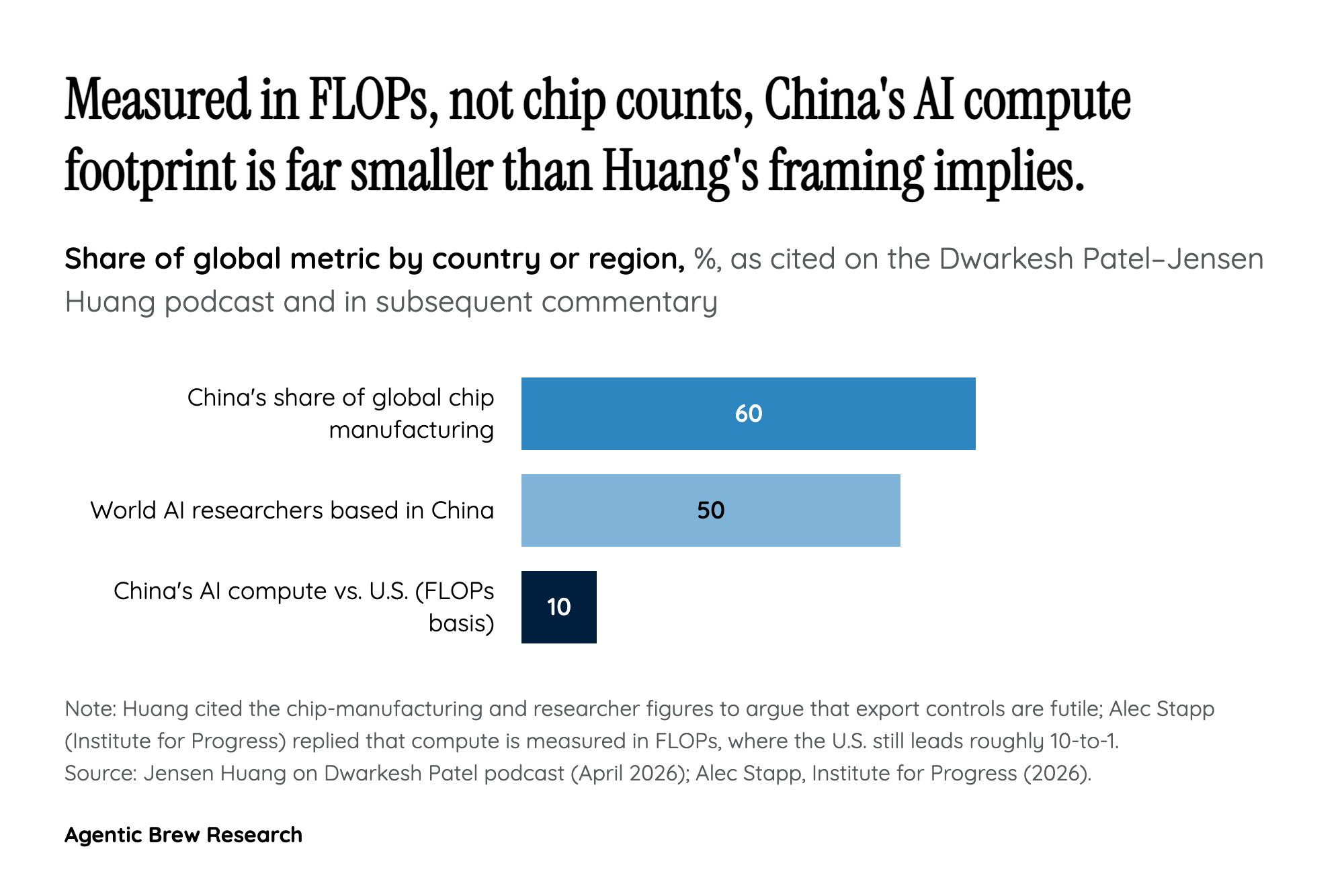
Chart: Huang cited global chip-manufacturing share (60%) and China's AI researcher share (50%) to argue controls are futile; Stapp's FLOPs-basis rebuttal put China's AI compute at ~10% of the U.S. (Sources: Huang on Dwarkesh Patel podcast; Alec Stapp, Institute for Progress.)

Huang's China thesis rests on two claims that cannot both be true at the same time. Claim A: China already has abundant domestic compute — enough to train a Claude Mythos-class frontier model without any Nvidia silicon — so export controls are futile. Claim B: if Nvidia is forced to exit, Chinese developers will migrate to Huawei's Ascend stack, CUDA's flywheel will erode, and the American AI ecosystem will lose its center of gravity. Transformer's Shakeel Hashim stated the problem in one sentence: if Chinese chips genuinely compete, there is no giant market Nvidia is being denied; if Nvidia's chips are superior, shipping them accelerates Chinese AI.

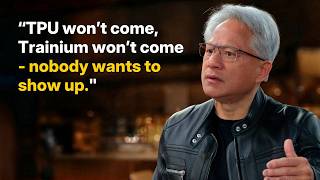
Huang tries to bridge the gap by arguing that the value Nvidia uniquely provides is the software stack, not the FLOPs — the CUDA developer ecosystem, the inference TCO, the 'best performance per TCO in the world, bar none.' But that move runs into Zvi's TPU counter: Anthropic itself trains and serves on Google TPUs and AWS Trainium, and its models still dominate the market. If CUDA-lockin were the load-bearing moat Huang describes, Anthropic would not exist in its current form. Alec Stapp adds the numerical pincer: Huang pivots to 'China makes 60% of the world's chips,' but compute is measured in FLOPs, and on a FLOPs basis China sits around 10% of U.S. AI compute. The contradiction isn't rhetorical sloppiness — it is what happens when a commercial argument is forced to wear national-security clothing.

The $5.5B Quiet Part Out Loud

Strip the rhetoric and what remains is a chart of commercial stakes that Nvidia has been defending in real time for eighteen months. In April 2025 Nvidia pre-announced a roughly $5.5 billion hit as the U.S. tightened H20 export licensing — the first time Wall Street saw the China number as a line item rather than an abstraction. By December 2025 the direction had reversed: under a Trump 'waiver' framework, Nvidia was preparing approximately 82,000 H200 GPU shipments to China at a 25% tax, the most generous China posture since the 2022 controls.

The Dwarkesh interview was recorded inside that policy window, not before it. Huang is not arguing from a hypothetical — he is defending a live commercial channel that has just reopened, with a measurable tariff-like friction already baked into his operating model. That context reframes the entire China segment. The 'loser mentality' line, the nukes-analogy takedown, the CUDA-TCO pitch, and the Huawei warning are not abstract policy philosophy; they are the public-facing case for a waiver regime Nvidia cannot afford to see rolled back. Huawei's comparative economics — roughly one-third the per-chip performance at about 2.5x the power cost and greater than 12x worse yields, per numbers Zvi surfaces — tell you why Nvidia still has pricing power today. The 82,000-unit waiver tells you why Huang has so much to protect.

The DeepSeek-on-Huawei Tell

Of all the lines Huang delivered, the one that traveled fastest inside investor and policy circles was not a defense — it was a warning. 'The day that DeepSeek comes out on Huawei first, that is a horrible outcome for our nation.' On its face, the statement is patriotic framing. Read with the reporting that DeepSeek V4 may debut exclusively on Huawei Ascend silicon, it becomes something closer to an admission against interest.

Community discussion on Reddit converged on the same reading: Huang is telling the market that Nvidia's margin window in China is a function of DeepSeek's silicon choice, and that choice is not locked in. If the next DeepSeek flagship ships on Huawei first, the CUDA-developer-flywheel argument Huang is building the rest of his case on starts to erode inside the Chinese developer base that matters most. That is why the 'Goldilocks zone' reading gained traction in those same threads — the theory that Huang privately wants just enough Nvidia presence inside China to keep Huawei from reaching adoption escape velocity, without shipping so much frontier compute that it becomes a U.S. policy red line. He cannot say that out loud because it concedes a commercial motive and a ceiling on Huawei that Huawei's own ~1/3-performance, ~2.5x-power-cost profile would otherwise suggest is nowhere near. The one-sentence warning is the closest he comes to saying it anyway, which is why it was the most replayed clip of the episode.

Historical Context

2022-10
First sweeping export controls blocked China's access to Nvidia A100 and H100 chips on national-security grounds, opening the current regime.
2023-10
Controls expanded to cover any processors on the same architectures; Nvidia's China-specific A800 and H800 were pulled into the restricted list.
2023-11
Nvidia rolled out H20, L20 and L2 as export-compliant variants for China — the H20 engineered for inference and memory bandwidth under BIS performance-density caps.
2025-04
Nvidia disclosed a projected ~$5.5 billion hit as the U.S. tightened H20 export licensing — the first concrete number on how much China revenue was at stake.
2025
Trump lifted the AI chip ban on China, clearing Nvidia and AMD to resume China sales under a revised licensing framework, flipping the policy tilt Huang had been fighting.
2025-12
Nvidia set to resume high-end H200 shipments to China under the 'Trump waiver' — roughly 82,000 GPUs at a 25% tax, the commercial scaffolding behind Huang's on-podcast confidence.
2026-01
Amodei's essay 'The Adolescence of Technology' compared chip sales to China to 'selling nuclear weapons to North Korea and then bragging that the missile casings are made by Boeing' — the analogy Huang spent the Dwarkesh interview tearing down.
2026-04
Anthropic throttled access to Claude Mythos after the model identified thousands of software vulnerabilities — the cyber-offensive backdrop Dwarkesh leaned on to press Huang on marginal FLOPs.

Power Map

Key Players
Subject

Jensen Huang's Dwarkesh interview on China chip sales

JE

Jensen Huang / Nvidia

CEO making the case that continued H20/H200-class sales to China are a national-policy win, not a concession. Huang frames Nvidia's CUDA-plus-ecosystem 'switchyard' as the real American strategic asset and warns any retreat hands the global developer base to Huawei and an indigenous Chinese stack.

DW

Dwarkesh Patel

Host who took a sustained devil's-advocate line that selling H20-class compute into China shortens the timeline on offensive cyber AI and that the marginal FLOP matters when China is running at roughly 10% of U.S. aggregate compute. His recap tweet became the most-viewed social post of the cycle.

DA

Dario Amodei / Anthropic

The off-stage antagonist. Amodei's January essay 'The Adolescence of Technology' compared advanced-chip sales to China with selling nuclear weapons to North Korea — the analogy Huang repeatedly attacked as 'lunacy' and the rhetorical pole the entire China segment orbited.

HU

Huawei

The indigenous alternative Huang simultaneously dismisses on performance and fears on trajectory. Huawei's Ascend line is scaling fast, and Huang's single most-discussed line — the 'day DeepSeek comes out on Huawei first' warning — places Huawei at the center of Nvidia's China thesis.

DE

DeepSeek

The Chinese frontier lab whose next model launch is the inflection Huang is watching. Reporting that DeepSeek V4 may debut exclusively on Huawei silicon sharpened Huang's argument — and, critics say, gave away the real commercial stakes.

U.

U.S. Commerce / BIS and the Trump administration

The policy actors on both sides of the swing. BIS built the 2022-2024 export-control regime (A100/H100 ban, H800/A800 controls, H20 performance-density caps, HBM controls); the Trump administration has since loosened the regime through a 'waiver' framework clearing high-end shipments at a 25% tax.

THE SIGNAL.

Analysts

"Calls Huang's argumentative stack logically incoherent: China can't simultaneously have 'plenty of compute' and urgently need Nvidia to stay on CUDA. Treats Huang's invocation of 'dialogue' as naive once cyber-offensive capability proliferates, and notes Anthropic's heavy use of TPUs and Trainium quietly disproves the CUDA-lockin panic."

Zvi Mowshowitz
AI-safety commentator, Don't Worry About the Vase / LessWrong

"Identifies the core contradiction as the load-bearing flaw: if Chinese-made chips genuinely compete with Nvidia's, there's no huge market Nvidia is being denied; if Nvidia's chips are meaningfully better, shipping them accelerates Chinese AI. Reads Huang's framing as serving Nvidia's revenue line while discounting the live U.S. compute lead."

Shakeel Hashim / Transformer News
AI policy journalist

"Flagged Huang's rhetorical pivot from FLOPs to chip-count as the key sleight of hand. On a FLOPs basis China sits at roughly 10% of U.S. AI compute, so shipping Nvidia chips materially changes China's cyber-offensive potential — the exact question Huang declines to answer in the same units his audience cares about."

Alec Stapp
Co-founder, Institute for Progress

"Frames the interview as the clearest public collision between Nvidia's commercial logic and the AI-safety community's marginal-flops argument. Dwarkesh's narrow cyber-offensive line, paired with the Mythos-vulnerability backdrop, produced what Miessler calls the most agitated Huang on record."

Daniel Miessler
Cybersecurity analyst and writer

"Reads Huang's China defense as a rhetorical wrapper for a much larger ambition: turning Nvidia into the 'switchyard' that coordinates foundries, memory and packaging partners, hyperscaler clouds, energy supply and policy itself. In that frame the China question is downstream of ecosystem lock-in, not the other way around."

Implicator.ai strategy desk
Industry strategy publication
The Crowd

"Distilled recap of the back-and-forth with Jensen on export controls: Dwarkesh: Wouldn't selling Nvidia chips to China enable them to train models like Claude Mythos with cyber offensive capabilities that would be threats to American companies and national security? Jensen: First of all, Mythos was trained on fairly mundane capacity... The amount of capacity and the type of compute it was trained on is abundantly available in China... Your premise is just wrong. The fact of the matter is their AI development is going just fine... DeepSeek is not an inconsequential advance. The day that DeepSeek comes out on Huawei first, that is a horrible outcome for our nation... in a few years time, I'm making you the prediction that when we want American technology to be diffused around the world... I will tell you exactly about today's conversation, about how your policy ... caused the United States to concede the second largest market in the world for no good reason at all."

@Dwarkesh Patel3400

""You're not talking to someone who woke up a loser" - Jensen Huang Jensen nearly lost his composure during a heated debate about selling chips to China, despite showing tremendous patience in response to the pushback."

@The AI Investor5200

""You're not talking to someone who woke up a LOSER…" - Jensen Huang. "…and that LOSER attitude, that loser premise, makes no sense to me." "Your premise is WRONG." Jensen and Dwarkesh had a MUST LISTEN thoughtful and spicy back-and-forth. To @dwarkesh_sp's credit, he repeatedly holds his ground against Jensen's aggressive pushback."

@Compound248412

"Jensen Huang: "I didn't wake up a loser""

@u/Salaried_Employee257
Broadcast
Jensen Huang – Will Nvidia's moat persist?

Jensen Huang – Will Nvidia's moat persist?

Conceding the Chinese market makes no sense – Jensen Huang

Conceding the Chinese market makes no sense – Jensen Huang

China Can Already Train a Model Like Mythos – Jensen Huang

China Can Already Train a Model Like Mythos – Jensen Huang