Microsoft-OpenAI Partnership Amendment
TECH

Microsoft-OpenAI Partnership Amendment

37+
Signals

Strategic Overview

  • 01.
    On April 27, 2026, Microsoft and OpenAI announced an amended partnership that ends Microsoft's exclusive license to OpenAI's IP and models while extending the now non-exclusive license through 2032.
  • 02.
    OpenAI can now serve all its products through any cloud provider, while Microsoft remains primary cloud partner with Azure-first product launches unless Microsoft cannot or chooses not to support required capabilities.
  • 03.
    OpenAI's revenue share payments to Microsoft continue through 2030 at the same percentage but are now subject to a total cap, while Microsoft will no longer pay a revenue share to OpenAI on resold products.
  • 04.
    The amendment eliminates the controversial AGI clause that had previously made Microsoft's IP rights contingent on whether OpenAI achieved artificial general intelligence.

Deep Analysis

The $13B Investment That Just Got Decoupled From AGI

For nearly seven years, the most consequential clause in the Microsoft-OpenAI relationship was a single contractual trigger: if OpenAI's board (and later, after the October 2025 restructuring, an independent expert panel) declared that AGI had been achieved, Microsoft's privileged access to the most advanced models would effectively be cut off. That clause turned every benchmark milestone into a legal event, and it sat awkwardly atop more than $13B in cumulative Microsoft commitments — the original $1B in 2019, follow-on capital between 2021 and early 2023, and the roughly $10B announced in January 2023.

The April 27 amendment removes that fault line entirely. Microsoft now holds a non-exclusive license to OpenAI's models and products through 2032 'regardless of how far the technology advances,' as The Decoder summarized. Eliminating the AGI clause replaces a contingent, hard-to-value right with predictable economics, and it neutralizes the commercial role of the independent verification panel that was created barely six months earlier. For a company that just took a roughly 27% stake in the post-restructuring public benefit corporation, swapping a contested technical milestone for seven more years of contractual access is a quietly enormous concession from OpenAI.

Exclusivity Out, Cap In: The Economic Logic of a Capped Revenue Share

The financial mechanics of the amendment look modest in headline form but are structurally sharp. OpenAI continues paying Microsoft a revenue share through 2030, reportedly at the same 20% rate as before, but the new agreement layers a total cap on top of that stream. In the other direction, Microsoft will no longer pay a revenue share to OpenAI on resold products — a flow that mattered as Azure OpenAI Service and Copilot scaled. Both companies have effectively agreed to bound their financial entanglement.

Constellation Research's Holger Mueller frames the cap as a two-edged instrument: it 'may hurt OpenAI down the road' if growth runs hot, but it 'gives Microsoft a way to not overpay for OpenAI after all of its investments.' Evercore ISI's Kirk Materne reaches a similar conclusion from the Microsoft side, calling the deal a clean trade of exclusivity for 'clarity, flexibility and economic certainty' and reaffirming a $580 price target. The amendment essentially converts an open-ended, equity-and-revenue-linked entanglement into a finite, capped contract — which is exactly the kind of structure investors prefer when an IPO is in view.

The Multi-Cloud AI Race Officially Begins

Until April 27, OpenAI's distribution architecture was constrained: Azure-first by exclusivity, Azure-only in practice for the largest workloads. The amendment's most operationally significant line is that 'OpenAI can now serve all its products to customers across any cloud provider,' with Azure-first launches preserved only when Microsoft can and chooses to support the required capabilities. That language reframes the cloud market overnight.

The beneficiary list is concrete. AWS gets formal enablement of its reported $38B alliance with OpenAI, layered on top of Amazon's separately expanded Anthropic deal — more than $100B in AWS spend over the next decade. Google Cloud and Oracle become viable infrastructure substrates for OpenAI workloads. Microsoft's own Azure segment, which grew 39% in fiscal Q2 2026 and recently absorbed a $5B Anthropic investment tied to a $30B Azure compute commitment, is itself already a multi-model platform. The post-amendment world is one where every hyperscaler runs every frontier model, and exclusivity as a competitive moat is dead.

Why OpenAI Pushed for This: A Memo, an Anthropic Surge, and an IPO

The renegotiation did not appear out of nowhere. On April 13, 2026 — exactly two weeks before the announcement — a leaked internal OpenAI memo cited the Amazon alliance and bluntly stated that the Microsoft partnership had 'limited our ability' to reach enterprise clients. That memo landed against an uncomfortable backdrop: enterprise API market share figures cited in 2026 reporting show OpenAI falling from 50% to 25% while Anthropic rose from 12% to 32%, with much of the swing flowing through AWS Bedrock distribution.

The other pressure was capital. Wedbush analysts noted that the new structure 'positions OpenAI for an IPO' precisely because exclusivity barriers are gone — OpenAI can now distribute across AWS, Google Cloud, and Oracle, and prospective public-market investors no longer have to underwrite a single-cloud distribution risk or an unbounded revenue-share to a strategic competitor. The trade OpenAI made — accepting a capped but continuing revenue stream to Microsoft and losing Microsoft's reciprocal payments — buys exactly the cleanliness an S-1 needs.

The Hidden Risk: Losing Microsoft's Enterprise Sales Muscle

The least-discussed risk in the amendment is one Constellation Research highlighted directly: with exclusivity gone and Microsoft's revenue share to OpenAI eliminated, Microsoft's incentive to push OpenAI products through its enterprise channel is structurally diminished. Microsoft has spent years routing Copilot, Azure OpenAI Service, and bundled enterprise agreements through one of the most powerful B2B sales organizations on earth. That distribution muscle was a genuine asset for OpenAI, not just a constraint.

Bloomberg Intelligence's Anurag Rana noted that Microsoft is already routing Copilot through both OpenAI and Anthropic, which is precisely why the 2032 IP extension matters so much to Microsoft — it preserves optionality without obligation. For OpenAI, the symmetric implication is that it now has to win enterprise customers more directly, on AWS and elsewhere, against an Anthropic that has been doing exactly that with measurable share gains. Viral YouTube coverage has framed the announcement as a 'massive Microsoft divorce' and a 'lost biggest partner,' but the more analytically honest framing is that OpenAI just chose distribution breadth over distribution depth — and the bill for that choice will come due in enterprise win rates over the next eighteen months.

Historical Context

2019-07-22
Microsoft makes its initial $1 billion investment in OpenAI, becoming exclusive cloud provider for OpenAI's compute-heavy research with roughly half delivered as Azure credits.
2021
Microsoft launches the Azure OpenAI Service to give enterprises governed access to GPT-3 and related systems, formalizing Azure as the distribution channel for OpenAI models.
2023-01-23
Microsoft announces a third-phase, multiyear, multibillion-dollar investment (reported at ~$10B) following ChatGPT's viral launch, bringing total commitments above $13B.
2025-10
OpenAI completes restructuring into a for-profit public benefit corporation; an independent expert panel is given authority to verify any AGI claim, with Microsoft receiving roughly a 27% stake.
2026-04-13
A leaked OpenAI internal memo cites the Amazon alliance and states the Microsoft partnership has 'limited our ability' to reach enterprise clients, foreshadowing the renegotiation.
2026-04-20
Amazon expands its strategic collaboration with Anthropic with a commitment of more than $100B in AWS spend over the next decade, intensifying multi-cloud AI competition just before the Microsoft-OpenAI amendment.
2026-04-27
Microsoft and OpenAI announce the amended partnership: non-exclusive IP license through 2032, OpenAI revenue share to Microsoft capped through 2030, AGI clause removed, Microsoft revenue share to OpenAI eliminated, OpenAI cleared to deploy across any cloud.

Power Map

Key Players
Subject

Microsoft-OpenAI Partnership Amendment

MI

Microsoft

Largest investor and formerly exclusive cloud/IP partner. Loses exclusivity but secures capped OpenAI revenue inflows through 2030, non-exclusive IP rights through 2032, retained equity stake (~27%), and an end to its own revenue-share outflows to OpenAI.

OP

OpenAI

Gains strategic flexibility to deploy across AWS, Google Cloud, Oracle, and other providers, removing distribution bottlenecks and clearing a path toward an IPO. Trade-off: continues paying capped revenue share to Microsoft through 2030 and loses Microsoft's revenue-share contributions on resold products.

AM

Amazon Web Services (AWS)

Major beneficiary of OpenAI's multi-cloud opening; a previously announced $38B alliance with OpenAI is now formally enabled, positioning AWS to capture OpenAI workloads alongside its expanded Anthropic relationship.

AN

Anthropic, Google Cloud, and Oracle

Competitive cloud and model rivals. Anthropic has been gaining enterprise share against OpenAI; Oracle and Google Cloud become viable infrastructure options for OpenAI workloads under the new non-exclusive structure.

IN

Independent AGI Verification Panel

Established in October 2025 with OpenAI's transition to a public benefit corporation to verify any AGI declaration. Its commercial role is effectively superseded by the elimination of the AGI clause in the new agreement.

Source Articles

Top 5

THE SIGNAL.

Analysts

"Calls the revised agreement unsurprising, arguing it gives Microsoft greater clarity, flexibility, and economic certainty in exchange for reduced exclusivity, while OpenAI gains broader market access. Says removing AGI language should reduce prior investor uncertainty; maintains Outperform on Microsoft with a $580 price target. Quote: "We do not believe this revised agreement should come as a major surprise to investors at this point, as Microsoft has increasingly signaled interest in a broader multi model strategy, while OpenAI has clear incentives to expand distribution more broadly across the market.""

Kirk Materne
Analyst, Evercore ISI

"Frames the amendment as a partial separation that benefits both partners. The capped revenue share could constrain OpenAI later but protects Microsoft from overpaying given its prior investments. Warns OpenAI may lose the unique enterprise distribution muscle Microsoft provided. Quote: "Microsoft and OpenAI separate each other to a point, which gives both partners more flexibility.""

Holger Mueller
Principal Analyst, Constellation Research

"Argues that the extension of Microsoft's IP rights through 2032 is the most important aspect of the amendment, since Microsoft is already routing Copilot through both OpenAI and Anthropic and the long-dated IP access protects that multi-model product strategy."

Anurag Rana
Analyst, Bloomberg Intelligence

"Note that the new structure positions OpenAI for an IPO by removing barriers tied to the original partnership, since OpenAI can now deploy across AWS, Google Cloud, and Oracle and is no longer encumbered by Microsoft exclusivity."

Wedbush analysts
Analysts, Wedbush Securities
The Crowd
Broadcast
MASSIVE Microsoft Divorce That WILL BANKRUPT OpenAI and ChatGPT Forever

MASSIVE Microsoft Divorce That WILL BANKRUPT OpenAI and ChatGPT Forever

OpenAI Just Lost Its Biggest Partner, Microsoft Abandon Sinking Ship To Pursue Self-Sufficiency...

OpenAI Just Lost Its Biggest Partner, Microsoft Abandon Sinking Ship To Pursue Self-Sufficiency...

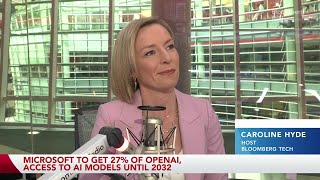
OpenAI Gives Microsoft 27% Stake, Clears Path to For-Profit

OpenAI Gives Microsoft 27% Stake, Clears Path to For-Profit