When a Pull Request Stops Being a Pull Request
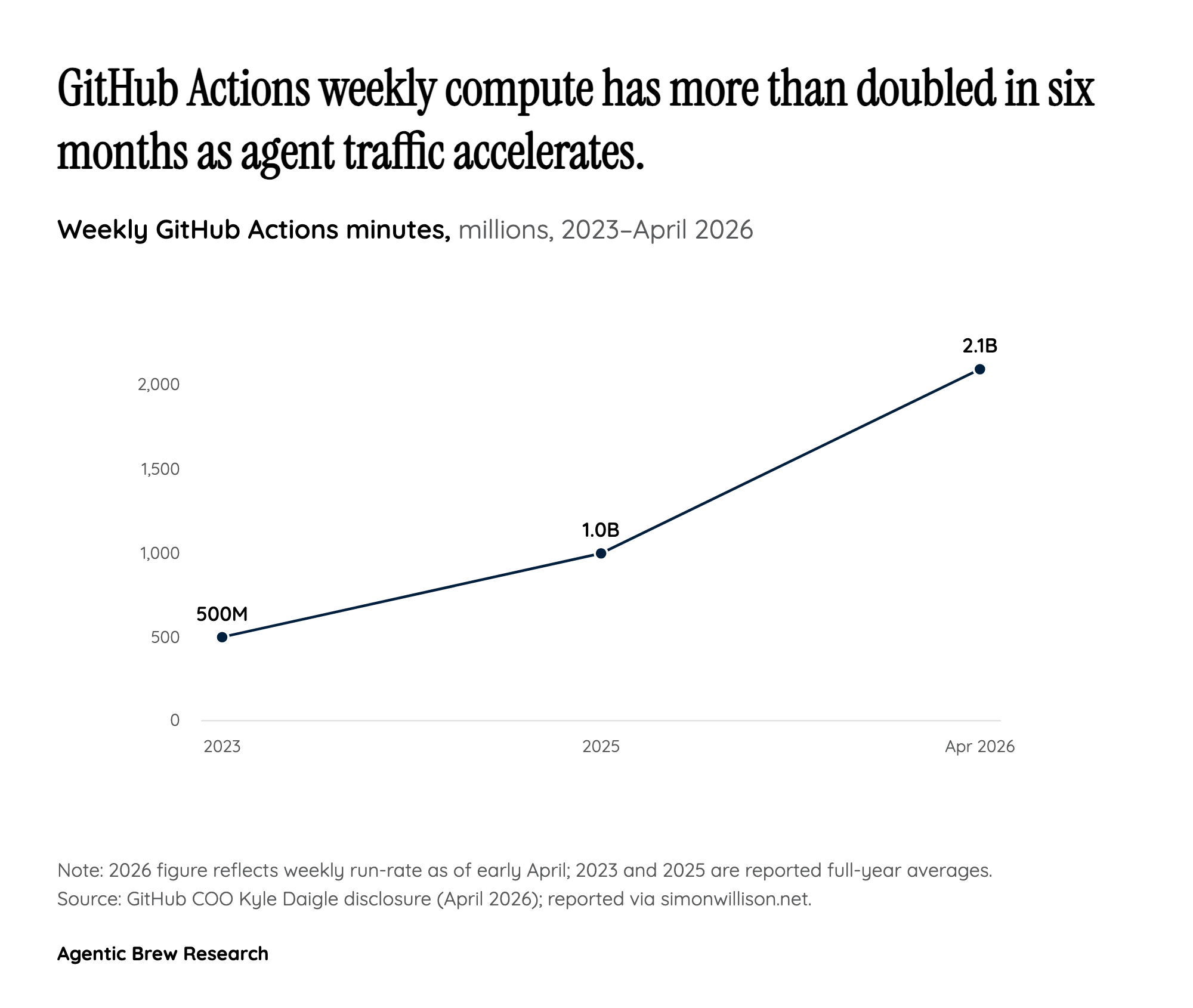
The 14x commit surge is not just a bigger pile of the same kind of work — it is a categorical shift in how GitHub is used. Kyle Daigle's disclosure that the platform now ingests 275 million commits per week, on pace for 14 billion in 2026 against just 1 billion in all of 2025, captures one face of the change. The sharper face is the fanout. Vlad Fedorov's own engineering note describes how a single PR ripples through Git storage, mergeability checks, branch protection, Actions, search, notifications, permissions, webhooks, APIs, background jobs, caches, and databases. When a human opens five PRs a week, that fanout is invisible. When a Copilot or Claude Code session opens fifty in an afternoon — and reruns checks each time it tweaks a comma — the same architecture is asked to absorb an order-of-magnitude more downstream events.
The pace is the load-bearing variable. Agents do not pause to read documentation, eat lunch, or context-switch between meetings. They hammer the API surface continuously, often across many repositories in parallel. Claude Code alone is reportedly responsible for ~2.6 million commits a week — roughly 4.5% of public commits — up from about 100,000 weekly in late September 2025. That is a 25x climb in a single tool's footprint in roughly six months. The platform was sized for human tempo and human curiosity. It is now being driven by what amounts to a fleet of always-on contributors that share none of those rate-limiting traits.