Alibaba AI Pivot and Earnings
TECH

Alibaba AI Pivot and Earnings

31+
Signals

Strategic Overview

  • 01.
    Alibaba reported Q3 FY2026 revenue of 284.8 billion yuan ($41.4 billion), missing analyst consensus of 290.7 billion yuan, with net income plunging 66% to 15.6 billion yuan.
  • 02.
    Alibaba's Cloud Intelligence Group delivered 36% revenue growth to 43.3 billion yuan ($6.2 billion), with AI-related product revenue maintaining triple-digit growth for the tenth consecutive quarter.
  • 03.
    On March 19, 2026, Alibaba announced a target to surpass $100 billion in annual revenue from AI and cloud businesses within five years, while establishing the 'Alibaba Token Hub' business unit under CEO Eddie Wu.
  • 04.
    Alibaba Cloud raised AI computing and storage prices by up to 34% amid surging demand, while launching Wukong, an agentic AI enterprise tool with planned Slack, Teams, and WeChat integrations.

Deep Analysis

Why This Matters

Alibaba's December quarter earnings represent a watershed moment for China's largest cloud provider and one of Asia's most influential technology conglomerates. The 66% net income decline and missed revenue estimates are not merely disappointing numbers -- they are the financial signature of a company deliberately sacrificing short-term profitability to position itself at the center of China's AI economy. With $53 billion committed to AI infrastructure over three years and a newly announced $100 billion annual revenue target for cloud and AI, Alibaba is making the most aggressive strategic bet in its 27-year history.

The significance extends far beyond a single quarterly report. Alibaba's pivot signals that China's tech giants view AI not as an incremental feature but as a fundamental platform shift comparable to the internet itself. CEO Eddie Wu's characterization of AI as a 'once-in-a-generation' opportunity, combined with the creation of a dedicated Token Hub business unit, suggests the company is restructuring its entire organizational DNA around AI. For investors, enterprise customers, and competitors alike, Alibaba's willingness to absorb severe margin compression establishes a new baseline for what it costs to compete in the AI infrastructure race -- and raises the stakes for every player in the ecosystem.
How It Works

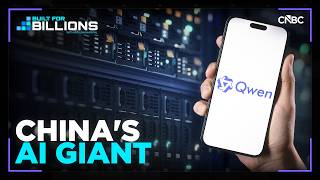
Alibaba's AI pivot operates on three interconnected levels: infrastructure, platform, and application. At the infrastructure layer, the company is deploying massive GPU clusters and expanding data center capacity across China and internationally, funded by the $53 billion three-year investment. This compute backbone powers the Alibaba Cloud Intelligence Group, which now commands 35.8% of China's cloud market. The platform layer centers on MaaS (Model-as-a-Service) delivered through the Bailian platform, which has become Alibaba Cloud's fastest-growing product. Enterprises access Alibaba's Qwen foundation models and third-party models through API calls, paying per token consumed -- hence the significance of the 'Token Hub' branding.

At the application layer, Alibaba is building vertical AI tools like Wukong, an agentic AI assistant designed for enterprise workflows with integrations planned for Slack, Microsoft Teams, and WeChat. The pricing strategy reveals the demand dynamics: Alibaba Cloud raised AI computing and storage prices by up to 34%, a move that signals genuine supply constraints rather than promotional growth. The triple-digit growth in AI-related product revenue for ten consecutive quarters demonstrates that enterprise adoption has moved well beyond experimentation into production workloads, creating a durable revenue stream that justifies the infrastructure investment cycle.

By The Numbers

By The Numbers
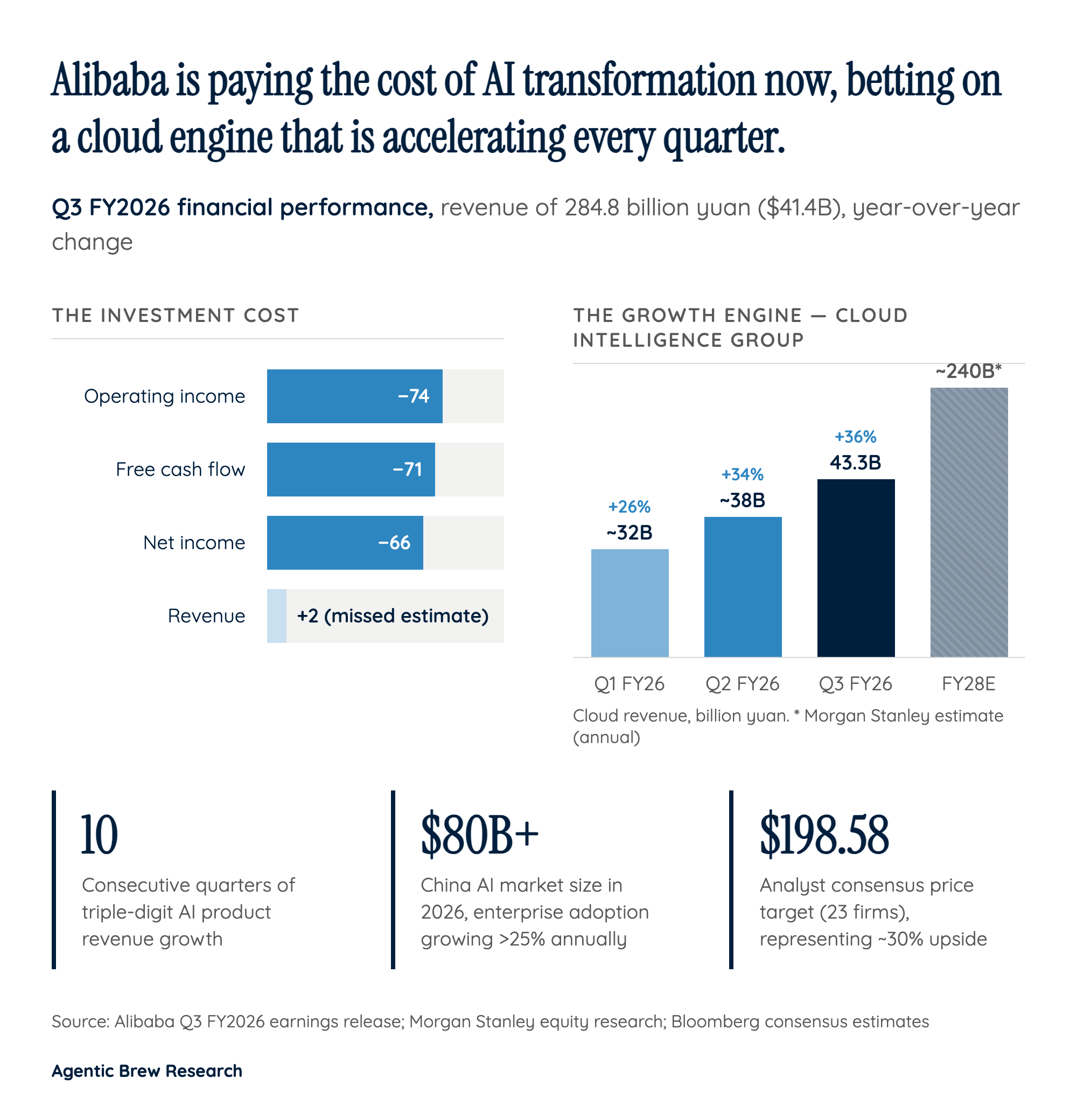
Alibaba Q3 FY2026: Investment cost vs. cloud growth acceleration

The financial picture reveals a company in deliberate transformation. Q3 FY2026 revenue of 284.8 billion yuan ($41.4 billion) grew just 2% year-over-year and missed the consensus estimate of 290.7 billion yuan by roughly $860 million. Net income collapsed 66% to 15.6 billion yuan from 46.4 billion yuan, while operating income fell 74%. Free cash flow declined 71% to $1.6 billion. These headline numbers reflect the cost of building AI infrastructure at scale -- not a deterioration in business fundamentals.

The cloud segment tells the growth story. Cloud Intelligence Group revenue reached 43.3 billion yuan ($6.2 billion), up 36% year-over-year and accelerating from 34% in the previous quarter and 26% in the quarter before that. AI-related product revenue maintained triple-digit growth for the tenth consecutive quarter. Morgan Stanley projects cloud revenue will double to 240 billion yuan by 2028. The analyst consensus of 23 covering firms maintains a Strong Buy rating with a mean price target of $198.58, representing approximately 30% upside from the current trading level near $134. China's overall AI market is expected to exceed $80 billion in 2026, with enterprise adoption growing more than 25% annually.

Impacts & What's Next

In the near term, investors face continued margin compression as Alibaba ramps its infrastructure spending. The stock dropped 4-5% in premarket trading following the earnings release, reflecting market sensitivity to profit declines even when the strategic rationale is clear. The 71% free cash flow decline limits Alibaba's capacity for shareholder returns and could pressure the stock until cloud revenue growth materially offsets the investment burden. Citi and Macquarie analysts have flagged that margin improvement in 2026 is essential for sustaining investor confidence.

Looking further ahead, Alibaba's competitive position hinges on several critical variables. U.S. export controls on advanced Nvidia processors represent a structural constraint that forces Alibaba to develop or source alternative AI chips, potentially slowing its infrastructure buildout relative to U.S. hyperscalers deploying approximately $650 billion in AI infrastructure in 2026. The departure of Junyang Lin, principal architect of the Qwen model, raises talent retention questions at a moment when AI researchers are in extreme demand. On the opportunity side, Alibaba's 35.8% share of China's cloud market and its pricing power -- evidenced by the 34% price increases -- position it to capture disproportionate value as Chinese enterprises shift from experimental to production AI workloads. The $100 billion annual revenue target implies roughly a 4x increase from current cloud run rates, an ambitious but not implausible goal given the acceleration trajectory.

The Bigger Picture

Alibaba's AI pivot is unfolding against the backdrop of an intensifying global AI infrastructure race. U.S. hyperscalers -- Amazon Web Services, Microsoft Azure, and Google Cloud -- are collectively deploying approximately $650 billion in AI infrastructure in 2026, dwarfing Alibaba's $53 billion commitment in absolute terms. Yet within China's market, Alibaba's investment is transformative. Kenny Ng of Everbright Securities predicts competitors will be forced to follow, suggesting that Alibaba's spending could trigger an industry-wide investment cycle that reshapes China's technology landscape for the next decade.

The geopolitical dimension adds complexity that has no parallel in the U.S. cloud market. U.S. export controls create an asymmetric competitive environment where Chinese AI companies must innovate around chip constraints that their American counterparts do not face. Paradoxically, this constraint has fueled innovation: DeepSeek's model breakthroughs and Alibaba's own Qwen family (which surpassed 1 billion downloads) demonstrate that Chinese AI labs are finding efficient paths forward despite hardware limitations. For global observers, Alibaba's earnings report is less about one company's quarterly performance and more about whether China's AI ecosystem can achieve competitive parity through a fundamentally different approach -- one built on domestic infrastructure, alternative chips, and a market of 1.4 billion potential users. The answer to that question will shape the technology industry's structure for years to come.

Historical Context

2024-05
Chairman Joe Tsai and CEO Eddie Wu outlined a 'user-first, AI-driven' strategic approach in their annual shareholder letter, signaling the beginning of Alibaba's formal pivot toward AI.
2025-02
Alibaba announced a $53 billion three-year AI infrastructure investment, exceeding the company's total AI and cloud spending over the past decade, making it China's largest private computing project.
2025-09
Alibaba's AI revenue surge triggered a $50 billion stock rally as cloud revenue grew 26% year-over-year, marking the first major market validation of its AI strategy.
2025-11
Cloud growth accelerated to 34% year-over-year, beating analyst estimates, though overall profit declined as AI infrastructure spending ramped up significantly.
2026-03-16
Alibaba announced a major organizational revamp, creating the 'Alibaba Token Hub' business unit to consolidate all AI services under CEO Eddie Wu's direct leadership.
2026-03-19
Alibaba reported December quarter earnings with a 66% net income decline and set a $100 billion five-year annual revenue target for AI and cloud businesses.

Power Map

Key Players
Subject

Alibaba AI Pivot and Earnings

AL

Alibaba Group (Eddie Wu, CEO)

Parent company and strategic decision-maker directing a $53 billion three-year AI infrastructure investment, the largest private computing project in China, which reshapes competitive dynamics across China's cloud and AI ecosystem.

CL

Cloud Intelligence Group

Alibaba's fastest-growing segment commanding 35.8% of China's cloud market, whose 36% revenue growth and pricing power over AI compute directly determines whether the conglomerate's pivot from e-commerce to AI delivers returns.

U.

U.S. Government (Export Controls)

Regulatory gatekeeper restricting Alibaba's access to advanced Nvidia processors, forcing reliance on alternative chip designs and constraining the pace of AI infrastructure buildout relative to U.S. hyperscalers.

BA

Baidu and Tencent

Domestic competitors vying for China's cloud and AI market share, whose investment responses to Alibaba's $53 billion commitment will determine whether Alibaba retains its first-mover advantage or faces a spending war.

DE

DeepSeek

Chinese AI startup whose model breakthroughs have intensified competition in the foundation model space, pressuring Alibaba to accelerate its own Qwen model development and MaaS platform growth.

THE SIGNAL.

Analysts

"Characterized the Token Hub creation as evidence of 'robust token consumption' and projects Alibaba Cloud revenue will double to 240 billion yuan by 2028, signaling strong conviction in the AI-driven growth trajectory."

Gary Yu
Analyst, Morgan Stanley

"Noted that the $53 billion AI investment is surprisingly large and predicted competitors would follow, citing Alibaba's 'first-mover advantages' in cloud infrastructure as a key moat."

Kenny Ng
Strategist, Everbright Securities

"Maintained a Strong Buy consensus with a mean price target of $198.58, implying approximately 30% upside, framing BABA as 'a value play with an AI call option' despite near-term earnings pressure."

Wall Street Analyst Consensus
23 Covering Analysts

"Cautioned that margin improvement is needed in 2026 but acknowledged that AI-driven efficiency gains signal a credible path to profitability for the cloud business."

Citi and Macquarie Analysts
Equity Research, Citi and Macquarie
The Crowd

"ALIBABA EARNINGS: REVENUE: $40.7 BILLION, UP 9% Y/Y (MISS BY $1.3B). DILUTED EPS: $1.01 (MISS BY $0.50). FREE CASH FLOW: $1.6B, DOWN 71%. CLOUD REVENUE GROWTH ACCELERATES TO 36%. DOWN 1.7% PRE-MARKET. The headline numbers all missed but the cloud segment--the one with the AI in it--saw massive acceleration. $BABA"

@@AJButton262

"Alibaba $BABA 3QFY26 Results: Revenue +2% to $40.7B. Non-GAAP EPS $1.01. Cloud rev grew 36% to $6.2b. Qwen surpassed 1bn downloads."

@@BrianTycangco57

"ALIBABA CLOUD GUIDANCE JUST RELEASED ON EARNINGS CALL. They are aiming for $100 billion in *ANNUAL* cloud/AI revenue five years from now. $BABA"

@@AJButton257

"Qwen AI app rival to ChatGPT"

@u/unknown368
Broadcast
How Alibaba Quietly Became a Leader in AI

How Alibaba Quietly Became a Leader in AI

Alibaba and Google, the AI trade's comeback kids

Alibaba and Google, the AI trade's comeback kids

Alibaba AI arm grows by 34% in September quarter

Alibaba AI arm grows by 34% in September quarter