China Blocks Meta-Manus Acquisition
TECH

China Blocks Meta-Manus Acquisition

48+
Signals

Strategic Overview

  • 01.
    China's National Development and Reform Commission formally prohibited Meta's roughly $2 billion acquisition of agentic AI startup Manus on April 27, 2026, ordering both parties to unwind the transaction.
  • 02.
    The decision caps a months-long probe launched by China's Ministry of Commerce in January 2026 that examined export controls, technology transfer rules, and outbound investment regulations.
  • 03.
    Manus, originally founded as Butterfly Effect in Beijing in 2022, relocated its registered headquarters to Singapore in mid-2025 while keeping China-based affiliated entities active — a structure regulators effectively rejected.
  • 04.
    Meta said the deal complied fully with applicable law and signaled it expects an 'appropriate resolution,' even as roughly 100 Manus employees had already relocated to Meta's Singapore offices and Chinese investors had been paid out.

Deep Analysis

The Mechanism: How NDRC Built a 'Chinese CFIUS' on the Fly

The block was not delivered through China's traditional anti-monopoly review track. It came from the NDRC's Office of the Working Mechanism for Foreign Investment Security Review, with MOFCOM acting as the front-end probe arm starting January 2026. According to research, MOFCOM stated it would assess 'compliance with export controls, technology transfer rules, and outbound investment regulations' — what Geopolitechs called 'a deliberately broad framework.' That breadth is the point. Regulators argued Manus's core AI algorithms qualify as restricted export technologies and that its products process massive Chinese user data, requiring technology export licensing and data security assessments the parties allegedly bypassed. In effect, Beijing has stitched together export-control law, data-security law, and outbound-investment rules into a single instrument that functions like a Chinese mirror of CFIUS — only pointed outward at deals leaving the country rather than inward at deals entering it. The legal basis is plural and overlapping by design, which makes it hard for any future cross-border AI deal involving Chinese-origin technology to argue that it falls outside Beijing's reach.

The 'Singapore Washing' Crackdown

Manus's mid-2025 relocation to Singapore was supposed to be a clean structural answer to rising Chinese tech-export scrutiny. Research describes Beijing's view bluntly: the move is treated as 'a structural attempt to circumvent Chinese investment and export oversight,' and the block is intended to deter other Chinese AI startups from doing the same. Crucially, Manus did not fully sever its China footprint — its parent is registered in Singapore but China-based affiliated entities including Beijing Red Butterfly Technology and Beijing Butterfly Effect Technology remained active. That residual nexus is what gave NDRC jurisdiction to begin with. The signal to founders is unambiguous: a Singapore holdco does not launder a Chinese-origin AI company out of Beijing's reach if Chinese subsidiaries, Chinese data, or Chinese-developed model weights are still in the picture. For the cohort of Chinese AI startups quietly redomiciling abroad through 2025, this is the moment the loophole closes.

An Unwind That May Be Structurally Impossible

Reversing a deal is easy when it is paper. This one is not. By March 2026, roughly 100 Manus employees had already moved into Meta's Singapore offices. Manus tooling had been integrated into Meta products as part of Meta's 2026 agentic AI push. And critically, Chinese investors — Tencent, ZhenFund, and Hongshan — had already received acquisition proceeds. Each of those facts is a separate unwind problem: clawing back cash from sovereign-adjacent Chinese funds, separating intermingled engineering teams under Singapore employment law, and surgically removing Manus capabilities from shipping Meta products. Add the founders' exit bans and you have a target company whose legal control sits with Meta, whose two senior leaders sit in China unable to travel, and whose original investors have already been cashed out. The likely outcome research points to is not a clean reversal but a litigated, prolonged limbo — which itself becomes leverage for whichever side is more patient.

Timing: A Bargaining Chip Days Before the Xi-Trump Summit

The decision did not arrive in a vacuum. Research explicitly ties the block to the May 2026 Xi-Trump summit, characterizing the move as 'verbal warnings on similar deals and the leveraging building before the Xi-Trump summit.' Alfredo Montufar-Helu of Ankura China Advisors framed the broader logic: 'In the same way the US has tried to prevent China's access to advanced semiconductors, China is now moving to constrain American access to AI tech.' Read together, the timing tells a story about negotiation choreography. By blocking a marquee American AI acquisition on the eve of a leader-level meeting, Beijing creates a concrete bargaining chip — and demonstrates a regulatory tool it can deploy or holster depending on what Washington offers on chip controls. Lian Jye Su of Omdia put the underlying posture plainly: 'China is showing the world that it is willing to play hardball when it comes to AI talents and capabilities.' Whether the Manus block becomes a precedent or a one-off bargaining gesture depends in part on what comes out of the summit room.

Meta's Agent Bet and the Cost of Importing Foreign AI Talent

Meta's Agent Bet and the Cost of Importing Foreign AI Talent
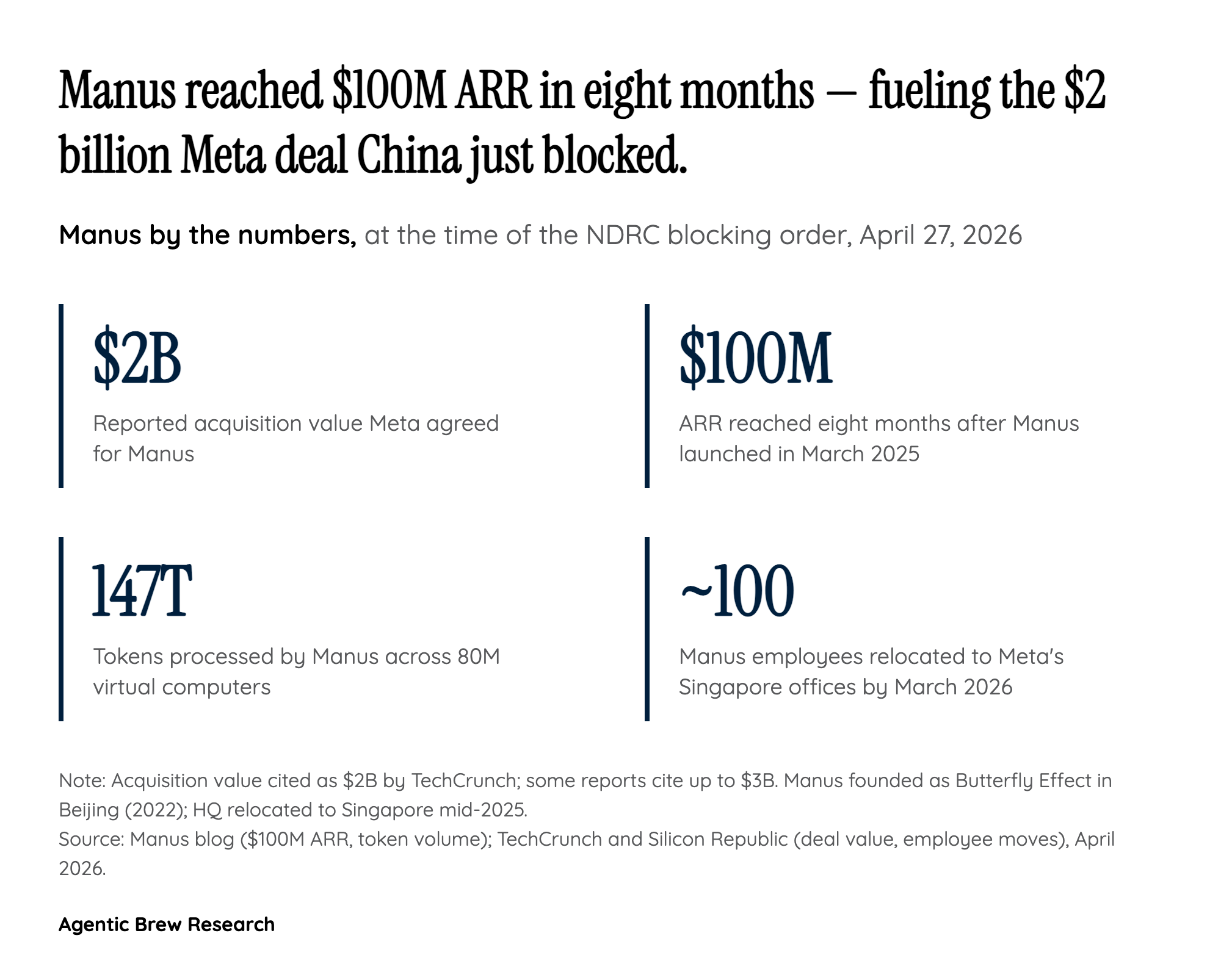
Manus by the numbers at the time of the April 27, 2026 NDRC blocking order

Meta entered 2026 with a $135B spending budget and 8,000 job cuts framed as a reallocation toward AI investments. Manus was supposed to be the centerpiece acquisition — a general-purpose agent maker that had hit $100M ARR roughly eight months after launch, was running at a $125M+ revenue run-rate with 20%+ month-over-month growth post Manus 1.5, and had processed 147 trillion tokens powering 80 million virtual computers. In other words, Meta did not buy speculative IP; it bought a working agentic platform with measurable traction, and was betting it could plug that directly into Meta AI. The block forces a strategic rethink. Even if Meta keeps the relocated employees and the integrated tooling in practice, the NDRC ruling brands any continued use as a non-compliant transaction in Beijing's eyes — which creates legal and reputational drag on every Meta product that ships with Manus DNA inside it. The contrarian read: Meta may quietly conclude that the talent and code already inside its Singapore office are worth the regulatory friction, and that the unwind order, however emphatic, is unenforceable extraterritorially. That is the wager that will define how this story ends.

Historical Context

2022
Parent company Butterfly Effect was founded in Beijing by Xiao Hong, Ji Yichao, and Tao Zhang.
2018-07-26
Qualcomm terminated its $40B NXP acquisition after Chinese regulators failed to grant approval — an earlier example of Beijing using merger review for geopolitical leverage.
2025-03
Manus launched as the first 'general-purpose' AI agent, gaining global attention for autonomously completing complex computer-based tasks.
2025-04
Benchmark led a $75M funding round in Manus at a roughly $500M valuation, ahead of the company's revenue acceleration.
2025-mid
Manus relocated its registered headquarters from Beijing to Singapore while keeping Chinese affiliated entities operational — a move Beijing later treated as structural circumvention.
2025-12-29
Meta announced the acquisition of Manus, with the deal coming together in under two weeks at valuations reported between $2B and $3B.
2026-01
MOFCOM launched a formal review under export control and outbound investment rules, signaling that the Singapore-headquartered structure would not shield the deal.
2026-03
Co-founders Xiao Hong and Ji Yichao were summoned to Beijing and barred from leaving China; by this point roughly 100 Manus employees had relocated to Meta's Singapore offices.
2026-04-27
China's NDRC formally prohibited foreign investment in Manus and ordered the parties to unwind the acquisition, citing foreign investment security review authority.

Power Map

Key Players
Subject

China Blocks Meta-Manus Acquisition

ME

Meta

Acquirer attempting to fold Manus's general-purpose agent technology into Meta AI as a centerpiece of its 2026 AI agent push, backed by a $135B annual spending budget.

MA

Manus (Butterfly Effect / Monica.im)

Target startup making general-purpose AI agents; registered in Singapore with active Chinese affiliates Beijing Red Butterfly Technology and Beijing Butterfly Effect Technology.

CH

China's National Development and Reform Commission (NDRC)

State planner that issued the prohibition, working through the Office of the Working Mechanism for Foreign Investment Security Review.

CH

China's Ministry of Commerce (MOFCOM)

Initiated the January 2026 probe assessing the deal under export controls, technology import/export rules, and overseas investment compliance.

XI

Xiao Hong and Ji Yichao

Manus's CEO and Chief Scientist; summoned to Beijing in March 2026 and placed under exit bans during the regulatory review.

TE

Tencent, ZhenFund, Hongshan, and Benchmark

Existing investors — Chinese funds had already received acquisition proceeds before the block, while US firm Benchmark led Manus's $75M round in April 2025 at a roughly $500M valuation.

Source Articles

Top 5

THE SIGNAL.

Analysts

"Reads the block as a deliberate signal that Beijing now classifies AI talent and capabilities as core national security assets and will intervene in deep-tech acquisitions accordingly: 'China is showing the world that it is willing to play hardball when it comes to AI talents and capabilities, which the country views as a core national security asset.'"

Lian Jye Su
Chief Analyst, Omdia

"Frames the action as a mirror of US semiconductor curbs: 'In the same way the US has tried to prevent China's access to advanced semiconductors, China is now moving to constrain American access to AI tech.'"

Alfredo Montufar-Helu
Managing Director, Ankura China Advisors

"Argues China is shifting from controlling exports to controlling corporate exits, treating foreign acquisitions as state-relevant strategic events: 'China is not only controlling exports. It is controlling exits... A foreign acquisition is no longer treated as a private liquidity event.'"

Geopolitechs analysis
Policy commentary outlet

"Calls the Manus block 'a clarifying moment' for cross-border AI deals, signaling that the regulatory ground rules have changed for any future Chinese-origin AI acquisition."

Ke Yan
Tech Analyst, DZT Research (Singapore)
The Crowd

"Breaking news: China has blocked Meta's $2bn acquisition of artificial intelligence platform Manus, after regulators reviewed whether the deal violated Beijing's investment rules."

@@FT0

"BREAKING: China bans Meta's $2.5B acquisition of AI startup Manus on national security grounds. The move reflects Beijing's broader strategy to protect China's AI know-how amid the US-China tech race. KEY DETAILS: Manus developed AI agent for writing research reports..."

@@cmani0

"i mean what an insane story. meta's $2B acquisition is now dead: -> March 2025: Manus launches AI agent -> 2M waitlist in 7 days, invite codes reselling for $1400 each (i tried to buy one lol) -> relocates from Beijing to Singapore to escape chinese authorities -> hits $90M..."

@@cryptopunk72130
Broadcast
China is not happy with the Meta-Manus deal

China is not happy with the Meta-Manus deal

Meta Just Acquired AI Startup Manus For More Than $2BN | All You Need To Know

Meta Just Acquired AI Startup Manus For More Than $2BN | All You Need To Know

China Blocking Meta Buying Manu AI - Chinese Angry at American Threats

China Blocking Meta Buying Manu AI - Chinese Angry at American Threats