Why This Matters
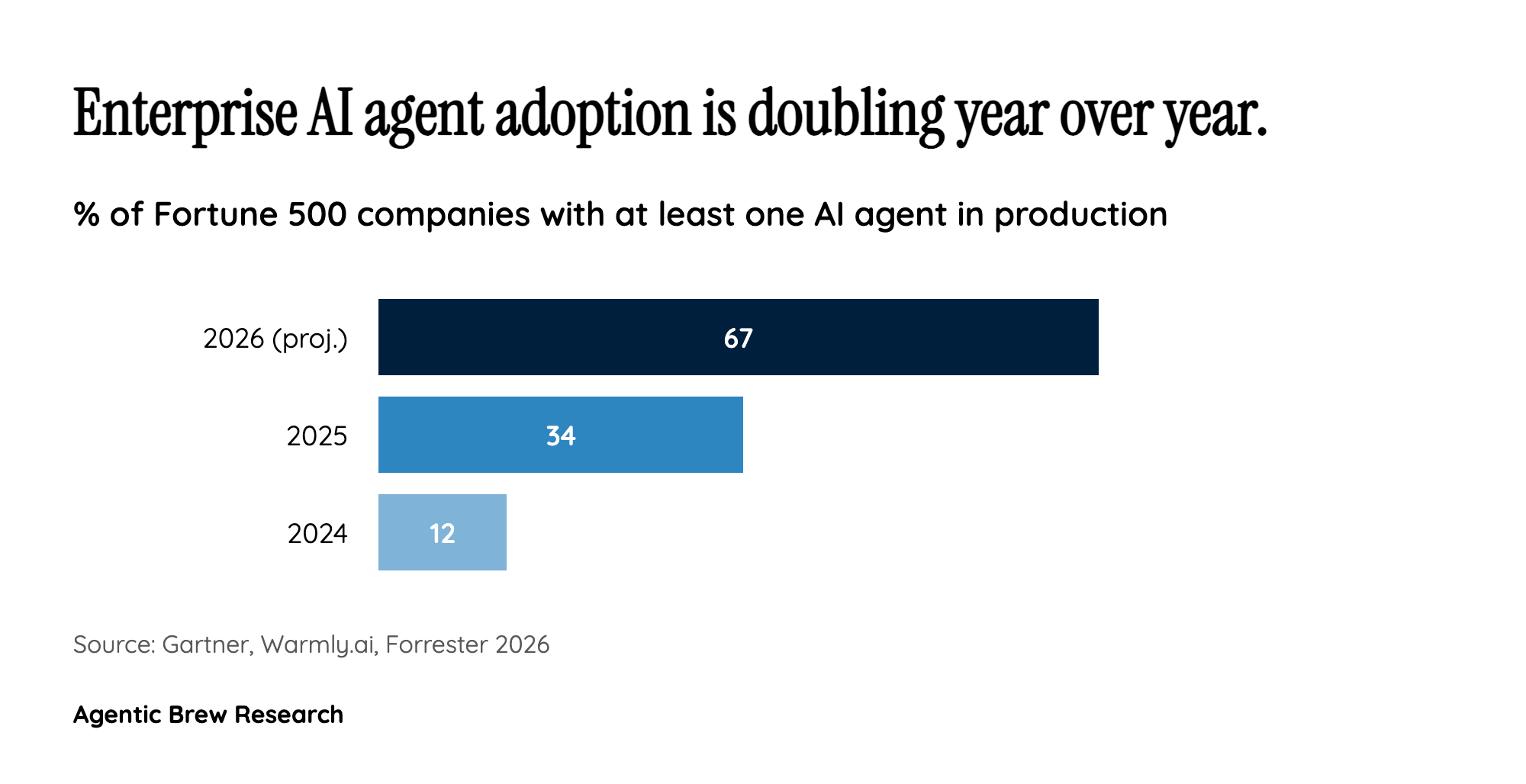
The rise of AI agents represents a fundamental shift in how software is built, deployed, and consumed. Unlike previous waves of automation that targeted narrow, well-defined tasks, agents operate with broad autonomy — reasoning through ambiguous problems, orchestrating multi-step workflows, and making decisions that previously required human judgment. The economic incentive structure is overwhelming: companies report 60% greater productivity with human-AI collaboration, and 62% expect 100%+ ROI from agent deployments. With the market projected to grow from $7.63B to $182.97B by 2033, the financial gravity pulling organizations toward agent adoption is immense.
Three converging forces are driving this inflection. First, foundation model capabilities crossed a critical threshold in late 2025 — context windows expanded to 1M tokens (Anthropic's Claude Opus 4.6), reasoning improved dramatically, and tool-use became reliable enough for production. Second, open-source frameworks like OpenClaw democratized agent development, reducing the barrier from months of custom engineering to hours of configuration. Third, enterprise infrastructure matured: NVIDIA's NemoClaw provides guardrails and sandboxing, Gartner projects 40% of enterprise apps will embed agents by year-end, and major consultancies like McKinsey already operate 25,000 agents alongside 40,000 employees. The convergence of capability, accessibility, and infrastructure creates a deployment flywheel that is accelerating faster than any previous technology wave.