OpenAI invests $2M in tokens in each YC startup for equity
TECH

OpenAI invests $2M in tokens in each YC startup for equity

37+
Signals

Strategic Overview

  • 01.
    Sam Altman announced that OpenAI is offering $2 million in API tokens to every startup in Y Combinator's current batch in exchange for equity, structured as an uncapped Simple Agreement for Future Equity (SAFE).
  • 02.
    The SAFE will not include a Most Favored Nation (MFN) provision, meaning OpenAI's stake gets priced in a future round but it does not automatically inherit better terms if the startup later issues a better SAFE.
  • 03.
    The pilot is open to YC's spring and summer 2026 batches, and runs through OpenAI as a company rather than through Sam Altman personally.
  • 04.
    Sam Altman, Greg Brockman, YC general partner Tyler Bosmeny, and YC CEO Garry Tan publicly confirmed the program on X within minutes of one another, with Tan framing it as 'tokenmaxxing confirmed.'

Deep Analysis

The cheapest equity OpenAI will ever buy

The headline reads as a $2 million investment per startup, but the underlying economics are wildly asymmetric. The currency is API tokens, not dollars - a unit OpenAI prints internally and sells at retail margins. The Information's reporting that the program is structured as an uncapped SAFE means OpenAI receives a contractual right to equity, but does not have to commit cash to a balance sheet line item; what it spends is inference capacity it already owns [1]. The pricing is set at retail token values, which exaggerates the apparent generosity relative to OpenAI's own cost basis.

The structural details sharpen that asymmetry. The Information reports the SAFE is uncapped and excludes a Most Favored Nation (MFN) clause, in contrast to YC's standard $375,000 SAFE which does include one [1]. An uncapped SAFE means the eventual equity stake is set by a future priced round, not capped on the upside for OpenAI. Excluding MFN means if a startup later issues a more favorable SAFE to a different investor, OpenAI does not automatically inherit those terms - a concession that arguably favors the founder, but one OpenAI can comfortably make because what it is offering is so disproportionately leveraged to its own cost of compute.

The punchline: OpenAI is buying a low-cost option on every company in two YC batches, denominated in a currency whose marginal cost it controls. If even one of these companies turns into a public-grade outcome, the IRR on the position is functionally infinite.
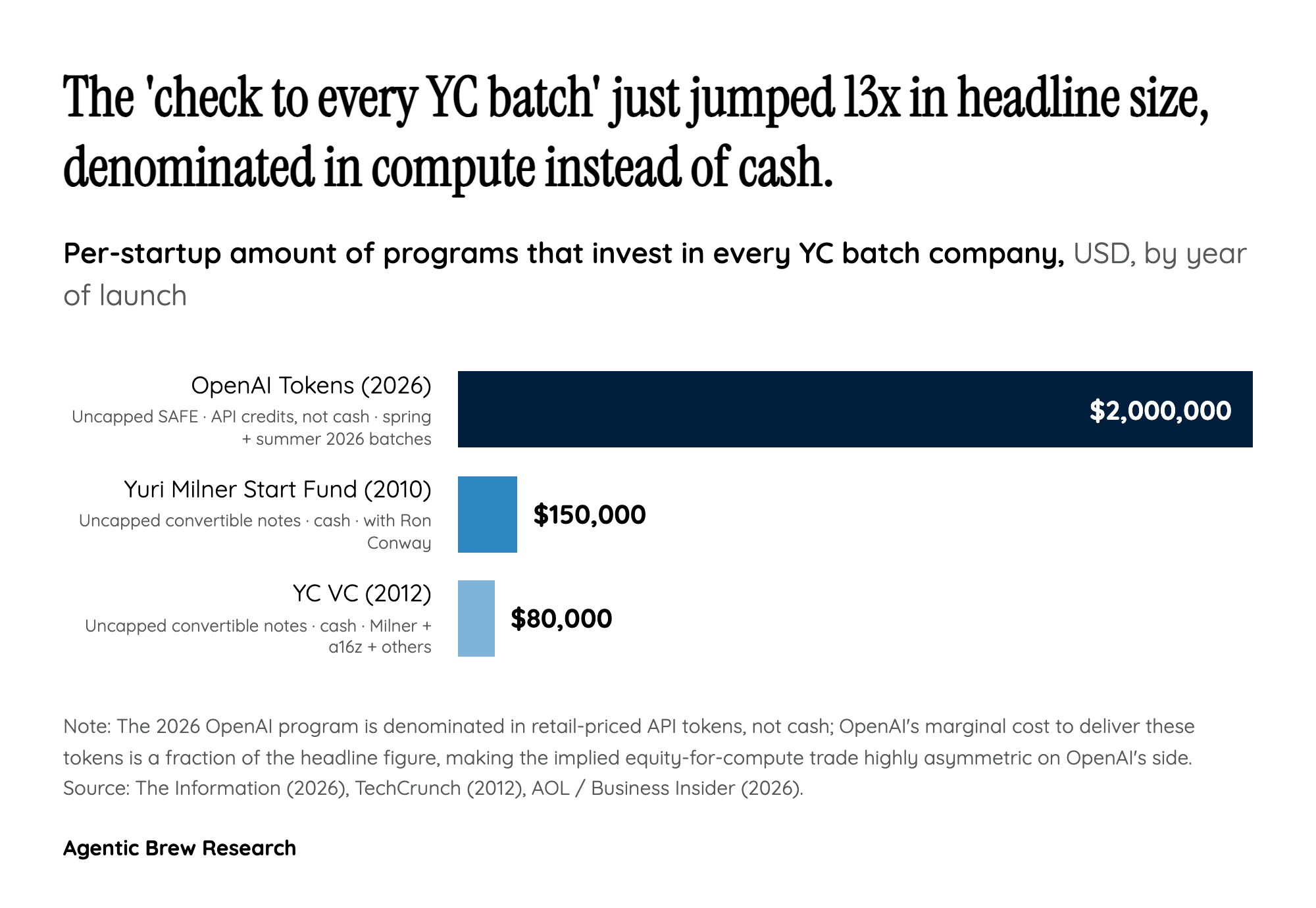
Tokens are the new Yuri Milner check

Tokens are the new Yuri Milner check
Per-startup amount of programs that invest in every YC batch company, by year of launch. The 2026 OpenAI tokens program is denominated in retail-priced API tokens, not cash.

The clearest historical precedent for an investor writing the same check to every YC startup is Yuri Milner's Start Fund, which in 2010 began putting $150,000 of uncapped convertible notes into every YC company [2]. The Start Fund was later restructured in 2012 into YC VC at $80,000 per startup, partly because Graham observed that the larger checks were creating friction when companies struggled to raise follow-on rounds [2]. The shape of OpenAI's program - same terms, every startup in the batch, instrument that converts in a future round - is recognizably the Milner model.

What has changed is the medium. In 2010, the scarce, batch-defining resource was capital itself. In 2026, capital is comparatively abundant for AI startups and the scarce input is high-end inference budget; founders building agent products routinely report spending five or six figures a month on tokens to ship at all. By denominating the program in tokens rather than dollars, OpenAI has done two things at once: priced its deal in the unit that currently constrains its target companies, and bypassed the cash leg entirely. The Milner check moved money from a VC into a startup. The OpenAI check moves nothing - it issues forward-redeemable claims on OpenAI's own infrastructure.

That reframing matters because it suggests a category, not a one-off. If compute can function as a SAFE-priced asset, every major AI lab can play the same game with its own batch - Anthropic with Claude credits, Google with TPU time. The OpenAI/YC announcement is the first public proof that compute-as-seed-capital is a workable instrument.

The platform trap question Calacanis put on the table

The most pointed external response came from Jason Calacanis, who told YC founders to 'be careful' and warned that OpenAI could one day incorporate a startup's idea into its own product - framing it, in his own words, as 'the classic platform playbook' [3]. The reporting in Digg expands the warning verbatim: Calacanis told founders that taking the tokens carries 'a non-zero chance that OpenAI will study exactly what your startup is doing, copy your idea and put your app into their free offering' [4].

There are two ways to read that. The narrow read is that OpenAI is a SAFE holder, not a board member or detailed reporting recipient, and that startups already buy OpenAI tokens at scale - as the YC-backed Apten founder Roshan Kumaraswamy noted in response to Calacanis, 'the startups are buying openai tokens anyways' [3]. By that logic, the equity attachment is the only material new fact, and it sits behind a future-priced SAFE that gives OpenAI no special governance rights.

The wider read, which Calacanis is pushing, is that OpenAI now has API-level telemetry on what every funded YC company is building and a fractional equity claim on the upside. Even without an MFN, the optionality is dense: which prompts, which products, which feature gaps. OpenAI can argue it does not use API traffic for model training without consent, but the directional intelligence is hard to unsee. The Reddit reception skewed toward suspicion of vendor lock-in - several commenters in r/singularity flagged the deal as a deepening of dependency rather than a pure grant, even as a few noted that $2M of tokens is not strictly comparable to a couple thousand dollars of AWS credits because it is theoretically resaleable through routing layers.

YC's compounding bet on the OpenAI ledger

What makes the deal land differently for YC than for any other accelerator is that YC is on both sides of it. Hacker News commentary on Daring Fireball's piece estimates YC's stake in OpenAI at roughly 0.6%, which at OpenAI's recent $852 billion valuation works out to over $5 billion [5]. That stake originates from YC Research, an offshoot launched in October 2015 while Sam Altman ran YC, with Altman personally donating $10 million to seed what became OpenAI [6].

The current deal extends that loop. Each YC company that opts in starts metering its product in OpenAI tokens, builds a moat-shaped dependency on OpenAI's API, and contributes to OpenAI's enterprise revenue trajectory - which in turn supports the valuation against which YC's 0.6% is marked. Daring Fireball's John Gruber argues the unspoken consequence is a conflict-of-interest gravity well: Paul Graham and Jessica Livingston have billions of personal exposure to OpenAI's success through YC, and Graham has been a vocal public defender of Altman's character without consistently disclosing that exposure [5]. Whether or not that critique lands, the structural point is mechanical: a YC company that takes the tokens is paying rent into the same ledger that prices YC's largest portfolio mark.

It is also worth noting what the broader founder community grasped without naming it: this is not a discrete event but a closing of a feedback loop. A single batch's worth of equity, denominated in OpenAI's own compute, marks the moment a frontier lab graduated from being a vendor to YC startups to being a co-investor with structural skin in their outcomes. Whether that pulls the rest of the lab cohort - Anthropic, Google, xAI - into mirror deals is now the most interesting open question in early-stage AI funding.

Historical Context

2010
Created The Start Fund, putting $150,000 of uncapped convertible notes into every YC startup — the original 'invest in the whole batch' model that the OpenAI deal updates with tokens instead of cash.
2012-11-26
Replaced the Start Fund with YC VC, dropping the broad batch check from $150K to $80K across investors (including Milner) after Graham observed that bigger checks created friction in later rounds.
2014-2019
Ran Y Combinator as president, the period during which YC Research seeded OpenAI with a $10M donation from Altman, establishing the equity relationship that today gives YC roughly 0.6% of OpenAI.
2026-05-20
Announced the $2M-in-tokens-for-equity offer to every startup in the current YC batch, with the pilot extending through the spring and summer 2026 cohorts.

Power Map

Key Players
Subject

OpenAI invests $2M in tokens in each YC startup for equity

OP

OpenAI

Underwriter of the program. Pays in inference credits, which carry far lower marginal cost than the headline $2M, and gets uncapped SAFE equity in return — buying a low-cost option on every YC company.

Y

Y Combinator

Distribution channel and the only accelerator getting the deal. YC already holds roughly 0.6% of OpenAI (about $5B at OpenAI's $852B valuation), so it now both feeds startups into OpenAI's API revenue and benefits from OpenAI's growth.

SA

Sam Altman

Two-sided protagonist. As OpenAI CEO he is offering the deal; as a former YC president (2014-2019) he is the one who originally pulled OpenAI into the YC orbit via YC Research's 2015 seed.

GA

Garry Tan

YC's CEO. Publicly endorsed 'tokenmaxxing' before this deal and is the partner who decided YC engineers should have no token budget at all, signaling that high token spend is now a YC-wide cultural and strategic stance.

JA

Jason Calacanis

Loudest external skeptic. Warning founders that taking the tokens hands OpenAI a window into what every YC startup is building, with the implication that OpenAI may absorb those ideas into its own product surface.

Fact Check

6 cited
  1. [1] Sam Altman Offers YC Founders $2 Million in OpenAI Tokens For Equity
  2. [2] Y Combinator's YC VC Will Replace The Start Fund; Includes Yuri Milner, Andreessen Horowitz But Offers Less Money
  3. [3] Sam Altman has a proposition for startup founders: AI tokens for equity
  4. [4] OpenAI YC $2M Token Investment
  5. [5] Y Combinator's Stake in OpenAI
  6. [6] Y Combinator

Source Articles

Top 4

THE SIGNAL.

Analysts

"Framed the program as a bet on 'tokenmaxxing startups,' saying he is excited 'both for how they work internally and the products they can build.'"

Sam Altman
CEO, OpenAI

"Positioned the offer as compute infrastructure rather than cash, calling it 'compute for powering the next generation of startups.'"

Greg Brockman
President, OpenAI

"Called it 'a mic drop moment' for YC, treating it as the most consequential perk added to the current batch."

Tyler Bosmeny
General Partner, Y Combinator

"Endorsed the deal with 'Tokenmaxxing confirmed,' extending an earlier stance that YC engineers should face no limit on token consumption — anchoring the program in YC's existing belief that maximum inference spend is a competitive edge."

Garry Tan
CEO, Y Combinator

"Warned founders to 'be careful,' arguing OpenAI may one day fold a startup's idea into its own product — what he frames more broadly as 'the classic platform playbook.'"

Jason Calacanis
Investor, 'All-In' podcast cohost
The Crowd

"i am excited to see what will happen with tokenmaxxing startups, both for how they work internally and the products they can build. openai offered to invest $2M in tokens into every startup in the current yc batch. happy building!"

@@sama0

"openai offering to invest $2M in API credits in every @ycombinator startup in the current batch. compute for powering the next generation of startups."

@@gdb0

"NEWS: Sam Altman has offered $2M in OpenAI tokens to every YCombinator startup in the current batch in exchange for equity."

@@exec_sum0

"Sam Altman Offers YC Founders $2 Million in OpenAI Tokens For Equity"

@u/Steap-Edit15
Broadcast