Terafab: SpaceX/Tesla AI Chip Megafab in Texas
TECH

Terafab: SpaceX/Tesla AI Chip Megafab in Texas

38+
Signals

Strategic Overview

  • 01.
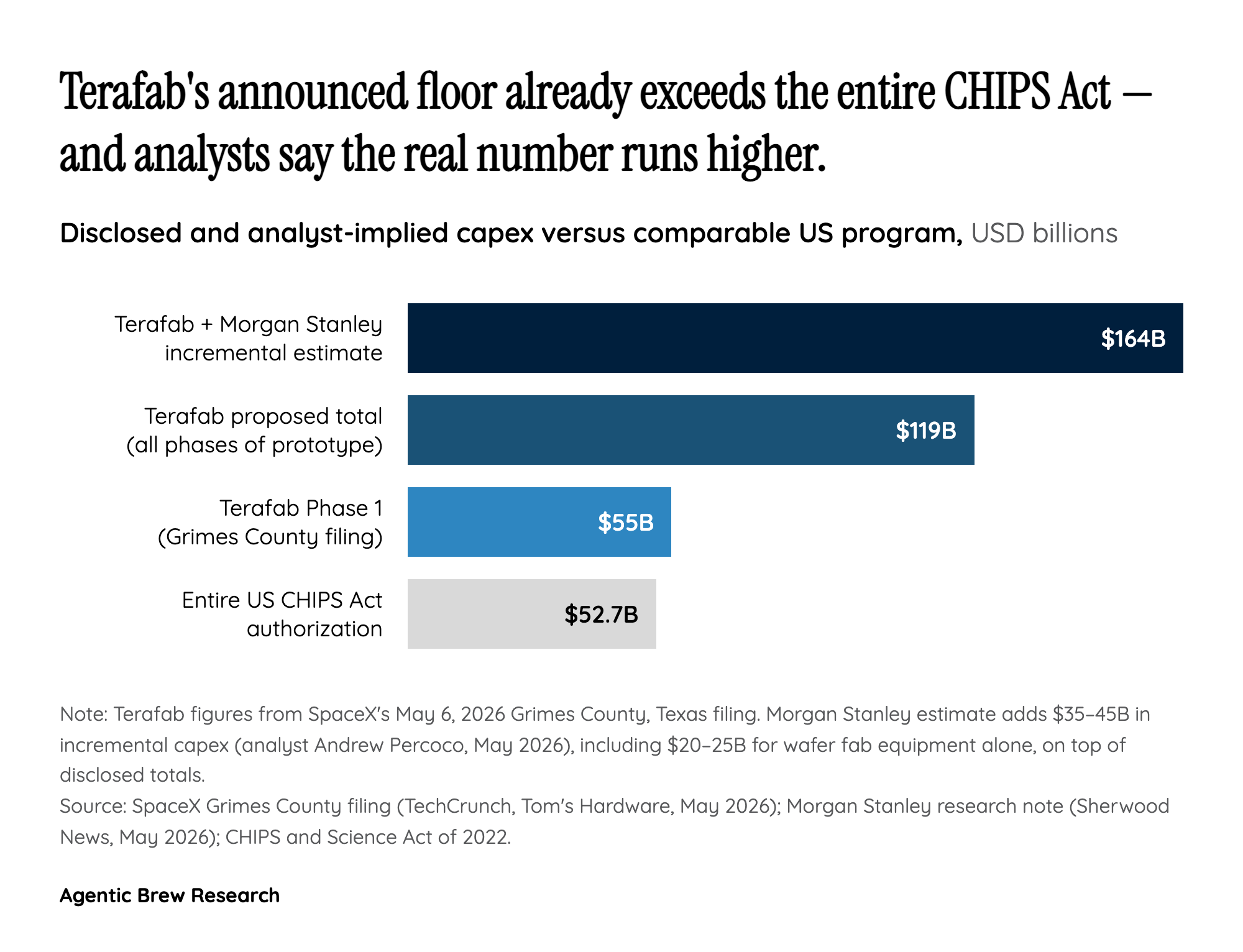
    On May 6, 2026, SpaceX filed Grimes County, Texas paperwork disclosing an initial $55B spend on Terafab that could scale to $119B across phases of the prototype fab — a floor that already exceeds the roughly $52.7B Congress authorized for the entire CHIPS Act.
  • 02.
    Terafab targets producing more than one terawatt of AI compute per year, ramping from 100,000 wafer starts per month toward 1,000,000, with chips destined for Tesla FSD, Optimus humanoid robots, xAI training, and SpaceX/Starship-launched orbital data centers.
  • 03.
    Intel formally joined as primary foundry partner on April 7, 2026 — its first marquee external advanced-node win — sending INTC up roughly 115% across the month even as Intel Foundry posted a $10.3B FY2025 operating loss.
  • 04.
    Morgan Stanley calls Terafab a 'Herculean task' and pegs an additional $35-45B in capex on top of the disclosed numbers, with no chip output expected before mid-2028; Tesla's existing $20B/yr capex envelope does not include any of this.

Deep Analysis

The math doesn't math: why $119B is the floor, not the ceiling
The math doesn't math: why $119B is the floor, not the ceiling
Disclosed and analyst-implied Terafab capex versus the entire US CHIPS Act authorization, in USD billions.

Start with the headline. SpaceX's Grimes County filing pegs Terafab's prototype phase at $55B initial, scaling to $119B. That floor alone already exceeds the roughly $52.7B Congress authorized through the entire CHIPS Act for the U.S. semiconductor industry. It is the largest single semiconductor capex commitment ever proposed in this country, and it is supposedly only the first phase. Then look at what Terafab is meant to do: more than one terawatt of AI compute per year, ramping from 100,000 wafer starts per month toward a million. A million wafer starts monthly is roughly 12 million wafers a year, at the same order of magnitude as TSMC's entire advanced-node output today.

Morgan Stanley's Andrew Percoco, who is broadly positive on the strategy, still adds $35-45B on top of the disclosed numbers — $20-25B of that is wafer fabrication equipment alone, none of which lives inside Tesla's $20B/yr existing capex budget. Tesla has not raised, segregated, or even acknowledged the marginal capital. The hard physical bottleneck the announcement skipped past entirely is ASML: there are roughly 40-55 EUV lithography machines built globally per year, and a single fab at Terafab's claimed scale would consume a meaningful fraction of worldwide EUV supply for years. That is the pivot behind the technical estimates circulating in semiconductor-literate forums — extrapolating Musk's own 1 TW/year capacity claim against his $200B framing yields an implied total program cost closer to $5 trillion. The skeptics are not arguing about ambition. They are arguing about arithmetic — announced numbers, EUV machine counts, and wafer-throughput physics that do not reconcile.
Intel is the silent kingmaker, and it is being revalued in real time

The headline says Tesla and SpaceX, but the stock that actually moved is Intel's. INTC closed up more than 4% on April 7, 2026 when Intel formally joined as Terafab's primary foundry partner, more than 11% the next day, and finished April roughly 115% higher. Year-to-date 2026, the stock is up about 76%, and shares now trade near 126x forward earnings — pricing that only makes sense if you believe Terafab structurally re-rates Intel Foundry as a credible alternative to TSMC.

The mutual dependency is what makes this interesting. Intel needs an external anchor customer for its 14A node, full stop. Foundry posted a roughly $10.3B operating loss in FY2025; without a marquee win, the unit's runway looked finite. Terafab gives Intel the win. Musk in turn gets a Western foundry partner whose roadmap aligns with his 2027-2028 ramp window. But Musk himself has acknowledged 14A is 'not yet totally complete,' and Intel has historically slipped advanced-node timelines. The market is treating the announcement as if execution is already de-risked. The real question for Intel investors is what happens to that 115% rerating if Tesla AI5/AI6 keeps taping out on TSMC — as AI5 just did in April — while 14A development drifts. Intel's revaluation is the part of this story that has the most concrete near-term consequences, and it depends on the Terafab story holding up at exactly the level of detail the skeptics are picking apart.

The orbital data center bet hidden in the wafer allocation

Buried in the official messaging is a number that reframes the entire project: the announced wafer allocation puts roughly 80% of Terafab's chip output toward space-based compute, with only 20% earmarked for terrestrial use. That is not a chip strategy, it is a launch-economics strategy in disguise. The thesis only closes if Starship cost-per-kilogram falls far enough that putting AI training clusters in orbit beats putting them in West Texas, and it requires chips designed for the thermal and radiation environment of orbit — Tesla's D3 work on space-optimized silicon, the same lineage that started with the D1 Dojo chip in 2021, is the bridge.

This is why Musk's framing on the announcement stage drifted into 'becoming a galactic civilization' rhetoric rather than staying grounded in foundry economics. The orbital data center pitch is what justifies a one-terawatt annual compute target that no terrestrial customer base can plausibly absorb, and it is what links Terafab to SpaceX's Starship cadence rather than Tesla's vehicle volume. It also explains why SpaceX, not Tesla, is the lead filer in Grimes County: chip output is being structured as a SpaceX-scale demand pipeline, with Tesla, Optimus, and xAI as anchor customers along the way. If Starship economics do not arrive on the implied timeline — and Starship has not yet achieved the launch-cost reductions the project's economics require — the 80/20 allocation collapses and Terafab becomes a conventional terrestrial fab. At which point the announced capacity is several times oversized for the buyers it actually has.

The skeptic case from inside the industry: no clean room, no job listings, no tool orders

The most damaging critique of Terafab is not that it is too expensive. It is that nothing observable in the semiconductor ecosystem matches the announcement. The most-upvoted technical critique came from a self-identified electrical engineer specializing in device design and process integration, who laid out the receipts: no public job listings for fab-class researchers, process integration engineers, or yield engineers; no observable EUV or DUV tool orders flowing through ASML, Applied Materials, Lam Research, or KLA's customer pipelines; no clean-room construction permits matching the disclosed scale; no announced relationships with the specialty gas, ultrapure water, or photoresist suppliers that any real fab procurement touches months before ground breaks.

The technical critique is what made it land in semiconductor-literate communities — falsifiable, specific, and grounded in what fab procurement actually looks like. The comparison getting traction is the 4680 battery cell, which Tesla announced with similar fanfare and ultimately delivered at roughly 2% of original volume targets, as Electrek's HBrown notes. The community framing in technically-grounded forums has crystallized around two arguments: the timing aligns suspiciously with declining Tesla auto sales and a pre-IPO SpaceX narrative, and the absence of normal procurement signals is itself the signal. Local Grimes County residents have separately raised water and infrastructure concerns familiar from earlier industrial proposals in the area. None of this disproves Terafab. But the shape of community reaction is consistent across technically literate circles — enthusiasm on the official channels, hard skepticism wherever people know what the supply chain for a real fab actually looks like.

Historical Context

2021-08-19
Tesla unveiled the D1 chip and Dojo supercomputer at AI Day, intended to be the largest in-house FSD video-training cluster — the seed of vertical silicon integration.
2025-11-01
Tesla pushed AI5 volume production to mid-2027, forcing the Cybercab to launch on AI4 hardware and signaling deepening foundry-supply pain.
2026-03-21
Musk announced the Terafab joint venture at Austin's Seaholm Power Plant with an initial framing of $20-25B and a 1-terawatt-per-year compute target.
2026-04-07
Intel formally joined Terafab as primary foundry partner; INTC closed up >4% that day, >11% the next, and roughly 115% higher across April.
2026-04-15
Tesla taped out the AI5 chip nearly two years behind original schedule — on TSMC, not Intel — underscoring how fragile the in-car compute roadmap remains until Terafab produces silicon.
2026-05-06
SpaceX filed Grimes County paperwork disclosing $55B initial and up to $119B total spend on the Terafab prototype fab, escalating the project from announcement rhetoric into binding regulatory commitments.

Power Map

Key Players
Subject

Terafab: SpaceX/Tesla AI Chip Megafab in Texas

SP

SpaceX

Lead filer and operator on the Grimes County paperwork; will run high-volume chip manufacturing and absorb compute for xAI; framed Terafab in regulatory documents as a multi-phase, vertically integrated semiconductor and computing facility.

TE

Tesla

Co-developer and primary chip customer; selected Intel 14A on the Q1 2026 earnings call to feed FSD, the AI5/AI6 in-car compute roadmap, and Optimus humanoid robots. Capex pressure is the central financial overhang.

IN

Intel

Primary foundry and process partner contributing the 14A (1.4nm-class) node; Terafab is its first marquee external advanced-node win and the financial referendum on whether Intel Foundry can survive a $10.3B annual operating loss long enough to matter.

XA

xAI

Compute customer for AI training and inference; sits within SpaceX's corporate umbrella per recent reporting and is positioned as a primary consumer of Terafab's training silicon.

GR

Grimes County, Texas

Host jurisdiction for the prototype fab at the Gibbons Creek Reservoir site, where a coal-fired plant retired in 2018; commissioners scheduled a June 3, 2026 hearing on property tax abatement, and some residents have already pushed back on industrial projects citing water and infrastructure strain.

Source Articles

Top 5

THE SIGNAL.

Analysts

"Believes Terafab is the right strategic move despite enormous upfront cost, but estimates an additional $35-45B in capex on top of the disclosed figures, with $20-25B for wafer fabrication equipment alone — none of which sits inside Tesla's existing $20B/yr capex envelope. Quote: 'Even understanding Elon Musk's history of doing difficult things, this seems like a Herculean task.'"

Andrew Percoco
Semiconductor Analyst, Morgan Stanley

"Argues Intel 14A will be mature by the time Terafab scales, casts the project as historically unprecedented in scale, and frames it as forced by the inability of TSMC and Samsung to expand fast enough. Quote: 'We either build the Terafab or we don't have the chips, and we need the chips, so we build the Terafab.'"

Elon Musk
CEO, Tesla and SpaceX

"Skeptical the project will work; argues Tesla has zero semiconductor manufacturing experience and the timing aligns suspiciously with declining auto sales and a SpaceX IPO narrative, drawing a parallel to the 4680 battery initiative which delivered roughly 2% of original volume goals. Quote: 'I don't believe this will work because building a chip fab is extremely difficult.'"

HBrown
Tesla/EV columnist, Electrek
The Crowd

"Formal announcement of the TERAFAB project, which will be done jointly by @SpaceX and @Tesla, tonight around 8pm CT. Livestream on 𝕏. The goal is to produce over a TERAWATT of compute per year (logic, memory & packaging) with ~80% for space and ~20% for the ground."

@@elonmusk0

"Intel is proud to join the Terafab project with @SpaceX, @xAI, and @Tesla to help refactor silicon fab technology. Our ability to design, fabricate, and package ultra-high-performance chips at scale will help accelerate Terafab's aim to produce 1 TW/year of compute to power..."

@@intel0

"TERAFAB: the next step to becoming a galactic civilization. Together with @SpaceX & @xAI, we're building the largest chip manufacturing facility ever (1TW/year) – combining logic, memory & advanced packaging under one roof. To harness as much power as possible from the Sun, we..."

@@Tesla0

"Elon Musk's Terafab semiconductor project could cost $5 trillion"

@u/sr_local424
Broadcast
TERAFAB | The Largest Chip Manufacturing Facility Ever

TERAFAB | The Largest Chip Manufacturing Facility Ever

New American Chip Factory That Terrifies TSMC

New American Chip Factory That Terrifies TSMC

Elon Reveals TERAFAB (Tesla & SpaceX) - Full Replay - Becoming a galactic civilization

Elon Reveals TERAFAB (Tesla & SpaceX) - Full Replay - Becoming a galactic civilization