Qualcomm Data Center Chip Push to Hyperscaler
TECH

Qualcomm Data Center Chip Push to Hyperscaler

35+
Signals

Strategic Overview

  • 01.
    On the Q2 fiscal 2026 earnings call (April 29, 2026), CEO Cristiano Amon confirmed Qualcomm's custom silicon engagement with a leading hyperscaler is on track for initial shipments in the December quarter, framed as a multi-generation partnership.
  • 02.
    Qualcomm beat Q2 FY26 estimates with $2.65 adjusted EPS on $10.6 billion in revenue (down 2% YoY), authorized a new $20 billion buyback on top of the existing program, and returned $3.7 billion to shareholders in the quarter.
  • 03.
    Shares reversed an after-hours decline to surge roughly 16-17%, hitting $182.20 against a $156.00 close and adding an estimated $20-35 billion in market cap intraday.
  • 04.
    Amon also told investors China Android handset revenue is bottoming out in fiscal Q3 with sequential growth resuming the following quarter as customer inventory normalizes.

Deep Analysis

The mechanism: rack-scale inference, not another server CPU

What changed since Qualcomm's 2018 retreat is the architecture of the bet. Centriq tried to win in general-purpose Arm servers against an x86 fortress; the new entry is purpose-built for AI inference, sold as a rack rather than a chip. The AI200 packs 768 GB of LPDDR per card, draws 160 kW per rack, uses direct liquid cooling, and scales up to 72 chips per system, with the AI250 promising 'more than 10x higher effective memory bandwidth' via near-memory computing in 2027. The pitch is that inference economics are a memory-bandwidth and TCO problem more than a peak-FLOPS problem — exactly the workload profile where Qualcomm's mobile-derived Hexagon NPUs and post-NUVIA CPU IP are most defensible.

The hyperscaler engagement layered on top of this is a different shape of business than selling catalog parts. CEO Cristiano Amon framed it as 'a leading hyperscaler custom silicon engagement' with multi-generation cadence, meaning Qualcomm is doing semi-custom work — closer to the Broadcom/Marvell model than to Nvidia's merchant GPU model. That matters because custom silicon programs tend to lock in unit economics and roadmaps for years once the first tape-out lands, but they also concentrate revenue on a single customer and a single workload. December 2026 first shipments puts Qualcomm in market roughly a year behind its own AI200 launch and well behind Nvidia's Blackwell rack cadence — which is the gap the equity story is now valued against.
The money: $20 billion of market cap for $1.5 billion of revenue

The money: $20 billion of market cap for $1.5 billion of revenue
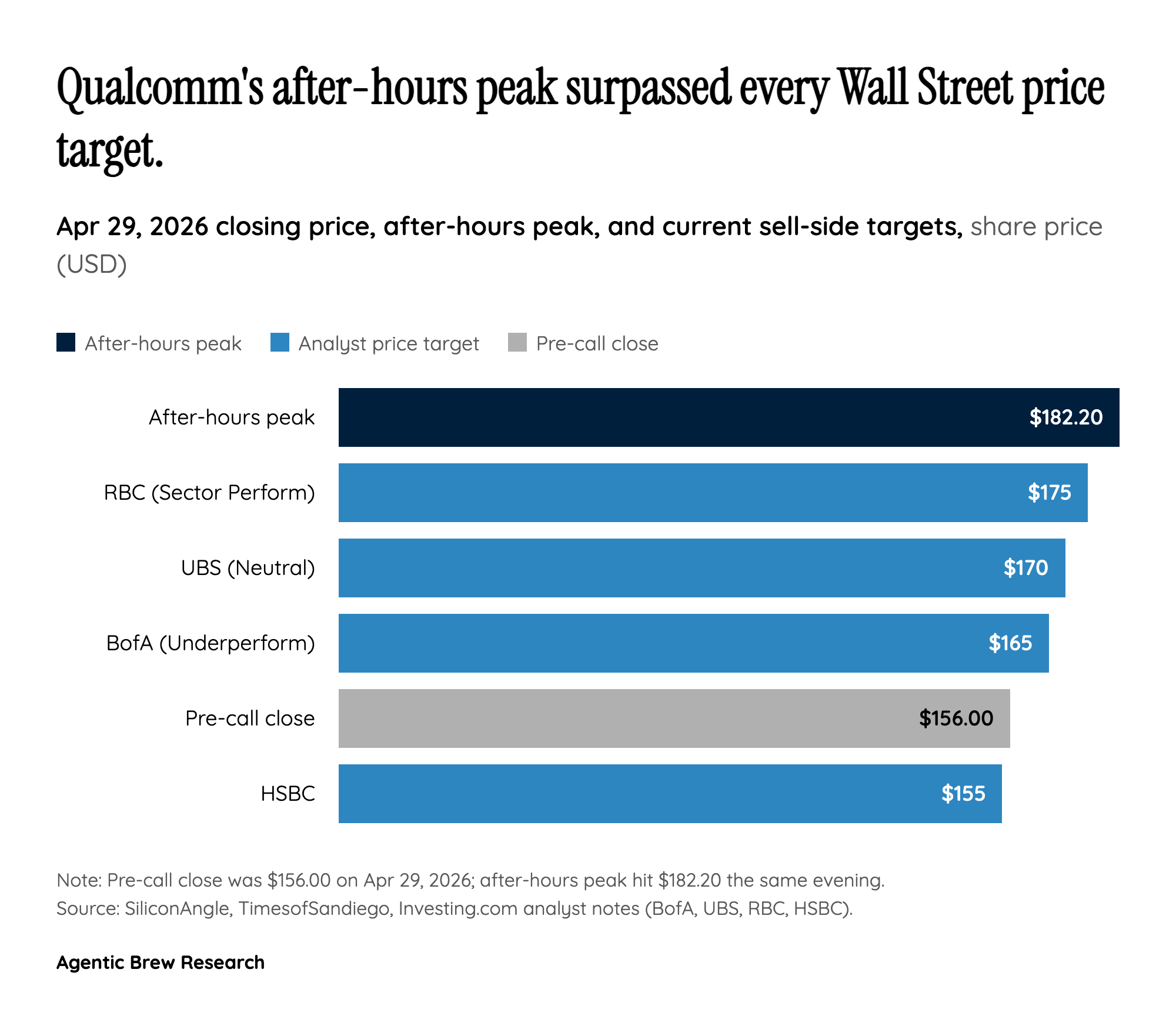
Qualcomm's after-hours peak ($182.20) sits above every published Wall Street price target.

The market reaction is where this story stops being a product launch and starts being a valuation puzzle. Shares spiked to $182.20 from a $156.00 close, a roughly 16-17% move that added $20-35 billion in market cap intraday — for a custom silicon program that BofA models will contribute up to $750 million in fiscal 2027 and $1.5 billion in fiscal 2028. UBS's Timothy Arcuri argues the program would need to generate roughly $10 billion in annual revenue to justify the strategic pivot. The arithmetic gap between those numbers and the day's tape is the entire bull/bear debate compressed into one print.

Layered on top is the capital-return story: a fresh $20 billion buyback on top of the existing program, with $3.7 billion already returned in Q2. That's the part of the move that is mechanically defensible — Qualcomm is shrinking the float into the data center narrative. But it doesn't resolve the underlying tension that analyst price targets ($155 from HSBC, $165 from BofA, $170 from UBS, $175 from RBC) bracket $182, meaning the after-hours peak was already above the highest sell-side number on the Street. BofA, notably, raised its target by $20 and still rates the stock Underperform. Arcuri's framing of Qualcomm as 'a company in transition' captures the asymmetry: a confirmed $4-5 billion annual Apple modem headwind on the downside, and a hyperscaler revenue stream that is real but, on current modeling, materially smaller than the multiple expansion already implied.

The 2018 ghost: why this might fail (and the one structural reason it might not)

Qualcomm has been here before. The Centriq 2400 launched in November 2017 with the same kind of fanfare — first 10nm 64-bit Arm server CPU, marquee hyperscaler engagements, an explicit pitch as the credible challenger to x86. By December 2018 the division had been cut from over 1,000 employees to roughly 50, with 269 layoffs, and Qualcomm publicly conceded it would 'refocus on edge of 5G and AI inference cloud opportunities.' The proximate cause was financial: Broadcom's hostile takeover attempt and the collapse of the NXP deal forced cost cuts. The structural cause was that x86 lock-in and a then-ascendant AMD EPYC roadmap left no oxygen for an Arm general-purpose server CPU.

The reason the second attempt may not rhyme is that the workload Qualcomm is targeting did not exist in 2018. Inference at hyperscaler scale — particularly for large-context language models and agentic systems — is bottlenecked on memory bandwidth and rack-level power efficiency, not on CPU ISA portability. Hyperscalers (Meta, Microsoft, Amazon, Google) have already publicly committed to commissioning bespoke chips precisely to escape Nvidia margins, which is why semi-custom designs are a structurally larger TAM today than they were eight years ago. The execution risk is real and well-rehearsed, but the addressable market argument is materially different. The open question is whether Qualcomm has the software stack maturity — compilers, kernels, framework integrations — to support a hyperscaler in production, which is exactly where Intel Gaudi tripped despite competitive silicon.

The crowd's read: Wall Street hedges, hardware Reddit shrugs

The split between price action and qualitative reception is the most interesting tell here. Sell-side analysts uniformly raised price targets but kept ratings cautious — BofA at Underperform, UBS and RBC at Neutral/Sector Perform — and explicitly anchored the upside to disclosure events (Qualcomm's June 24 investor day, customer name reveal) that haven't happened yet. RBC's note speculating the customer is 'either Meta Platforms or Microsoft' is itself a tell: the Street is pricing optionality on identity rather than fundamentals on units shipped.

Hardware Reddit's reaction skewed sharply skeptical. Commenters on r/hardware fixated on the absent TFLOPS numbers in Qualcomm's launch materials, the 160 kW per rack power draw versus Nvidia's 60-120 kW reference designs, and TSMC N5P node selection that would be one to two nodes behind 2026 competition. The recurring concern was the software stack, with explicit comparisons to Intel's Gaudi failure even though the silicon there was competitive. On X, the framing was bullish but technical — analysts like Beth Kindig and AI infrastructure commentators highlighting the HUMAIN 200 MW commitment and inference economics. Mainstream business media on YouTube (CNBC, Bloomberg) leaned hard into the 'Qualcomm vs Nvidia' inference narrative, which is the sound bite the equity move is responding to. The collective signal: the further you get from the trading desk, the less the December shipment date alone seems to justify the move.

Historical Context

2017-11-01
Qualcomm formally launched the Centriq 2400, the world's first 10nm 64-bit Arm server processor, aimed at hyperscale cloud workloads.
2018-05-07
Bloomberg reported Qualcomm planned to exit server chips amid cost cuts following Broadcom's hostile takeover attempt and the failed NXP acquisition.
2018-12-10
Qualcomm officially wound down its data center business, cutting the division from over 1,000 employees to roughly 50 (with 269 layoffs), and stated it would refocus on the edge of 5G and AI inference cloud opportunities.
2025-10-27
Qualcomm announced AI200 (2026) and AI250 (2027) rack-scale inference accelerators, marking its formal return to the server market; the stock closed up 11% on the day.
2025-11-01
Qualcomm and HUMAIN agreed to deploy 200 MW of AI200/AI250 racks in Saudi Arabia starting in 2026 as part of Saudi Vision 2030, with Bernstein pegging the deal at roughly $2 billion.
2026-04-29
Qualcomm beat Q2 estimates, announced a $20B buyback authorization, and confirmed initial hyperscaler shipments for the December quarter, sending shares up roughly 16-17% after hours and adding $20-35 billion in market cap.

Power Map

Key Players
Subject

Qualcomm Data Center Chip Push to Hyperscaler

QU

Qualcomm (QCOM)

Chip designer re-entering the data center market after exiting in 2018; building custom silicon for a leading hyperscaler with multi-generation roadmap and rack-scale AI200/AI250 accelerators.

CR

Cristiano Amon

Qualcomm Chairman and CEO; spokesperson for the data center pivot, the China bottoming narrative, and the agentic AI roadmap; provided the December shipment guidance for the hyperscaler engagement.

AK

Akash Palkhiwala

Qualcomm CFO; quantified the China handset bottoming and forecasted sequential growth recovery on the earnings call.

UN

Unnamed 'leading hyperscaler' customer

Anchor design-win for Qualcomm's custom data center silicon; identity expected at Qualcomm's June 24 investor day. RBC speculated either Meta Platforms or Microsoft.

HU

HUMAIN (Saudi Arabia)

Saudi PIF-backed AI company committed to deploying 200 MW of Qualcomm AI200/AI250 racks starting in 2026; Bernstein estimates the deployment at roughly $2 billion in revenue.

NV

Nvidia and AMD

Incumbent data center AI chip leaders Qualcomm is targeting; the AI200 and AI250 rack-scale architectures are positioned as inference-focused alternatives to their GPU systems.

Source Articles

Top 3

THE SIGNAL.

Analysts

"Raised price target to $165 from $145 while maintaining an Underperform rating. Estimates the hyperscaler custom silicon program could contribute up to $750 million in fiscal 2027 and $1.5 billion in fiscal 2028, and notes management identified the June quarter as the bottom for China handset revenues."

Bank of America (BofA Securities)
Sell-side equity research

"Raised price target to $170 from $150 (Neutral). Argues the custom silicon program would need to generate roughly $10 billion in annual revenue to justify the strategic move, and characterizes Qualcomm as 'a company in transition' with a $4-5 billion annual Apple modem revenue headwind partially offset by automotive, IoT, and agentic AI tailwinds."

Timothy Arcuri (UBS)
Managing Director, UBS Equity Research

"Raised price target to $175 from $150 (Sector Perform). Speculates the customer is either Meta Platforms or Microsoft but is staying on the sidelines pending more disclosure at Qualcomm's investor day, citing the line: 'Qualcomm announced a custom silicon win at a major hyperscaler with shipments starting in December 2026.'"

RBC Capital Markets
Sell-side equity research

"Estimated the previously announced HUMAIN 200 MW deployment of Qualcomm AI200/AI250 chips at approximately $2 billion in revenue, providing a public reference point for what a single rack-scale customer of this size is worth."

Stacy Rasgon (Sanford C. Bernstein)
Senior Analyst, Bernstein

"Frames the hyperscaler deal as the start of a multi-generation custom silicon partnership and says 'the rise of AI agents is reshaping our roadmap across every platform we develop,' tying the data center push to a broader agentic AI thesis spanning handset, automotive, and edge."

Cristiano Amon (Qualcomm CEO)
Chairman and CEO, Qualcomm
The Crowd

"Qualcomm launches AI200 and AI250 chip-based accelerator cards and racks—delivering industry-leading rack-scale inference performance and memory efficiency for data center #AI workloads. These solutions mark a major leap forward in enabling scalable, efficient, and flexible"

@@cristianoamon0

"Qualcomm $QCOM unveiled its first AI data center chips and rack scale solutions, the AI200 and AI250, due in 2026 and 2027 to compete with Nvidia $NVDA and AMD $AMD. Saudi Arabia's Humain has agreed to purchase 200MW of the AI200 racks in 2026."

@@Beth_Kindig0

"Qualcomm is entering data center AI with new AI200 and AI250 accelerators focused on inference, aiming at Nvidia and AMD with a rack-scale system, aggressive memory bandwidth, and power-first economics. The AI200 ships first in 2026 and comes as both a chip and a full rack with"

@@rohanpaul_ai0

"Qualcomm Unveils AI200 and AI250—Redefining Rack-Scale Data Center Inference Performance for the AI Era"

@u/DerpSenpai29
Broadcast
Qualcomm announces new data center AI chips to target AI inference

Qualcomm announces new data center AI chips to target AI inference

Qualcomm CEO on new AI chips: Trying to prepare for the next phase of AI data center growth

Qualcomm CEO on new AI chips: Trying to prepare for the next phase of AI data center growth

Qualcomm Takes on Nvidia with new AI Chips

Qualcomm Takes on Nvidia with new AI Chips