Anthropic releases Claude Opus 4.7
TECH

Anthropic releases Claude Opus 4.7

39+
Signals

Strategic Overview

  • 01.
    Anthropic released Claude Opus 4.7 on April 16, 2026, across Claude products, the API, Amazon Bedrock, Google Cloud Vertex AI, Microsoft Foundry, and GitHub Copilot.
  • 02.
    Pricing holds at $5 per million input tokens and $25 per million output tokens, unchanged from Opus 4.6, but a new tokenizer maps the same input to roughly 1.0-1.35x more tokens depending on content type.
  • 03.
    The release introduces a new xhigh reasoning effort level between high and max, and raises max image input to 2,576 pixels on the long edge — roughly 3.75 megapixels, more than three times prior Claude models.
  • 04.
    Anthropic positions Opus 4.7 as deliberately less broadly capable than the restricted Claude Mythos Preview, which remains limited to about 40 vetted enterprise and government partners under Project Glasswing.

The Mythos Shadow

The single strangest thing about Claude Opus 4.7 is what Anthropic chose not to ship. In the same materials that call 4.7 its most powerful generally available model, the company acknowledges an even more capable system — Claude Mythos Preview — that remains locked behind Project Glasswing, distributed to only about 40 vetted enterprise and government partners. The stated reason is safety: Mythos can autonomously discover and exploit zero-day vulnerabilities, a capability Anthropic is not willing to put on a public rate card.

That framing reshapes how to read 4.7. It is not simply the next iteration on a linear curve; it is a deliberately constrained sibling of a model the company believes is too dangerous to release broadly. Anthropic says it reduced cyber capabilities during training and added automatic detection and blocking of high-risk cybersecurity requests, pairing that with a new Cyber Verification Program for researchers who need access to the sharper edges. The result is a product that is explicitly less than what Anthropic could ship — a posture that will either look prudent or self-sabotaging depending on whether rival labs feel bound by the same line.

The Tokenizer Tax

Opus 4.7's headline price is a non-event: $5 per million input tokens and $25 per million output tokens, exactly matching Opus 4.6. The quieter change is underneath. Anthropic shipped a new tokenizer that processes text more efficiently on the model side but produces roughly 1.0 to 1.35 times more tokens per input than the previous one, depending on content type. The rate card is flat; the meter runs faster.

For casual users this is invisible. For teams running high-volume agentic pipelines, it is a stealth price hike of up to 35% that will not show up in any press release. It also complicates apples-to-apples cost comparisons with Opus 4.6, GPT-5.4, and Gemini 3.1 Pro, because the denominator has quietly changed. The dynamic has already become a talking point in power-user communities, where tokenizer bloat sits alongside other concerns about whether the upgrade is as economical as the unchanged price tag suggests.

Enterprise Wins, Power-User Revolt

The early-partner testimonials are strong and specific. Cursor's Michael Truell reports CursorBench climbing from 58% on Opus 4.6 to 70% on 4.7. Rakuten's Yusuke Kaji says the model resolves three times more production tasks than its predecessor. Box's Yashodha Bhavnani cites a 56% reduction in model calls and a 50% reduction in tool calls on internal workflows. XBOW's Oege de Moor describes an internal visual-acuity benchmark jumping from 54.5% to 98.5%. These are the kinds of numbers that close enterprise deals.

The power-user reception has been sharply different. The most-engaged follow-up threads on r/ClaudeAI and r/ClaudeCode frame 4.7 as a regression rather than an upgrade, describing ignored configured preferences, ignored citation requirements, fabricated search behavior, unsolicited editorial refusals, and unusable per-session limits on Claude Max. Community concerns cluster around four items: tokenizer-driven effective price increases, stricter instruction-following that breaks prompts tuned for earlier Opus versions, the removal of the Extended Thinking toggle in favor of a non-controllable Adaptive Thinking behavior, and a reported drop on long-context MRCR v2 at 1M tokens from 78.3% to 32.2%. The split suggests 4.7 is optimized for the agentic, tool-heavy workloads enterprise partners stress-tested, while individual power users who had hand-tuned earlier Opus workflows are finding the new defaults disruptive.

A Narrow Lead, Bought With Focused Gains

A Narrow Lead, Bought With Focused Gains
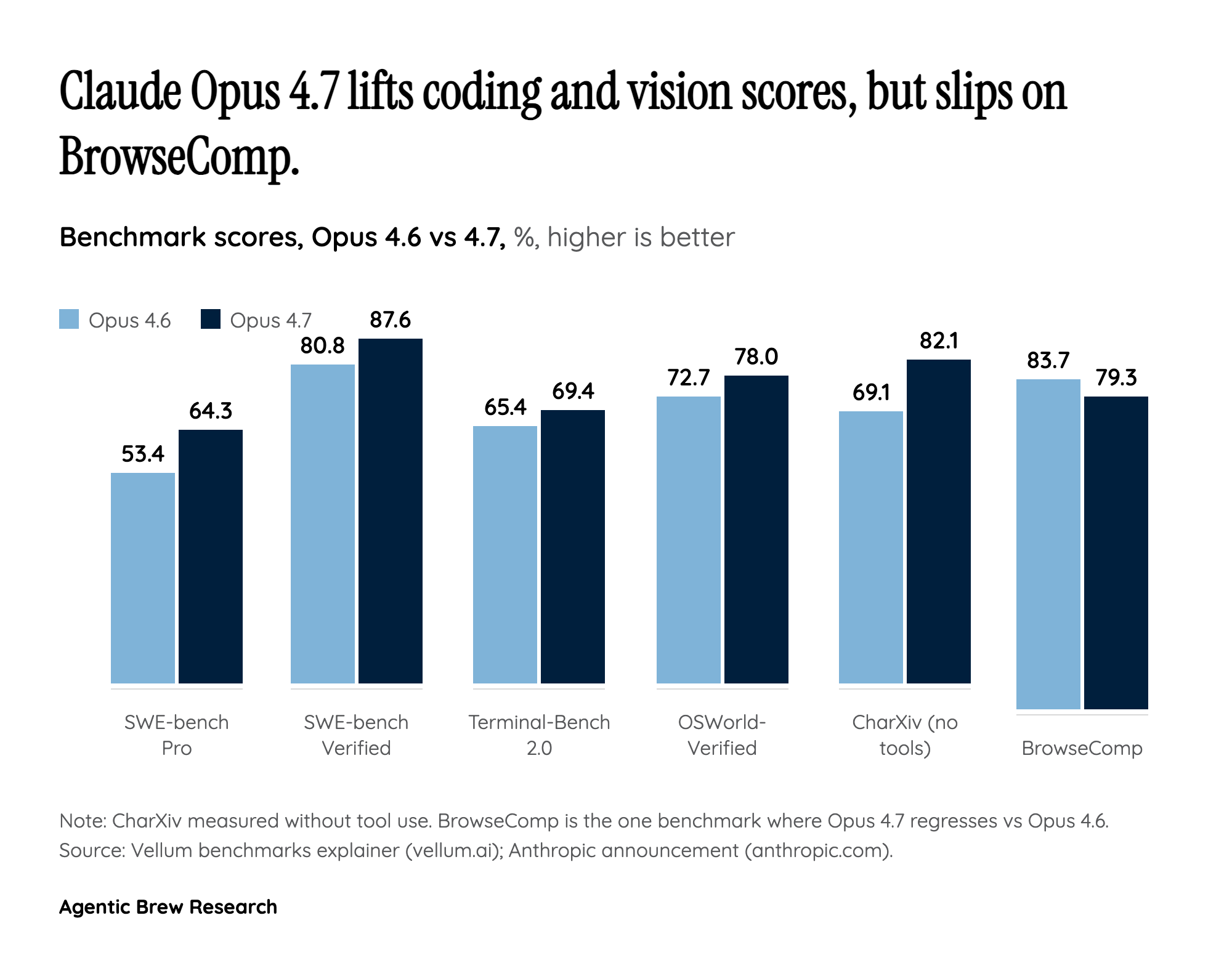
Claude Opus 4.7 vs Opus 4.6 across 6 published benchmarks — coding and vision gain, BrowseComp slips.

On benchmarks Anthropic controls the narrative for, the numbers are unambiguous. SWE-bench Pro rises from 53.4% on Opus 4.6 to 64.3% on 4.7. SWE-bench Verified climbs from 80.8% to 87.6%, ahead of Gemini 3.1 Pro at 80.6%. Terminal-Bench 2.0 moves from 65.4% to 69.4%. MCP-Atlas tool use hits 77.3%, described as best-in-class. OSWorld-Verified computer use rises from 72.7% to 78.0%. CharXiv visual reasoning without tools jumps from 69.1% to 82.1%, and GPQA Diamond reaches 94.2%.

But the lead is narrower than the individual line items suggest. VentureBeat's Carl Franzen notes that on directly comparable benchmarks Opus 4.7 only leads GPT-5.4 seven-to-four, and BrowseComp has actually dropped 4.4 points from 83.7% to 79.3%, making 4.7 slightly weaker for research-heavy web browsing. Anthropic also flags a modestly weaker posture on harm-reduction advice about controlled substances versus 4.6. The shape of this release, in other words, is a focused push on coding, tool use, agentic computer use, and vision — paid for with trade-offs elsewhere and with a top-of-leaderboard position that rivals can plausibly reclaim within a single release cycle.

Historical Context

2024-03-04
Released Claude 3 Opus, the original Opus flagship.
2025-05-22
Released Claude Opus 4.
2025-11-24
Released Claude Opus 4.5 with improved coding and Infinite Chats.
2026-02-05
Released Claude Opus 4.6 with a 1M-token context window and Agent Teams.
2026-04-16
Released Claude Opus 4.7 two months after 4.6, establishing a bimonthly Opus cadence.

Power Map

Key Players
Subject

Anthropic releases Claude Opus 4.7

AN

Anthropic

Developer and publisher of Claude Opus 4.7; frames it as the most capable generally available Claude while holding back Mythos Preview under Project Glasswing for safety reasons.

AM

Amazon Web Services (Bedrock)

Cloud distribution channel hosting Opus 4.7 on next-gen Bedrock inference in US East, Tokyo, Ireland and Stockholm, with limits up to 10,000 requests per minute per account.

GI

GitHub Copilot

Developer-tools partner where Opus 4.7 replaces 4.5 and 4.6 in the model picker for Pro+, Business, and Enterprise plans, with a 7.5x premium-request multiplier through April 30, 2026.

CU

Cursor

Early design partner whose CEO reports a CursorBench jump from 58% on Opus 4.6 to 70% on 4.7.

RA

Rakuten

Enterprise early tester reporting roughly three times more production tasks resolved versus the predecessor model.

BO

Box

Enterprise early tester citing 56% fewer model calls and 50% fewer tool calls on internal workflows with Opus 4.7.

THE SIGNAL.

Analysts

"Reports a materially higher coding score on Cursor's internal benchmark versus Opus 4.6 — 70% on CursorBench compared to 58% on Opus 4.6."

Michael Truell
Co-founder and CEO, Cursor

"Observed near-perfect performance on an internal visual-acuity benchmark, jumping from 54.5% to 98.5% on Opus 4.7."

Oege de Moor
CEO, XBOW

"Production-task throughput tripled on Opus 4.7 relative to the previous model."

Yusuke Kaji
AI lead, Rakuten

"Says Opus 4.7 demonstrates significant efficiency gains, with a 56% reduction in model calls and 50% reduction in tool calls in internal testing."

Yashodha Bhavnani
Head of AI, Box

"Praises the model's design taste: 'The design taste is genuinely surprising — it makes choices I'd actually ship.'"

Aj Orbach
Triple Whale

"Characterizes the lead as narrow: on directly comparable benchmarks Opus 4.7 only leads GPT-5.4 seven-to-four."

Carl Franzen
Reporter, VentureBeat
The Crowd

"Introducing Claude Design by Anthropic Labs: make prototypes, slides, and one-pagers by talking to Claude. Powered by Claude Opus 4.7, our most capable vision model. Available in research preview on the Pro, Max, Team, and Enterprise plans, rolling out throughout the day."

@@claudeai58000

"Anthropic launched Claude Opus 4.7 today, the new #1 in our GDPval-AA benchmark for performance on agentic real-world work tasks. Opus 4.7 scored 1753 on GDPval-AA at launch with its 'max' effort setting, surpassing GPT-5.4 xhigh. This is a significant upgrade, placing Opus back..."

@@ArtificialAnlys536

"I'll give Anthropic credit for moving quickly. Opus 4.7 Adaptive Thinking now triggers thinking much more often, including for the tasks it failed at yesterday. That also means it is doing a lot more web search. So far, a large improvement in output quality on non-coding tasks."

@@emollick615

"Introducing Claude Opus 4.7, our most capable Opus model yet."

@u/ClaudeOfficial3300
Broadcast
Claude Opus-4.7 Just Dropped, And...

Claude Opus-4.7 Just Dropped, And...

Claude Opus 4.7 Just Dropped... Or Did It Really?

Claude Opus 4.7 Just Dropped... Or Did It Really?

Claude Opus 4.7 Is INSANE - Is This the Best Model Yet?

Claude Opus 4.7 Is INSANE - Is This the Best Model Yet?