Anthropic Mythos AI cybersecurity model release
TECH

Anthropic Mythos AI cybersecurity model release

42+
Signals

Strategic Overview

  • 01.
    Anthropic announced Claude Mythos Preview on April 7, 2026 as a frontier model whose agentic coding skills translate into striking vulnerability-discovery and exploitation capability, and is being released only to a limited group of partners under Project Glasswing rather than made generally available.
  • 02.
    Anthropic says Mythos Preview can identify and exploit zero-day vulnerabilities in every major operating system and every major web browser when directed by a user, and that engineers without security training have asked it overnight for remote code execution exploits and woken up to working code.
  • 03.
    Mozilla used Mythos Preview alongside other AI models to ship 423 Firefox security bug fixes in April 2026, with 271 issues attributed specifically to Mythos and patched across Firefox 149.0.2, 150.0.1, and 150.0.2 - including a 15-year-old <legend> flaw and a 20-year-old XSLT bug.
  • 04.
    Roughly a month after Mythos's debut, OpenAI launched a limited preview of GPT-5.5-Cyber under its Trusted Access for Cyber program, positioned as a more permissive policy variant for verified defenders rather than a more capable underlying model.

Deep Analysis

The 6-to-12-Month Window Amodei Says We Have to Patch the World

The clock that matters in this story isn't Mythos's release date - it's the gap before adversary AI achieves parity. Dario Amodei has put a number on it: a 6-to-12-month patching window before Chinese AI catches up. Inside that window, Anthropic's pitch is that defensive coordination via Project Glasswing can harden critical infrastructure faster than offensive actors can weaponize equivalent capability. AISI's independent evaluation gives that argument empirical scaffolding: Mythos succeeds 73% of the time on expert-level capture-the-flag tasks that no model could complete before April 2025, completes the full 32-step 'The Last Ones' simulated corporate cyberattack in 3 of 10 attempts (averaging 22 of 32 steps versus Claude Opus 4.6's 16), and according to ArmorCode reproduced vulnerabilities and developed working exploits on the first attempt in over 83% of cases.

What makes the window claim load-bearing is that the offensive ceiling has already moved. Anthropic itself states Mythos can identify and exploit zero-day vulnerabilities in every major operating system and every major web browser when directed by a user. Engineers without security training reportedly asked the model overnight for remote code execution exploits and returned to working code. If those numbers are even directionally correct, the question for defenders isn't whether to deploy AI-assisted patching - it's whether they can deploy it at the scale and speed the threat curve now demands. Amodei's framing - 'a moment of danger where if we respond correctly we can have a better world on the other side' - effectively asks the rest of the security ecosystem to sprint.

Hype vs. Substance: 423 Real Firefox Fixes Against a Chorus of Skeptics

Hype vs. Substance: 423 Real Firefox Fixes Against a Chorus of Skeptics
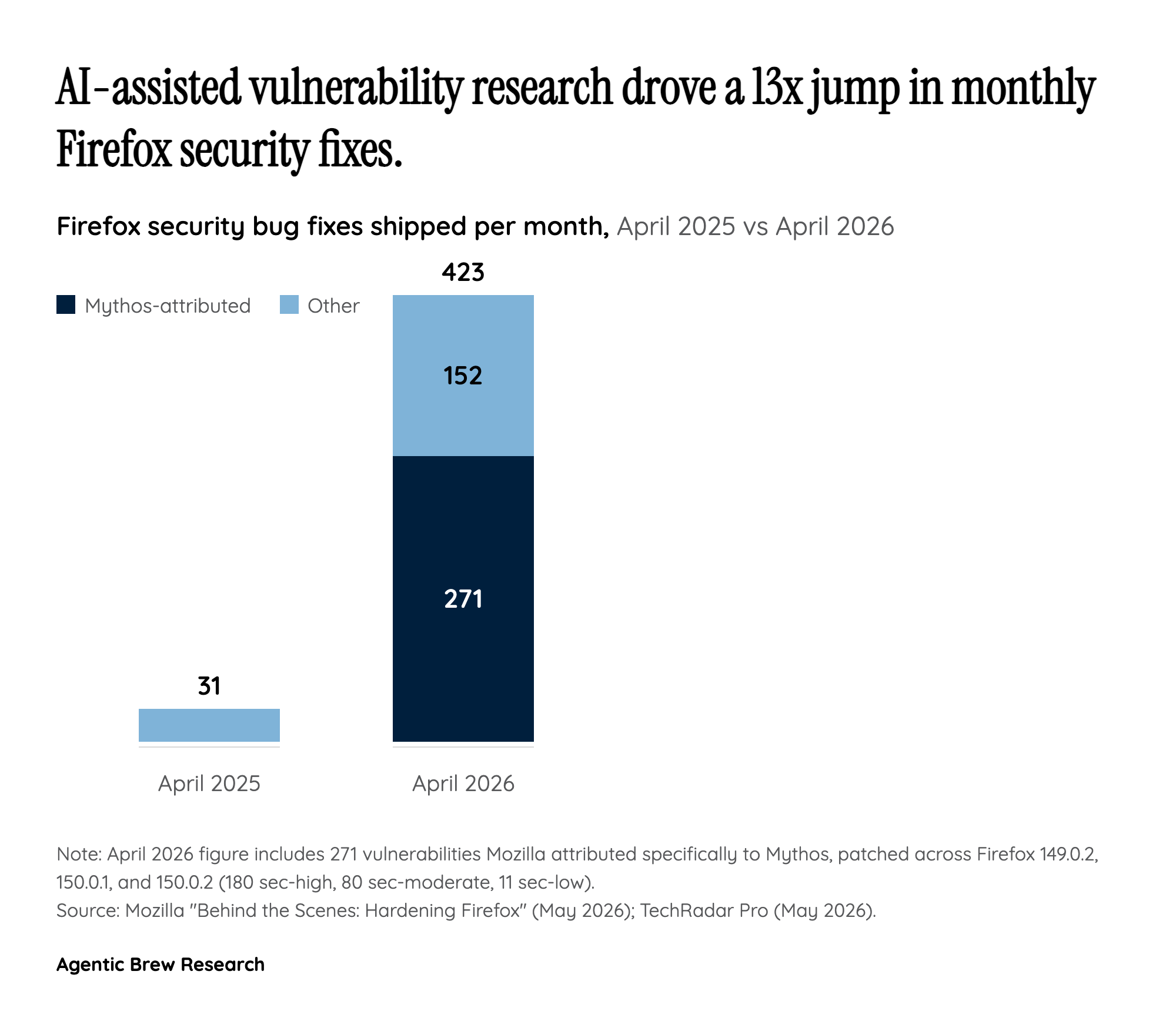
Mozilla shipped 423 Firefox security bug fixes in April 2026 — 271 attributed specifically to Anthropic Mythos — versus 31 in April 2025.

The strongest evidence Mythos is more than marketing came not from Anthropic's own blog post but from Mozilla's engineering team. Mozilla shipped 423 Firefox security bug fixes in April 2026 with AI assistance, with 271 attributed specifically to Mythos and patched across Firefox 149.0.2, 150.0.1, and 150.0.2 - including a 15-year-old <legend> flaw and a 20-year-old XSLT bug. The severity split (180 sec-high, 80 sec-moderate, 11 sec-low) is hard to wave away as PR. Mozilla's own engineers credit two things: the models got more capable, and they dramatically improved their techniques for harnessing them - steering, scaling, and stacking outputs to generate large amounts of signal.

The skeptical case is equally pointed and comes from credible voices. Gary Marcus calls Mythos 'incrementally better than previous recent models, but certainly not an off-the-chart breakthrough,' adding that 'to a certain degree, I feel that we were played.' Emily M. Bender frames it as part of a recurring pattern of 'unsubstantiated claims of power.' Georgia Tech's Peter Swire is blunter: 'The Anthropic announcement was very dramatic and was a PR success, if nothing else.' Reddit's r/Anthropic community piled on with the aisle.com finding that eight cheap open-weights models reproduced the same FreeBSD analysis. The honest read is that both can be true: capability is genuinely up enough to industrialize patch discovery at Mozilla's scale, while remaining short of the singular leap the launch theatrics implied. The marketing was bigger than the model; the model was still big enough to matter.

Project Glasswing's $100M Coalition - Defensive Coordination or Antitrust Problem?

Project Glasswing is structured as a controlled-release coalition: 12 launch partners (Anthropic plus AWS, Apple, Broadcom, Cisco, CrowdStrike, Google, JPMorganChase, Linux Foundation, Microsoft, NVIDIA, Palo Alto Networks) and 40-plus additional organizations granted Mythos access. Anthropic is committing up to $100M in usage credits, plus $2.5M to Alpha-Omega/OpenSSF via the Linux Foundation and $1.5M to the Apache Software Foundation, with post-preview pricing set at $25/$125 per million input/output tokens. The defensive logic is real - put the strongest vulnerability-finding tool into the hands of those running foundational systems first - but the structural picture is that the world's most powerful offensive-capable AI is now a club good for incumbents.

Two data points sharpen the governance question. First, the leak: Fortune reported on April 23 that users gained unauthorized access to Mythos by 'guessing where it was located' - which functionally proves that gating frontier offensive capability is brittle even when restriction is the stated business model. Second, the access asymmetry surfaced by Axios: CISA, the U.S. civilian cyber agency, does not have access to Mythos despite NIST testing it. Bank CEOs got a Treasury and Federal Reserve summit; the federal agency charged with defending civilian infrastructure did not get the model. When you stack the antitrust optics of an incumbent-only safety coalition on top of a porous gate and uneven government access, 'coordinated defense' starts to look like a distribution choice with significant second-order politics.

The Patch-Velocity Gap: Banks, Hospitals, and OpenAI's Defensive Counter-Move

Amodei's specific worry isn't a Hollywood cyber-9/11 - it's volume. He frames the danger as 'just some enormous increase in the amount of vulnerabilities, in the amount of breaches, in the financial damage that's done from ransomware on schools, hospitals, not to mention banks.' That's why Jerome Powell and Scott Bessent convened major U.S. bank CEOs on Mythos-related cyber risk: the institutions in 'hysteria,' per CNBC, are precisely those that depend on a long tail of small-town banks, hospitals, and water plants whose security capacity does not scale to AI-generated exploit volume. AISI's clinical version of the same concern: Mythos 'is at least capable of autonomously attacking small, weakly defended and vulnerable enterprise systems where access to a network has been gained.'

OpenAI's response a month later is the clearest signal that the competitive landscape has reorganized around defensive AI as a product category. GPT-5.5-Cyber, launched May 7, is gated behind Trusted Access for Cyber for verified defenders and explicitly 'not intended to significantly increase cyber capability beyond GPT-5.5 - it's primarily trained to be more permissive' for vulnerability triage, malware analysis, reverse engineering, detection engineering, and patch validation. AISI benchmarks GPT-5.5 at 2 of 10 completions on the same 32-step simulation where Mythos hit 3 of 10 - close enough that the differentiator becomes policy, not raw capability. The bet both labs are now placing is the same: that vetted-defender programs combined with capability-class licensing become the new floor for distributing offensive-capable AI. Whether that floor holds for under-defended sectors - the schools, hospitals, and water plants Amodei keeps naming - is the question the next 12 months will actually answer.

Historical Context

2025-04
AISI notes that no model could complete expert-level capture-the-flag tasks before April 2025, establishing the prior baseline that Mythos Preview later crossed.
2026-03-26
Fortune reports a leak revealing Anthropic was internally testing a 'step change' model named Mythos before the official preview.
2026-04-07
Anthropic publicly announces Claude Mythos Preview and Project Glasswing.
2026-04-21
Mozilla discloses 271 Firefox vulnerabilities found via Mythos, patched in Firefox 150.
2026-04-23
Fortune reports a group of users leaked Mythos by 'guessing where it was located,' raising concerns about access controls on a model whose entire premise is restricted distribution.
2026-05-05
Amodei issues 'moment of danger' warning; Powell and Bessent convene bank CEOs on Mythos-related cyber risk.
2026-05-07
OpenAI launches GPT-5.5-Cyber preview under Trusted Access for Cyber, positioned as its answer to Mythos.
2026-05-08
Mozilla discloses cumulative total: 423 Firefox security bugs fixed in April 2026 with AI assistance.

Power Map

Key Players
Subject

Anthropic Mythos AI cybersecurity model release

AN

Anthropic

Developer of Claude Mythos Preview; created Project Glasswing as a controlled-release coalition and is committing up to $100M in usage credits plus open-source security donations to coordinate defensive use.

PR

Project Glasswing launch partners

Receive Mythos Preview access to find and fix vulnerabilities in foundational systems: Amazon Web Services, Apple, Broadcom, Cisco, CrowdStrike, Google, JPMorganChase, Linux Foundation, Microsoft, NVIDIA, Palo Alto Networks (plus Anthropic).

MO

Mozilla

First high-profile open-source deployment partner; used Mythos plus other models to fix 423 Firefox security bugs in April 2026, including a 15-year-old <legend> flaw and a 20-year-old XSLT bug.

OP

OpenAI

Competitive response with GPT-5.5-Cyber under Trusted Access for Cyber, granting verified defenders fewer classifier-based refusals for vulnerability triage, malware analysis, reverse engineering, detection engineering, and patch validation.

U.

U.S. Federal Reserve and Treasury

Fed Chair Jerome Powell and Treasury Secretary Scott Bessent convened major U.S. bank CEOs to discuss cyber risks raised by Mythos.

U.

U.K. AI Security Institute (AISI)

Government safety evaluator that independently benchmarked Mythos Preview's offensive cyber capabilities against prior frontier models and found it represents a measurable step up.

Source Articles

Top 5

THE SIGNAL.

Analysts

"Frames Mythos as a 'moment of danger' but a manageable one if patching keeps pace, arguing that responding correctly now leads to a better world on the other side."

Dario Amodei
CEO, Anthropic

"Sees the immediate harm as an enormous increase in vulnerabilities, breaches, and ransomware damage against under-defended sectors including schools, hospitals, and banks."

Dario Amodei
CEO, Anthropic

"Skeptical that Mythos is an unforeseen leap, calling the announcement very dramatic and a PR success more than a paradigm break."

Peter Swire
Professor, School of Cybersecurity and Privacy, Georgia Institute of Technology; former Clinton/Obama advisor

"Acknowledges Mythos is consequential but pushes back on apocalyptic framing, calling it a big deal but unlikely to prove the end of the world."

Ciaran Martin
Professor of Practice, Blavatnik School of Government, Oxford; former CEO U.K. National Cyber Security Centre

"Argues capability gains are incrementally better than recent models but not an off-the-chart breakthrough, and that the public reaction was steered by Anthropic's marketing - to a degree, he feels we were played."

Gary Marcus
AI analyst and industry skeptic

"Treats Mythos's framing as part of a recurring pattern of unsubstantiated claims of power around AI capability."

Emily M. Bender
Technology scholar; coauthor of 'The AI Con'

"Confirms Mythos Preview is a step up over previous frontier models in a landscape where cyber performance was already rapidly improving, and is at least capable of autonomously attacking small, weakly defended enterprise systems where network access has been gained."

U.K. AI Security Institute (AISI)
Government AI safety evaluator
The Crowd

"NEWS: Anthropic's new model, Claude Mythos, is so powerful that it is not releasing it to the public. Instead, it is starting a 40-company coalition, Project Glasswing, to allow cybersecurity defenders a head start in locking down critical software."

@@kevinroose0

"The "Assessing Claude Mythos Preview's cybersecurity capabilities" post has me saying "wtf" over and over and over again. Like, holy crap: > During our testing, we found that Mythos Preview is capable of identifying and then exploiting zero-day vulnerabilities in every major [OS/browser]..."

@@mhmazur0

"scoop on @axios: CISA doesn't have access to Anthropic's Mythos model, two sources tell me. Interestingly, Anthropic briefed both CISA and NIST's Center for AI Standards and Innovation ahead of its public announcement, and NIST is testing Mythos."

@@samsabin9230

"Unauthorized group has gained access to Anthropic's exclusive cyber tool Mythos, report claims"

@u/1nfer1or10000
Broadcast
Claude Mythos is too dangerous for public consumption...

Claude Mythos is too dangerous for public consumption...

Why Anthropic's Mythos Is Sparking Alarm

Why Anthropic's Mythos Is Sparking Alarm

Mythos is real and it scares me...

Mythos is real and it scares me...