OpenAI plans to double workforce to 8,000 by end of 2026
TECH

OpenAI plans to double workforce to 8,000 by end of 2026

33+
Signals

Strategic Overview

  • 01.
    OpenAI plans to nearly double its workforce from approximately 4,500 to about 8,000 employees by the end of 2026, adding roughly 3,500 new hires across product development, engineering, research, and sales.
  • 02.
    The aggressive hiring push is driven by intensifying competition with Anthropic and Google, particularly after CEO Sam Altman issued an internal 'code red' directive in late 2025 in response to Google's Gemini 3 launch.
  • 03.
    OpenAI has leased over 1 million square feet of office space in San Francisco and is in advanced discussions with TPG, Brookfield, and Bain Capital for an approximately $10 billion AI adoption joint venture.
  • 04.
    Recent acquisitions including Astral (Python dev tools), Promptfoo (AI security), Software Applications Inc., and Neptune signal OpenAI's shift toward becoming a full-stack enterprise platform company.

Deep Analysis

Why This Matters

OpenAI's plan to nearly double its workforce represents far more than a hiring spree. It signals a fundamental strategic pivot from a research-first organization to an enterprise-facing technology company willing to spend aggressively to defend its market position. The timing is critical: CEO Sam Altman's late-2025 'code red' directive, triggered by Google's Gemini 3, reveals a company that perceives an existential competitive threat and is responding with brute-force scaling.

The underlying driver is the rapid erosion of OpenAI's first-mover advantage. Ramp's corporate spending data showing businesses 70% more likely to choose Anthropic for first-time AI purchases is a stark warning sign. While OpenAI still dominates consumer AI through ChatGPT, the enterprise market, where the real revenue lies, is slipping. Anthropic's 85% enterprise revenue share and 10x annual growth demonstrate that technical superiority alone does not win corporate contracts. Companies want dedicated support, integration help, and trust, exactly the capabilities that OpenAI's new 'technical ambassadorship' roles are designed to provide.

This hiring push also reflects the broader reality that AI companies are transitioning from the research phase to the deployment phase. Building the best model is no longer sufficient; companies must build the best go-to-market infrastructure. OpenAI's acquisitions of Astral, Promptfoo, and others show it is assembling the full stack of developer and enterprise tools necessary to compete with Google's integrated ecosystem and Microsoft's enterprise distribution.
How It Works

OpenAI's expansion strategy operates on three parallel tracks: organic hiring, strategic acquisitions, and partnership-driven growth. The approximately 3,500 new hires span product development, engineering, research, and sales, but the emphasis on 'technical ambassadorship' roles is particularly telling. These are not traditional sales roles; they represent a hybrid function combining technical expertise with business development, designed to embed OpenAI deeply within enterprise workflows. This mirrors the developer relations model that companies like Stripe and Twilio used to build platform dominance.

The acquisition strategy complements the hiring push. Astral brings Python development tooling, Promptfoo adds AI security and testing capabilities, and the other acquisitions fill gaps in OpenAI's platform offering. Together, these moves suggest OpenAI is building a comprehensive developer ecosystem rather than simply scaling a model API. The parallel discussions with TPG, Brookfield, and Bain Capital for a $10 billion AI adoption joint venture indicate that OpenAI is also pursuing indirect market access, partnering with firms that have deep relationships with Fortune 500 companies.

Physically, the company is preparing for this growth by leasing over 1 million square feet of office space in San Francisco. This commitment to physical infrastructure in an era of remote work suggests OpenAI values co-location for research collaboration, a philosophy consistent with the intensive, iterative nature of AI development. The scale of the lease alone signals confidence that the hiring targets are not aspirational but operational.

By The Numbers

By The Numbers
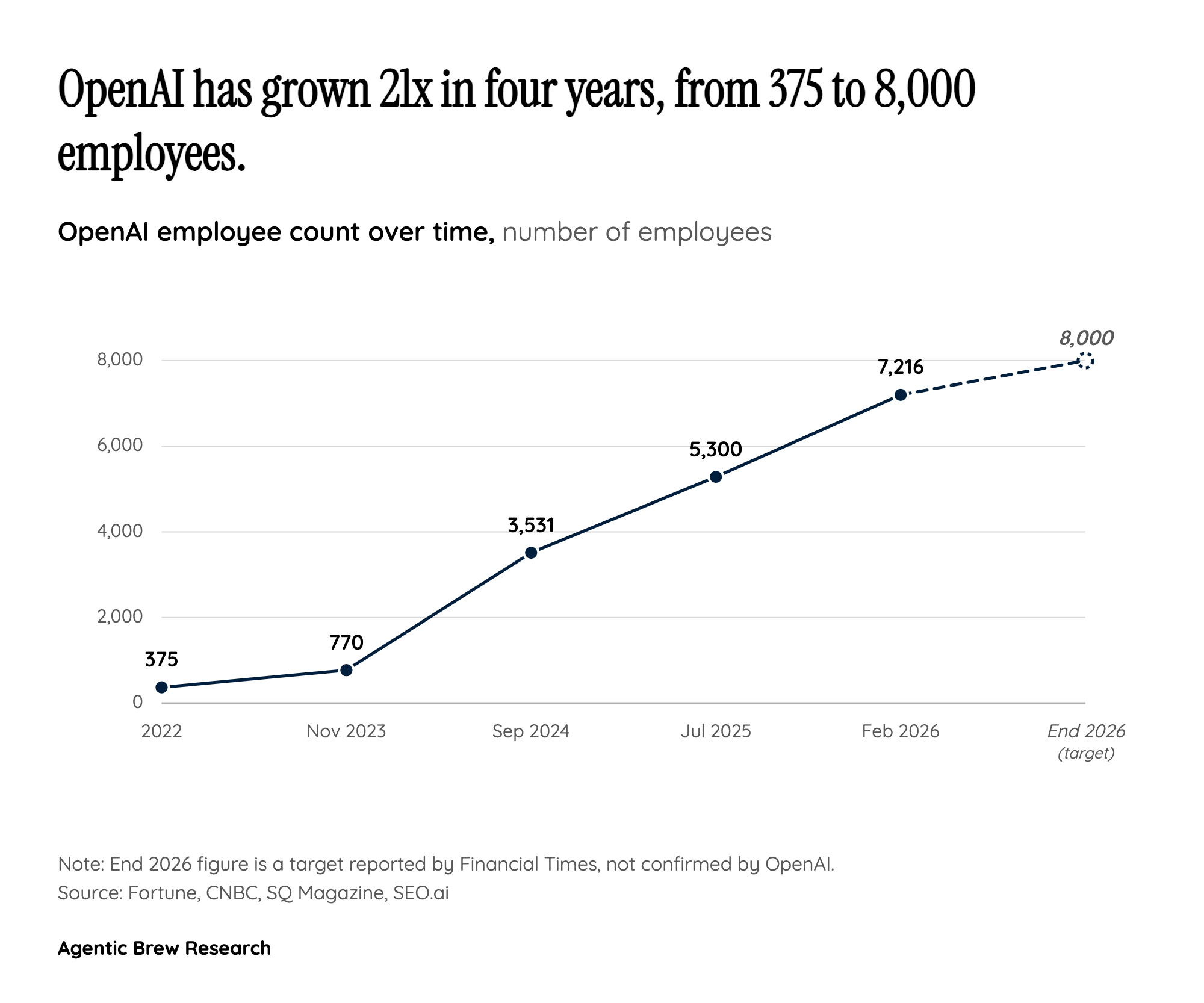
OpenAI employee growth from 375 (2022) to 8,000 target (end 2026)

The quantitative picture of OpenAI's growth is staggering. From 10 employees at founding in 2015 to a target of 8,000 by end of 2026 represents an 80,000% increase in just over a decade. The acceleration is even more dramatic in recent years: 375 employees pre-ChatGPT in 2022, 770 in November 2023, 3,531 by September 2024, 5,300 by July 2025, and an estimated 7,216 by February 2026. If the 8,000 target is met, OpenAI will have grown more than 21x in just four years.

The financial dimensions are equally striking. OpenAI's average stock compensation of $1.5 million per employee is reportedly the highest of any tech startup in history, with stock compensation representing approximately 46.2% of revenue. The company's $110 billion funding round at an $840 billion valuation provides the capital to sustain this spending, but the burn rate raises questions about sustainability. With 450+ open positions in the US alone and a salary floor above $200,000, the annual compensation commitment for 3,500 new hires could exceed $5 billion when factoring in equity.

The competitive context adds further dimension to these numbers. Anthropic's enterprise metrics, 85% enterprise revenue, 10x annual growth, and 70% preference rate for first-time buyers, quantify the gap OpenAI is trying to close. Meanwhile, Meta's counter-offensive with hundreds of millions in signing bonuses for its Superintelligence Labs has created an industry-wide talent inflation that benefits no single company. The AI talent war has become a multi-billion-dollar arms race where the cost of inaction may exceed the cost of overspending.

Impacts & What's Next

In the short term, OpenAI's hiring surge will intensify the already fierce AI talent war. With Meta, Google, Anthropic, and OpenAI all competing for a limited pool of AI researchers and engineers, compensation packages will continue to inflate. Tim Tully of Menlo Ventures notes that AI research scientists at even Series D startups now command $2-4 million in stock grants. Smaller AI startups and academic institutions will find it increasingly difficult to attract and retain top talent, potentially concentrating AI capabilities among a handful of well-funded companies.

For the enterprise AI market, OpenAI's expansion should accelerate adoption. More technical ambassadors and sales staff mean more companies will receive hands-on help implementing AI solutions. The $10 billion joint venture with TPG, Brookfield, and Bain Capital could create a new category of AI integration services targeting large enterprises that lack internal AI expertise. This could be a decisive move if executed well, as enterprise customers consistently cite implementation support as their primary bottleneck.

Looking further ahead, the trajectory raises questions about OpenAI's path to profitability. At 8,000 employees with industry-leading compensation, the company's cost structure will be enormous. The introduction of advertising in ChatGPT and the pursuit of enterprise contracts suggest revenue diversification is already underway, but the gap between spending and earning remains wide. Both OpenAI and Anthropic are reportedly racing toward IPOs in late 2026, and the market's appetite for AI companies will ultimately determine whether this aggressive scaling strategy is vindicated or punished.

Social media sentiment captured on X reveals notable skepticism. Users highlighted the contradiction between Altman's January 2026 statement about 'slow hiring' and the March announcement of plans to add 3,500 people, just 54 days later. This pattern of contradictory public statements risks eroding trust with employees and investors alike.

The Bigger Picture

OpenAI's workforce expansion is a bellwether for the AI industry's maturation from research experimentation to industrial-scale deployment. Dr. Elena Rodriguez's comparison to Salesforce crossing $1 billion in revenue is apt: at 8,000 employees, OpenAI is no longer a lab, it is a major technology corporation with all the organizational complexity that entails. The question is whether a company born in the research culture of non-profit AI safety can successfully transform into an enterprise software giant without losing the technical edge that made it dominant in the first place.

The broader industry pattern is clear. The AI sector is experiencing a consolidation phase where capital and talent flow toward the largest players. OpenAI, Anthropic, Google, Meta, and a few others are building vertically integrated AI platforms that combine research, infrastructure, developer tools, and enterprise services. This echoes the cloud computing wars of the 2010s, where AWS, Azure, and GCP emerged as the dominant platforms through massive upfront investment in infrastructure and go-to-market capabilities. The companies that invested most aggressively in that era, even at the cost of short-term profitability, ultimately captured the most value.

Yet the AI landscape has a crucial difference: the technology itself is evolving so rapidly that today's competitive advantage can evaporate within months. Google's Gemini 3 triggered OpenAI's code red; the next breakthrough could come from Anthropic, Meta, or an entirely new entrant. Hiring 3,500 people is a bet that the current competitive dynamics will persist long enough for those employees to become productive. If a fundamental shift in AI capabilities or architecture occurs in the meantime, OpenAI could find itself with a bloated workforce optimized for yesterday's competitive landscape. The scale of the bet reflects the scale of the stakes: in the race to build artificial general intelligence, no company can afford to be outpaced, even if the cost of keeping up threatens to become unsustainable.

Historical Context

2015
OpenAI was founded as a non-profit research lab with just 10 employees.
2022
OpenAI had approximately 375 employees before the launch of ChatGPT.
2023-11
Employee count reached approximately 770, with growth accelerating post-ChatGPT launch.
2024-09
Workforce surged to approximately 3,531 employees with peak onboarding of 50 new hires per week.
2025-07
Employee count reached approximately 5,300, representing a 718% increase from November 2023.
2025-12
Altman issued an internal 'code red' directive, pausing non-core projects in response to Google's Gemini 3 launch.
2026-02
Employee count crossed approximately 7,216 and the company secured a Department of Defense contract.
2026-03
Financial Times reported OpenAI's target to reach 8,000 employees by end of 2026, driven by competition with Anthropic and Google.

Power Map

Key Players
Subject

OpenAI plans to double workforce to 8,000 by end of 2026

SA

Sam Altman

CEO of OpenAI. Issued an internal 'code red' directive in late 2025 pausing non-core projects to focus resources on competing with Google and Anthropic. Driving the aggressive hiring and enterprise expansion strategy.

AN

Anthropic

Primary competitor capturing enterprise market share. Ramp data shows businesses are 70% more likely to choose Anthropic for first-time AI purchases, with 85% enterprise revenue and 10x annual growth, directly threatening OpenAI's business trajectory.

GO

Google

Key competitor whose Gemini 3 launch triggered OpenAI's code red. Google's deep integration with enterprise tools (Workspace, Cloud) gives it a distribution advantage that OpenAI's hiring surge is partly designed to counter.

SO

SoftBank

Major investor in OpenAI's $110 billion funding round at an $840 billion valuation, providing the capital that enables the aggressive hiring and acquisition strategy.

MI

Microsoft

Major partner and simultaneous competitor in the enterprise AI space. Microsoft's Copilot products compete directly with OpenAI's enterprise offerings while also being built on OpenAI's technology.

ME

Meta

Competitor that launched its own hiring spree for Meta Superintelligence Labs, offering hundreds of millions in compensation packages, escalating the AI talent war that drives up costs industry-wide.

THE SIGNAL.

Analysts

"AI research scientists at Series D startups are receiving $2-4 million in stock grants, illustrating the extreme escalation in talent costs that companies like OpenAI face as they scale their workforce."

Tim Tully
Partner, Menlo Ventures

"At 8,000 employees, OpenAI approaches the size Salesforce was when it crossed $1 billion in revenue, marking OpenAI's transformation from a research lab into a full-scale enterprise software company."

Dr. Elena Rodriguez
Analyst, Prism News

"Businesses are 70% more likely to choose Anthropic over OpenAI for first-time AI purchases, suggesting OpenAI faces a significant enterprise adoption gap that its hiring push and 'technical ambassadorship' roles are designed to close."

Ramp AI Index
Corporate Spending Analytics, Ramp
The Crowd

"Jan 2026 Sam Altman: "we're planning to dramatically slow hiring. we think we'll be able to do much more with fewer people." 54 days later: openai plans to go 4,500 to 8,000 employees"

@@zivdotcat1900

"OpenAI will nearly double its workforce as it pivots away from consumer experiments toward a massive push into the business market."

@@rohanpaul_ai4000

"OpenAI plans to almost double its headcount by the end of 2026 as it seeks to fend off competition from companies such as Anthropic and Google, according to the Financial Times"

@@business114
Broadcast
Why The OpenAI And Anthropic Rivalry Is Heating Up

Why The OpenAI And Anthropic Rivalry Is Heating Up

Anthropic Vs. OpenAI: How Safety Became The Advantage In AI

Anthropic Vs. OpenAI: How Safety Became The Advantage In AI

Will OpenAI's Insane Strategy Payoff?

Will OpenAI's Insane Strategy Payoff?