The Bifurcation Trade: Why Two Hyperscalers Won and Two Lost on the Same Night
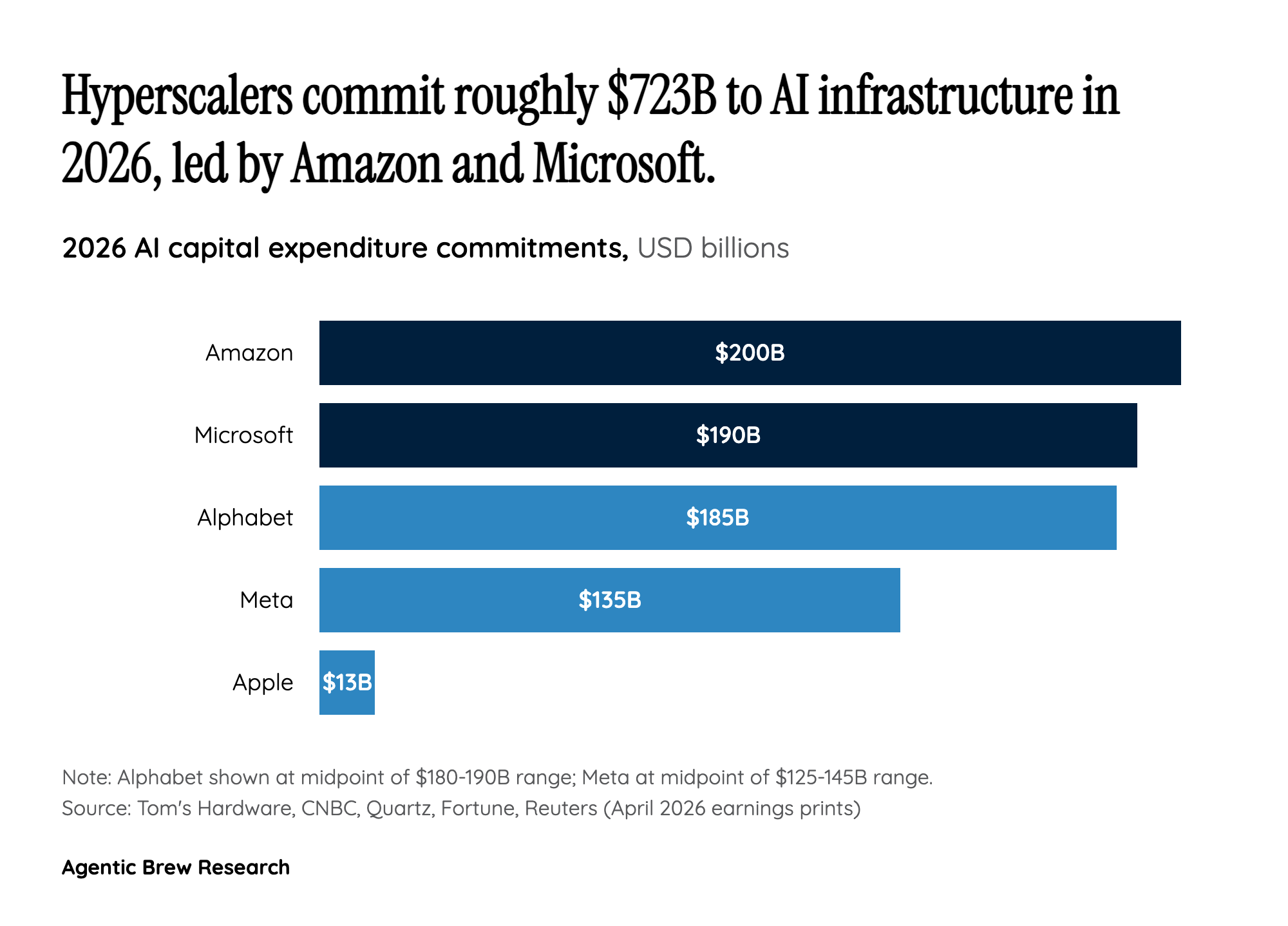
April 29 produced one of the most explicit market verdicts of the AI cycle so far. All four mega-cap hyperscalers reported the same evening, all four beat estimates, all four raised capex — and yet the tape sorted them into clear winners and losers. Alphabet rose roughly 7-10% as Google Cloud printed 63% YoY growth to $20.03B with backlog ballooning to over $460B. Amazon rallied on AWS's +28% growth, the fastest pace in 15 quarters, with management citing triple-digit AI revenue growth on Bedrock. Meta fell about 6% as Mark Zuckerberg deflected analyst ROI questions, and Microsoft sat flat despite Azure growing 40% and an AI run-rate of $37B (+123%).
The distinguishing variable was not how much each company is spending — it was whether investors could draw a clean line from capex to revenue. As S&P Global's Melissa Otto put it, Google demonstrated 'an emerging business line that is beating expectations in a pretty competitive environment.' Meta, by contrast, kept asking the market to extrapolate from internal lab signals. The implication for the rest of 2026 is that the market has stopped grading the AI trade as a single basket. Each quarter is now a referendum on whether a specific hyperscaler can convert another tranche of GPU spend into another tranche of cloud or ad revenue, and earnings-day commentary explicitly framed the prints as an 'AI payoff' test rather than an AI vision test.