The Android-of-Humanoids Bet — and Why Bosworth Said the Quiet Part Out Loud
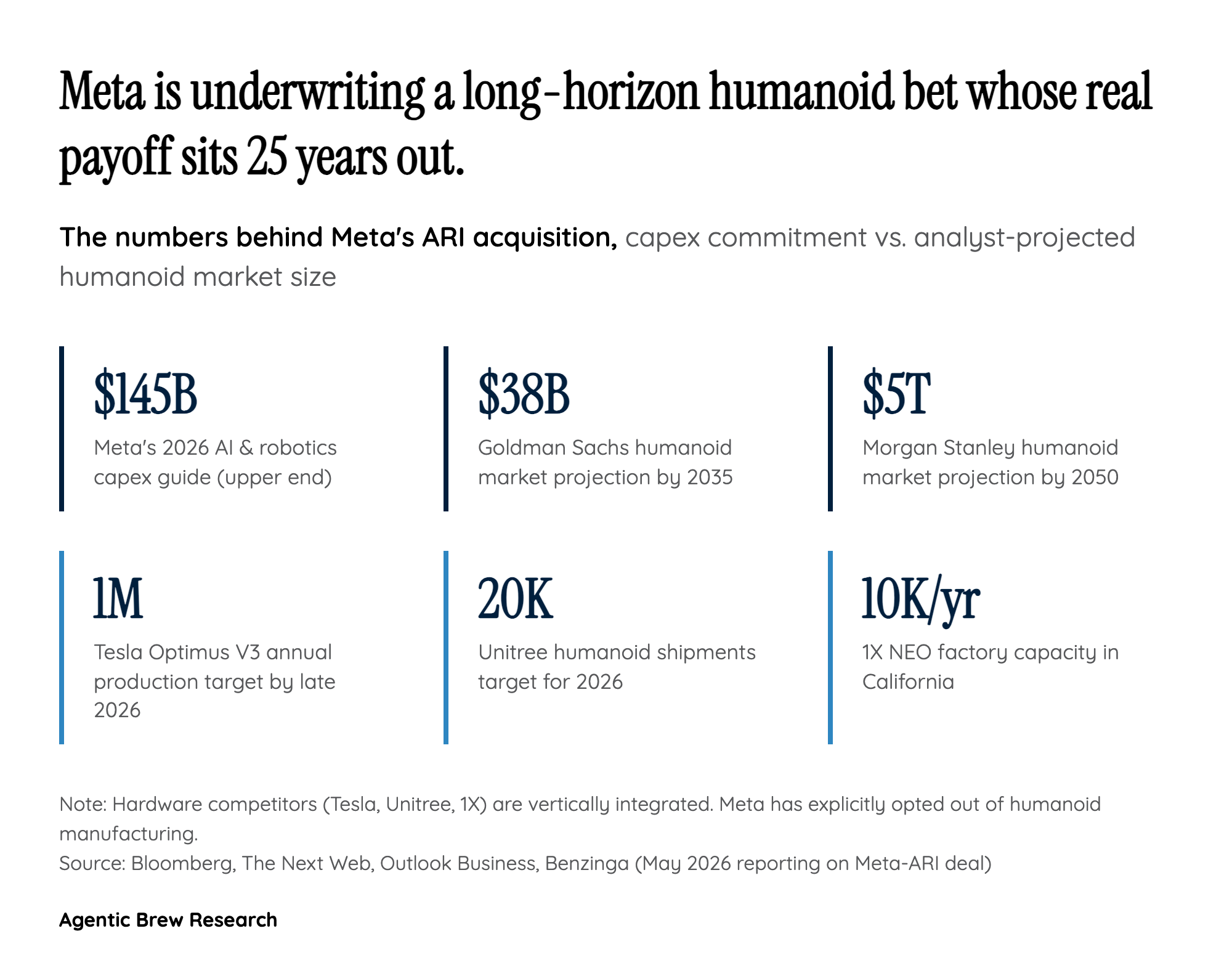
Most tech giants chasing humanoids — Tesla with Optimus, 1X with NEO, Figure, Apptronik, Boston Dynamics, Xiaomi — are vertically integrated: their own actuators, their own chassis, their own AI stack. Meta is doing the opposite. CTO Andrew Bosworth explicitly said 'I don't care about us being the hardware manufacturers,' and the company's stated playbook is to provide for humanoids what Android did for phones and what Qualcomm did for radios: a reference software stack, sensors like ARI's E-Flesh, and foundation models that other OEMs license. ARI's whole-body control models and tactile-sensing IP are the missing pieces of that platform.
The strategic logic is that hardware margins in humanoid robots are likely to compress as Chinese OEMs (Unitree targets 20,000 shipments in 2026, Xiaomi already hit a 90.2% task-success rate in EV assembly) drive prices down, while the AI brain remains the scarce asset. If Meta can be the default 'OS' layer, it captures the highest-margin slice without the capex of a robot factory. The risk is structural: Android only worked because Google gave it away. Meta's licensing model assumes OEMs will pay for what Tesla and 1X are building in-house and giving themselves for free.