
Intel and Google Multi-Year AI Infrastructure Partnership
TECH

Intel and Google Multi-Year AI Infrastructure Partnership

33+
Signals

Strategic Overview

  • 01.
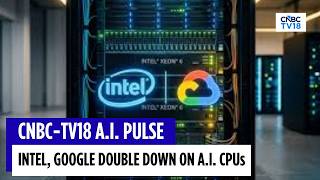
    Intel and Google announced a multiyear collaboration on April 9, 2026, to advance AI and cloud infrastructure through Xeon 6 CPUs and co-developed custom ASIC-based Infrastructure Processing Units (IPUs).
  • 02.
    Google Cloud will deploy multiple generations of Intel Xeon 6 processors — including the 288-core Sierra Forest E-core variant on Intel 18A — for AI training, inference, and general-purpose computing workloads.
  • 03.
    Intel stock surged 4.7% to $61.72 on the announcement, with trading volume 39% above the three-month average, extending a 225% gain over the past year as investors bet on the company’s turnaround.
  • 04.
    The expanded partnership builds on nearly two decades of Intel-Google collaboration, including the 2022 launch of the Mount Evans IPU that enabled 200 Gbps networking in Google Cloud C3 instances.

Deep Analysis

The CPU Bottleneck No One Saw Coming: How Agentic AI Reverses the GPU-Only Narrative

For the past three years, the AI infrastructure story has been written almost entirely in GPU terms — who can secure the most Nvidia H100s, who can build the biggest training clusters, who can scale GPU interconnects the fastest. In that narrative, CPUs were afterthoughts, the quiet janitors of the data center while GPUs did the glamorous work of training foundation models. The Intel-Google partnership announcement on April 9 signals that this narrative is breaking down, and breaking down fast.

The structural driver is the shift from AI training to inference and deployment at scale, compounded by the rise of agentic AI. As analyst Stephen Sopko of HyperFrame Research put it, "CPUs are no longer seen as background infrastructure; they are becoming the active bottlenecks." The reason is architectural: agentic AI systems — where autonomous agents orchestrate API calls, query databases, manage state, and coordinate with other agents — generate workloads that are fundamentally CPU-bound. These are not matrix multiplication tasks suited to GPU parallelism; they are serial, branching, I/O-heavy operations that general-purpose processors handle best. Constellation Research analyst Holger Mueller reinforced this point: "In the agentic world where agents call APIs and business applications, CPUs are the best to do the job." What makes this consequential is scale. Every GPU-optimized AI cluster still relies on host CPUs for orchestration, pre/post-processing, and system management. As inference volumes explode — driven by millions of AI agents running continuously rather than batch training jobs — the CPU-to-GPU ratio in data centers is being re-examined. Google’s commitment to multiple generations of Xeon 6 is a bet that this ratio needs to tilt back toward more capable CPUs, not just more GPUs.

Intel’s IPU Gambit: A $1 Billion Custom Silicon Business Hiding Behind the Xeon Headlines

The Xeon commitment grabbed the headlines, but the more strategically significant element of the Intel-Google deal may be the expanded co-development of custom ASIC-based Infrastructure Processing Units. IPUs offload networking, storage, and security functions from host CPUs — functions that become exponentially more demanding as AI clusters scale. Google and Intel have been building this relationship since the 2022 launch of the Mount Evans IPU, which enabled 200 Gbps networking in Google Cloud C3 instances. The new deal deepens that co-development across future generations.

What makes the IPU angle underappreciated is the business it has already built. Intel’s custom ASIC division grew over 50% in 2025, reaching an annualized revenue run rate exceeding $1 billion. This positions Intel not just as a CPU vendor but as a custom silicon partner for hyperscalers — a business model closer to Broadcom’s highly profitable custom chip operation than to Intel’s traditional merchant silicon approach. The IPU co-development with Google is the flagship example: rather than selling commodity chips, Intel is embedding itself into Google’s infrastructure architecture at the design level, creating switching costs that commodity CPU sales alone cannot. This also opens a competitive front against Nvidia’s DPU (Data Processing Unit) business, which targets the same infrastructure offloading workloads. While Nvidia dominates in GPUs, its DPU penetration at hyperscalers is less entrenched, giving Intel an opening — particularly when the IPU is co-designed with the customer’s specific requirements.

Google’s Chip Diversification Strategy: Why Betting on Intel Is Really About Not Betting on Anyone

Google’s decision to deepen its Intel partnership should not be read as a vote of exclusive confidence in Intel — it is a calculated diversification play. Google simultaneously develops its own Axion Arm-based processors, uses AMD EPYC chips, designs custom TPUs for AI training, and relies heavily on Nvidia GPUs. The Intel commitment adds another leg to a deliberately multi-vendor strategy designed to prevent dependency on any single supplier. As Amin Vahdat, Google’s SVP and Chief Technologist for AI Infrastructure, noted, "Intel has been a trusted partner for nearly two decades, and their Xeon roadmap gives us confidence" — careful language that endorses Intel’s roadmap without declaring exclusivity.

The timing is revealing. Reports indicate Anthropic is eyeing its own custom chips, and every major hyperscaler is investing in proprietary silicon. In this environment, maintaining strong relationships with merchant silicon vendors like Intel gives Google leverage in multiple directions: it keeps pricing competitive against custom alternatives, ensures supply resilience, and provides a mature ecosystem (software stack, security features like TDX, validated instance types like C4 and N4) that custom chips take years to replicate. For Intel, the risk is that Google’s commitment is broad but shallow — a multiyear deal with no disclosed financial terms could mean anything from billions in procurement to a modest extension of existing volumes. The market’s reaction — a 4.7% stock jump on 154.3 million shares traded — suggests investors are giving Intel the benefit of the doubt, but the absence of financial specifics is a notable gap that bears watching.

Historical Context

2000s
Intel and Google began their data center partnership, with Intel once commanding over 99% of the data center CPU market and Google as one of its largest customers.
2022
Intel and Google launched the Mount Evans IPU alongside Google Cloud C3 instances, enabling 200 Gbps networking and establishing the IPU co-development relationship.
2025
Intel’s custom ASIC business grew over 50% to an annualized revenue run rate exceeding $1 billion.
2026-04-09
Intel and Google announced an expanded multiyear collaboration covering Xeon 6 CPU deployment and custom IPU co-development.
2026-04-09
Intel shares surged 4.7% to $61.72, with KeyBanc raising its price target to $70, capping a 225% gain over the prior year.

Power Map

Key Players
Subject

Intel and Google Multi-Year AI Infrastructure Partnership

IN

Intel

Chip manufacturer supplying Xeon 6 CPUs and co-developing custom IPUs. The deal validates CEO Lip-Bu Tan’s turnaround strategy and Intel’s foundry ambitions, securing a marquee hyperscaler commitment at a critical juncture for the company’s relevance in AI infrastructure.

GO

Google / Google Cloud

Hyperscale cloud provider deploying Intel silicon across C4 and N4 instances. Google gains supply diversification for its AI infrastructure, reducing dependency on any single chip vendor while securing a proven CPU partner for the inference-heavy workloads driven by agentic AI.

NV

Nvidia

Dominant GPU and DPU supplier whose data center networking products (DPUs) compete directly with Intel’s IPU line. The Intel-Google IPU co-development deepens a competitive threat to Nvidia’s infrastructure offloading business.

AM

AMD

Intel’s primary competitor in server CPUs (EPYC line). The multiyear Google commitment to Xeon 6 constrains AMD’s ability to expand its data center CPU share at Google, one of the world’s largest cloud operators.

AR

Arm Holdings

Architecture licensor whose custom Arm-based server CPUs — including Google’s own Axion processor — represent an alternative path for data center compute, pressuring both Intel and AMD on power efficiency.

THE SIGNAL.

Analysts

""AI doesn’t run on accelerators alone – it runs on systems. CPUs and IPUs are central to delivering the performance, efficiency and flexibility modern AI workloads demand." Tan frames the deal as proof that the AI compute stack extends far beyond GPUs."

Lip-Bu Tan
CEO, Intel

""Intel has been a trusted partner for nearly two decades, and their Xeon roadmap gives us confidence." Vahdat’s endorsement signals that Google sees Intel’s future chip generations as viable for its AI infrastructure scaling plans."

Amin Vahdat
SVP & Chief Technologist, AI Infrastructure, Google

""CPUs are no longer seen as background infrastructure; they are becoming the active bottlenecks...The surge in agentic AI is driving materially higher CPU demand." Sopko identifies a structural shift in AI compute economics."

Stephen Sopko
Analyst, HyperFrame Research

""In the agentic world where agents call APIs and business applications, CPUs are the best to do the job...Google will need mixed processors, and partnering with Intel for Xeon makes sense." Mueller argues that agentic AI shifts compute demand back toward general-purpose processors."

Holger Mueller
Analyst, Constellation Research
The Crowd

"Intel trying to promote the use of its technology in data centers, said Alphabet's Google has committed to using future generations of its Xeon processors and other chips. Intel Wins Google Commitment to Use Xeon Chips in Data Centers (bloomberg.com)"

@@business73

"Intel and Google announce multi-year chip deal — Google will deploy Intel Xeon with custom IPUs for next-gen AI, cloud infrastructure (tomshardware.com)"

@@tomshardware73

"Intel wins Google's commitment to use Xeon chips in data centres. $INTC $GOOGL"

@@financialjuice25
Broadcast
Intel Wins Google Promise to Keep Using Xeon in Data Centers | Bloomberg Businessweek

Intel Wins Google Promise to Keep Using Xeon in Data Centers | Bloomberg Businessweek

Google & Intel Expand Partnership; Anthropic Eyes Its Own Chips | The AI Pulse | CNBC TV18

Google & Intel Expand Partnership; Anthropic Eyes Its Own Chips | The AI Pulse | CNBC TV18

The $1 Trillion Tangled Web Of AI Deals Mapped Out

The $1 Trillion Tangled Web Of AI Deals Mapped Out

Intel and Google Multi-Year AI Infrastructure Partnership | Agentic Brew